This article is published on an independent advisory platform (not a law firm) and must not imply an attorney-client relationship. The content provided is for informational and advisory purposes only and does not constitute legal representation or legal advice. Legal services are only provided by licensed attorneys under a separate engagement.
What if the most critical decision in your custody case happens before you even step into a courtroom? For many international families, the intersection of civil and religious law feels like an impossible maze. You likely worry that being an expat puts you at a disadvantage or that outdated legal defaults will dictate your relationship with your children. This guide provides a clear roadmap through israeli child custody laws for foreigners, helping you protect your parental rights and manage the specific risks of “no-exit” orders. You’ll gain a strategic framework for choosing the right court system and learn how modern shifts toward joint parental responsibility affect your case. We’ll also explain how to secure your relocation rights in a system that prioritizes the best interests of the child above all else.
Key Takeaways
- Understand the critical jurisdictional differences between the Civil Family Court and Religious Courts to ensure your case is heard in the most appropriate forum.
- Learn how modern israeli child custody laws for foreigners have shifted toward joint parental responsibility, moving away from the traditional “Tender Years Presumption.”
- Identify the legal risks of international relocation and how to navigate Hague Convention protocols to prevent claims of wrongful child removal.
- Prepare for the mandatory “Settlement of Dispute” period and the influential role court-appointed social workers play in custody recommendations.
- Recognize why early, temporary custody arrangements often become the permanent “status quo” and how to set a strategic foundation from the start.
Understanding the Israeli Dual Court System for Custody
This article is published on an independent advisory platform (not a law firm) and does not imply an attorney-client relationship.
In Israel, custody matters aren’t managed by a single judicial body. Instead, two parallel systems share jurisdiction: the Civil Family Court and the Religious Courts. For many expats and international families, Understanding the Israeli Dual Court System is the first step in protecting their family’s future. While the Civil Family Court follows secular statutes, Rabbinical courts apply Jewish law. This dual structure creates a unique environment where the choice of forum significantly impacts the trajectory and tone of your case.
To better understand how these laws apply to your specific situation, watch this helpful video:
One of the most critical aspects of israeli child custody laws for foreigners is the “race to jurisdiction.” This term describes a situation where the court where a claim is first filed generally gains the authority to hear the entire matter. If a parent files for divorce in the Rabbinical court and includes custody in that filing, that court may take control of the proceedings. Foreigners often prefer the Family Court because its procedures and standards align more closely with international legal expectations. Taking proactive steps to file in the Family Court first is a primary strategy for those seeking a more familiar, secular legal framework.
Family Court vs. Rabbinical Court
The Family Court operates under civil law and prioritizes the “Best Interests of the Child” as its supreme guiding principle. This standard involves a holistic review of the child’s physical, emotional, and developmental needs by professional experts. In contrast, the Rabbinical Court operates under Halacha (Jewish Law). While both systems are legally bound to consider the child’s welfare, their procedural nuances and cultural perspectives differ. Foreign nationals who prefer a secular approach or who aren’t Jewish should focus on securing jurisdiction within the civil system early in the process to ensure their rights are evaluated through a civil lens.
The Concept of Natural Guardianship
Under IL law, both parents are considered natural guardians of their children. This status, known as Apotropus, applies regardless of your citizenship, residency status, or whether you were married. It’s vital to distinguish between guardianship and physical custody. Guardianship gives you the right and responsibility to make major life decisions regarding education, healthcare, and religious upbringing. Even if one parent is granted sole physical custody (meaning the child lives primarily with them), guardianship almost always remains joint. This ensures both parents stay legally involved in the child’s long-term welfare, which is a key consideration for those navigating a divorce or separation in a foreign jurisdiction.
This article is published on an independent advisory platform (not a law firm) and does not imply an attorney-client relationship.
Types of Custody and the Tender Years Presumption
The Israeli legal landscape is currently undergoing a significant transition toward joint physical custody, frequently referred to as Mishmoret Meshutefet. While older models favored a primary caregiver, modern rulings reflect a contemporary understanding of child development. Courts now prioritize the active involvement of both parents in a child’s daily life. For those navigating israeli child custody laws for foreigners, this shift offers a more balanced starting point, but it also requires a high level of parental cooperation. The court’s willingness to grant joint custody often hinges on how well parents can communicate and manage a shared schedule across two households.
When courts evaluate the “Best Interests of the Child,” they rely heavily on reports from court-appointed experts. These professionals, often social workers or psychologists, assess the emotional bond between the child and each parent. They also examine the practical stability of each home environment. For expat parents, non-traditional work schedules can sometimes complicate these assessments. If your career involves significant global travel or irregular hours, it is vital to present a structured plan that demonstrates how you will maintain a consistent presence in your child’s life despite professional demands.
The Tender Years Presumption (Early Childhood Rule)
A specific challenge for many international families is the “Tender Years Presumption.” This is a legal principle suggesting that children under the age of six should remain in the custody of their mother unless there are compelling reasons otherwise. While this rule is still part of the statute, its application in 2026 has significantly weakened. Judges now treat it as a rebuttable presumption rather than an absolute rule. Foreign fathers often feel anxious about this default, yet it is increasingly common for courts to bypass it if a joint arrangement serves the child’s welfare better. Demonstrating an established history of active caregiving is the most effective way to address this systemic preference.
Joint vs. Sole Physical Custody
In IL, the term “Residential Responsibility” describes where a child sleeps on a day-to-day basis. Equal parenting time is becoming the standard for families living in close proximity. This arrangement also carries financial implications; when parenting time is equal and incomes are similar, child support obligations may be reduced. However, joint custody presents unique logistical hurdles for international families. If one parent eventually intends to return to their home country, a joint arrangement in Israel can make future international custody and relocation more complex. Understanding how
International Relocation and the Hague Convention protocols apply to your specific situation is essential before agreeing to a permanent residential status quo.
Because early decisions regarding living arrangements often become the long-term legal standard, you should seek a clear strategy before signing any temporary agreements. You can request a confidential consultation to discuss how these custody models might apply to your family’s specific cross-border circumstances.
This article is published on an independent advisory platform (not a law firm) and does not imply an attorney-client relationship.
International Relocation and the Hague Convention
Israel is a signatory to the Hague Convention on the Civil Aspects of International Child Abduction. This treaty facilitates the prompt return of children who have been wrongfully removed from their country of habitual residence. For those navigating israeli child custody laws for foreigners, this international framework is a central pillar of cross-border strategy. The law distinguishes between “wrongful removal,” which is taking a child out of Israel without consent, and “wrongful retention.” Retention occurs when a parent takes a child abroad for a permitted trip but fails to return them to Israel by the agreed date.
A frequent complication in IL family law is the “Stay of Exit” order, known as Nechut Yitzia. During active custody disputes, a court may issue this order to prevent a child from leaving the country until a final decision is reached. This can be a source of great stress for expat parents who need to travel for work or family visits. Protecting your right to travel requires proactive planning. You may need to provide the court with financial guarantees or demonstrate deep ties to the local community to reassure the judge that the child will return to Israel after any overseas visit.
Seeking Permission to Relocate
Israeli courts apply rigorous standards when a parent seeks to move a child to another country permanently. The judge will scrutinize a comprehensive relocation plan that covers everything from specific schooling and healthcare to the child’s social integration in the new country. A critical component of this plan is how the child will maintain a meaningful relationship with the parent remaining in Israel. To learn more about how courts weigh these factors, read our guide on Understanding International Custody and Relocation.
The Risks of Unilateral Action
Taking a child across borders without a court order or the other parent’s written permission can lead to immediate legal action under the Hague Convention. These proceedings are designed to return the child to Israel quickly so that the local courts can decide on custody. This process is deeply rooted in Israeli family law for foreigners and carries long-term consequences for your parental standing. Unilateral action often results in a loss of trust from the court, which can negatively impact future custody rulings. For detailed guidance on these risks, visit our page on Hague Convention and Child Abduction Guidance.
This article is published on an independent advisory platform (not a law firm) and does not imply an attorney-client relationship.
Practical Steps for Foreigners Navigating IL Custody
Initiating a custody claim in Israel involves a specific procedural path that differs from many Western systems. Under the Family Cases Litigation Arrangement Law, you don’t simply file a lawsuit. You must first file a “Request for Settlement of Dispute” before you can submit a formal custody claim. This triggers a mandatory 45 to 60-day period where litigation is stayed. During this time, you’ll attend meetings with the court’s Assistance Unit to explore mediation. Research from the Israeli Courts Research Division indicates that this process has led to a 20% reduction in family court litigation, with roughly 50% of families reaching a resolution without a formal trial.
For those studying israeli child custody laws for foreigners, the first 90 days are critical for establishing a narrative. You should document your daily involvement in your child’s life immediately. This includes records of school communication, medical appointments, and extracurricular activities. The court values stability and the “status quo,” so the roles you fulfill during this initial phase often set the foundation for long-term legal arrangements. Proactive documentation prevents your contributions from being overlooked during the evaluation process.
The Role of Court-Appointed Experts
The Pekidat Saad, or court-appointed social worker, is perhaps the most influential figure in your case. They conduct home visits and interviews to draft a recommendation for the judge. As an English speaker, it’s vital to communicate clearly and potentially request an interpreter if your Hebrew isn’t fluent. Cultural sensitivity is also paramount. Israeli evaluators often look for specific markers of “active parenting” that may differ from your home country’s norms. Being prepared for these interviews can significantly impact the outcome of your evaluation and the judge’s final decision.
Special Protections for Expats
Navigating the system is more complex when one parent doesn’t hold permanent residency in IL. In these instances, the court may be more inclined to issue temporary “no-exit” orders to prevent the child from leaving the jurisdiction during the proceedings. You must work to ensure that any visitation rights granted are practically enforceable, especially if there is a possibility of future travel or a return to your home country. For more specific guidance on these unique challenges, you can explore our Resources for Expats and Foreign Nationals.
Success in the Israeli system requires a proactive approach and a clear understanding of local procedural expectations. If you’re concerned about how these regulations might affect your parental rights or your ability to travel, you can contact us to schedule a strategic consultation.
This article is published on an independent advisory platform (not a law firm) and does not imply an attorney-client relationship.
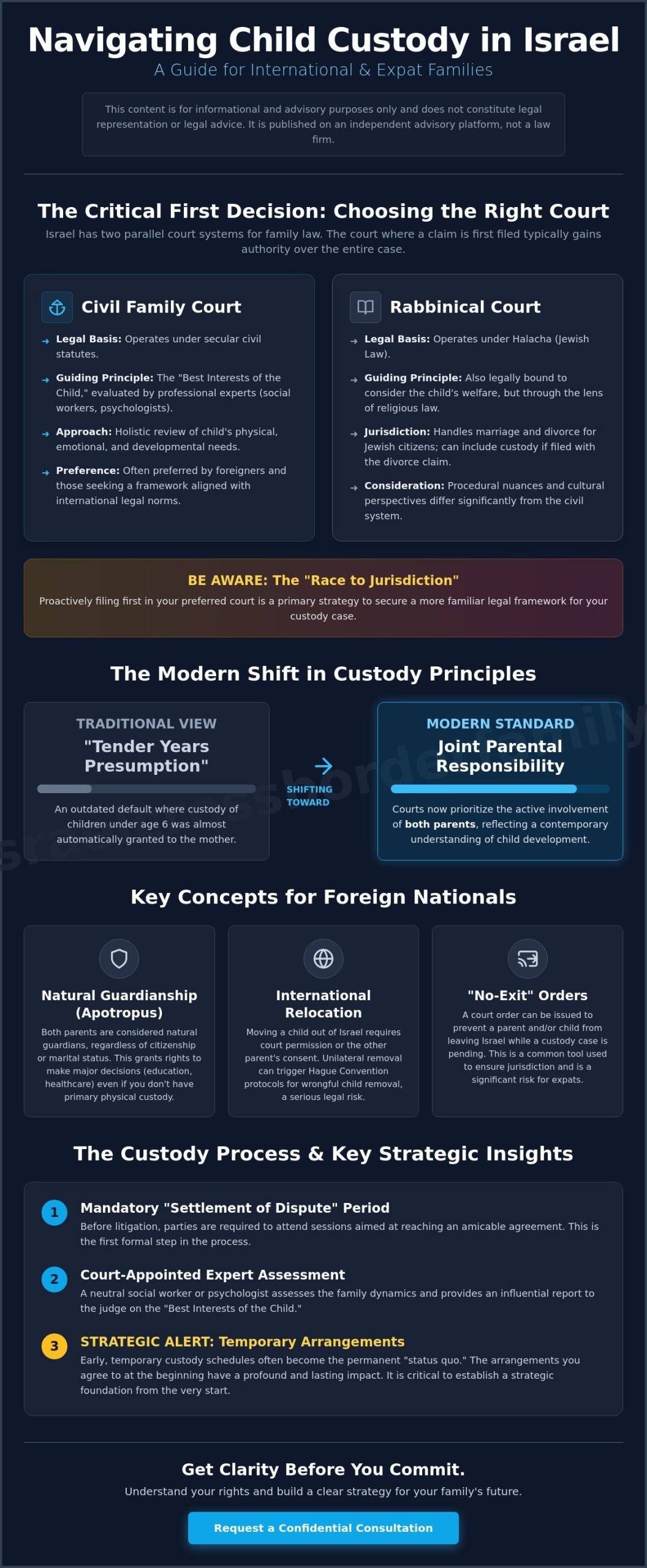
Strategy Before Commitment: Protecting Your Parental Rights
In Israel, the first few weeks of a separation are often the most defining for the years that follow. Many parents mistakenly believe that temporary living arrangements are just that; they’re temporary. In reality, the Israeli courts place immense weight on the “status quo.” If a child lives primarily with one parent for several months while the legal process unfolds, the court is likely to maintain that arrangement in the final ruling. Navigating israeli child custody laws for foreigners requires a shift in perspective. Western parenting norms often emphasize individual rights, but the IL system focuses heavily on communal and expert-driven assessments that favor stability over change.
Because of these systemic preferences, early decisions carry the most weight. Mediation and “Collaborative Divorce” offer a more controlled environment for international families to reach an agreement. These paths allow you to draft specific clauses about international travel, holiday schedules, and future relocation that a judge might not include in a standard ruling. Reaching a consensus outside of the courtroom often results in a more flexible and enforceable arrangement for parents who may eventually need to manage their lives across different borders.
Choosing the Right Jurisdiction
The “race to jurisdiction” is a critical strategic element in IL. While the Rabbinical court is sometimes viewed with apprehension by expats, there are specific, rare instances where its focus on traditional family structures might align with a parent’s specific goals. However, for most international families, ensuring the case stays in the Family Court is the priority. This is achieved by being the first to file a request for a dispute settlement that specifically includes custody matters. You should also be aware that international prenuptial agreements are often limited in their power regarding custody; the court will always override a contract if it believes the “Best Interests of the Child” requires a different outcome.
Cross-Border Advisory vs. Legal Representation
Before you engage a litigator, you need strategic clarity. A litigator’s primary role is to win a dispute within the courtroom, but an advisor’s role is to help you decide if you should be in court at all. An advisory approach helps manage the emotional and financial costs of cross-border disputes by focusing on long-term family goals rather than immediate tactical wins. For a deeper look at these dynamics, watch our overview on the Israel Family Law YouTube channel. Understanding the landscape before you commit to a specific legal path is the most effective way to protect your parental rights.
Get clarity before you commit. You can reach out for a confidential advisory call or message us on WhatsApp to discuss your situation.
This article is published on an independent advisory platform (not a law firm) and does not imply an attorney-client relationship.
Securing Your Family’s Future Across Borders
Navigating the intersection of two legal systems requires more than just reacting to court dates. It demands a proactive strategy that accounts for the unique challenges of the dual-court hierarchy and the specific nuances of israeli child custody laws for foreigners. By understanding how early decisions establish a long-term status quo, you can better protect your relationship with your children. Whether you’re managing a mandatory dispute settlement or preparing for a potential international relocation, clarity is your most valuable asset.
Our approach provides specialized US-Israel cross-border expertise. We offer authoritative guidance for international families through practitioners who are licensed in multiple jurisdictions. This multi-qualified perspective ensures that your global interests are considered alongside local requirements. You can move forward with confidence when you have a clear roadmap for the road ahead.
Get clarity before you commit. Request a confidential consultation to discuss your strategic options. You don’t have to manage these complexities alone. With the right preparation, you can achieve a stable and fair outcome for your family.
This article is published on an independent advisory platform (not a law firm) and does not imply an attorney-client relationship. The content provided is for informational and advisory purposes only and does not constitute legal representation or legal advice. Legal services are only provided by licensed attorneys under a separate engagement.
Frequently Asked Questions
Do mothers always get custody of young children in Israel?
Mothers do not automatically receive sole custody, though the “Tender Years Presumption” for children under six remains a factor in the law. In 2026, judges treat this as a rebuttable presumption rather than a fixed rule. The court’s primary focus is the “Best Interests of the Child,” and there is a strong trend toward granting joint physical custody if both parents are capable and live in close proximity.
Can I take my child back to my home country if I have a foreign custody order?
A foreign custody order does not grant an automatic right to remove a child from Israel. You must first domesticate the order or obtain specific permission from an Israeli court. Taking a child across borders without consent or a court order is considered a violation of the Hague Convention. This applies even if you hold a valid custody decree from a court in the US or Europe.
What happens if a parent refuses to follow a visitation schedule in Israel?
The Israeli legal system provides several mechanisms to enforce visitation schedules, including filing a motion through the Family Court or the Execution Office. The court can impose financial sanctions or fines for every instance of non-compliance. If the refusal persists, the court-appointed social worker may recommend a formal review of the custody arrangement to ensure the child’s right to maintain a relationship with both parents.
Can the Rabbinical court rule on custody if I am not an Israeli citizen?
The Rabbinical court can exercise jurisdiction over custody matters if it is already handling a divorce case between Jewish parents, regardless of their citizenship. However, foreign nationals often have grounds to request that the case be moved to the Civil Family Court. This is a complex procedural area where early strategic choices are vital to ensure your case is heard in the forum that best fits your family’s needs.
How does the “Race to Court” affect child custody for foreigners?
The “Race to Court” is a fundamental concept within israeli child custody laws for foreigners because it determines which judicial system will oversee the case. The first parent to file a claim generally locks in that court’s jurisdiction. For expats, filing first in the Family Court is often a priority to ensure that secular legal standards and familiar procedural protections are applied to their custody and relocation matters.
What is a “No-Exit” order and how do I prevent one?
A “No-Exit” order is a preventative measure issued by the court to ensure a child remains within the country during active litigation. To prevent or lift such an order, you generally need to show that you have no intention of abducting the child. This often involves providing financial guarantees or demonstrating significant ties to the local community. It’s a common hurdle for international families who need to travel for work or family visits.
How long does a typical custody case take in the Israeli Family Court?
The timeline for a typical case under israeli child custody laws for foreigners depends on the level of conflict and the complexity of the expert evaluations. The mandatory “Settlement of Dispute” period takes 45 to 60 days. If the parties cannot reach an agreement during this phase, a contested case can take several months or longer. Expert reports from social workers usually take at least 90 days to complete and submit to the judge.
Do I need an Israeli lawyer if I already have a lawyer in the US?
You definitely need local representation in Israel because only an Israeli-licensed attorney can appear in IL courts. While your US lawyer manages your domestic interests and overall international strategy, your Israeli practitioner handles the specific local filings and expert interviews. Cross-border cases are most successful when your legal teams in both jurisdictions work collaboratively to ensure a consistent strategy across all borders.

Article by
Gabriel Lior
A Personal Journey That Became a Mission
The advisory was founded by an American father Gabriel Lior, LLB, MBA , global entrepreneur, and cross-border advisor who spent more than a decade navigating the Israeli family court system firsthand and now lives in Singapore with his son.
As a divorced parent in a cross-border family, Gabriel faced nearly every legal challenge a foreign parent can encounter in Israel — including child custody disputes, child support proceedings, property matters in Israel and abroad, false accusations, and complex immigration and relocation proceedings.
Over the years, he learned the hard way how difficult it is for non-Israeli parents to understand the system, identify the right legal strategy, and choose the right legal representation — especially when language, culture, and jurisdictional differences are involved. He also witnessed how foreign parents and new immigrants are often disadvantaged or taken advantage of by service providers and institutions simply because they lack local knowledge or fluency.
From Client to Advisor
To truly understand — and survive — the system, Gabriel pursued formal legal education in Israel, completing two Israeli law degrees, alongside a BA and MBA earned in the United States. This was never about becoming a practicing attorney, but about gaining a deep, structural understanding of how the system works — and where it breaks down for foreign parents.
This rare combination of:
Firsthand client experience
Israeli legal and US business education
International business and negotiation training
Decades of commercial execution
created a unique perspective – one that understands both sides of the table.
After years of litigation, persistence, and at times self-representation, he ultimately succeeded in securing custody of his son and relocating abroad through a rare legal victory in the Israeli Supreme Court — becoming one of the first fathers in Israel to do so under these circumstances.
Disclaimer
Important Disclaimer:
The information provided on this website and in its content is for general informational and educational purposes only and does not constitute legal advice, legal opinion, or legal representation.
Gabriel Lior is not licensed to practice law in Israel (nor is he interested in doing so) and does not provide legal services, despite having completed 2 Law Degrees. The services offered are advisory in nature and are intended to provide general guidance, strategic insight, and information regarding cross-border family law considerations.
No attorney-client relationship is formed by accessing this website, reading its content, or communicating with us.
Any decisions made based on this information are at your own discretion and risk. For legal advice specific to your situation, you should consult a licensed attorney in the relevant jurisdiction.
Where appropriate, we may refer clients to independent, licensed attorneys or professionals. Such referrals do not constitute legal representation and no liability is assumed for services provided by third parties.