This article is published on an independent advisory platform. It focuses on strategy, risks, and decision-making guidance. It does not provide legal advice or establish an attorney-client relationship.
Filing for divorce in the country where you currently live might seem like the obvious first step, but for international families, it can often be the most costly mistake. You’re likely feeling overwhelmed by the “race of jurisdiction” and the fear that the Israeli legal system won’t understand your American cultural background. Jay Hait specializes in bridging this gap, applying a strategic, cross-border framework to resolve complex tensions for international families. It’s a valid concern; the dual court system in Israel creates a layer of complexity that simply doesn’t exist in the US.
In this guide, you’ll learn how to approach these challenges with clarity before you make life-altering commitments. We will examine the critical differences between the two systems, the importance of early decision-making, and how to protect your assets across jurisdictions. Understanding these nuances helps you move from a place of fear to a position of informed strength. Get clarity before you commit. Request a confidential consultation.
Key Takeaways
- Understand why Jay Hait utilizes his dual licensing in New York and Israel to provide a strategic bridge for families navigating divergent legal cultures.
- Learn how a strategy-first approach during the initial 30 days can help you avoid the high-stakes “race of jurisdiction” within the Israeli court system.
- Identify the systemic differences between American no-fault principles and the dual-court reality of Israel’s Family and Rabbinical courts.
- Discover the process of auditing international assets to determine which jurisdiction offers the most effective protection for your specific situation.
- Gain strategic clarity on your legal options through an independent advisory model before committing to a formal course of action.
Table of Contents
- Who is Jay Hait? The Strategic Bridge for International Families
- The Hait Strategy: Why Planning Precedes Litigation
- Navigating Systemic Differences: US vs. Israeli Family Law
- Practical Steps for Protecting Your Family and Assets
- The Independent Advisory Model: Clarity Before Commitment
Who is Jay Hait? The Strategic Bridge for International Families
Jay Hait represents a unique intersection of legal cultures. As an attorney licensed in both New York and Israel, he brings decades of experience to the table for families caught between two different legal systems. For international families, the primary challenge isn’t just the law itself; it’s the cultural and linguistic divide that often leads to confusion and fear. He serves as a calm, authoritative voice for those who feel lost in a foreign system. His practice focuses on translating complex legal realities into actionable frameworks that resonate with “Anglo” cultural norms and expectations.
The core mission of the practice is to provide a steady hand during high-stress international disputes. Families often face language barriers that make even routine hearings feel intimidating. By prioritizing clarity and transparency, the focus is on helping clients understand the logic behind every procedural step. This approach translates values like directness and strategic planning into a system that can otherwise feel aggressive or unpredictable. You can learn more about the philosophy behind this approach on the about the advisory page.
To better understand his background and professional approach, watch this introductory video:
A Multi-Jurisdictional Background
The foundation of this expertise was built in the United States, where rigorous legal standards and a client-first mentality are the norm. After transitioning to Israel, it became clear that a significant gap existed in support for expats and English-speaking families. The Israeli legal system is a complex blend of common law, civil law, and religious jurisdictions. This structure is often jarring for those accustomed to the “no-fault” systems common in many US states. Being truly “bilingual” in both language and legal culture allows for the identification of risks that a local practitioner might overlook.
The Cross-Border Specialty
Domestic practitioners often lack the specific training required to handle multi-jurisdictional complexity. Whether it’s a dispute over international assets or a high-stakes custody case, the strategy must account for the laws of both nations. Jay Hait acts as a strategic advisor, helping families understand how a decision made in Jerusalem might impact their assets or legal status in New York. This involves a deep understanding of treaties like the Hague Convention on child abduction and the cross-border enforcement of child support. This high-level perspective is essential for multi-national families who need to protect their interests on both sides of the ocean.
Get clarity before you commit. Request a confidential consultation.
The Hait Strategy: Why Planning Precedes Litigation
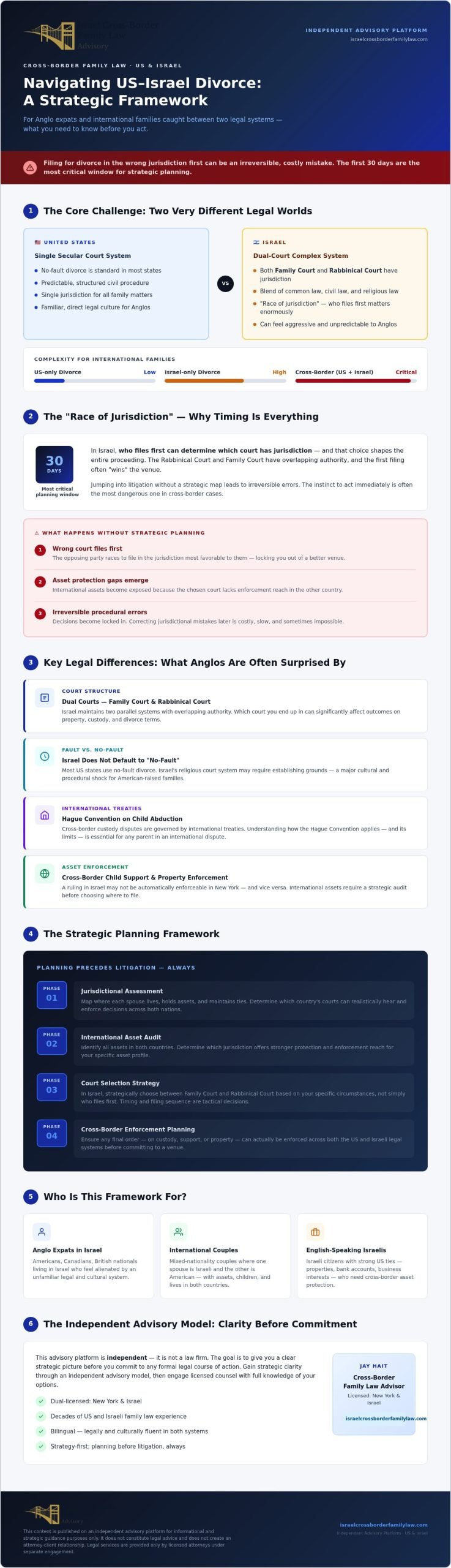
In the high-stakes environment of international family law, the instinct is often to act immediately. However, Jay Hait emphasizes that the first 30 days of a case are the most critical for strategic planning. Jumping into litigation without a clear map often leads to irreversible jurisdictional errors. For families with ties to both the US and Israel, the goal isn’t just to file; it’s to file in the venue that offers the most equitable protection for your specific family structure. Pausing to build a strategy helps you avoid reactive decisions that could haunt your financial future for years.
Israel’s legal landscape is defined by the “race of jurisdiction.” This means the court where a case is first filed, whether the civil Family Court or the religious Rabbinical Court, often retains authority over key issues like property division. For an expat, this race expands across borders. You must decide if an Israeli court or a US court is better suited to handle your assets or custody arrangements. A thorough risk assessment identifies the strengths and weaknesses of your position before a single document is signed. This honest evaluation is the only way to protect your interests in a multi-jurisdictional environment.
Decision-Making Guidance for Expats
Expats often feel pressured by the aggressive nature of the Israeli system. The Hait strategy focuses on empowering you with information so you can make informed choices rather than reactive ones. This includes evaluating the role of mediation or alternative dispute resolution. These paths can often resolve disputes more calmly than traditional litigation, provided both parties are willing to engage. By identifying long-term goals early, you can determine if a settlement is more beneficial than a protracted court battle. You can explore the details of this process on the how it works page.
Managing Cross-Border Complexity
Managing assets in multiple countries requires a high level of coordination. If you own property in the US but live in Israel, your divorce strategy must account for both legal systems. Jay Hait acts as a strategic coordinator, often working with legal teams in the US to ensure that a ruling in one country won’t be ignored in the other. This strategic perspective helps maintain neutrality during the emotional turmoil of a family conflict. It’s about protecting long-term interests, such as retirement accounts or international business holdings, that a local-only lawyer might miss. Before taking any formal legal steps, it’s wise to assess your strategic options to avoid common jurisdictional traps.
Get clarity before you commit. Request a confidential consultation.
Navigating Systemic Differences: US vs. Israeli Family Law
American expats often expect a “no-fault” divorce process similar to the systems they’ve encountered in the United States. In Israel, the reality is significantly more complex due to the country’s dual-court system. Jay Hait helps international families understand that jurisdiction isn’t just about location; it’s about which legal framework will ultimately govern your future. In Israel, family law matters can be heard in either the civil Family Court or the religious Rabbinical Court. While the civil court follows secular law, the Rabbinical Court operates under religious principles. This creates a “race of jurisdiction” where the first party to file often dictates the legal path for property division and other critical issues.
Expectations regarding privacy and procedural formality also differ between the two nations. In many US jurisdictions, family law proceedings are relatively private and follow strict rules of evidence. In contrast, Israeli courtrooms can feel more informal and, at times, more aggressive. Jay Hait plays a vital role in managing these expectations, ensuring clients aren’t blindsided by procedural differences or the intensity of the litigation process. Understanding these systemic nuances is the first step toward building a defense that protects your international interests.
The “Anglo” Experience in Israeli Courts
For English speakers, the language barrier is a primary source of stress during legal proceedings. Legal documents, court transcripts, and hearings are conducted in Hebrew. Even for those fluent in daily conversation, the technical nature of legal Hebrew is a significant hurdle. Cultural nuances also impact outcomes; what’s considered standard parenting or financial behavior in the US might be viewed differently by an Israeli judge. Specialized English-speaking guidance is a necessity for ensuring your cultural context is understood by the court. It’s about translating your life into a language the Israeli system recognizes.
International Custody and the Hague Convention
Relocation and child abduction are the most sensitive areas of cross-border law. Jay Hait provides detailed strategy for international custody and relocation, particularly when one parent wishes to move back to their home country. These cases often involve the Hague Convention, an international treaty designed to return children to their “habitual residence” if they’ve been removed without consent. Speed is a strategic necessity here. In 2026, Israeli Family Courts are required to hold an urgent preliminary hearing within 15 days of a Hague petition. Acting quickly is essential to protecting your parental rights and ensuring a stable environment for your children.
Get clarity before you commit. Request a confidential consultation.
Practical Steps for Protecting Your Family and Assets
Protecting your interests in a cross-border dispute requires a proactive rather than reactive stance. The complexity of managing a life split between two nations means that standard legal templates often fall short. Jay Hait advises families to follow a structured sequence to gain clarity before the pressure of litigation takes over. This methodical approach ensures that no international asset or jurisdictional advantage is overlooked during the initial stages of a conflict.
- Step 1: Conduct a comprehensive audit of all international assets. You can’t protect what you haven’t documented. This includes real estate, bank accounts, and retirement funds in both the US and Israel. Don’t forget digital assets or business interests that may have different valuation rules in each country.
- Step 2: Determine which jurisdiction is most favorable. Every family’s situation is unique. You need to evaluate which court system offers the most equitable framework for your specific assets and long-term goals.
- Step 3: Establish clear communication with a cross-border advisor. Having a single point of contact who understands both legal cultures prevents conflicting strategies and reduces the risk of procedural errors.
- Step 4: Review prenuptial and postnuptial agreements. According to a March 2026 Supreme Court ruling, prenuptial agreements in Israel must include specific clauses to remain valid after marriage. If your agreement was drafted in the US, it may need an international addendum to be enforceable in an Israeli court.
Estate Planning for Dual-Country Families
Estate planning is often neglected until a crisis occurs, yet it’s vital for families with assets in multiple jurisdictions. A will that’s valid in New York might not meet the specific requirements of the Israeli Inheritance Law, leading to expensive probate traps. Jay Hait helps families navigate the US-Israel estate planning process to ensure that assets are distributed according to your wishes without unnecessary delays. It’s about creating a seamless transition that respects the regulations of both countries while protecting your heirs from administrative burdens.
Child Support Enforcement Across Borders
Enforcing financial support across international lines is notoriously difficult. A November 2025 law granted Israeli Rabbinical courts temporary authority over child support, adding another layer of complexity for those with existing US orders. Strategic planning involves understanding how these local shifts impact child support cross-border enforcement. You must ensure that any support agreement is structured to be recognized and enforced by authorities in both jurisdictions to maintain your children’s financial stability.
Request a strategic asset protection review
Get clarity before you commit. Request a confidential consultation.
The Independent Advisory Model: Clarity Before Commitment
The independent advisory model serves as a strategic foundation for families who are not yet ready to commit to a specific legal path. Unlike a traditional law firm that may focus immediately on filing motions, the advisory platform led by Jay Hait prioritizes the “big picture” strategy. This model allows international families to explore their options in a neutral environment where the primary goal is informed decision-making rather than immediate legal solicitation. By separating high-level strategy from courtroom tactics, families can gain a clearer understanding of the risks and opportunities inherent in their cross-border situation.
This approach is collaborative by design. While the advisory provides the strategic roadmap, it works seamlessly with licensed attorneys in both the US and Israel who handle specific legal representation and filings. This multi-qualified professional team ensures that every decision aligns with the laws of both jurisdictions. Jay Hait acts as the coordinator, ensuring that the local legal teams understand the international implications of every move made in court. This structure provides a layer of oversight that is often missing when a family hires a domestic lawyer who lacks a cross-border perspective.
How the Advisory Process Works
The process begins with an initial confidential review designed to identify the most pressing jurisdictional and financial risks. During this session, you can expect a thorough examination of your family’s unique ties to both nations. The outcome of this review is a personalized Strategic Roadmap. This document outlines the most effective sequence of actions to protect your assets and parental rights, helping you visualize the process before you engage in formal litigation. You can find a detailed breakdown of these process steps by visiting the how it works page.
Early Decisions, Better Outcomes
In international family law, waiting to seek advice is rarely a neutral choice; it’s often a decision that limits your future options. Seeking guidance early helps you avoid the high costs and emotional exhaustion of reactive litigation. The “Clarity Call” serves as a vital tool for identifying immediate legal risks, such as potential Hague Convention issues or asset dissipation, before they become insurmountable. To gain more insight into these strategic concepts, you can watch helpful educational videos at @IsraelFamilyLaw. Taking the time to understand the system now ensures that you make choices based on facts rather than fear.
Get clarity before you commit. Request a confidential consultation.
This article is published on an independent advisory platform (not a law firm). It focuses on strategy, risks, and decision-making guidance. This content does not establish an attorney-client relationship or constitute legal advice.
Securing Your Family’s Future Across Borders
Navigating the intersection of two distinct legal systems requires a steady hand and a clear roadmap. We’ve explored how understanding the “race of jurisdiction” and the nuances of the Israeli court system can prevent costly errors for international families. By prioritizing a strategy-first methodology, you can address cross-border complexities before they escalate into high-stress litigation. Jay Hait utilizes his dual licensing in New York and Israel to provide this essential bridge, ensuring that your cultural context and long-term financial goals are respected in both jurisdictions.
Early intervention remains the most effective way to protect your assets and parental rights. Whether you’re managing a complex relocation or auditing international holdings, informed choices lead to more stable outcomes. Taking the time to gain clarity now provides the peace of mind needed to move forward with confidence. You don’t have to navigate these complexities alone.
Get clarity before you commit. Request a confidential consultation.
Your family’s stability depends on the decisions you make today. Informed planning is the first step toward a secure future.
Frequently Asked Questions
Who is Jay Hait and what is his legal background?
Jay Hait is an attorney with dual licensing in both New York and Israel, bringing decades of professional experience to international family disputes. Based in Israel with offices serving clients in Tel Aviv and Jerusalem, he specializes in the complexities of cross-border law. His background allows him to bridge the gap between American legal expectations and the reality of the Israeli system, providing a strategic advantage for families with multi-jurisdictional assets and ties.
Does Jay Hait provide legal advice for US family law matters?
While Jay Hait is licensed in New York, this specific platform operates as an independent advisory service rather than a law firm. It focuses on strategic decision-making and risk assessment for families in cities like Ra’anana and Herzliya. Legal representation or specific legal advice regarding US or Israeli law is only provided under a separate, formal engagement with a licensed attorney. This model ensures you receive strategic clarity before committing to a specific legal course.
How does the cross-border advisory model differ from a traditional law firm?
The cross-border advisory model prioritizes high-level strategy and informed choice over immediate litigation. Unlike a traditional firm that may focus solely on local filings in Netanya or Haifa, the advisory analyzes how an Israeli court decision might impact your US interests. It functions as a strategic bridge, often collaborating with your existing local professional teams in multiple countries. This approach helps international families avoid jurisdictional traps and ensures all decisions align with global long-term goals.
Can Jay Hait help with Hague Convention child abduction cases in Israel?
Yes, the advisory specializes in the strategic management of international custody and Hague Convention cases. For families in Modi’in or Beit Shemesh, the risk of child abduction or unauthorized relocation is a primary concern. The advisory helps parents understand the urgent procedural requirements of the Israeli courts, which often mandate preliminary hearings within 15 days of a petition. The focus is on acting quickly to protect parental rights and ensuring the child’s habitual residence is recognized.
What should I expect during a confidential case review with Jay Hait?
During a confidential case review, you can expect a comprehensive audit of your international assets and family situation. This session identifies immediate risks and explores which jurisdiction, whether in Israel or the US, offers the most favorable framework for your needs. Families in Givatayim or Petah Tikva receive a personalized strategic roadmap. This roadmap provides the clarity necessary to make informed decisions about divorce, custody, or estate planning before any formal legal steps are taken.
Are US prenuptial agreements enforceable in Israeli courts?
US prenuptial agreements are not automatically enforceable in Israel and often require specific authentication. A March 2026 Supreme Court ruling clarified that such agreements must include explicit clauses to remain valid after marriage and generally require approval by an Israeli Family Court. For expats in Caesarea or Zichron Ya’akov, having these documents reviewed by a cross-border specialist is essential. This ensures your American agreement meets the specific requirements of the Spouses’ Property Relations Law in Israel.
Does Jay Hait work with families who are not US citizens?
Yes, the advisory serves a diverse range of English-speaking international families, not just US citizens. Whether you are an expat from the UK, Canada, or Australia living in Ashdod or Be’er Sheva, the challenges of the Israeli legal system remain similar. The advisory provides the “Anglo” cultural translation and strategic guidance necessary to navigate the dual-court system. The focus is on the cross-border complexity that arises whenever a family’s life and assets span multiple international jurisdictions.
How do I know if I need a cross-border specialist or a local Israeli lawyer?
You likely need a cross-border specialist if your case involves assets, children, or legal agreements in more than one country. A local lawyer in Eilat or Kfar Saba may understand Israeli procedure but might overlook how those decisions impact your status in the US. The advisory provides the multi-jurisdictional perspective required to coordinate legal teams across borders. If your situation involves international relocation or foreign property, a strategic cross-border approach is necessary to protect your global interests.
Get clarity before you commit. Request a confidential consultation.

Article by
Gabriel Lior
A Personal Journey That Became a Mission
The advisory was founded by an American father Gabriel Lior, LLB, MBA , global entrepreneur, and cross-border advisor who spent more than a decade navigating the Israeli family court system firsthand and now lives in Singapore with his son.
As a divorced parent in a cross-border family, Gabriel faced nearly every legal challenge a foreign parent can encounter in Israel — including child custody disputes, child support proceedings, property matters in Israel and abroad, false accusations, and complex immigration and relocation proceedings.
Over the years, he learned the hard way how difficult it is for non-Israeli parents to understand the system, identify the right legal strategy, and choose the right legal representation — especially when language, culture, and jurisdictional differences are involved. He also witnessed how foreign parents and new immigrants are often disadvantaged or taken advantage of by service providers and institutions simply because they lack local knowledge or fluency.
From Client to Advisor
To truly understand — and survive — the system, Gabriel pursued formal legal education in Israel, completing two Israeli law degrees, alongside a BA and MBA earned in the United States. This was never about becoming a practicing attorney, but about gaining a deep, structural understanding of how the system works — and where it breaks down for foreign parents.
This rare combination of:
Firsthand client experience
Israeli legal and US business education
International business and negotiation training
Decades of commercial execution
created a unique perspective – one that understands both sides of the table.
After years of litigation, persistence, and at times self-representation, he ultimately succeeded in securing custody of his son and relocating abroad through a rare legal victory in the Israeli Supreme Court — becoming one of the first fathers in Israel to do so under these circumstances.
Disclaimer
Important Disclaimer:
The information provided on this website and in its content is for general informational and educational purposes only and does not constitute legal advice, legal opinion, or legal representation.
Gabriel Lior is not licensed to practice law in Israel (nor is he interested in doing so) and does not provide legal services, despite having completed 2 Law Degrees. The services offered are advisory in nature and are intended to provide general guidance, strategic insight, and information regarding cross-border family law considerations.
No attorney-client relationship is formed by accessing this website, reading its content, or communicating with us.
Any decisions made based on this information are at your own discretion and risk. For legal advice specific to your situation, you should consult a licensed attorney in the relevant jurisdiction.
Where appropriate, we may refer clients to independent, licensed attorneys or professionals. Such referrals do not constitute legal representation and no liability is assumed for services provided by third parties.