This article is published on an independent advisory platform (not a law firm). This content is for informational and advisory purposes only; it does not constitute legal representation or legal advice. Legal services are provided separately by licensed attorneys. Our focus is on strategy, risks, and decision-making guidance. For direct assistance, reach out via WhatsApp.
What if a civil divorce decree finalized in 2018 in London or New York is considered non-existent by the authorities in Jerusalem? For many international families, the discovery that a foreign legal process did not satisfy specific religious requirements can lead to the devastating label of mamzer for their children. It’s understandable to feel a sense of dread when you encounter the "marriage blacklist" in IL, a database that included approximately 6,700 individuals according to 2023 Rabbinical Court reports. You likely believe that following the civil laws of your home country should be enough to protect your family’s future.
This guide explains the practical legal implications of this status in modern Israel and shows how international families can manage these complexities through proactive strategy. We’ll examine the legal definitions used by the Rabbinical Courts and provide a clear path forward for your family planning. You don’t have to face these cross-border challenges without a clear map. Get clarity before you commit. Request a confidential consultation.
Key Takeaways
Distinguish between the religious definition of a mamzer and the secular term "bastard" to understand who is actually at risk under Israeli law.
Recognize the "cross-border trap" where a civil divorce without a religious Get leaves a woman legally married in Israel, potentially affecting the status of future children.
Understand how the Rabbinical Courts use the "Me’ukavei Nisuin" database to conduct background checks before issuing marriage licenses in Israel.
Learn why coordinating between international and Israeli legal systems is essential for preventing long-term marriage restrictions for your family.
Discover how early strategic decisions and professional advisory can help families navigate complex religious status issues before they become irreversible.
Table of Contents
This article is published on an independent advisory platform (not a law firm). This content is for informational and advisory purposes only and does not constitute legal representation or legal advice. We focus on strategy, risks, and decision-making guidance. For assistance with your specific situation, you may reach out via WhatsApp for a strategy session.
What is a Mamzer? Defining the Status in Modern Israel
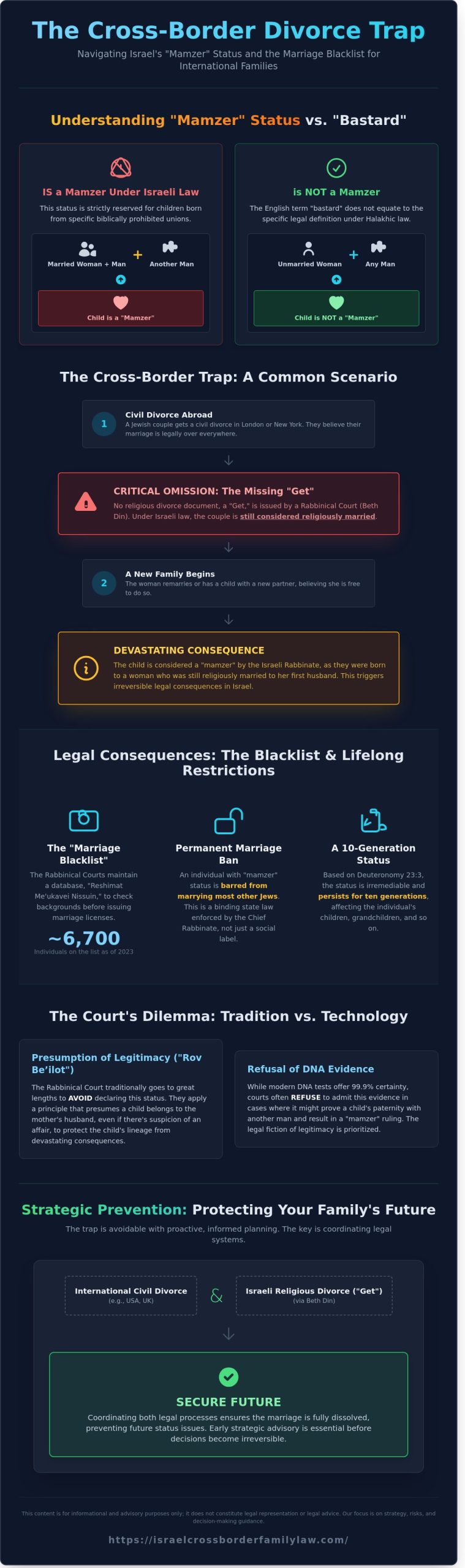
In the Israeli legal system, the term mamzer carries a weight that far exceeds its common English translation. While many people equate it with the term "bastard," the two concepts are legally distinct. Under halakhic law, which governs marriage and divorce for Jews in Israel, a child born to unmarried single parents isn’t a mamzer. Instead, this status is strictly reserved for children born from specific biblically prohibited unions. The most frequent case involves a child born to a woman who’s legally married to one man but conceives with another.
Understanding What is a Mamzer in Jewish law is vital because the Chief Rabbinate holds exclusive jurisdiction over Jewish marriage in Israel. This means religious definitions aren’t just social labels; they’re binding state law. If the Rabbinical Court (Beth Din) determines an individual holds this status, that person is barred from marrying most other Jews. This restriction isn’t temporary. It’s an irremediable status that persists for ten generations, affecting the individual’s future children and grandchildren.
Biblical Roots vs. Modern Legal Application
The legal foundation rests on Deuteronomy 23:3, which states that a person with this status shouldn’t enter the assembly of the Lord even unto the tenth generation. Historically, this status relied on community knowledge or witnesses. Today, the Israeli Rabbinical Courts utilize a digital database known as the "Blacklist" (Reshimat Me’ukavei Nissuin). This database contains over 5,000 names of individuals who are restricted from marriage. Since the 1953 Rabbinical Courts Jurisdiction Law, these ancient texts have become integrated into the modern Israeli bureaucracy, turning a religious category into a significant civil hurdle for expats and locals alike.
The Burden of Proof and the "Presumption of Legitimacy"
Despite the severity of the status, the Beth Din traditionally goes to great lengths to avoid such a declaration. Judges often apply the legal principle of "Rov Be’ilot" (the majority of relations). This presumption assumes that a child belongs to the mother’s husband, even if there’s suspicion of an affair. Historically, courts would ignore rumors to protect a child’s lineage. However, the rise of modern DNA testing has introduced a complex challenge. While biological science offers 99.9% certainty, the Rabbinical Courts often refuse to admit DNA evidence in paternity cases where it might result in a mamzer ruling. They prioritize the legal fiction of legitimacy to prevent the devastating social and legal consequences of the status.
Get clarity before you commit. Request a confidential consultation.
This article is published on an independent advisory platform (not a law firm). Do NOT use language that implies attorney-client relationship, legal representation, or giving legal advice. Focus on strategy, risks, and decision-making guidance. Request an advisory call.
How Mamzer Status is Triggered in International Families
The "Cross-Border Trap" is a frequent issue for Jewish families living between the US and IL. Many couples believe their legal obligations end when a US judge signs a divorce decree. This is a dangerous assumption. Under Israeli law, a Jewish marriage only dissolves through a "Get," which is a specific religious divorce document. If a woman remarries or has children with another man without this document, those children may be labeled a mamzer. This status creates permanent restrictions on who they can marry within the Jewish community for generations to come.
The Importance of the "Get" in Cross-Border Divorce
A Get is the essential mechanism for ending a marriage in Jewish law. It’s a physical document delivered from the husband to the wife under the supervision of a rabbinical court. International families must ensure their US civil proceedings and IL religious requirements align perfectly to avoid future status issues. A civil decree from a US court has no standing in an IL Rabbinical marriage registry. Without a Get, the woman remains "halakhically" married to her first husband, even if she has a 2024 civil divorce certificate from a court in New York or California. Any children born from a subsequent relationship while the first religious marriage is still active are viewed as products of an adulterous union.
Common Scenarios for Expats and Anglos
Expats often encounter these issues when relocating to IL years after a previous marriage ended. A common scenario involves a woman who civilly divorced in the US in 2015 but never obtained a Get because she didn’t think it was necessary. She remarries civilly and has children. When these children later apply for marriage licenses in IL, the Rabbinical Courts investigate their lineage. This investigation often uncovers the modern legal problems of mamzer status, which can lead to the children being placed on a marriage "blacklist."
For those dealing with divorce for international families, understanding these religious requirements is vital before moving. Get refusal is another significant risk. If a husband refuses to grant a Get as a bargaining chip in a financial dispute, he isn’t just affecting his ex-wife’s current life; he’s potentially compromising the legal status of her future children. You should consider the long-term implications of your religious status before finalizing any cross-border settlement.
The Registry Check: The IL Rabbinical Court maintains a database of individuals whose status is "delayed" or "prohibited" until their lineage is cleared.
Retroactive Discovery: Status issues are often discovered decades later, usually when a child or grandchild attempts to register for their own wedding in IL.
The Secular Myth: Many families believe that having a secular lifestyle exempts them from these rules, but the state of IL applies these laws to all Jewish citizens regardless of their level of observance.
Secular families often think these rules don’t apply to them. They assume that because they don’t keep kosher or attend synagogue, the Rabbinical Courts have no jurisdiction. This is incorrect. In IL, the Rabbinical Court holds exclusive authority over the marriage and divorce of all Jewish citizens and residents. It doesn’t matter if the original wedding was a civil ceremony in Las Vegas or a courthouse in London. If the couple is Jewish, the state of IL requires a religious divorce to recognize the end of the union and prevent the mamzer status from affecting future generations. If you’re unsure about your current standing, you might check your status with a qualified advisor.
Get clarity before you commit. Request a confidential consultation.
This article is published on an independent advisory platform (not a law firm). The following information is for strategy, risk management, and decision-making guidance. It does not constitute legal representation or legal advice. Legal services are provided separately by licensed attorneys.
The Legal Consequences: The "Blacklist" and Marriage Restrictions
In the Israeli legal system, the status of a mamzer is not merely a religious label. It is a state-enforced administrative reality with profound consequences for personal status. The Chief Rabbinate of IL maintains a centralized database known as the Me’ukavei Nisuin list. This registry, often referred to as the "blacklist," contains the names of thousands of individuals who are restricted or prohibited from marrying under Jewish law. Estimates suggest several thousand individuals are currently flagged within this system, preventing them from accessing the standard path to marriage in the country.
The legal weight of this status is absolute within the borders of IL. It creates a permanent barrier that affects not only the individual but their entire lineage. According to Halakhic principles, the status persists through the "tenth generation," meaning it does not dilute or disappear over time. Every child born to a person with this status inherits the same restrictions, creating a multi-generational legal challenge for families who may not even be aware of their standing until they interact with the state’s religious authorities.
Marriage in Israel: The Monopoly of the Rabbinate
The primary difficulty for those with this status stems from the fact that IL does not offer civil marriage for its Jewish citizens. The Rabbinical Courts hold a total monopoly over marriage and divorce. If the court identifies an individual as a mamzer, they are legally barred from marrying most other Jews. Their options are restricted to marrying someone with the same status or a convert to Judaism. This limitation often forces couples to seek marriage solutions outside the country, a common route for expats and foreign nationals who find themselves caught in the complexities of the Israeli system. While the state may recognize a civil marriage performed abroad for registration purposes, the religious status remains unchanged in the Rabbinate’s records.
The Discovery Process: When the Status Comes to Light
Most individuals do not realize they have a problematic status until they begin the marriage application process. This procedure involves a Birur Yahadut, or a clarification of Jewishness and personal status. Rabbinical Courts conduct thorough background checks, cross-referencing modern digital databases with historical records. They look for discrepancies in previous divorce decrees, the timing of births relative to a mother’s prior marriage, and witness testimonies.
If a "doubtful" status is flagged, the court initiates a formal investigation. This process often involves deep genealogical research. In today’s interconnected world, the Rabbinate can access records from Jewish communities globally, making it difficult to bypass these checks. The discovery often happens during what should be a celebratory time, leading to significant psychological and social distress. Families are forced to confront sensitive history, such as an ancestor’s "improper" divorce or a long-forgotten civil separation that was never finalized with a religious Get. The impact is not just legal; it’s a fundamental shift in how an individual views their place within the community.
Understanding these risks early is vital for anyone planning a future in IL. The system is rigid, and the administrative hurdles are high. Decisions made by previous generations can suddenly become a modern legal crisis, requiring strategic navigation and an understanding of the Rabbinical Court’s internal procedures.
Get clarity before you commit. Request a confidential consultation.
This article is published on an independent advisory platform (not a law firm). Do NOT use language that implies attorney-client relationship, legal representation, or giving legal advice. Focus on strategy, risks, and decision-making guidance. Soft CTA to advisory call / WhatsApp.
Strategic Prevention: Protecting Your Family’s Future
Preventing the status of a mamzer requires a proactive strategy that begins long before a new relationship is even a consideration. In Israel, the 1953 Rabbinical Courts Jurisdiction Law grants exclusive authority over Jewish marriage and divorce to the Rabbinate. This means that a civil divorce decree from a court in New York, London, or Toronto doesn’t resolve your religious status. If you’re part of the 15 percent of international Jewish couples who overlook the religious requirements during a civil split, you risk leaving your future children with an irreversible legal and social stigma under Israeli law.
It’s vital to achieve clarity before you make any new commitments. For many Anglos living in IL, the complexity of managing two distinct legal systems simultaneously leads to paralysis. However, the risks of inaction are too high to ignore. Strategic prevention involves understanding that the religious "Get" is not just a ceremony; it’s a legal prerequisite for your family’s future legitimacy. Since the 2018 legislative updates in IL, the Rabbinical courts have expanded their reach to help resolve recalcitrant cases, but these tools are only effective if you engage with the system correctly from the start.
Sequencing Your Divorce Correctly
Proper timing is the most effective shield against the mamzer designation. You must follow a specific order of operations to ensure every jurisdiction recognizes your single status. Start by consulting a cross-border advisor who can map out how your civil proceedings in the US or UK will interact with the Beth Din in IL. It’s a common mistake to wait until the civil divorce is final to start the religious process. Instead, you should aim to have the Get delivered and accepted before you finalize civil settlements. This prevents the Get from being used as a bargaining chip in financial negotiations. Finally, ensure you obtain a formal Certificate of Divorce from the Rabbinate. This document is essential if you ever plan to register a marriage or establish residency in IL, as it serves as the only recognized proof of your eligibility to wed.
Professional Advisory vs. Standard Legal Advice
Standard US divorce lawyers are experts in equitable distribution and custody, but they often lack the specialized knowledge required to navigate the intersection of civil law and Halacha. They may not realize that a child born to a woman who is civilly divorced but religiously "chained" is legally considered a mamzer. An advisory that understands both the "Start-up Nation" and the "Beth Din" provides a bridge between these two worlds. This specialized guidance helps you navigate the 92-day waiting period often required by religious law and ensures your strategy aligns with both secular and religious mandates. You can learn more about how the advisory works to coordinate these complex multi-jurisdictional requirements.
In IL, the legal system provides mechanisms to compel a Get if one party is being recalcitrant. These include financial sanctions, such as daily fines ranging from ₪500 to ₪1,000, or even the revocation of a driver’s license. Understanding how to trigger these mechanisms requires a sophisticated approach that balances diplomatic negotiation with firm legal positioning. Don’t leave your family’s future to chance by following a single-jurisdiction mindset.
Building a secure future for your children starts with making informed choices today. Secure your family’s legal standing by addressing these cross-border complexities early.
Get clarity before you commit. Request a confidential consultation.
Navigating Complexity with Informed Choice
This article is published on an independent advisory platform (not a law firm). Do NOT use language that implies attorney-client relationship, legal representation, or giving legal advice. Focus on strategy, risks, and decision-making guidance. Soft CTA to advisory call / WhatsApp.
Decisions made during the early stages of an international divorce often dictate a family’s legal trajectory for decades. In the context of Israeli law, the status of a mamzer is not merely a religious concept; it’s a legal reality that affects a child’s ability to marry within the State of Israel. While the implications are serious, most legal risks in this area are preventable with a proactive strategy. You don’t need to wait for a crisis to seek clarity. Identifying potential jurisdictional conflicts between civil and rabbinical courts is the first step toward protection.
Reliable data from the Israeli Rabbinical Courts indicates that while thousands of divorce cases are processed annually, only a small fraction result in status restrictions. These cases usually involve procedural errors or a lack of coordination between international jurisdictions. By understanding how the 1953 Rabbinical Courts Jurisdiction Law applies to your specific situation, you can navigate these complexities without unnecessary fear. Informed choice is your most effective tool for safeguarding your children’s future and ensuring their rights are protected under Israeli law.
The Advisory Approach to Family Law
Strategic planning focuses on long-term risk mitigation rather than just immediate litigation. Many families find that resolving status concerns requires a deep understanding of both Israeli and foreign legal systems. We provide advisory guidance to help you understand these multi-jurisdictional challenges. Please note that these advisory services are provided separately from formal legal representation. You can start this process by requesting a Confidential Case Review to assess your current standing. This initial step helps you identify which legal paths are open to you before you commit to a specific court system.
Watch: Expert Insights on Israel Family Law
Visual resources can simplify these complex topics. We encourage you to explore the Israel Family Law YouTube channel for detailed explanations. You’ll find specific videos covering "International Divorce" and the inner workings of "Rabbinical Courts." These insights help expats and English speakers understand the "team on the ground" perspective required for success in Israel. Watching these videos provides a foundation of knowledge before you engage in formal proceedings. The goal is to ensure you aren’t caught off guard by cultural or systemic differences that often surprise those from the U.S. or Europe.
The Israel Cross Border Law Firm acts as a bridge for those navigating the "start-up nation" legal environment. Whether you’re dealing with a mamzer concern or a standard custody dispute, the strategy remains the same: gather facts, understand the risks, and act decisively. Waiting until a court date is set is often too late to change the narrative. Strategic decisions made today can save you from years of expensive litigation and emotional distress later. Get clarity before you commit. Request a confidential consultation.
This article is published on an independent advisory platform (not a law firm). Do NOT use language that implies attorney-client relationship, legal representation, or giving legal advice. Focus on strategy, risks, and decision-making guidance. Soft CTA to advisory call / WhatsApp.
Protecting Your Family’s Legal Future in Israel
Navigating international divorce and Israeli Rabbinical law requires more than standard legal paperwork. A single oversight in a foreign jurisdiction can inadvertently trigger mamzer status for future children. This often leads to inclusion on the Rabbinical Court’s "blacklist" of restricted marriages. With over 5,000 names currently listed, the stakes are high. Effective strategy involves understanding how the 1953 Rabbinical Courts Jurisdiction Law applies to expats and ensuring US civil court steps align with Israeli requirements.
We provide specialized expertise in US-Israel cross-border family law. We’ve guided international families through complex civil and Rabbinical frameworks to keep their status protected. For visual guidance, explore our YouTube channel. Taking proactive steps today ensures your family’s future isn’t compromised by technicalities.
Get clarity before you commit. Request a confidential consultation.
This article is published on an independent advisory platform (not a law firm). Do NOT use language that implies attorney-client relationship, legal representation, or giving legal advice. Focus on strategy, risks, and decision-making guidance. Soft CTA to advisory call / WhatsApp.
Frequently Asked Questions
Is mamzer status the same as being born out of wedlock?
No, mamzer status isn’t the same as being born to unmarried parents. In Jewish law, a child born to a single woman is generally not a mamzer. This specific legal classification only arises if a child is born from an adulterous union where the mother is religiously married to another man, or from specific forbidden incestuous relationships. It’s a complex distinction that affects marriage rights in IL but doesn’t apply to the majority of children born outside of a marriage.
Can a DNA test prove that a child is not a mamzer in the eyes of the Rabbinical Court?
The Rabbinical Courts generally refuse to admit DNA evidence for the purpose of determining a child’s status. They rely on a long standing legal principle that "the majority of relations are attributed to the husband," which presumes the husband is the father. Since a DNA test could potentially prove adultery and label a child a mamzer, the court avoids such testing to protect the child’s legal standing and social future within the Jewish community.
Does mamzer status affect an individual’s right to Israeli citizenship or the Law of Return?
No, this status doesn’t impact your eligibility for Aliyah or Israeli citizenship. The 1950 Law of Return and the 1952 Citizenship Law are civil statutes. They grant residency and passport rights based on Jewish lineage or conversion, regardless of whether the Rabbinate considers a person marriageable. While a mamzer faces restrictions in the religious marriage market, they enjoy full civil rights, social benefits, and protection under Israeli law.
What happens if a woman remarries civilly in the US but never received a religious Get?
She is still considered married to her first husband under Jewish law. This creates a dangerous cross-border legal trap. Any children born from her second relationship will be classified as mamzerim by the Israeli Rabbinate. Even if a US civil court issued a final divorce decree years ago, the lack of a religious Get means the first marriage is still active in the eyes of the religious authorities, leading to permanent consequences for future generations.
Can the status of mamzer ever be reversed or "fixed" later in life?
While the status is technically permanent, the Rabbinate often utilizes sophisticated legal loopholes to avoid making an official declaration. They might investigate the original marriage ceremony from decades ago to find a technical flaw, such as an unqualified witness. If they can retroactively annul the first marriage, the child is no longer considered the product of adultery. This strategy requires early intervention and a deep understanding of religious procedural law.
How does the Chief Rabbinate find out about a person’s family history or divorce status?
The Rabbinate maintains a centralized computerized database known as the "restricted list," which contains records dating back to 1948. When you apply for a marriage license in IL, officials cross-reference your file with population registry data and historical religious court records. If there’s any inconsistency in your parents’ divorce history or your own marital status, the system flags the application for a more intensive investigation into your lineage.
Are there civil marriage alternatives in Israel for those on the "restricted" list?
Israel does not perform civil marriages within its borders, but it does recognize them if they’re performed abroad. Many couples on the restricted list choose to marry in Cyprus or utilize a Utah online marriage ceremony. Once you present a valid foreign marriage certificate to the Ministry of Interior and pay the registration fee of approximately ₪265, you’re officially registered as married. This grants you all civil tax, inheritance, and parental rights.
Is the "tenth generation" rule still strictly followed in modern Israeli law?
Yes, the rule based on Deuteronomy 23:3 remains a fundamental part of the religious legal framework. It specifies that the status is hereditary and doesn’t expire over time. If a person is declared a mamzer, the restriction on marrying within the general Jewish community passes to their children and grandchildren indefinitely. Because this status is permanent, the Rabbinical Courts often go to great lengths to avoid labeling a child in the first place.
https://www.youtube.com/@IsraelFamilyLaw
Get clarity before you commit. Request a confidential consultation.

Article by
Gabriel Lior
A Personal Journey That Became a Mission
The advisory was founded by an American father Gabriel Lior, LLB, MBA , global entrepreneur, and cross-border advisor who spent more than a decade navigating the Israeli family court system firsthand and now lives in Singapore with his son.
As a divorced parent in a cross-border family, Gabriel faced nearly every legal challenge a foreign parent can encounter in Israel — including child custody disputes, child support proceedings, property matters in Israel and abroad, false accusations, and complex immigration and relocation proceedings.
Over the years, he learned the hard way how difficult it is for non-Israeli parents to understand the system, identify the right legal strategy, and choose the right legal representation — especially when language, culture, and jurisdictional differences are involved. He also witnessed how foreign parents and new immigrants are often disadvantaged or taken advantage of by service providers and institutions simply because they lack local knowledge or fluency.
From Client to Advisor
To truly understand — and survive — the system, Gabriel pursued formal legal education in Israel, completing two Israeli law degrees, alongside a BA and MBA earned in the United States. This was never about becoming a practicing attorney, but about gaining a deep, structural understanding of how the system works — and where it breaks down for foreign parents.
This rare combination of:
Firsthand client experience
Israeli legal and US business education
International business and negotiation training
Decades of commercial execution
created a unique perspective – one that understands both sides of the table.
After years of litigation, persistence, and at times self-representation, he ultimately succeeded in securing custody of his son and relocating abroad through a rare legal victory in the Israeli Supreme Court — becoming one of the first fathers in Israel to do so under these circumstances.
Disclaimer
Important Disclaimer:
The information provided on this website and in its content is for general informational and educational purposes only and does not constitute legal advice, legal opinion, or legal representation.
Gabriel Lior is not licensed to practice law in Israel (nor is he interested in doing so) and does not provide legal services, despite having completed 2 Law Degrees. The services offered are advisory in nature and are intended to provide general guidance, strategic insight, and information regarding cross-border family law considerations.
No attorney-client relationship is formed by accessing this website, reading its content, or communicating with us.
Any decisions made based on this information are at your own discretion and risk. For legal advice specific to your situation, you should consult a licensed attorney in the relevant jurisdiction.
Where appropriate, we may refer clients to independent, licensed attorneys or professionals. Such referrals do not constitute legal representation and no liability is assumed for services provided by third parties.