This article is published on an independent advisory platform (not a law firm). Do not use this information as legal advice or as a substitute for an attorney-client relationship. It focuses on strategy, risks, and decision-making guidance.
Imagine receiving news of a legacy in the heart of the Negev while sitting thousands of miles away in a different time zone. For many international families, the initial gratitude of an inheritance is quickly replaced by the daunting reality of Hebrew legal filings and the physical distance from the Southern District authorities. Managing estate administration for non-residents in Be’er Sheva requires more than just local knowledge; it demands a strategic bridge between your home jurisdiction and the specific administrative landscape of Israel. You likely feel that the combination of language barriers and complex document authentication requirements, such as the Hague Apostille, makes the process feel overwhelming. It’s common to worry that a simple administrative error could lead to frozen bank accounts or significant tax exposure.
We understand that the logistical gap between foreign residency and local Negev bureaucracy is often the most challenging hurdle to clear. This strategic guide provides a clear roadmap to help you secure Be’er Sheva property and financial assets with total clarity and foresight. We’ll examine the 2026 procedural requirements, from electronic probate petitions to managing the unique rental market dynamics surrounding Ben-Gurion University, ensuring you can make informed choices without the need for constant travel.
Key Takeaways
- Learn how to navigate the 2026 digital filing requirements for a Succession Order or Probate Order through the Be’er Sheva Registrar of Inheritance Affairs.
- Understand the mandatory document authentication process, including the Hague Apostille and certified Hebrew translations, required for foreign-domiciled estates.
- Successfully manage estate administration for non-residents in Be’er Sheva by coordinating with local municipal authorities regarding property tax clearances and vacancy regulations.
- Evaluate the strategic implications of Israel’s 25% capital gains tax on inherited real estate to determine the most beneficial path for your Negev property.
- Discover how to execute the entire succession process remotely via an authenticated Power of Attorney, eliminating the logistical burden of international travel.
This article is published on an independent advisory platform (not a law firm). Do NOT use language that implies attorney-client relationship, legal representation, or giving legal advice. Focus on strategy, risks, and decision-making guidance. Soft CTA to advisory call / WhatsApp.
Understanding Estate Administration for Non-Residents in Be’er Sheva
Estate administration for non-residents in Be’er Sheva involves the formal legal and administrative steps required to transfer ownership of Israeli assets from a deceased individual to their beneficiaries. For those living outside Israel, this process often feels like a logistical puzzle. It encompasses everything from validating a foreign will to liquidating local bank accounts. Because Israeli law governs any real estate or financial holdings physically located within its borders, international families must engage with the Israeli probate proceedings to gain legal standing. Managing estate administration for non-residents in Be’er Sheva requires more than just translating a will; it demands a strategic bridge between your home country and the Israeli legal system.
Be’er Sheva has transformed into a critical innovation hub, anchored by Ben-Gurion University and the CyberSpark district. This evolution has significantly impacted local estate values, particularly in residential areas favored by tech professionals and faculty. Identifying assets in the Negev region is the first hurdle. While an apartment in a neighborhood like Ramot is easy to spot, many heirs aren’t aware of dormant Israeli bank accounts or pension funds. The Registrar of Inheritance Affairs (Rasham HaYerusha) oversees these matters, ensuring that the distribution of the estate aligns with either the deceased’s written wishes or statutory law. To better understand the inheritance system, you can explore the educational videos available on our YouTube channel, Israel Cross Border Law Firm.
The Legal Framework for International Heirs
Israeli law applies to all property within the country, even if the owner was never a citizen. The “Center of Life” test is a primary factor in determining which jurisdiction’s laws apply to the deceased’s overall estate, but for a Be’er Sheva apartment itself, Israeli law is the final word. If a valid will exists, you’ll seek a Probate Order (Tzav Kiyum Tzava). Without one, the estate follows intestate succession rules via a Succession Order (Tzav Yerusha). These distinctions dictate who receives what percentage of the assets, making early strategic analysis vital for non-resident families.
Why Be’er Sheva Requires Local Expertise
Managing an estate from abroad requires a bridge to the Southern District’s administrative offices. The Be’er Sheva Registrar has its own pace and specific requirements for document authentication. Local market trends also play a role; an inherited property in the Old City requires different management than a modern unit in Neve Ze’ev. Having a local point of contact is essential for property maintenance and dealing with the municipality. Without a physical presence, simple tasks like paying the Arnona (property tax) or responding to a tenant emergency can become significant administrative burdens. Successful estate administration for non-residents in Be’er Sheva is most effective when you have a clear strategy for these local logistical realities.
The Israeli Probate Process: A Step-by-Step Roadmap
Securing a legal mandate is the essential next step once you’ve identified the assets within the Southern District. The process begins with an Israeli inheritance order application (Tzav Yerusha) if there is no will, or a Probate Order (Tzav Kiyum Tzava) if a valid testamentary document exists. These documents serve as the legal keys to unlocking bank accounts and transferring property titles in Be’er Sheva. For those managing estate administration for non-residents in Be’er Sheva, the process is largely centralized through the digital portal of the Registrar of Inheritance Affairs, though the physical jurisdiction remains with the Be’er Sheva office.
Applying for the Succession Order from Abroad
The 2026 system heavily favors electronic submissions, allowing heirs to initiate the process without stepping foot in Israel. An online application currently costs ₪566, while physical filings at the Be’er Sheva office on HaTikva Street incur a higher fee of ₪597. Non-resident heirs must provide specific identification for all beneficiaries; if you lack an Israeli ID, you’ll need to submit authenticated copies of foreign passports. The Southern District Registrar typically processes uncontested electronic petitions within three to six months, though foreign domicile issues can extend this timeline if the documentation isn’t perfect from the start.
The Role of the Administrator General
Every file involving a foreign resident is automatically transferred to the Administrator General (Potropus Klali) for review. The state intervenes to ensure that the rights of absent heirs or potential creditors are protected under Israeli law. Common queries often involve the “Foreign Legal Opinion” required to validate how your home country’s laws interact with Israeli assets. To expedite this clearance and ensure smooth estate administration for non-residents in Be’er Sheva, you should ensure that all foreign vital records are authenticated with a Hague Apostille and accompanied by certified Hebrew translations. Delays often stem from incomplete documentation rather than actual legal disputes.
After the Registrar issues the order, a public notice is published in the Official Gazette and a local newspaper. This starts a mandatory 14-day window for any interested party to file an objection. Once this period passes without challenge, the order becomes final and legally binding. You can then proceed to register the inherited property at the Be’er Sheva Land Registry Bureau (Tabu) or present the order to financial institutions to release held funds. If you’re feeling overwhelmed by these technical requirements, you can explore strategic guidance for your specific case to avoid common filing errors that lead to long delays.
This article is published on an independent advisory platform (not a law firm). Soft CTA to advisory call / WhatsApp.
Critical Challenges for Non-Resident Heirs and Beneficiaries
Securing a probate order is only half the battle. The logistical reality of estate administration for non-residents in Be’er Sheva often hinges on the meticulous execution of paperwork that satisfies both Israeli bureaucracy and international standards. While the digital age has simplified many aspects of the process, the “paper trail” remains a significant bottleneck for those living abroad. Misunderstanding the strict requirements for document authentication or translation can lead to months of administrative delays and mounting costs. You must view these technical requirements as the foundation of your strategy rather than a mere formality.
Authentication and Power of Attorney
Israeli authorities, particularly the Land Registry Bureau (Tabu) in Be’er Sheva, require a high level of certainty regarding the identity of foreign signatories. You cannot simply sign a document at a local bank and mail it to Israel. Every foreign vital record or legal instrument must be authenticated via a Hague Apostille. If you are in a jurisdiction that doesn’t participate in the Hague Convention, you’ll need authentication from the nearest Israeli Consulate. Drafting a Power of Attorney (Yipui Koach) is a critical step; it must be specifically worded to meet Israeli standards for property management and asset liquidation. Errors in the phrasing of these documents often result in the Land Registry rejecting the filing, forcing heirs to restart the authentication process from scratch.
Cross-Border Tax and Financial Considerations
As of 2026, Israel maintains a 0% inheritance tax rate. This applies to all inherited assets, including Be’er Sheva real estate and local bank deposits, regardless of your residency status. However, the financial complexity arises after the inheritance is processed. Unlike some jurisdictions, Israel does not provide a “step-up” in cost basis at the time of death. Heirs carry over the original purchase price of the property. If you choose to sell the inherited apartment, you’ll likely face a 25% capital gains tax (Mas Shevach) on the inflation-adjusted gains. For US citizens, managing these assets also triggers specific reporting requirements, such as the FBAR and FATCA, which track foreign financial interests.
Liquidity is another challenge. Israeli banks typically freeze accounts immediately upon notification of the account holder’s death. Even with a valid probate order, transferring funds to a foreign account involves rigorous “Know Your Customer” (KYC) and Anti-Money Laundering (AML) checks. Banks will demand proof of the origin of funds and full documentation of the succession process before authorizing an international wire. Successful estate administration for non-residents in Be’er Sheva requires anticipating these hurdles early to ensure that funds remain accessible for property maintenance or distribution to beneficiaries.
This article is published on an independent advisory platform (not a law firm).
Be’er Sheva Specifics: Managing Local Real Estate and Assets
Managing property within the ‘Capital of the Negev’ presents unique logistical challenges that differ from the administrative environment of central Israel. While the legal framework for estate administration for non-residents in Be’er Sheva is consistent with national standards, the practical execution occurs through local Southern District offices. Success depends on navigating the specific requirements of the Be’er Sheva Land Registry and the local municipality (Iriya) while ensuring that physical assets remain secure from a distance. You’re not just dealing with a legal file; you’re managing a physical asset in one of Israel’s fastest-growing urban centers.
The Be’er Sheva Land Registry (Tabu)
The Be’er Sheva Land Registry Bureau, located at Kiryat HaMemshala on HaTikva Street, is the final authority for transferring title to non-resident heirs. Filings in this district often encounter discrepancies in older property records, particularly regarding block (Gush) and parcel (Chelka) identifications in established neighborhoods like Shechuna Gimel or the Old City. Non-resident heirs must provide authenticated documentation that matches the historical records exactly. If the deceased’s name or passport number differs even slightly from the registry entry, you’ll likely face administrative delays that require additional legal declarations to resolve. It’s vital to verify these details before submitting your final petition.
Municipal Clearances and Arnona
Before any property can change hands at the Tabu, you must obtain a ‘Section 324’ certificate from the Be’er Sheva Municipality. This document confirms that all municipal taxes (Arnona) and utility debts are settled in full. Be’er Sheva has specific regulations regarding vacant apartments that you shouldn’t ignore. While heirs might qualify for a one-time, short-term exemption on Arnona for an empty property, failing to manage this timeline can lead to significant debt accumulation. For more detailed guidance on these cross-border logistical hurdles, see our resources For Expats & Foreign Nationals.
Handling tenants and property maintenance from abroad is the final piece of the management puzzle. Be’er Sheva’s rental market is heavily influenced by the proximity of Ben-Gurion University and Soroka Medical Center, creating a high demand for multi-tenant student housing. Absentee heirs often inherit units with active leases or urgent maintenance needs. Without a local point of contact to handle ‘Va’ad Bayit’ (house committee) payments or emergency repairs, the asset’s value can quickly diminish. Effective estate administration for non-residents in Be’er Sheva requires a proactive approach to these municipal and logistical realities to ensure the property remains a viable investment.
This article is published on an independent advisory platform (not a law firm).
Strategic Management: Bridging the Distance
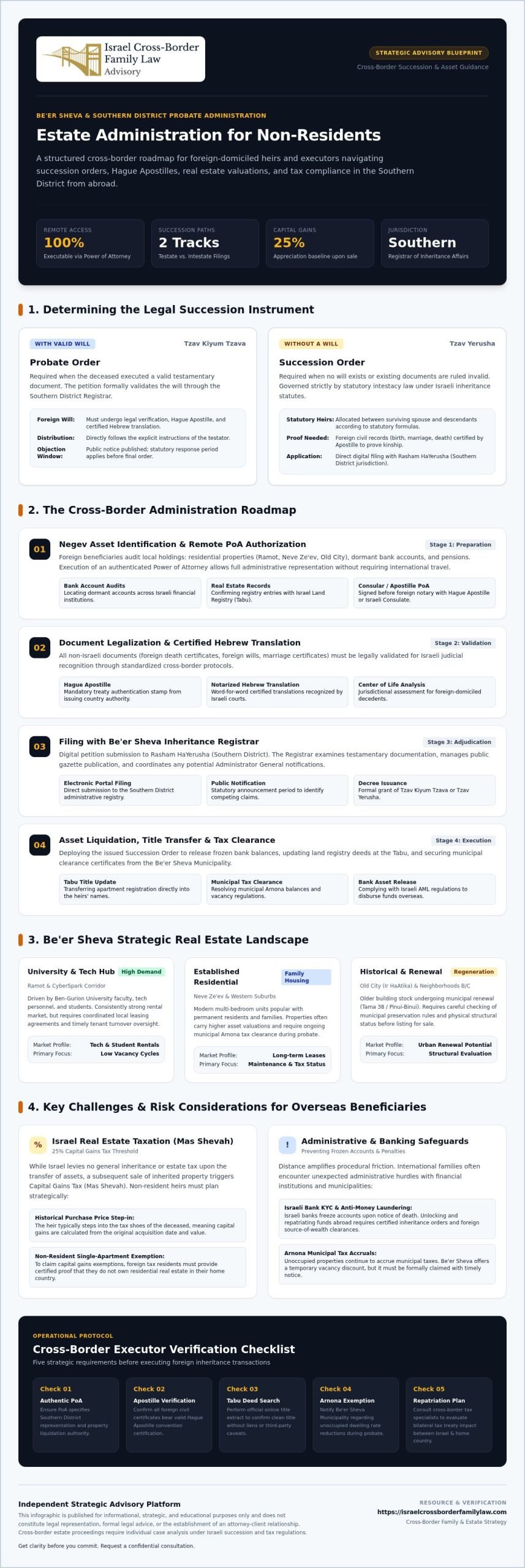
Successful estate administration for non-residents in Be’er Sheva requires moving beyond the technical filings to focus on long-term commercial strategy. While the previous sections detailed the “how” of probate and title transfer, the “why” behind your choices determines the ultimate value of the inheritance. Managing a cross-border estate involves balancing local market dynamics with the personal financial goals of heirs who may never intend to live in Israel. Early strategic decisions are paramount. Waiting until the probate order is issued to consider the property’s future often leads to missed market opportunities or unnecessary maintenance costs.
Developing an Exit Strategy
The Be’er Sheva real estate market has evolved into a sophisticated investment landscape. With the expansion of the “Tech District” and the continued growth of the industrial parks, property values in surrounding residential areas have seen steady shifts. Heirs must evaluate whether to keep the property for rental yield, which is supported by the high demand from Soroka Medical Center staff and university students, or to pursue an immediate sale. You should consider the carry-over basis and capital gains implications discussed earlier when timing your exit. If you’re interested in how our team supports these complex cross-border decisions, you can learn more About the Advisory and our focus on risk management.
Communication and Transparency
Distance often magnifies family friction. When multiple heirs are scattered across different countries and time zones, a lack of transparency can quickly lead to disputes. To maintain harmony, it’s essential to coordinate through a centralized digital trail. This includes documenting all interactions with the Be’er Sheva municipality, the Land Registry, and local utility providers. Providing all beneficiaries with regular updates on the status of the estate administration for non-residents in Be’er Sheva reduces the risk of misunderstandings regarding the timeline or costs involved. Informed heirs are generally more patient with the three to six-month processing windows typical of the Southern District Registrar.
Clarity before commitment is the most effective way to manage a cross-border inheritance. By addressing the logistical “bridge” between your home and the Negev early in the process, you avoid the common pitfalls of reactive decision-making. Every choice, from selecting a property manager to determining the best tax path for a sale, should be part of a cohesive plan. Informed choices lead to smoother transitions and ensure the legacy is preserved rather than drained by administrative delays.
Securing Your Legacy in the Negev
Managing an estate from across the globe shouldn’t feel like an insurmountable hurdle. You’ve now seen how the digital shift in 2026 has streamlined probate; yet the local nuances of Be’er Sheva municipal clearances and Land Registry requirements remain critical to a successful outcome. Successfully managing estate administration for non-residents in Be’er Sheva hinges on your ability to bridge the gap between your home jurisdiction and the specific administrative landscape of the Southern District. By prioritizing document authentication and early tax planning, you protect the financial value of the inheritance while minimizing family friction.
Our advisory specializes in the cross-border complexity that international families face. We focus on the unique needs of the Anglo and expat community, providing strategic guidance that ensures your decisions are informed and deliberate. Clarity before commitment is the most effective way to navigate the Israeli legal system with confidence. Get clarity before you commit.
Take the first step toward securing your Negev assets with foresight and professional support.
This article is published on an independent advisory platform (not a law firm).
Frequently Asked Questions
Do I need to travel to Be’er Sheva to claim my inheritance?
You don’t need to travel to Israel to manage the inheritance process. 100% of the administration can be handled remotely through an authenticated Power of Attorney. This document allows a representative to act on your behalf before the Registrar of Inheritance Affairs and the Land Registry. Whether you’re in the US or UK, you can execute these documents locally via an Apostille or at an Israeli consulate, ensuring the estate moves forward without international travel.
How long does the probate process take for non-residents in Israel?
The timeline for estate administration for non-residents in Be’er Sheva typically ranges from three to six months for uncontested electronic petitions. If the estate involves a foreign will, the process often extends to eight or twelve months. This extra time is necessary to secure a Foreign Legal Opinion and complete certified Hebrew translations. Delays usually occur when document authentication doesn’t meet the specific standards of the Southern District Registrar.
Are there inheritance taxes for US citizens inheriting property in Be’er Sheva?
Israel abolished inheritance and estate taxes in 1981, so you won’t pay local tax on the inheritance itself. However, US citizens must still comply with IRS reporting requirements, including FBAR and FATCA, for foreign financial assets. If you later sell the Be’er Sheva property, you’ll likely face a 25% capital gains tax on the real gains. It’s vital to coordinate with a tax professional who understands both jurisdictions to minimize overall exposure.
What is an Apostille and why do I need it for my Israeli estate?
An Apostille is an international certification that validates the authenticity of your foreign documents for use in Israel. You need it because the Israeli Registrar of Inheritance Affairs won’t accept foreign death certificates or wills without this standardized verification. Without an Apostille, your documents lack legal standing in the Southern District. It serves as the essential bridge between your home country’s public records and the Israeli administrative system, preventing document fraud in cross-border cases.
Can I sell an inherited apartment in Be’er Sheva before the probate is finished?
You cannot legally finalize the sale of an inherited apartment until the probate or succession order is issued and the title is registered in your name. While you might sign a preliminary agreement “subject to” receiving the order, this carries significant risks for both parties. The Be’er Sheva Land Registry requires the final order to process any deed transfer. It’s safer to wait for the legal mandate before committing to a commercial transaction.
How do I handle an Israeli bank account of a deceased relative from abroad?
Israeli financial institutions freeze accounts immediately upon learning of an account holder’s death. To release these funds, you must present an officially sealed probate or succession order to the bank. Non-residents will also need to complete rigorous “Know Your Customer” and Anti-Money Laundering checks. Banks often demand proof of the origin of funds before authorizing any international wire transfers to your home country, making early documentation vital for liquidity.
What happens if there is no will for the Be’er Sheva assets?
If the deceased left no valid will, the estate follows the default rules of the Israeli Succession Law. In most cases, the surviving spouse inherits all movable property and 50% of the remaining estate, while the children divide the other 50% equally. You’ll need to apply for a Succession Order (Tzav Yerusha) to formally identify the statutory heirs. This process ensures that estate administration for non-residents in Be’er Sheva adheres to Israeli legal protections for family members.
Who manages the property in Be’er Sheva while the legal process is ongoing?
The heirs are responsible for the property’s upkeep, though they can petition the court to appoint an Estate Manager (Menahal Izavon) for complex cases. Since the Be’er Sheva municipality requires ongoing payments for property taxes (Arnona) and utilities, having a local point of contact is essential. This person manages tenant interactions and emergency repairs while the legal process unfolds. Proper management prevents the asset from falling into disrepair or accumulating municipal debt during the administrative window.

Article by
Gabriel Lior
A Personal Journey That Became a Mission
The advisory was founded by an American father Gabriel Lior, LLB, MBA , global entrepreneur, and cross-border advisor who spent more than a decade navigating the Israeli family court system firsthand and now lives in Singapore with his son.
As a divorced parent in a cross-border family, Gabriel faced nearly every legal challenge a foreign parent can encounter in Israel — including child custody disputes, child support proceedings, property matters in Israel and abroad, false accusations, and complex immigration and relocation proceedings.
Over the years, he learned the hard way how difficult it is for non-Israeli parents to understand the system, identify the right legal strategy, and choose the right legal representation — especially when language, culture, and jurisdictional differences are involved. He also witnessed how foreign parents and new immigrants are often disadvantaged or taken advantage of by service providers and institutions simply because they lack local knowledge or fluency.
From Client to Advisor
To truly understand — and survive — the system, Gabriel pursued formal legal education in Israel, completing two Israeli law degrees, alongside a BA and MBA earned in the United States. This was never about becoming a practicing attorney, but about gaining a deep, structural understanding of how the system works — and where it breaks down for foreign parents.
This rare combination of:
Firsthand client experience
Israeli legal and US business education
International business and negotiation training
Decades of commercial execution
created a unique perspective – one that understands both sides of the table.
After years of litigation, persistence, and at times self-representation, he ultimately succeeded in securing custody of his son and relocating abroad through a rare legal victory in the Israeli Supreme Court — becoming one of the first fathers in Israel to do so under these circumstances.
Disclaimer
Important Disclaimer:
The information provided on this website and in its content is for general informational and educational purposes only and does not constitute legal advice, legal opinion, or legal representation.
Gabriel Lior is not licensed to practice law in Israel (nor is he interested in doing so) and does not provide legal services, despite having completed 2 Law Degrees. The services offered are advisory in nature and are intended to provide general guidance, strategic insight, and information regarding cross-border family law considerations.
No attorney-client relationship is formed by accessing this website, reading its content, or communicating with us.
Any decisions made based on this information are at your own discretion and risk. For legal advice specific to your situation, you should consult a licensed attorney in the relevant jurisdiction.
Where appropriate, we may refer clients to independent, licensed attorneys or professionals. Such referrals do not constitute legal representation and no liability is assumed for services provided by third parties.