What if moving quickly is not the safest first step in a divorce involving Israel? If you live abroad, the right process may depend on facts spanning more than one country, and early choices can affect how you prepare and communicate. Understanding the mistakes to avoid when filing for divorce from abroad starts with getting clear on which questions need answers before you act.
It’s understandable to want a straightforward checklist, especially when distance, deadlines, children, property, support, and documents all cross borders. But the applicable jurisdiction and process can depend on your circumstances. Assumptions based on another country’s system may lead to avoidable confusion.
This article outlines common planning and communication mistakes, along with facts, dates, and questions to prepare for independent licensed counsel. It also explains how Israel Cross Border Law Firm can provide independent strategic and informational support to help organize your priorities and next steps. Israel Cross Border Law Firm does not provide legal advice or representation. Those services are provided by independent licensed attorneys through their own firms. Clear preparation can help you approach those conversations with focused questions before committing to a course of action.
Key Takeaways
- Living abroad alone doesn’t determine which court or process may apply. Map the countries connected to your family before making filing decisions.
- One of the key mistakes to avoid when filing for divorce from abroad is treating timing, jurisdiction, and service of documents as separate details rather than connected questions.
- Prepare a clear timeline of important dates and note where children, property, and support arrangements involve different countries.
- Use your organized facts to prepare focused questions for independent licensed counsel in the relevant jurisdictions.
- An advisory session can help structure your priorities and questions. Legal advice and representation are provided by independent licensed attorneys under separate engagement.
Filing for Divorce from Abroad: Why Israel Cross-Border Cases Need Careful Planning
Managing a divorce connected to Israel while living in another country can make it difficult to know where to begin. A cross-border divorce involves meaningful connections to more than one country. Those connections might include where each spouse lives, their citizenships, where they married, where children live, or where assets are located. Each detail can raise a different question, and none automatically settles which court or process applies.
There isn’t one process that fits every international family. Israel’s legal framework includes civil and religious courts, but how that system relates to a particular family’s circumstances requires case-specific review. For background, see this overview of Israeli law and its dual court system. Families may also bring different expectations about how family decisions are discussed, recorded, or communicated. Explaining those expectations can help professionals understand the context, without assuming that cultural experience determines the applicable process.
Families may be living in Tel Aviv, Jerusalem, Herzliya, Ra’anana, Netanya, Haifa, Modi’in, Beit Shemesh, Kfar Saba, Hod Hasharon, Ramat Gan, Givatayim, Petah Tikva, Ashdod, Be’er Sheva, Eilat, Caesarea, or Zichron Ya’akov, while another family member lives abroad. Wherever family members are based, identifying each country connected to the situation is a useful first step.
Early cross-border planning can help prevent avoidable confusion by bringing the relevant countries, family circumstances, and questions into view before decisions are made.
Which facts can make a divorce cross-border?
Map the family’s connections rather than assuming one detail tells the whole story. Record where each spouse currently lives, relevant citizenships, where and when the marriage took place, where children live, and where significant family assets are located. These details help identify what independent licensed counsel may need to assess.
For example, one spouse might live abroad while the other remains in Israel, with children or family assets connected to Israel. That creates links to more than one country, but it doesn’t by itself establish which court can deal with each issue. A connection to Israel is a fact to examine, not a conclusion about jurisdiction. Note any differences in terminology or expectations that could affect how each person understands the decisions being discussed.
Why acting on assumptions can create avoidable problems
Informal assumptions can leave important questions unasked. Someone might rely on a friend’s experience, assume the process follows the rules of their current country, or treat children, property, and support as if they raise identical cross-border issues. These shortcuts don’t determine the right approach. They can make it harder to coordinate information and seek focused guidance.
The relevant process depends on the family’s individual facts and the current rules in each jurisdiction involved. Before taking action, make a simple record of the countries connected to the family and note what you don’t yet understand. Include questions about unfamiliar terms, procedures, or expectations rather than assuming they mean the same thing in every setting. Bring those facts and questions to independent licensed counsel familiar with the relevant jurisdictions.
For readers assessing the mistakes to avoid when filing for divorce from abroad, a useful first step is to separate confirmed facts from assumptions. That distinction can support informed decisions without presuming which country’s process governs.
Jurisdiction, Timing, and Service: Three Filing Assumptions to Check First
Living abroad alone doesn’t establish which jurisdiction applies to a divorce involving Israel. Jurisdiction means which court or legal system may handle a particular matter. It’s a question to assess, not something determined simply by where one spouse currently lives. A useful starting point is to separate three issues: where a matter might be started, what timing requirements may apply, and how formal notice of proceedings must be given.
These questions can be related, but they aren’t interchangeable. The Israeli Family Courts and Rabbinical Courts are systems to discuss with independent licensed counsel, not a basis for assuming in advance where every issue belongs. Family Laws and Regulations in Israel provides general background on the country’s family law framework. Your circumstances and the current rules in each relevant jurisdiction still need individual assessment.
Filing choices should be checked against the family’s facts and the current rules in every relevant jurisdiction.
Mistake: choosing a jurisdiction based on one fact
Citizenship, current residence, the place of marriage, or a connection to Israel may each be relevant, but one fact alone may not answer every question. A spouse’s residence, the children’s circumstances, and other family connections can also matter to the assessment. Avoid treating a single detail as proof of which court is competent or which country’s law applies. Those conclusions are jurisdiction-specific and require review by licensed counsel.
Prepare a timeline for counsel that records where each spouse lived at important points, where the marriage took place, and key family events, including changes of residence. Note which dates are certain and which are estimates. This organized account gives an attorney a clearer basis for identifying what must be checked, without turning an incomplete picture into a conclusion.
Mistake: overlooking timing and notice across borders
Deadlines and the steps for giving formal notice, sometimes called service, can depend on the forum and the circumstances of the case. A general timeline found online may not apply to your situation or to every country involved. Don’t assume there is one universal deadline, or that sending an email or message necessarily meets a court’s requirements.
Keep a dated record of relevant communications, documents received, and any stated time limits. Preserve the original wording and note how and when information reached you. This record can help independent licensed counsel assess what procedural requirements may apply. Only an attorney licensed to advise in the relevant jurisdiction can evaluate those requirements for your circumstances.
If you would like help organizing cross-border facts and questions to raise with counsel, you can request an advisory conversation. ICBFL provides independent advisory and informational support; legal advice and representation are provided by independent licensed attorneys through their own firms.
Children, Property, and Support: Avoid Treating Cross-Border Issues as Separate Silos
Children, property, and financial support can each raise different questions when a family has connections to Israel and another country. They may also affect one another in practical ways. For example, a proposed change in a child’s residence could affect parenting arrangements, while family members, assets, and existing support arrangements may be spread across countries. Organizing these issues together helps counsel see the wider picture without assuming that one decision answers every question.
Use a simple record to identify what is known and what needs review. The questions below are starting points for discussion, not conclusions about which law applies or what a court will decide.
| Issue | Facts to organize | Question for independent licensed counsel |
|---|---|---|
| Children | Where each child lives, current parenting arrangements, any proposed relocation, and existing orders or agreements. | Which jurisdiction-specific rules or existing decisions may be relevant to the proposed arrangements? |
| Property | Assets, debts, and financial records, noting the country where each is held or located. | How should the relevant countries’ current rules and any existing agreements be assessed? |
| Support | Current support arrangements, any existing orders, payment history, and the countries connected to the family. | What processes may apply to the arrangement, and how should recognition or enforcement be assessed? |
Mistake: making child-related plans without checking the cross-border context
A child’s current residence, a possible relocation, day-to-day parenting arrangements, and any existing order are distinct facts to discuss with counsel. Don’t assume that a plan made in one country will automatically be accepted or treated the same way in another. Before changing a child’s residence or arrangements, seek guidance from independent licensed counsel familiar with the relevant jurisdictions. This cross-border custody and relocation guidance can help you identify topics to organize for that conversation.
Mistake: assuming property and support work the same way everywhere
List property, debts, and support arrangements by country, but avoid drawing conclusions about ownership, division, recognition, or enforcement from the location of an asset or the existence of an order alone. The relevant processes depend on current rules and the circumstances involved. If support orders cross borders, cross-border child support enforcement is a separate issue to discuss with counsel. An order or decision from one country isn’t automatically recognized or enforced elsewhere.
Coordination matters, but these issues shouldn’t be treated as a single legal question. A clear inventory can help independent licensed attorneys assess each area separately and identify where the facts may intersect. That’s one of the practical mistakes to avoid when filing for divorce from abroad: assuming that children, property, and support will follow the same process across borders.
A Practical Preparation Plan Before Starting a Divorce from Abroad
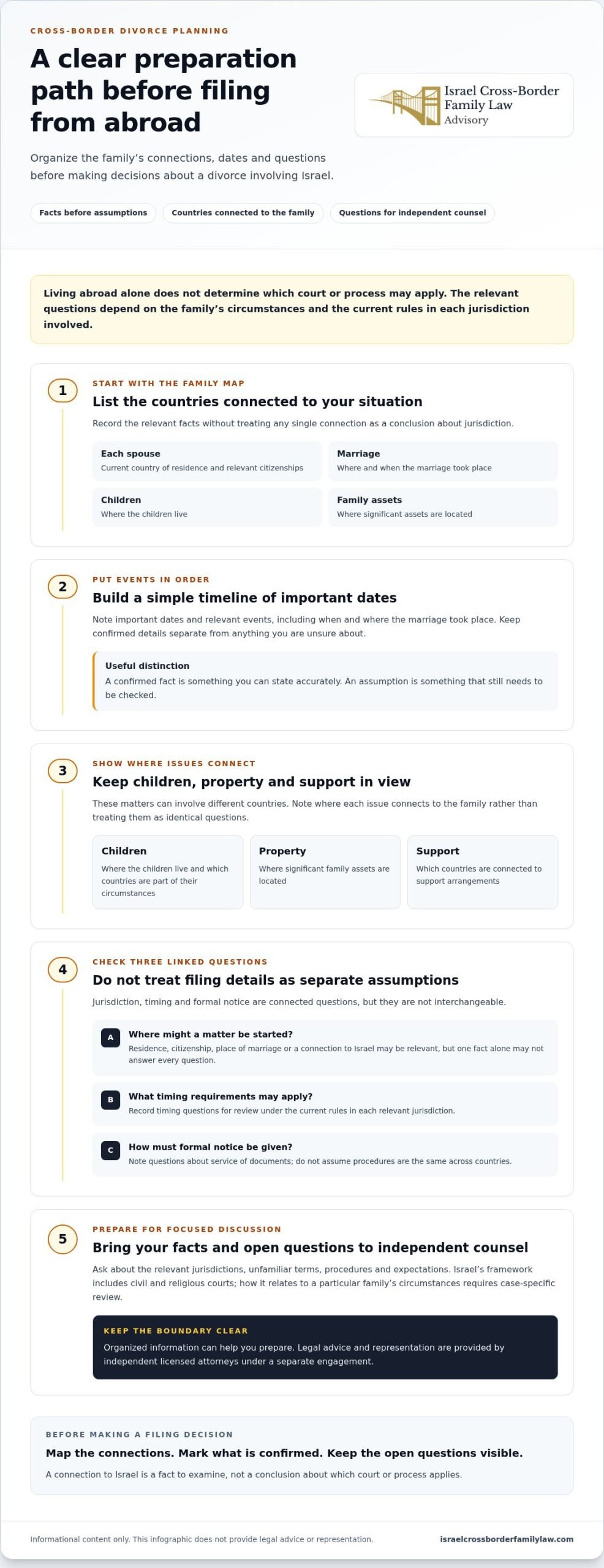
Preparation doesn’t require you to decide where a case should proceed or gather every document before asking for help. The aim is to make the family’s cross-border circumstances easier to understand, identify what remains uncertain, and prepare focused questions for the appropriate professionals. A clear timeline can help independent licensed counsel see how events and locations fit together.
Use this sequence to create a concise working summary:
- Map the countries. Note where each spouse lives now and where children, relevant family assets, or existing proceedings are connected.
- Record key dates. Include the marriage date and location, changes in residence, important dates involving children, and dates of any known proceedings, orders, or formal communications.
- List your priorities. Identify the practical issues that need attention, such as arrangements for children, property, support, or communication across distance.
- Organize questions. Separate what you know from what you need counsel to assess. Avoid presenting assumptions as established facts.
- Consult independent licensed counsel. Ask which jurisdictions and current procedures need review for your family’s circumstances.
Build a clear timeline and country-by-country issue list
Keep the timeline simple. Record each relevant event, its date or approximate date, and the country involved. Add current locations, the children’s living arrangements, and any known proceedings or orders. If you’re unsure about a date or detail, mark it as uncertain rather than guessing. This helps counsel distinguish confirmed information from points that may need further review.
Next, group your questions by topic. You might ask which jurisdiction needs assessment, whether timing or notice requirements need attention, and what information about children, property, or support is relevant. This list is a preparation tool, not a way to determine the answers yourself.
Prepare questions for independent licensed counsel
Ask which countries’ rules need consideration, what deadlines or formal notice requirements may apply, and which documents counsel needs to assess your situation. These are questions for a licensed attorney to answer after reviewing the relevant circumstances and current rules. A general online checklist can’t settle case-specific procedure.
Keep the initial enquiry concise: provide a brief summary of the situation, the countries involved, and relevant dates or deadlines. Don’t send passports, full case files, or sensitive documents at this stage. Documents may be relevant later in an appropriate process with a licensed lawyer; follow that lawyer’s instructions for handling them. An advisory discussion can help organize questions and practical next steps, but legal advice and representation are provided by independent licensed attorneys under separate engagement.
Taking these steps can help you approach the next conversation with greater clarity, without committing before you understand what needs review.
Choosing the Right Next Step: Independent Guidance and Licensed Counsel
Once you have gathered the basic facts, consider what kind of support you need next. Israel Cross-Border Family Law Advisory provides independent strategic guidance and informational support for families with matters involving Israel and another country. It can help organize cross-border issues, priorities, and questions. It does not provide legal advice or representation, file court documents, or represent clients in court.
Legal advice and representation are provided only by independent licensed attorneys through their own firms and under separate arrangements. Keeping these roles clear helps you understand what an advisory discussion can contribute and when an attorney should assess the legal process.
What an independent strategy session can help organize
The cross-border strategy session is a 45 to 60 minute video call. It can help organize the countries involved, the facts you’ve gathered, your priorities, and the questions or documents to raise with a licensed lawyer. The discussion can also cover practical next steps and, where appropriate, an introduction to an independent licensed attorney.
The session is intended to help with preparation, not to determine which court should handle a matter or predict an outcome. It can help you identify missing information, distinguish immediate concerns from longer-term questions, and prepare topics for counsel to review. The fee is USD 200, and the scope and fee are agreed before paid advisory work begins.
An initial enquiry is free and doesn’t constitute a paid booking. You can begin from abroad by providing a concise summary and relevant dates. Don’t send passports, full case files, or sensitive documents at this stage. Communication is available in English, French, or Russian. Any later document-sharing should follow an appropriate process.
When a licensed attorney should assess the legal process
Consult an independent licensed attorney when you need an assessment of how the law applies to your circumstances, including jurisdiction, deadlines, formal notice, documents, or possible court procedures. Only a licensed attorney can provide case-specific legal advice or representation. If more than one country is involved, counsel can assess the current rules relevant to each jurisdiction.
Advisory guidance and legal work are separate. ICBFL can help structure questions and practical next steps, while legal filings and court representation remain outside its role. Clear priorities can help you approach the decisions ahead without confusing preparation with legal representation.
Take the Next Step with Clarity
Before making a decision, identify what needs attention first and what remains uncertain. Choose one immediate priority, note what information you still need, and decide which questions call for professional assessment. This can help make your next conversation more focused.
The mistakes to avoid when filing for divorce from abroad can begin with acting before you understand what needs review. You don’t need to resolve every issue at once. A thoughtful next step can help you move forward at a pace that reflects your circumstances.
Frequently Asked Questions
Can I file for divorce in Israel if I live abroad?
Possibly, but living abroad by itself doesn’t determine whether an Israeli process applies to your situation. Relevant details may include each spouse’s circumstances, family connections to Israel, and any proceedings already underway elsewhere. Before taking steps, ask independent licensed counsel to assess the facts and current rules in the countries involved. The phrase “file in Israel” can also refer to different issues, so clarify which matter you’re asking about.
Which country should I file for divorce in when my spouse and I live in different countries?
There’s no universal country that applies simply because spouses live in different places. Counsel may need to understand each spouse’s residence and citizenship, where the marriage took place, the children’s circumstances, and any existing proceedings or agreements. For example, if one spouse lives in Israel and the other lives elsewhere, those facts can raise questions for more than one legal system. Ask counsel to assess the specific jurisdictions and issues before deciding where to act.
Do I need to travel to Israel to begin a divorce involving Israel?
Whether travel is needed depends on the relevant process and your particular circumstances. Don’t assume that an initial conversation from abroad means every later step can be completed remotely, or that an in-person appearance is always required. Ask an independent licensed attorney to clarify what participation may be needed, at which stage, and whether the answer differs across issues. This helps distinguish an advisory conversation from formal steps in a legal process.
What documents should I prepare before discussing an international divorce?
Begin with a dated outline of key events and a list of questions, such as whether an existing order or agreement needs review. For an initial enquiry to Israel Cross-Border Family Law Advisory, share only a concise summary and relevant dates. Don’t send passports, full case files, or sensitive documents at that stage. A licensed lawyer can later explain which records are useful and how to provide them through an appropriate process.
Can an Israeli divorce order be recognized or enforced in another country?
Recognition or enforcement in another country depends on that country’s applicable rules and the details of the order. Don’t assume that an Israeli order will automatically have the same effect elsewhere, or that the steps are identical in every country. Ask licensed counsel in the relevant jurisdictions to assess what process may apply. It can help to identify the type of order, the country where it was issued, and where you may need it recognized or enforced.
What happens if divorce proceedings are started in two countries?
Proceedings in more than one country can raise questions about coordination, timing, and how the matters relate to each other. The implications depend on the jurisdictions and facts, so it isn’t possible to predict the result from the number of proceedings alone. Make a record of where each matter was started, relevant dates, and any notices received. Then ask independent licensed counsel in the relevant jurisdictions to assess the situation before making further procedural decisions.
Can an advisory service file divorce papers or represent me in court?
No. Israel Cross-Border Family Law Advisory is an independent advisory platform and doesn’t file court papers or represent clients in court. Legal advice, filings, and representation are handled by independent licensed attorneys through their own firms under separate arrangements. An advisory discussion may help you organize relevant facts and questions, but it doesn’t replace an attorney’s assessment when you need guidance about legal procedure or a court matter.

Article by
Gabriel Lior
A Personal Journey That Became a Mission
The advisory was founded by an American father Gabriel Lior, LLB, MBA , global entrepreneur, and cross-border advisor who spent more than a decade navigating the Israeli family court system firsthand and now lives in Singapore with his son.
As a divorced parent in a cross-border family, Gabriel faced nearly every legal challenge a foreign parent can encounter in Israel — including child custody disputes, child support proceedings, property matters in Israel and abroad, false accusations, and complex immigration and relocation proceedings.
Over the years, he learned the hard way how difficult it is for non-Israeli parents to understand the system, identify the right legal strategy, and choose the right legal representation — especially when language, culture, and jurisdictional differences are involved. He also witnessed how foreign parents and new immigrants are often disadvantaged or taken advantage of by service providers and institutions simply because they lack local knowledge or fluency.
From Client to Advisor
To truly understand — and survive — the system, Gabriel pursued formal legal education in Israel, completing two Israeli law degrees, alongside a BA and MBA earned in the United States. This was never about becoming a practicing attorney, but about gaining a deep, structural understanding of how the system works — and where it breaks down for foreign parents.
This rare combination of:
Firsthand client experience
Israeli legal and US business education
International business and negotiation training
Decades of commercial execution
created a unique perspective – one that understands both sides of the table.
After years of litigation, persistence, and at times self-representation, he ultimately succeeded in securing custody of his son and relocating abroad through a rare legal victory in the Israeli Supreme Court — becoming one of the first fathers in Israel to do so under these circumstances.
Disclaimer
Important Disclaimer:
The information provided on this website and in its content is for general informational and educational purposes only and does not constitute legal advice, legal opinion, or legal representation.
Gabriel Lior is not licensed to practice law in Israel (nor is he interested in doing so) and does not provide legal services, despite having completed 2 Law Degrees. The services offered are advisory in nature and are intended to provide general guidance, strategic insight, and information regarding cross-border family law considerations.
No attorney-client relationship is formed by accessing this website, reading its content, or communicating with us.
Any decisions made based on this information are at your own discretion and risk. For legal advice specific to your situation, you should consult a licensed attorney in the relevant jurisdiction.
Where appropriate, we may refer clients to independent, licensed attorneys or professionals. Such referrals do not constitute legal representation and no liability is assumed for services provided by third parties.