What if the strongest relocation case is not the one with the most compelling reasons for a parent to move, but the clearest picture of how the child’s life would work afterward? For parents considering convincing a Haifa judge that relocation is best for my child, that distinction matters. A proposal needs to address the child’s needs and the practical effects of living across borders, including how the child’s relationship with the other parent could continue.
It’s understandable to feel uncertain about what information to prepare, especially when a move could change a child’s school, care arrangements, community, and familiar routines. Comparing those details with the child’s current life can make a proposal clearer and more child-focused. It can also reveal questions to resolve before plans are made.
This article explains how to compare current and proposed arrangements, consider schooling and day-to-day care at the destination, and develop a realistic plan for parent-child contact. It also highlights why cross-border system and cultural differences make early coordination important. The information is educational, not legal advice or representation. Legal services are provided by licensed attorneys under a separate engagement.
Key Takeaways
- A child-centered relocation proposal explains the child’s specific needs and how the move could affect everyday life and important relationships.
- When preparing to convince a Haifa judge that relocation is best for my child, separate established facts from future plans and identify what remains uncertain.
- Compare current and proposed arrangements across caregiving, education, support networks, travel, communication, and disruption to the child’s routines.
- Explain why the move is being proposed now, and prepare for questions about the destination, parenting arrangements, and alternatives.
- Clarify your goals, organize the facts, assess the practical plan, and understand cross-border implications before making commitments.
What Makes a Child-Centered Relocation Proposal Persuasive in Haifa?
Weighing a possible move against a child’s established life can be difficult. A parent may see real opportunities in another country while recognizing that the child has familiar routines, important relationships, and a connection with the parent who may remain in Israel. A clear proposal takes both sides of that reality seriously and explains what the child’s day-to-day life could look like after a move.
A child-centered relocation proposal sets out the child’s needs, the possible benefits of moving, and the practical arrangements intended to support the child’s wellbeing and relationships. It cannot predict what a court will decide. It can, however, distinguish a parent’s hopes from the child’s likely experience.
For a broader view of the issues families may need to coordinate, the international custody and relocation overview explains the cross-border context.
How to distinguish the parent’s reasons from the child’s interests
Work, family support, safety, or a more stable home may explain why a parent wants to move. These reasons provide context, but they do not by themselves show how the move would meet this particular child’s needs. Connect each proposed advantage to the child’s age, routine, care, education, or support needs.
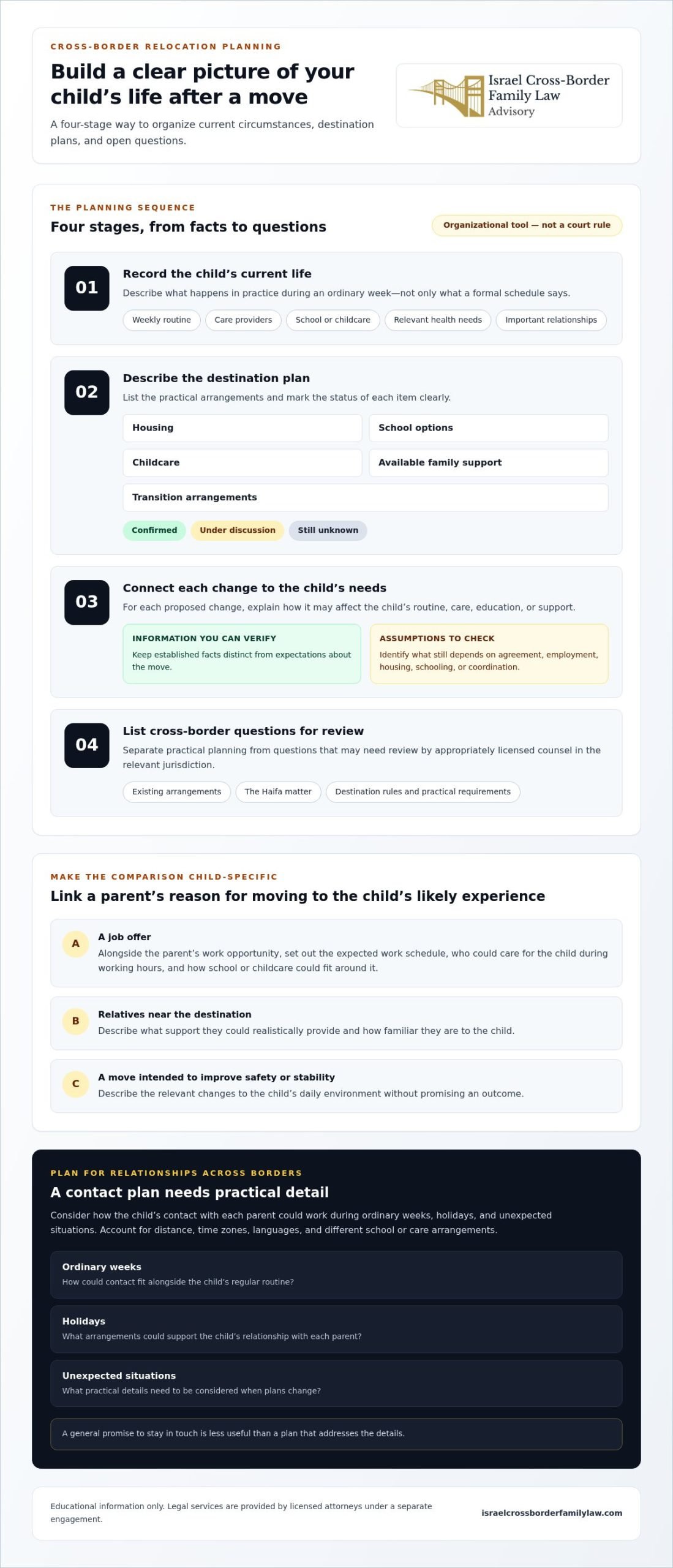
For example, a job offer may improve a parent’s ability to provide financially. A child-focused explanation would also set out the expected work schedule, who could care for the child during working hours, and how school or childcare would fit around it. If relatives live near the destination, explain what support they could realistically provide and how familiar they are to the child. If the move is intended to improve safety or stability, describe the relevant changes to the child’s daily environment without promising an outcome.
Keep the parent’s reasons and the child’s likely experience distinct. A practical note can list each reason for moving alongside its expected effect on the child and the information that supports that expectation. This helps identify assumptions and the questions that still need answers.
Why the Haifa and cross-border context matters
An international move can involve two legal systems, as well as coordination across distance, time zones, languages, and different school or care arrangements. These practical considerations are not automatic reasons for or against relocation. Consider how the child’s contact with each parent could work during ordinary weeks, holidays, and unexpected situations. A general promise to stay in touch is less useful than a plan that addresses the details.
For families in Haifa and across Israel, including Tel Aviv, Jerusalem, Herzliya, Ra’anana, Netanya, Modi’in, Beit Shemesh, Kfar Saba, Hod Hasharon, Ramat Gan, Givatayim, Petah Tikva, Ashdod, Be’er Sheva, Eilat, Caesarea, and Zichron Ya’akov, local routines and existing arrangements may be an important part of the child’s present circumstances. When a proposed move crosses borders, identify which details need current legal review, including existing arrangements, the status of any agreement or court decision, the Haifa case context, and the destination’s rules and practical requirements. Israeli legal frameworks and court procedures can be specific, and their application depends on the circumstances. A qualified Israeli family-law attorney can review how they relate to a particular matter.
Israel Cross Border Law Firm handles family law matters, including child custody issues, for families navigating Israel-related cross-border circumstances. Early preparation can help separate known facts from plans that still depend on agreement, employment, housing, schooling, or cross-border coordination. This article is informational, not legal advice or representation. Legal services are provided by licensed attorneys under a separate engagement.
How to Build Evidence Around Your Child’s Needs and the Proposed Move
Organize information to show what life is like now, what the proposed move could change, and which details remain uncertain. The sequence below is an organizational tool, not a court rule or a guarantee that particular material will be considered or given weight. Its purpose is to help you describe your child’s circumstances clearly and identify questions that may need further review.
- Record the current picture. Note the child’s ordinary weekly schedule, who provides care at different times, school or childcare arrangements, relevant health needs, and important relationships. Focus on what happens in practice, not only what a formal schedule says.
- Describe the destination plan. Set out what is known about housing, school options, childcare, available family support, and the transition. Mark each item as confirmed, under discussion, or still unknown.
- Connect facts to needs. For each proposed change, explain how it may affect the child’s routine, care, education, or support. Keep assumptions separate from information you can verify.
- Identify cross-border questions. List issues about existing arrangements, the Haifa matter, and the destination that may need review by appropriately licensed counsel in the relevant jurisdiction.
Organize a clear picture of the child’s current life
A dated calendar can show school days, caregiving handovers, activities, and recurring appointments. Relevant school communications, care schedules, or health information may add context where appropriate. Keep notes factual: record what happened and when rather than describing the other parent with labels or accusations. Consistent records can make patterns easier to understand, but no single document guarantees admissibility, weight, or a particular outcome.
Separate firsthand information from estimates and assumptions. For example, distinguish “I collected the child from school on these recorded days” from “I believe the other parent is usually unavailable.” If a detail comes from someone else, note its source. If you do not know the answer, mark it for confirmation rather than filling the gap with a guess.
Explain what life in the proposed destination would look like
Describe the proposed arrangement in practical terms. Where known, include the expected home setting, potential school or childcare options, who could help with care, and how the child might adjust to changes in language, community, or routine. Explain what would happen during the transition, not just what the settled arrangement might look like.
Be candid about unresolved points. A school inquiry is not confirmed enrollment, and an intended housing plan may still depend on timing or other conditions. Label these distinctions clearly so it is easy to see which parts of the proposal rest on current facts and which depend on future steps.
For parents considering convincing a Haifa judge that relocation is best for my child, organized information can clarify the child’s needs without overstating what the records establish. Cross-border arrangements may raise legal questions in Israel and the destination country, and the applicable framework depends on the family’s circumstances. Israel Cross Border Law Firm handles family law matters, including child custody issues. A confidential consultation can help you identify the questions to address before making commitments. Request a confidential consultation.
How to Compare the Proposed Move With Your Child’s Current Arrangements
A side-by-side comparison can make the practical effects of a move easier to see. Describe the child’s present routine and the proposed arrangement without assuming that one is legally preferable. Use specific details where you have them, and mark estimates or unresolved plans clearly.
Caregiving time
Current: Who cares for the child on ordinary weekdays, weekends, and school breaks? Proposed: Who would provide care at those times, and how might the schedule change?
Education and daily routine
Current: Note the child’s school or childcare setting, usual hours, and established activities. Proposed: Describe the options being explored, likely schedule, language environment, and transition steps.
Support networks
Current: Identify familiar relatives, friends, and other regular sources of support. Proposed: Explain which relationships or sources of support could continue, and which would need to be built over time.
Travel and communication
Current: Record how the child sees and communicates with each parent now. Proposed: Consider travel time, likely visit patterns, remote contact, and how these could fit around school and rest.
Transition and continuity
Current: Note the routines and care arrangements the child relies on. Proposed: Identify what would change at once, what could continue, and what support may help with adjustment.
Distance can make regular contact harder to arrange, so address that concern directly. A workable contact plan matters in a cross-border proposal because it needs to account for travel, school calendars, communication methods, the child’s rest and routine, and how both parents could maintain meaningful contact over time.
Build a practical plan for the parent-child relationship across borders
Set out possible in-person visits and remote communication in practical terms. Consider how visits might fit around school breaks, how often video or phone calls could work with the child’s routine, and what could happen if travel plans change. Do not present an idea as agreed if it is still under discussion.
Clarify who could coordinate bookings, handovers, travel documents, and communication about changes, without assuming that responsibility must fall to one parent. A plan should also be reviewable as the child grows, changes schools, or develops different needs. The aim is to show how arrangements could function, not to promise that every visit or call will go exactly as planned.
Address disruption and uncertainty without overstating certainty
Consider possible adjustment to a new language or culture, separation from familiar people, and changes in continuity of care. Name foreseeable challenges and identify realistic responses, such as maintaining familiar routines where possible or helping the child sustain existing relationships. A thoughtful plan recognizes that adjustment may take time.
For parents focused on convincing a Haifa judge that relocation is best for my child, this comparison can help organize practical questions, but it cannot determine how a court will assess a particular matter. The legal assessment depends on the family’s circumstances and requires current review by appropriately licensed counsel.
How to Prepare for Questions and Concerns in a Haifa Relocation Matter
Preparation can help you explain the proposed move clearly without assuming what a Haifa court will decide. Start with a concise account of why the move is being considered now, then connect the timing to your child’s circumstances. For example, describe a change in work or family support and explain what it could mean for the child’s daily care, stability, or education. Keep the explanation factual and distinguish confirmed arrangements from plans still under discussion.
It can also help to prepare for questions in several areas:
- The destination: What is known about housing, school or childcare options, healthcare needs, and available support?
- Parenting arrangements: How might the child maintain contact with the parent remaining in Israel, including visits, calls, and changes to plans?
- Continuity: Which routines and relationships could continue, and what adjustments might the child face?
- Alternatives: Have you considered different timing, a different destination, or arrangements that might address some concerns without the proposed move?
These are preparation prompts, not a prescribed list of court questions or a script for a guaranteed answer. The right response depends on the family’s facts. A clear explanation should acknowledge practical difficulties and avoid promises that depend on other people, institutions, or future events.
Prepare for disagreement and alternative proposals
Try to state the other parent’s concerns fairly. They may be worried about reduced time with the child, travel demands, disrupted routines, or the effect of a move on the child’s connection with family and community. Address the substance of each concern rather than guessing at motives. Consider whether changes to timing, contact, or transition planning could help, while recognizing that these are options to discuss, not outcomes a court must order.
Keep the preparation process clear and properly bounded
A simple chronology can make the situation easier to explain. Note key dates, decisions already made, and important events relevant to the proposed move. Keep a separate, short list of open questions, such as what remains uncertain about schooling, travel, or the child’s arrangements. This helps prevent tentative plans from being presented as settled facts.
Local court practice and the legal framework for a relocation matter require current, case-specific review by qualified Israeli counsel. For an expat or foreign national, cross-border familiarity may also be relevant. The guidance for expats and foreign nationals discusses issues that can arise for international families. Israel Cross Border Law Firm focuses on family law and cross-border matters, helping families clarify questions and coordinate next steps.
Before Committing to an International Move With Your Child
An international move can affect a child’s routine, relationships, education, and contact with both parents. Before making commitments or taking steps that may be difficult to reverse, bring the practical plan and legal questions into focus. Preparation cannot predict a Haifa court’s decision, but it can help you understand what is known, what remains unsettled, and where qualified guidance is needed.
Use a decision sequence before making commitments
Work through the following steps in order. Treat them as a planning framework, not a court requirement or a substitute for case-specific legal guidance.
- Clarify your goals. Write down why you are considering the move now and which reasons relate directly to your child’s needs. Note the practical questions you still need to answer.
- Organize the facts. Separate your child’s current arrangements from the proposed destination plan. Mark what is established, what is tentative, and what needs confirmation.
- Assess the plan as a whole. Consider the destination, daily care, education, transition, and arrangements for the child’s relationship with the other parent together. Look for gaps or assumptions that could affect the plan’s feasibility.
- Seek appropriate guidance. Cross-border family matters may involve Israeli and destination-country considerations. Have case-specific legal questions reviewed by appropriately licensed attorneys before relying on assumptions or making consequential decisions.
This sequence can also help you prepare when considering convincing a Haifa judge that relocation is best for my child. The goal is not to find a guaranteed answer, but to make an informed choice with a clear view of your child’s circumstances and the practical implications of moving.
Choose an informed next step
Israel Cross Border Law Firm handles family law matters for families navigating Israel-related cross-border circumstances. Legal services are provided by licensed attorneys under a separate engagement. Use the questions you have identified to prepare for a focused discussion before committing to a move.
Keep expectations measured. The outcome of any relocation matter depends on its individual facts and the law that applies. No preparation framework can promise how a judge will decide. This informational content does not create an attorney-client relationship. Use it to identify questions and prepare for informed, case-specific guidance before you commit.
Take the Next Step With Clarity
A decision about moving a child across borders deserves more than a rushed choice between staying and going. Give yourself time to understand what the proposed change could mean for your child, what remains uncertain, and which questions need case-specific legal review. This preparation can support a more informed next step, though it cannot determine or guarantee how a judge will decide.
If you’re considering convincing a Haifa judge that relocation is best for my child, focus on making choices with a clear view of the practical and cross-border implications. Israel Cross Border Law Firm handles family law matters and works with families navigating Israel-related cross-border issues. A clear account of your questions can help make the next discussion more focused.
Moving forward carefully is a meaningful step in itself. You do not need to resolve every question at once. Start by clarifying what matters most for your child and what you need to understand before committing.
Frequently Asked Questions
Can I move abroad with my child before a Haifa judge decides the relocation issue?
Do not assume you can move before the issue is resolved. Before making travel or relocation plans, have a licensed Israeli family-law attorney review any existing court decisions or parenting agreements and explain what consent or other steps may apply to your situation. Moving first could make the dispute more complex across borders. If departure is being considered soon, seek case-specific guidance before taking action.
Does a child’s age affect how a relocation proposal is considered?
A child’s age and stage of development may affect how their needs and views are understood, but the relevance and treatment of those factors depend on the case and applicable law. Consider what the child can express about school, relationships, and daily life without pressuring them to choose between parents. Ask qualified Israeli counsel how a child’s views may be addressed in your circumstances.
What if the other parent agrees to the move?
Agreement can reduce uncertainty, but make sure it is clear what has been agreed. A written plan can address the destination, timing, contact, travel coordination, and what happens if circumstances change. Do not assume an informal exchange settles every legal or practical question. Ask qualified counsel whether the agreement needs a formal step in Israel or the destination country before relying on it.
Can a relocation proposal include a trial period or later review?
A proposal can raise a time-limited arrangement or later review for discussion, but do not assume a “trial” move can simply be reversed without legal or practical consequences. Before relying on that approach, clarify the proposed duration, the child’s schooling and contact arrangements, and what would trigger a return or review. Get case-specific guidance on how the arrangement could affect the family’s position in both countries.
What if my child has dual nationality or immigration questions in the destination country?
Dual nationality does not by itself answer whether a relocation is agreed or how parenting arrangements should work. Treat immigration and family arrangements as related but separate questions. Clarify the child’s travel and residence position, and whether the relocating parent can lawfully live and work at the destination. Requirements depend on the countries involved, so obtain guidance from appropriately licensed counsel familiar with each jurisdiction.
Will a Haifa judge decide based only on which parent has better employment prospects?
Do not assume employment prospects alone determine a relocation matter. A job offer may help explain a parent’s reasons for moving, but the proposal should also address how the change could affect the child’s care, routine, education, and relationships. For parents focused on convincing a Haifa judge that relocation is best for my child, it helps to connect employment details to the child’s lived circumstances. Outcomes depend on the individual facts and applicable law.

Article by
Gabriel Lior
A Personal Journey That Became a Mission
The advisory was founded by an American father Gabriel Lior, LLB, MBA , global entrepreneur, and cross-border advisor who spent more than a decade navigating the Israeli family court system firsthand and now lives in Singapore with his son.
As a divorced parent in a cross-border family, Gabriel faced nearly every legal challenge a foreign parent can encounter in Israel — including child custody disputes, child support proceedings, property matters in Israel and abroad, false accusations, and complex immigration and relocation proceedings.
Over the years, he learned the hard way how difficult it is for non-Israeli parents to understand the system, identify the right legal strategy, and choose the right legal representation — especially when language, culture, and jurisdictional differences are involved. He also witnessed how foreign parents and new immigrants are often disadvantaged or taken advantage of by service providers and institutions simply because they lack local knowledge or fluency.
From Client to Advisor
To truly understand — and survive — the system, Gabriel pursued formal legal education in Israel, completing two Israeli law degrees, alongside a BA and MBA earned in the United States. This was never about becoming a practicing attorney, but about gaining a deep, structural understanding of how the system works — and where it breaks down for foreign parents.
This rare combination of:
Firsthand client experience
Israeli legal and US business education
International business and negotiation training
Decades of commercial execution
created a unique perspective – one that understands both sides of the table.
After years of litigation, persistence, and at times self-representation, he ultimately succeeded in securing custody of his son and relocating abroad through a rare legal victory in the Israeli Supreme Court — becoming one of the first fathers in Israel to do so under these circumstances.
Disclaimer
Important Disclaimer:
The information provided on this website and in its content is for general informational and educational purposes only and does not constitute legal advice, legal opinion, or legal representation.
Gabriel Lior is not licensed to practice law in Israel (nor is he interested in doing so) and does not provide legal services, despite having completed 2 Law Degrees. The services offered are advisory in nature and are intended to provide general guidance, strategic insight, and information regarding cross-border family law considerations.
No attorney-client relationship is formed by accessing this website, reading its content, or communicating with us.
Any decisions made based on this information are at your own discretion and risk. For legal advice specific to your situation, you should consult a licensed attorney in the relevant jurisdiction.
Where appropriate, we may refer clients to independent, licensed attorneys or professionals. Such referrals do not constitute legal representation and no liability is assumed for services provided by third parties.