This article is published on an independent advisory platform and is for informational purposes only. It does not constitute an attorney-client relationship or legal advice. Legal services are provided only by licensed attorneys under a separate engagement.
In the Israeli legal system, the specific door you walk through first often determines the entire outcome of your case. For a us citizen getting divorced in israel, the decision to file in a civil Family Court versus a Rabbinical Court isn’t just a formality. It is a high-stakes strategic move that dictates how your assets, your pension, and your parental rights are handled across two different legal cultures.
You’re likely feeling the pressure of the “race to jurisdiction” while worrying about whether your U.S. based 401(k) or property in the States is safe from foreign intervention. It’s natural to feel anxious when you’re caught between the laws of two nations, especially when child custody and international relocation are on the line.
This guide provides the clarity you need to move forward with confidence. We’ll explore how to protect your cross-border assets under the 2026 tax disclosure rules, how to manage custody across international boundaries, and the vital steps to ensure your U.S. tax credits remain intact while you navigate the Israeli system.
Key Takeaways
- Understand the parallel authority of the Civil Family Court and the Rabbinical Court to determine which venue protects your specific interests.
- Learn why the “Race to Jurisdiction” makes the timing of your first filing the most critical strategic step for a us citizen getting divorced in israel.
- Discover how Israeli courts approach the “balancing of resources” when dividing complex cross-border assets like US-based pensions and pre-marital property.
- Gain clarity on the legal standards for international child custody and the specific challenges involved in relocation or Hague Convention cases.
- Identify why collaborative divorce and mediation often provide more stable, enforceable outcomes for international families than traditional litigation.
The US-Israel Divorce Shock: Understanding the Dual Court System
Many Americans arrive in Israel assuming their US civil marriage certificate offers a layer of protection against religious legal intervention. This is a common misconception. For a us citizen getting divorced in israel, the process involves a unique dual-court system where religious and civil authorities share power. If you are Jewish, the law identifies you by your religious status regardless of where your wedding took place. This remains true even if you were married in a secular ceremony in New York or a courthouse in California.
The State of Israel grants personal status jurisdiction to religious authorities. This means that even with a secular US marriage license, the Rabbinical Court holds exclusive authority over the act of divorce itself. You must receive or give a “Get”, which is the Jewish writ of divorce, to be considered legally single in Israel. For non-Jewish citizens or mixed-religion couples, the process differs; however, the Civil Family Court still operates within a framework that feels very different from the American system.
To better understand how these two systems interact, watch this helpful video:
Family Court vs. Rabbinical Court: The Essential Differences
The Civil Family Court focuses on modern legal principles, equity, and the “best interest of the child” standard. This court handles matters like child support, custody, and property division through a secular lens. In contrast, the Rabbinical Court operates under Halacha, or Jewish law. While it must follow certain civil precedents regarding property, its primary focus remains the religious dissolution of the marriage. A key distinction lies in jurisdiction. Some matters are under the “exclusive jurisdiction” of the Rabbinical Court, while others require “jurisdiction by consent” from both parties. For more detailed guidance on how this impacts your specific situation, you can read about divorce and separation for international families.
Why “No-Fault” Divorce Doesn’t Exist in Israel
In the United States, most states allow for “no-fault” divorce, where a marriage can end simply because one person wants out. Israel does not follow this model in the religious courts. To obtain a divorce without mutual consent, a spouse must prove specific “grounds for divorce.” These might include domestic neglect, infidelity, or abandonment. If a spouse is declared “rebellious” (moredet or mored), it can negatively impact their rights to alimony or specific property claims.
This systemic difference is often the primary cause of the “race to jurisdiction,” where each party tries to file first in the court they believe will be more sympathetic to their specific situation. For those navigating international custody, it is also vital to understand how these courts interact with the Hague Convention on International Child Abduction. Reaching a mutual agreement is usually the most effective way for a us citizen getting divorced in israel to bypass these complex litigation hurdles and ensure a stable outcome for the entire family.
The Race to Jurisdiction: Why Your First Filing is Critical
The “Race to Jurisdiction”, known in Hebrew as Merotz Samchuyot, is often the most time-sensitive element of an Israeli divorce. Because the Civil Family Court and the Rabbinical Court share parallel authority over matters like property division and spousal support, the court where the first valid claim is filed typically gains the right to decide those issues. For a us citizen getting divorced in israel, this means your choice of venue isn’t just a matter of convenience. It’s a strategic decision that dictates which legal logic will be applied to your life and your assets.
Delaying a filing carries significant risks. If your spouse files first in a court that is less favorable to your interests, you may find yourself litigating complex US-based assets under a legal framework that doesn’t align with your goals. It’s helpful to review the U.S. State Department guidance on foreign divorce to understand how these proceedings are viewed by American authorities. Understanding the landscape early allows you to make an informed choice before the “race” is decided for you. If you’re feeling uncertain about these early steps, you can request a strategic review to clarify your options.
Binding Matters to the Divorce Claim (The Saba Rule)
The “Saba Rule” refers to the legal ability to “bind” or attach ancillary matters to a divorce claim in the Rabbinical Court. By including property division, alimony, or custody in the initial filing, a spouse can ensure these issues are heard by the religious court rather than the civil one. For this to hold, the claim must be “sincere” and legally sound. Many Americans prefer the Civil Family Court for financial matters because it follows secular principles of equity and transparency. If a filing is deemed a “shell” claim meant only to block the other court, the jurisdiction may be challenged and overturned.
Preventing Exit Orders (Stay of Exit)
One of the most stressful aspects for expats is the possibility of a “Stay of Exit” order, known as Tzav Ikuv Yetzia. In Israel, a spouse can request an emergency order to prevent the other party or the children from leaving the country while proceedings are pending. This is often used as a tactical move to ensure that assets aren’t moved or that custody isn’t unilaterally changed. To protect your freedom of movement, it’s vital to address these risks before they become a reality. A us citizen getting divorced in israel must be aware that even a temporary stay can have long-term consequences for their career and family connections back in the United States.
Cross-Border Assets: Dividing US Pensions and Israeli Property
Israeli law generally follows a “balancing of resources” model. This principle mandates an equal 50/50 split of all assets accumulated during the marriage, regardless of where they are located or whose name is on the title. For a us citizen getting divorced in israel, the challenge lies in reconciling this Israeli standard with US-based financial instruments. As of January 1, 2026, new tax disclosure rules require Olim and returning residents to report foreign assets to the Israel Tax Authority. While the 10-year tax exemption remains, this transparency means that foreign accounts are now more visible in divorce negotiations.
Understanding the interaction between these two legal systems is vital for asset protection. This overview of Israeli family law offers a broader look at how local courts handle marital property. Strategic planning is necessary to ensure that your US-based retirement funds and Israeli real estate are divided fairly and legally.
Dividing US-Based Retirement and Investment Accounts
Dividing a 401(k) or an IRA requires more than just an Israeli court order. US plan administrators usually won’t recognize a foreign decree without a Qualified Domestic Relations Order (QDRO) issued by a US court. This creates a procedural gap that can leave assets in limbo for years. You also have to account for the 25% capital gains tax in Israel and fluctuating exchange rates. Social Security benefits add another layer of complexity; they’re governed by federal law and generally can’t be split by foreign court orders. These factors make it essential to value the entire “pot” of assets correctly before signing any agreement.
The 2026 Property Precedent: Is “Separate Property” Dead?
A major shift in 2026 has changed how courts view pre-marital assets. Following a recent Supreme Court decision, the court now applies a broader “partnership” standard. This means that pre-marital inheritances or real estate owned before the marriage may no longer be excluded from division, especially in long-term relationships. The court looks for evidence of an “intent to share,” which can be triggered by something as simple as using marital funds for a home renovation. To protect your separate property, an Israeli prenuptial agreement or postnuptial contract is the most effective tool. For a us citizen getting divorced in israel, these agreements provide the certainty that “separate” remains separate in the eyes of the law.
International Custody and the Hague Convention
For a us citizen getting divorced in israel, parental rights are determined through the “Best Interest of the Child” standard. While this sounds similar to US legal principles, the application in Israeli Family Courts involves specific cultural and systemic nuances. Judges look at the child’s psychological needs, their need for stability, and the ability of each parent to foster a healthy relationship with the other. Decisions are rarely based on a single factor; they involve a holistic view of the child’s life in Israel.
A major shift in 2026 is the final phasing out of the “Tender Years Doctrine.” Previously, Israeli law often favored mothers in custody disputes for children under age six. Today, courts prioritize shared parenting and joint custody arrangements as the default starting point. This change reflects a move toward gender neutrality in parenting roles, though the transition still requires careful strategic planning to ensure the arrangement respects the child’s routine and their international heritage.
Relocation Disputes: Can You Move Back to the US?
Relocation is frequently the most litigated issue for American expats in Israel. If one parent wishes to move back to the United States with the children, the court must grant permission if the other parent does not consent. This is a high bar to clear. The court evaluates the child’s social ties in Israel, their educational needs, and how the move would impact their relationship with the parent remaining behind. Judges often rely on court-appointed experts to assess the potential impact of such a significant move.
It’s important to distinguish between “Relocation” and “Visitation.” A temporary trip to visit family in the US is not relocation, but without clear legal safeguards, it can trigger concerns regarding the Hague Convention on the Civil Aspects of International Child Abduction. If a child is removed from Israel without consent, legal action should ideally be initiated within three months. Israeli courts aim to hold a preliminary hearing within 15 days to address these urgent matters. You can find more detailed guidance on International Custody & Relocation strategies to protect your family’s future.
Enforcing US Child Support in Israel
Many international families already have child support orders from a US state court. However, these orders are not automatically enforceable in Israel. For an Israeli court to recognize a foreign judgment, a formal application for “recognition” must be filed. The court will verify that the original order does not contradict Israeli public policy and that both parties were given a fair chance to present their case. This process ensures that a us citizen getting divorced in israel can maintain financial stability regardless of where the original order was issued.
Once recognized, the support order can be enforced through the Israeli Enforcement and Collection Authority. Navigating Child Support Cross-Border Enforcement requires understanding both the financial requirements in Israel and the tax implications for US citizens, such as the eligibility for US Child Tax Credits. If you are concerned about your parental rights or the possibility of an international move, reach out for a confidential strategy session.
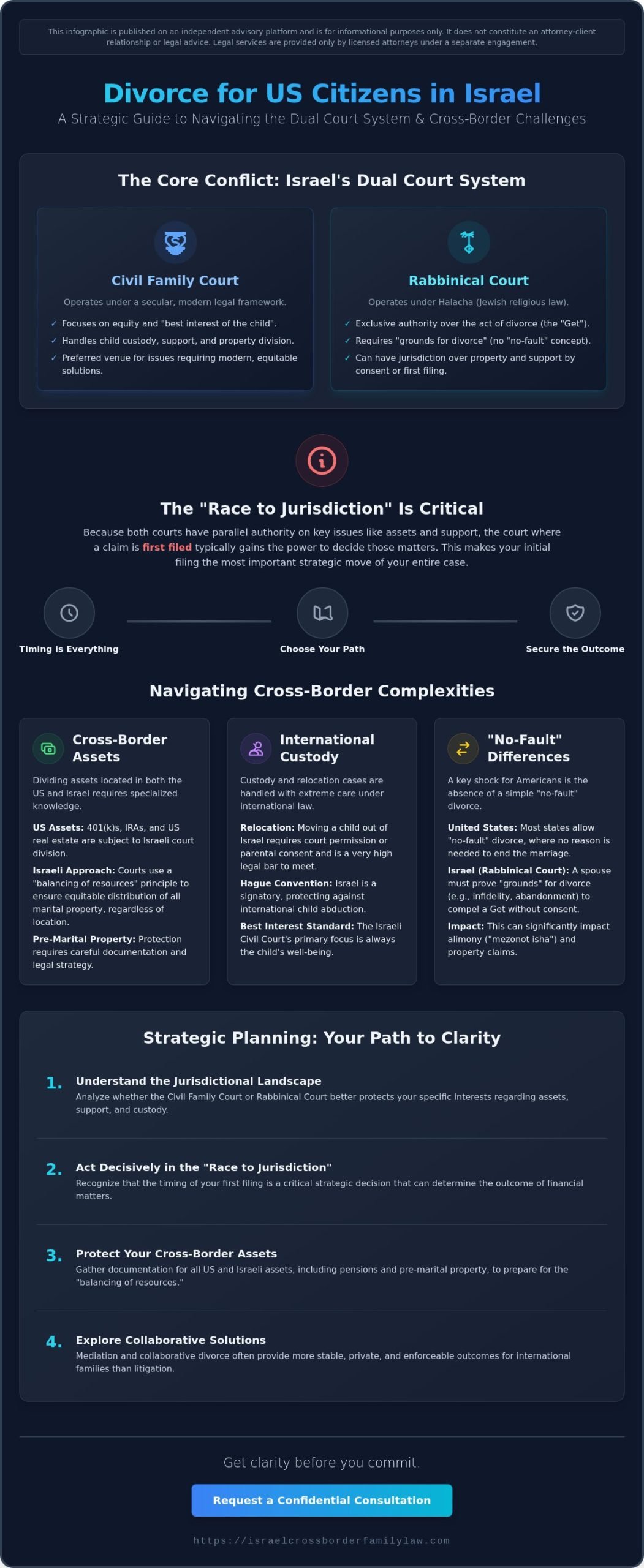
Strategic Planning: Clarity Before You Commit
Rushing into court is often the most expensive mistake a us citizen getting divorced in israel can make. While the “race to jurisdiction” requires timely action, it does not require impulsive action. Litigation in the dual-court system can take two to four years and often costs significantly more than a negotiated settlement. Choosing mediation or a collaborative divorce process often results in more stable arrangements that respect both US and Israeli legal requirements. These alternative paths allow families to maintain control over their future rather than leaving life-altering decisions to a judge.
An independent advisory approach focuses on high-level strategy. It differs from traditional representation by prioritizing the long-term impact on your assets and parental rights before any papers are filed. This bird’s-eye view is essential when dealing with multi-jurisdictional complexity. By analyzing the risks early, you can avoid the procedural traps that often catch expats off guard in the Israeli system.
The Advisory Process: Strategy First
Understanding the Cross-Border Advisory process is the first step toward reclaiming control. This phase involves mapping out potential risks, such as the loss of US-based pensions or the imposition of stay-of-exit orders. Consulting with practitioners who understand both systems ensures your Israeli strategy does not inadvertently create a tax or legal crisis in the United States. A thorough case review determines if the Civil Family Court or the Rabbinical Court offers the best jurisdictional advantage for your specific financial profile and family goals.
Next Steps for US Expats in Israel
Preparation is your most effective tool. Begin by gathering comprehensive financial documentation for both your US and Israeli assets. This includes 401(k) statements, property deeds, and recent tax returns. It is also vital to avoid common emotional mistakes. For example, making threats to relocate with children can lead to immediate “Stay of Exit” orders that restrict your travel for months or years. Instead, focus on building a clear, objective picture of your marital estate and your children’s needs.
To secure your future, you should request a confidential case review. This allows you to evaluate your position and develop a tailored roadmap before the “Race to Jurisdiction” officially begins. Gaining clarity before you commit ensures that your final divorce agreement is enforceable, fair, and protective of your international identity. Get clarity before you commit. Request a confidential consultation.
Securing Your Future Across Borders
Navigating a divorce as a us citizen getting divorced in israel requires more than just local legal knowledge. It demands a strategy that bridges two distinct legal systems. Success depends on understanding the unique dual-court system and making proactive choices before the “race to jurisdiction” dictates your future. By prioritizing asset protection for US-based pensions and ensuring custody arrangements respect international boundaries, you can move through this transition with confidence.
This advisory platform provides the authoritative guidance international families need to manage cross-border complexity. We focus on helping Anglos and expats gain a clear understanding of their risks and opportunities within the Israeli landscape. The decisions you make today will impact your financial security and family stability for years to come. It’s possible to reach a stable resolution that protects your interests in both nations.
Get clarity before you commit. Request a confidential consultation to begin building your strategic roadmap. You don’t have to navigate these complexities alone; professional guidance is available to help you make informed choices.
This article is published on an independent advisory platform and is for informational purposes only. It does not constitute an attorney-client relationship or legal advice. Legal services are provided only by licensed attorneys under a separate engagement.
Frequently Asked Questions
Can I get a divorce in Israel if I was married in the United States?
Yes, you can. Israeli courts have jurisdiction over residents living in the country regardless of where the marriage ceremony took place. Even if you hold a civil marriage certificate from a US state, the Israeli legal system will manage the dissolution of your marriage if you are currently residing in Israel. Jewish couples will still need to navigate the Rabbinical Court for the religious divorce process.
Does the Israeli Rabbinical Court have jurisdiction over a US citizen?
The Rabbinical Court has jurisdiction over any Jewish resident in Israel, including American citizens. Under Israeli law, your religious status determines which court has exclusive authority over the act of divorce itself. This means that Jewish US citizens must obtain a “Get” through the Rabbinical Court to be considered legally divorced in the eyes of the State of Israel, even if they were married in a secular US ceremony.
What happens to my US 401k or IRA during an Israeli divorce?
Israeli law typically mandates a 50/50 split of all assets accumulated during the marriage, including foreign retirement accounts. However, a US plan administrator won’t recognize an Israeli court order on its own. To divide these assets, you’ll likely need a Qualified Domestic Relations Order (QDRO) issued by a US court. This makes a coordinated strategy essential for a us citizen getting divorced in israel to ensure assets are protected and accessible.
Will a US court recognize an Israeli divorce decree?
US courts generally recognize foreign divorce decrees under the legal principle of comity, provided both parties received proper notice and a fair hearing. While the divorce itself is usually recognized, specific provisions regarding child custody or support may need to be registered or “domesticated” in a US state court to be fully enforceable. This is particularly important if one spouse plans to move back to the United States.
How is child custody determined for US citizens living in Israel?
Child custody is determined based on the “Best Interest of the Child” standard. Israeli courts examine the child’s psychological needs, social ties, and stability. In 2026, the system has moved away from the “Tender Years Doctrine,” which previously favored mothers for young children. Today, shared parenting and joint custody are the common starting points, ensuring both parents remain active in the child’s life regardless of their nationality.
Can my spouse prevent me from taking our children to visit the US during the divorce?
Yes, your spouse can request a “Stay of Exit” order to prevent the children from leaving the country while the case is pending. This is a frequent tactical move in international cases to prevent potential relocation. If you plan to travel, it’s vital to have a clear, court-approved agreement in place that outlines the return date and provides financial guarantees to reassure the court and the other parent.
Is alimony (spousal support) common in Israeli divorce law?
Alimony is less common in Israel than in many US jurisdictions. Israeli courts increasingly favor “rehabilitative alimony,” which provides temporary financial support to help a lower-earning spouse become self-sufficient. The duration and amount depend on the length of the marriage and the earning capacity of both parties. This differs significantly from the permanent alimony awards sometimes seen in various American states.
What is the “Race to Jurisdiction” and how does it affect me?
The “Race to Jurisdiction” refers to the fact that the person who files first chooses whether the case is heard in the Rabbinical Court or the Civil Family Court. This choice is a critical moment for a us citizen getting divorced in israel because each court applies different legal logic to property and support. Filing first allows you to select the venue that best aligns with your strategic goals and financial interests.

Article by
Gabriel Lior
A Personal Journey That Became a Mission
The advisory was founded by an American father Gabriel Lior, LLB, MBA , global entrepreneur, and cross-border advisor who spent more than a decade navigating the Israeli family court system firsthand and now lives in Singapore with his son.
As a divorced parent in a cross-border family, Gabriel faced nearly every legal challenge a foreign parent can encounter in Israel — including child custody disputes, child support proceedings, property matters in Israel and abroad, false accusations, and complex immigration and relocation proceedings.
Over the years, he learned the hard way how difficult it is for non-Israeli parents to understand the system, identify the right legal strategy, and choose the right legal representation — especially when language, culture, and jurisdictional differences are involved. He also witnessed how foreign parents and new immigrants are often disadvantaged or taken advantage of by service providers and institutions simply because they lack local knowledge or fluency.
From Client to Advisor
To truly understand — and survive — the system, Gabriel pursued formal legal education in Israel, completing two Israeli law degrees, alongside a BA and MBA earned in the United States. This was never about becoming a practicing attorney, but about gaining a deep, structural understanding of how the system works — and where it breaks down for foreign parents.
This rare combination of:
Firsthand client experience
Israeli legal and US business education
International business and negotiation training
Decades of commercial execution
created a unique perspective – one that understands both sides of the table.
After years of litigation, persistence, and at times self-representation, he ultimately succeeded in securing custody of his son and relocating abroad through a rare legal victory in the Israeli Supreme Court — becoming one of the first fathers in Israel to do so under these circumstances.
Disclaimer
Important Disclaimer:
The information provided on this website and in its content is for general informational and educational purposes only and does not constitute legal advice, legal opinion, or legal representation.
Gabriel Lior is not licensed to practice law in Israel (nor is he interested in doing so) and does not provide legal services, despite having completed 2 Law Degrees. The services offered are advisory in nature and are intended to provide general guidance, strategic insight, and information regarding cross-border family law considerations.
No attorney-client relationship is formed by accessing this website, reading its content, or communicating with us.
Any decisions made based on this information are at your own discretion and risk. For legal advice specific to your situation, you should consult a licensed attorney in the relevant jurisdiction.
Where appropriate, we may refer clients to independent, licensed attorneys or professionals. Such referrals do not constitute legal representation and no liability is assumed for services provided by third parties.