A judgment from a United States court represents a critical legal victory, yet its power can seem to halt at the Israeli border, leaving you to navigate a complex and unfamiliar legal landscape. The process of enforcing us court orders in israel is fraught with unique cross-border challenges, raising valid concerns about the order’s recognition, procedural requirements, and potential opposition. This can be a particularly daunting prospect when dealing with sensitive matters such as divorce decrees, child custody arrangements, or significant financial awards.
This comprehensive guide is engineered to demystify this multi-jurisdictional process, providing a definitive overview of the strategic framework for successful enforcement. We will navigate you through the step-by-step legal mechanics, from the initial petition to final recognition by the Israeli courts. You will gain a clear understanding of the necessary documentation, potential timelines, and the critical factors Israeli judges consider, empowering you to transform your US judgment into an actionable and legally binding instrument within the State of Israel.
The Legal Framework: How Israel Recognizes US Judgments
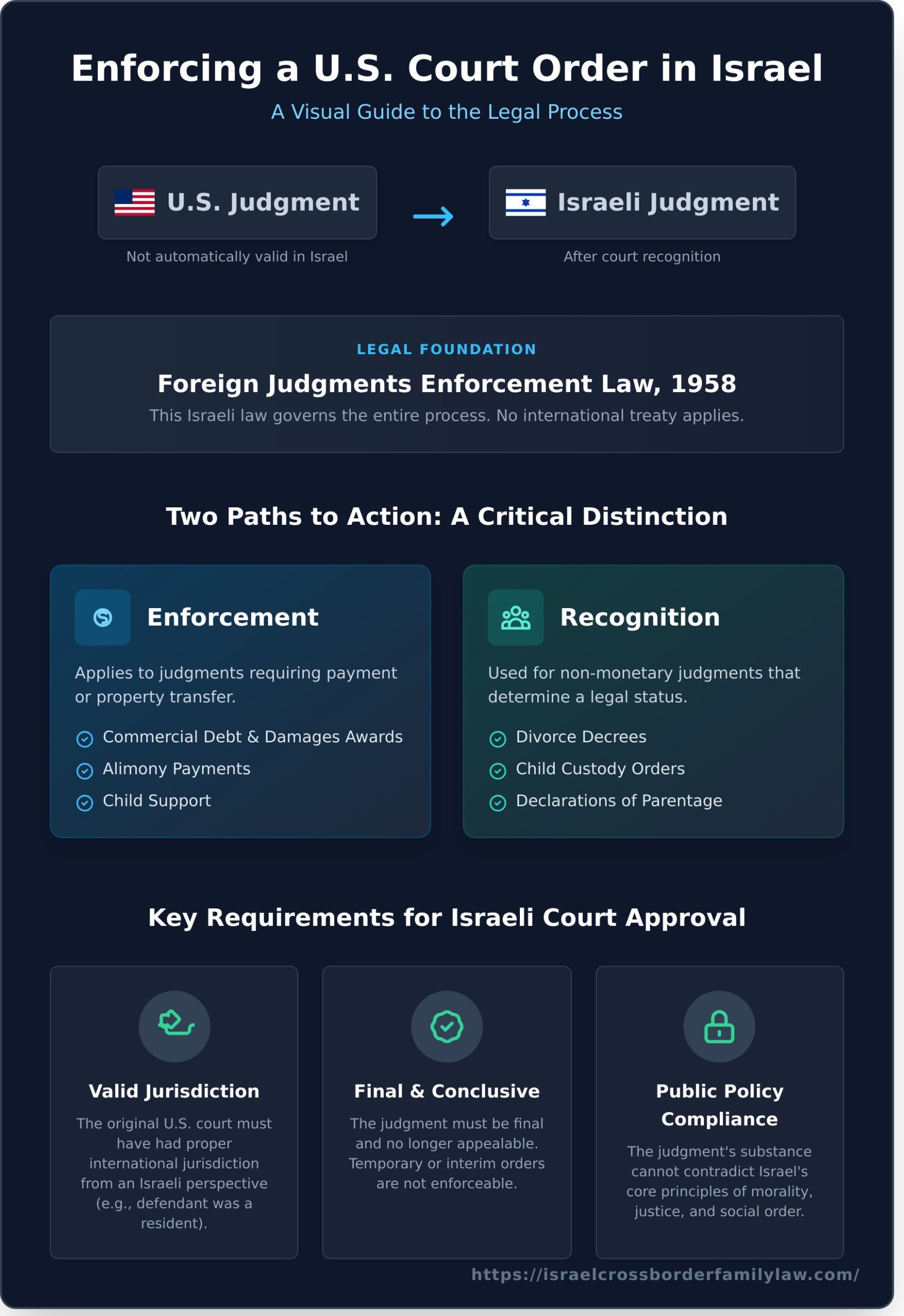
The process of enforcing a US court order in Israel requires navigating a specific and well-defined Israeli statutory framework. A common misconception is that a judgment issued by an American court is automatically effective within Israeli jurisdiction; this is not the case. The State of Israel is not a signatory to the Hague Convention on the Recognition and Enforcement of Foreign Judgments in Civil and Commercial Matters, meaning there is no overarching international treaty that mandates automatic acceptance of US rulings.
This section will further clarify the implications of enforcing us court orders in israel to ensure you are fully informed.
Instead, the entire process of enforcing a US court order in Israel is governed by domestic Israeli law, primarily the Foreign Judgments Enforcement Law, 1958. This legislation dictates that a foreign judgment, including one from the United States, must first be submitted to a competent Israeli court. Through a specific legal proceeding, the court can then “declare the judgment enforceable,” effectively transforming the foreign order into a domestic Israeli judgment that can be executed through local channels.
This video provides a concise overview of the key considerations when seeking to enforce a foreign judgment within the Israeli legal system:
Enforcement vs. Recognition: A Critical Distinction
The 1958 Law distinguishes between two fundamental actions, a distinction critical for determining the correct legal strategy for enforcing a US court order in Israel:
- Enforcement primarily applies to judgments requiring a party to pay a sum of money or transfer property. This includes commercial debt, damages awards, alimony, and child support payments. Once enforced, the judgment holder can utilize the Israeli Execution Office (Hotza’a LaPoal) to initiate collection actions such as wage garnishment, bank account levies, or liens on real estate.
- Recognition is utilized for non-monetary judgments that determine a legal status. Common examples include divorce decrees, child custody orders, or declarations of parentage. The goal of recognition is not to collect a debt but to have the legal status established by the US court accepted as a binding fact in Israel.
The Principle of Reciprocity Between the US and Israel
A central concept within the global legal framework for enforcing foreign judgments is reciprocity-the mutual understanding that courts in one country will enforce the judgments of another because they receive the same treatment in return. While the Israeli law mentions reciprocity as a condition, it is not an absolute prerequisite. Israeli courts have consistently demonstrated a pragmatic approach, generally finding that sufficient reciprocity exists with the courts of most US states. This established judicial precedent significantly simplifies the task of enforcing a US court order in Israel, making it a more predictable and streamlined undertaking than with judgments from jurisdictions where such reciprocity is not presumed.
Key Requirements for Enforcing a US Order in Israel
The process of enforcing a US court order in Israel is not an automatic rubber-stamping procedure. It is a sophisticated legal process governed by a specific statutory framework. An Israeli court will not re-litigate the merits of the original case but will meticulously verify that the US judgment meets a series of cumulative conditions set forth in the Israeli Foreign Judgment Enforcement Law of 1958. Failure to satisfy any one of these requirements can present a significant challenge to the enforcement action.
To successfully navigate this complex, multi-jurisdictional terrain, it is crucial to understand these core requirements before initiating proceedings in Israel.
Proving Jurisdiction of the Original US Court
A primary threshold is establishing that the original US court possessed proper international jurisdiction from the perspective of Israeli law. The Israeli court will conduct its own analysis to confirm this authority. This condition is typically satisfied if it can be proven that the defendant was a resident of the US state where the judgment was rendered when the lawsuit was filed, or if the defendant contractually consented to that specific court’s jurisdiction.
Finality and Enforceability of the Judgment
The US order must be a final, conclusive judgment. Israeli courts will not enforce temporary, interim, or interlocutory orders that are subject to change by the issuing court. For example, a final divorce decree or a final monetary judgment is enforceable, whereas a temporary child support order issued pending trial is not. Furthermore, you must provide clear evidence that the judgment is no longer appealable and remains fully enforceable in the US state where it was issued.
The Public Policy Exception
A US judgment will be denied enforcement if its substance or implications are fundamentally contrary to Israel’s public policy (Takanat HaTzibur). This refers to the core principles of morality, justice, and social order within Israel. For instance, judgments awarding excessively high punitive damages, which are often viewed as penal rather than compensatory, may be considered contrary to public policy. However, this exception is a high bar and is rarely invoked to deny the enforcement of standard family or commercial law judgments.
The Step-by-Step Process for Filing in Israeli Courts
Successfully enforcing a US court order in Israel requires a meticulous and structured approach through the Israeli legal system. The process is not automatic; it is initiated by filing a formal motion or a statement of claim to have the foreign judgment recognized and declared enforceable. This petition must be filed in the appropriate Israeli court, which then adjudicates the matter according to Israeli law.
Once the claim is filed, it must be properly served upon the defendant residing in Israel. This procedural step is critical, as it provides the defendant with formal notice of the legal action and the opportunity to respond. The defendant is then entitled to file a statement of defense within a specified timeframe, outlining any legal arguments against the enforcement of the US order.
Preparing and Authenticating Your Documents
The foundation of your enforcement action is a comprehensive and properly authenticated set of documents. Israeli courts require precise documentation to consider the recognition of a foreign judgment. Incomplete or improperly certified paperwork is a common cause for significant delays or outright dismissal. Key documents include:
- A certified copy of the final and conclusive US court order.
- An Apostille certificate, as mandated by the Hague Apostille Convention, to authenticate the US judgment for international use.
- A certified Hebrew translation of all documents, prepared and verified by a licensed Israeli notary.
- Supporting evidence, such as proof that the judgment is no longer subject to appeal (proof of finality).
Navigating the Israeli Court System
Filing your claim in the correct judicial venue is essential. Jurisdiction is determined by both the subject matter of the order and the defendant’s physical location. For example, orders pertaining to divorce, child support, or custody must be filed in the Family Court located in the district where the defendant resides. The court will then schedule a hearing where both parties can present evidence and legal arguments, ensuring due process is followed before a decision is rendered.
From Declaration to Execution
If the Israeli court rules in your favor, it will issue a judgment declaring the US order enforceable. At this point, the foreign order effectively acquires the legal status and power of a domestic Israeli judgment. This transformative step allows you to proceed to the final phase: practical enforcement. The new Israeli judgment is then taken to the Execution Office (Hotza’a LaPoal), the state authority responsible for compelling compliance through actions like asset seizure, wage garnishment, and other collection mechanisms. Let our experts handle the complexities of the Israeli court system for you.
Common Defenses and Potential Challenges to Enforcement
While the Israeli legal framework provides a clear path for the recognition of foreign judgments, enforcement is not an automatic or guaranteed outcome. The defendant in Israel is afforded the right to raise specific, statutory defenses as outlined in the Foreign Judgments Enforcement Law, 1958. A comprehensive understanding of these potential challenges is imperative for any party seeking to enforce a US court order, as a successful defense will lead the Israeli court to refuse enforcement.
Successfully enforcing a US court order in Israel requires a proactive legal strategy that anticipates and meticulously prepares to counter these potential defenses. The primary challenges that a defendant may raise include the following:
Lack of Due Process and Proper Notice
Among the most common defenses is the assertion that the defendant was not afforded a reasonable opportunity to be heard in the original U.S. proceeding. This defense focuses on procedural fairness, specifically whether the defendant was properly served with notice of the lawsuit. Israeli courts place significant emphasis on this fundamental right, and will closely scrutinize whether the service of process complied with applicable international treaties and provided the defendant with adequate time and information to mount a defense.
Judgment Procured by Fraud
An Israeli court will refuse to enforce a judgment that was obtained by fraud. It is crucial to understand that this defense pertains to “extrinsic fraud”-deception that prevented the defendant from having their case properly heard, such as misleading the U.S. court about jurisdiction or fabricating evidence of service. This does not provide an opportunity to re-litigate the merits of the original case or challenge the evidence presented therein; the Israeli court will not act as an appellate body for the U.S. judiciary.
Conflict with an Israeli Judgment or Pending Litigation
Enforcement may be denied if the U.S. judgment conflicts with prior or pending legal actions in Israel. This defense applies under two primary scenarios:
- A final and conclusive judgment regarding the same subject matter and between the same parties already exists from an Israeli court.
- A lawsuit concerning the same matter and between the same parties was already pending in an Israeli court at the time the U.S. action was initiated.
Navigating these complex procedural and substantive challenges demands experienced counsel with a deep understanding of multi-jurisdictional litigation. For expert guidance on your specific case, contact our cross-border legal team.
Specific Considerations for US Family Law Orders
While the foundational legal principles for foreign judgment enforcement apply broadly, US family law orders introduce a layer of multi-jurisdictional complexity that demands specialized knowledge. These are not merely commercial debts; they involve deeply personal matters of status, support, and parental rights. Understanding the nuanced distinctions between “enforcement” and “recognition” is paramount for success. This section provides targeted guidance for navigating the most common cross-border family law scenarios.
Enforcing Monetary Orders: Child and Spousal Support
Judgments for financial support, such as child support arrears or spousal maintenance (alimony), are the most direct cases for enforcement. These are treated as a monetary debt. Once a US order is declared enforceable by an Israeli court, it is registered with the Israeli Execution Office (Hotza’a LaPoal). This powerful body can then utilize various collection mechanisms, including wage garnishments, bank account liens, and other asset seizures, to compel payment of both accumulated arrears and ongoing support obligations.
Recognizing Status: Divorce Decrees
A US divorce decree is a matter of “recognition” rather than monetary enforcement. The objective is to have the Israeli Ministry of Interior officially update an individual’s marital status from married to divorced. This is essential for the ability to remarry in Israel and for clarifying rights related to inheritance and other official records. The Israeli Family Court typically handles the recognition of foreign civil divorces. For Jewish couples, however, further action in the Rabbinical Courts may be required to secure a religious divorce (Get).
Complex Cases: Child Custody and Visitation Orders
Custody and visitation orders from the US are also subject to “recognition,” but this process is far more complex. Israeli courts will not automatically validate a foreign custody arrangement. The court’s primary and non-negotiable mandate is to protect the “best interests of the child” (tovat ha’yeled) as determined under Israeli law and circumstances. While a US order provides a strong basis, the Israeli court will conduct its own evaluation. This process is distinct from actions under The Hague Convention, which specifically addresses cases of international child abduction.
Navigating these sensitive, cross-border family matters requires sophisticated counsel with deep experience in both the US and Israeli legal systems. For expert guidance on the intricate process of enforcing us court order in israel, from support arrears to complex custody arrangements, our dedicated team is positioned to provide strategic and effective representation.
Secure Your Judgment: The Path Forward in Israel
Successfully enforcing a US court order in Israel requires a meticulous approach, grounded in a comprehensive understanding of Israeli civil procedure. As we have detailed, while Israel’s legal framework provides a clear path for the recognition of foreign judgments, success is contingent upon meeting stringent requirements regarding finality, jurisdiction, and public policy. Overcoming potential defenses, particularly in sensitive family law cases, demands sophisticated, multi-jurisdictional legal strategy to navigate the complexities inherent in both legal systems.
Navigating this complex cross-border process demands more than just legal knowledge; it requires bicultural fluency. Our firm offers a distinct advantage with its deep expertise in both US and Israeli family law, a proven track record of successfully enforcing foreign judgments, and a dedicated team of bilingual attorneys qualified to practice in both jurisdictions. We serve as your strategic legal bridge, ensuring clear communication and robust representation. If you are ready to take decisive action, we invite you to schedule a consultation to discuss enforcing your US judgment. Let us provide the expert guidance needed to transform your court order into a tangible reality.
Frequently Asked Questions About Enforcing US Judgments in Israel
How long does it take to enforce a US court order in Israel?
The timeline for enforcement proceedings can vary significantly based on the complexity of the case and the court’s docket. For an uncontested matter where the opposing party does not raise substantive defenses, the process may take between 6 to 18 months. However, if the enforcement is contested or involves sophisticated legal arguments, the duration can extend considerably, requiring a strategic and experienced legal approach to navigate the Israeli judicial system efficiently.
What are the estimated legal costs for the enforcement process?
Legal costs are contingent upon the specific circumstances of the case, including its complexity and whether it is contested. Initial legal fees for preparing and filing the application for enforcement typically start in the range of ₪20,000 to ₪50,000. This estimate does not include court filing fees, translation costs, or potential costs associated with litigation if the other party raises a defense. We provide a detailed fee structure tailored to the unique requirements of each cross-border matter.
Do I need to be physically present in Israel to start the enforcement process?
No, your physical presence in Israel is not required to initiate or manage the enforcement proceedings. Our clients can provide us with a power of attorney, which authorizes our firm to act on their behalf. Our bilingual attorneys, with a team on the ground in Israel, can handle all necessary court filings, correspondence, and appearances, ensuring a seamless process while you remain in the United States or abroad. This is a core advantage when **enforcing a US court order in Israel**.
Can a temporary or interim US court order be enforced in Israel?
Generally, Israeli law requires that a foreign judgment be final and conclusive to be enforceable. Temporary or interim orders, such as temporary restraining orders or preliminary injunctions, typically do not meet this statutory requirement of finality. While such orders are not directly enforceable, our legal team can advise on pursuing parallel interim relief directly within the Israeli court system to protect your interests while the primary matter is pending.
What is an Apostille and why is it required for my US documents?
An Apostille is an international certification that authenticates the origin of a public document, such as a court order or birth certificate. It is governed by the 1961 Hague Convention, to which both the United States and Israel are signatories. The Apostille verifies the legitimacy of the signature and seal on your US court documents, making them legally valid for submission to Israeli courts. It is a mandatory prerequisite for the recognition and enforcement process.
What happens if the other party ignores the Israeli court proceedings?
Should the responding party fail to appear or submit a defense after being properly served, the Israeli court may issue a default judgment in your favor. The court will proceed based on the evidence and legal arguments presented in your application, and in the absence of a counter-argument, it is likely to grant the enforcement order. This ensures that a party cannot evade its legal obligations simply by ignoring the judicial process in Israel.
Can a US prenuptial agreement be enforced as part of a divorce decree?
When a US prenuptial agreement has been formally incorporated into a final and conclusive US divorce decree, the Israeli court’s focus shifts to enforcing the decree itself, rather than re-litigating the terms of the original agreement. The court will enforce the provisions of the decree, including those derived from the prenuptial agreement, provided that their enforcement does not contravene Israeli public policy. This is a critical consideration in any multi-jurisdictional family law matter.

Article by
Gabriel Lior
A Personal Journey That Became a Mission
The advisory was founded by an American father Gabriel Lior, LLB, MBA , global entrepreneur, and cross-border advisor who spent more than a decade navigating the Israeli family court system firsthand and now lives in Singapore with his son.
As a divorced parent in a cross-border family, Gabriel faced nearly every legal challenge a foreign parent can encounter in Israel — including child custody disputes, child support proceedings, property matters in Israel and abroad, false accusations, and complex immigration and relocation proceedings.
Over the years, he learned the hard way how difficult it is for non-Israeli parents to understand the system, identify the right legal strategy, and choose the right legal representation — especially when language, culture, and jurisdictional differences are involved. He also witnessed how foreign parents and new immigrants are often disadvantaged or taken advantage of by service providers and institutions simply because they lack local knowledge or fluency.
From Client to Advisor
To truly understand — and survive — the system, Gabriel pursued formal legal education in Israel, completing two Israeli law degrees, alongside a BA and MBA earned in the United States. This was never about becoming a practicing attorney, but about gaining a deep, structural understanding of how the system works — and where it breaks down for foreign parents.
This rare combination of:
Firsthand client experience
Israeli legal and US business education
International business and negotiation training
Decades of commercial execution
created a unique perspective – one that understands both sides of the table.
After years of litigation, persistence, and at times self-representation, he ultimately succeeded in securing custody of his son and relocating abroad through a rare legal victory in the Israeli Supreme Court — becoming one of the first fathers in Israel to do so under these circumstances.
Disclaimer
Important Disclaimer:
The information provided on this website and in its content is for general informational and educational purposes only and does not constitute legal advice, legal opinion, or legal representation.
Gabriel Lior is not licensed to practice law in Israel (nor is he interested in doing so) and does not provide legal services, despite having completed 2 Law Degrees. The services offered are advisory in nature and are intended to provide general guidance, strategic insight, and information regarding cross-border family law considerations.
No attorney-client relationship is formed by accessing this website, reading its content, or communicating with us.
Any decisions made based on this information are at your own discretion and risk. For legal advice specific to your situation, you should consult a licensed attorney in the relevant jurisdiction.
Where appropriate, we may refer clients to independent, licensed attorneys or professionals. Such referrals do not constitute legal representation and no liability is assumed for services provided by third parties.