For international families with significant ties to Israel and assets held abroad, the complexities of wealth transfer present a formidable challenge. The prospect of heirs facing punishing double taxation, assets becoming entangled in multi-jurisdictional legal conflicts, or a will drafted in one country being declared invalid in another, poses a direct threat to your family’s financial security. These sophisticated issues demand a robust and forward-thinking strategy, making comprehensive cross-border estate planning not just an advantage, but a necessity for preserving your legacy.
This strategic guide is designed to provide clarity and direction, navigating you through the intricate web of international and Israeli inheritance laws. We will delve into the critical mechanisms for protecting your assets, structuring a seamless transfer of wealth to your designated beneficiaries, and strategically minimizing tax liabilities across all relevant jurisdictions. Our objective is to equip you with the knowledge to create a legally sound and enforceable plan, ensuring your family is protected and your final wishes are honored, without complication or dispute.
Why Your Domestic Estate Plan Fails Across Borders
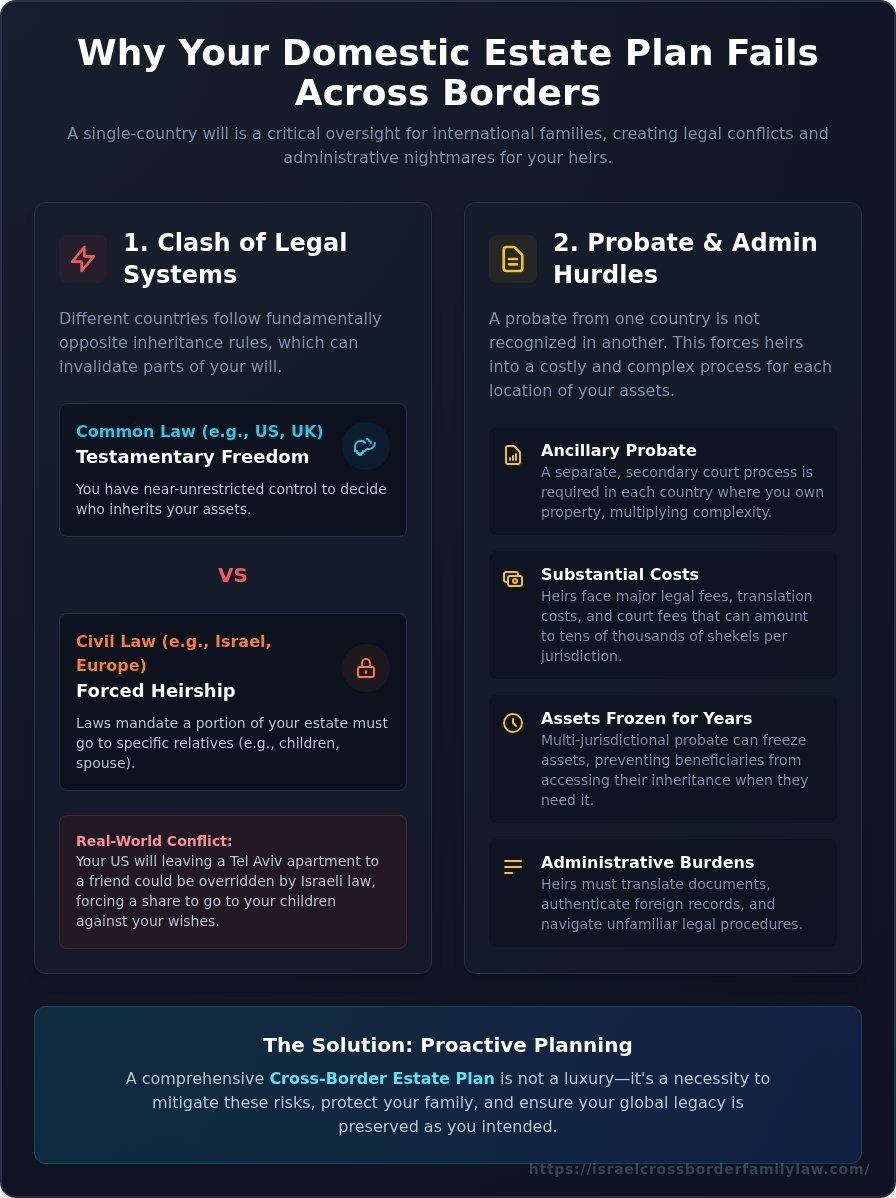
For international families with assets in multiple countries, relying on a single, domestic estate plan is a perilous oversight. A will meticulously drafted under U.S. or U.K. law may be deemed partially invalid or create profound legal conflicts when applied to assets located in a different jurisdiction, such as Israel. This discrepancy arises because the legal principles governing inheritance are not universal, leading to a high risk of your assets being distributed in a manner that directly contradicts your stated wishes and intentions. A sophisticated cross-border estate planning strategy is not a luxury but a necessity for safeguarding your global legacy.
To better understand the complexities involved, this overview provides a helpful introduction to the core issues:
The Clash of Legal Systems: Common Law vs. Civil Law
The fundamental conflict often originates from two distinct legal traditions. Common Law jurisdictions (e.g., the United States, United Kingdom) champion the principle of testamentary freedom, allowing individuals nearly unrestricted control over the disposition of their assets. Conversely, Civil Law systems, prevalent in much of Europe and including Israel, enforce forced heirship rules. These statutes mandate that a certain portion of an estate must be allocated to specific relatives, such as children or a spouse, regardless of the decedent’s will. For a U.S. citizen with a Tel Aviv apartment, this means Israeli succession law could override their American will, compelling a distribution of the property that was never intended. Navigating these divergent frameworks requires a deep understanding of the Foundational Concepts in International Estate Law to ensure a cohesive and enforceable plan.
Probate and Administrative Hurdles
A grant of probate in one country does not extend its authority to assets held in another. This legal reality necessitates a separate, secondary probate process known as “ancillary probate” in each jurisdiction where property is located. For your heirs, this triggers a cascade of complex and costly challenges. They will face significant administrative burdens, including translating and authenticating foreign documents, navigating unfamiliar court procedures, and incurring substantial legal fees that can amount to tens of thousands of shekels. This multi-jurisdictional process can effectively freeze assets for years, preventing beneficiaries from accessing their inheritance and undermining the efficiency of your entire estate settlement. Proper cross-border estate planning is designed to mitigate or eliminate these costly and time-consuming hurdles.
Foundational Concepts in International Estate Law You Must Know
Navigating the complex landscape of international wealth transfer begins with a firm grasp of its core terminology. These foundational concepts are not mere legal jargon; they are the critical determinants that dictate which country’s succession laws will govern your assets and which tax authorities will have a claim to your estate. A failure to comprehend these distinctions can lead to unintended legal consequences, excessive taxation, and significant complications for your heirs. It is essential to recognize that definitions for terms like domicile and residency can vary dramatically between jurisdictions, such as Israel and the United States, making expert guidance on the Essential Tools for Your Cross-Border Estate Plan indispensable from the outset.
Domicile, Residency, and Citizenship
Understanding your status under the law of multiple countries is the cornerstone of effective cross-border estate planning. While often used interchangeably in casual conversation, these three terms have distinct legal meanings with profound implications:
- Citizenship refers to your nationality-the country that issued your passport and to which you owe allegiance.
- Residency is typically determined by where you live and maintain a home. It is often the primary factor for income tax purposes.
- Domicile is a more nuanced concept representing your permanent legal home-the place where you intend to remain indefinitely and ultimately return.
Of these, domicile is frequently the most pivotal factor for estate and inheritance tax. For instance, the U.S. imposes estate tax on the worldwide assets of its citizens and domiciliaries, regardless of where they reside. Conversely, many other nations base inheritance tax on the residency of the deceased or the beneficiary, creating a complex web of overlapping tax obligations that requires strategic navigation.
Situs of Assets: Where Your Property Legally ‘Lives’
The legal location of an asset, known as its situs, determines which country has the primary right to tax it upon your death. The rules for establishing situs differ based on the type of property, and a clear understanding is vital for mitigating tax exposure. Assets are generally categorized as either tangible or intangible.
Tangible assets, such as real estate or physical art, have a clear situs in the country where they are physically located. An apartment in New York has a U.S. situs, while a villa in Herzliya Pituach has an Israeli situs. Intangible assets-including bank accounts, stocks, and intellectual property-are more complex. Their situs is often determined by factors like the location of the bank, the country where a company is incorporated, or the terms of a specific tax treaty. This distinction is critical, as it directly impacts which assets fall under the purview of a foreign tax authority.
Essential Tools for Your Cross-Border Estate Plan
Transitioning from high-level strategy to practical implementation, a successful cross-border estate plan is constructed from a selection of precise legal instruments. These are not merely administrative documents; they are the strategic components engineered to protect, manage, and transfer your global assets in accordance with your wishes. For international families with connections to Israel, navigating the interplay between different legal systems necessitates a sophisticated and multi-faceted approach, often requiring a carefully orchestrated combination of these essential tools.
International Wills: One Will or Several?
A foundational question in multi-jurisdictional planning is whether to utilize a single, global will or multiple, situs-specific wills. While a single will appears simpler, it often creates significant legal conflicts and may not be enforceable across different legal traditions. A more robust strategy involves creating separate, distinct wills for assets in each country. However, this approach carries a critical risk: a later will can inadvertently revoke a prior one. Therefore, it is paramount that legal counsel in each jurisdiction coordinate meticulously to ensure each will is precisely drafted to govern only the assets within its purview, preventing costly legal challenges.
The Role of Trusts in Protecting International Assets
Trusts serve as a powerful vehicle for holding and managing international assets, offering a layer of control and protection. In cross-border estate planning, both revocable trusts (offering flexibility) and irrevocable trusts (providing enhanced asset protection) can be deployed to minimize tax exposure and, crucially, avoid the complex probate process in jurisdictions like the United States. A significant challenge, however, is the issue of recognition. While Israel’s legal system accommodates trusts, many civil law countries do not, which can complicate the administration of assets held there. Strategic selection and structuring of trusts are therefore essential.
Powers of Attorney for International Incapacity Planning
An often-overlooked but critical component of international planning is preparing for potential incapacity. Financial and healthcare powers of attorney grant a trusted agent the authority to act on your behalf. However, these documents are intensely jurisdiction-specific. A power of attorney executed in the United States, for example, will almost certainly be rejected by an Israeli bank when your agent attempts to manage your account or by a hospital in Jerusalem regarding medical decisions. To ensure seamless management of your affairs, it is imperative to establish separate, locally compliant powers of attorney in each country where you hold significant assets.
Navigating International Tax Obligations and Treaties
For international families with assets in both the United States and Israel, the specter of double taxation presents a significant threat to wealth preservation. A primary objective of strategic cross-border estate planning is to mitigate this risk by developing a sophisticated understanding of the multi-jurisdictional tax landscape. Navigating these complex obligations is not merely an administrative task; it is fundamental to ensuring the maximum value of your estate is transferred to your intended beneficiaries.
Understanding Estate Tax, Inheritance Tax, and Gift Tax
The global framework for wealth transfer taxes is intricate, with different jurisdictions imposing unique obligations. It is critical to distinguish between the primary forms of taxation:
- US Estate Tax: A federal tax levied on the total value of a deceased person’s worldwide assets before they are distributed. US citizens and domiciliaries are subject to this tax regardless of where their assets are located.
- Inheritance Tax: A tax paid by the beneficiary upon receiving assets from an estate. It is crucial to note that Israel does not impose an inheritance tax, a significant factor in structuring wealth transfers.
- Gift Tax: A tax imposed on the transfer of property or assets from one living person to another. In the US, this is integrated with the estate tax system to prevent individuals from avoiding estate tax by giving away their assets before death.
The US-Israel Tax Treaty and Its Implications
To prevent the same assets from being taxed by multiple countries, nations enter into bilateral tax treaties. The United States and Israel are signatories to the Convention Between the Government of the State of Israel and the Government of the United States of America with Respect to Taxes on Estates, Inheritances, and Gifts. This treaty is designed to prevent double taxation by providing a system of credits, where taxes paid in one country can be used to offset liabilities in the other.
However, interpreting and applying these treaty provisions requires specialized expertise. The rules for determining asset situs (location for tax purposes) and the calculation of available credits are complex. Successfully leveraging these international agreements is a cornerstone of effective cross-border estate planning, requiring specialized legal counsel with deep experience in both US and Israeli tax law to protect your family’s legacy.
Developing Your Cross-Border Strategy: A Step-by-Step Approach
Navigating the complexities of multi-jurisdictional asset ownership requires more than just knowledge; it demands a structured, actionable plan. This strategic framework is designed to empower you to take decisive control over your international legacy. By systematically addressing each component of your estate, you can create a cohesive strategy that aligns with your long-term objectives and protects your family’s future across borders.
Step 1: Create a Comprehensive Inventory of Worldwide Assets
The foundation of any effective cross-border estate planning strategy is a meticulous and exhaustive inventory of your global assets. This process provides the clarity needed to understand the scope of your estate and the legal jurisdictions that govern it. Begin by documenting every significant asset you own, whether in Israel, the United States, or elsewhere.
- List All Assets: Itemize real estate (e.g., an apartment in Tel Aviv, a property in Florida), bank and investment accounts, business interests, life insurance policies, and valuable personal property.
- Identify Location and Situs: For each asset, specify its physical location and, critically, its legal situs-the jurisdiction whose laws govern its transfer.
- Gather Documentation: Collect all relevant ownership documents, such as property deeds, account statements, partnership agreements, and corporate records.
- Estimate Value: Assign a current market value to each asset, using local currency where appropriate (e.g., a property valued at ₪6,000,000 or a US brokerage account holding $500,000).
Step 2: Define Your Goals and Beneficiaries
With a clear picture of your assets, the next step is to articulate your specific intentions. Who are your intended heirs, and what are their individual circumstances? Consider if any beneficiaries are minors, have special needs, or reside in a different country than you, as this will significantly impact the structure of your plan. Define your primary objectives, whether they are minimizing global tax liabilities, protecting assets from creditors, or ensuring a seamless transfer of wealth that avoids lengthy and costly probate proceedings in multiple countries. This also includes clarifying your wishes for incapacity and end-of-life care through durable powers of attorney valid in each relevant jurisdiction.
Step 3: Assemble Your Team of International Experts
The intricate nature of international law means that a local lawyer, however skilled, is often insufficient for managing a global estate. A comprehensive cross-border estate planning solution requires a collaborative team of professionals. This team must include legal counsel with demonstrated expertise and qualifications in every jurisdiction where you hold assets, particularly in both Israeli and U.S. law. Coordinating their advice with that of your international tax advisors and financial planners is essential to creating a unified and effective strategy. Your team serves as the critical bridge between different legal systems, ensuring no detail is overlooked.
Navigating these sophisticated legal and financial frameworks requires a firm with a deep, nuanced understanding of both markets. Contact our firm to build a legal strategy that protects your US and Israeli assets.
Navigating Your International Legacy with Confidence
As we have explored, the complexities of managing assets across different jurisdictions render a standard domestic will dangerously inadequate. Successfully protecting your family’s wealth requires a sophisticated understanding of conflicting international laws, tax treaties, and multi-jurisdictional legal instruments. This is the fundamental challenge of effective cross-border estate planning: transforming a complex web of global regulations into a seamless, unified strategy that honors your intentions and safeguards your legacy.
The path forward demands expert guidance. With decades of focused experience in US-Israel cross-border law, our team of attorneys-licensed to practice in both the United States and Israel-provides the strategic counsel necessary to navigate these intricate family and estate matters. We are uniquely positioned to serve as the bridge between your assets and your heirs, ensuring a secure and efficient transfer of your global estate.
Do not leave your family’s future to chance. Schedule a Consultation to Secure Your International Legacy and take the definitive step toward preserving the wealth you have worked a lifetime to build.
Frequently Asked Questions About Cross-Border Estate Planning
Can I have two wills, one for my US assets and one for my Israeli assets?
Yes, utilizing separate wills for assets in different jurisdictions, often referred to as “situs wills,” is a common and highly effective strategy. This approach allows a US will to govern your US-based assets while an Israeli will addresses your Israeli property, thereby streamlining the probate process in each country. It is imperative that these documents are drafted by counsel experienced in multi-jurisdictional matters to prevent one will from inadvertently revoking the other, a critical component of sophisticated cross-border estate planning.
What happens to my property in Israel if I am a US citizen and die without a will?
In the absence of a valid will, a situation known as intestacy, the distribution of your Israeli property is governed by Israel’s Succession Law of 1965. This statute mandates a specific hierarchy for inheritance, typically dividing the estate between the surviving spouse and children. Your heirs would be required to navigate the Israeli court system to obtain a succession order, a process that can be both lengthy and complex for individuals residing outside of Israel.
Will my US living trust be recognized and avoid probate in Israel?
While Israel recognizes the legal concept of a trust under its domestic law and international conventions, a US-based living trust does not automatically bypass the probate process for Israeli real estate. Transferring title of Israeli property held in a foreign trust often requires an order from an Israeli court. Therefore, while a trust is a powerful instrument, it necessitates careful, jurisdiction-specific structuring by legal experts to achieve its intended efficiencies for assets located within Israel.
How can I avoid my heirs paying estate taxes in both the US and another country?
Mitigating double taxation is a primary objective achieved through the strategic use of international tax treaties, such as the estate and gift tax convention between the United States and Israel. This treaty provides credits to offset taxes paid in one jurisdiction against liabilities in the other. A comprehensive cross-border estate planning strategy, often involving sophisticated trust structures and lifetime gifting, is essential to navigate these complex regulations and maximize the treaty’s benefits for your international heirs.
Do I need a different power of attorney for each country I have assets in?
It is strongly advisable to execute a separate power of attorney for each jurisdiction in which you hold significant assets. A document drafted under US law may face acceptance issues with Israeli financial institutions and administrative bodies due to differing legal standards. Executing an Israeli-specific durable power of attorney (ייפוי כוח מתמשך) ensures that your designated agent can manage your Israeli affairs efficiently and without the legal hurdles that a foreign document might present.
Does Israel have an inheritance tax for foreign beneficiaries?
Israel does not currently levy an inheritance or estate tax, regardless of the beneficiary’s residency or citizenship. This means that assets located in Israel can pass to your heirs without being subject to Israeli inheritance tax. However, it is critical for beneficiaries who are US persons to consult with tax advisors, as they will still be subject to US tax laws, such as capital gains tax upon the future sale of the inherited Israeli assets.

Article by
Gabriel Lior
A Personal Journey That Became a Mission
The advisory was founded by an American father Gabriel Lior, LLB, MBA , global entrepreneur, and cross-border advisor who spent more than a decade navigating the Israeli family court system firsthand and now lives in Singapore with his son.
As a divorced parent in a cross-border family, Gabriel faced nearly every legal challenge a foreign parent can encounter in Israel — including child custody disputes, child support proceedings, property matters in Israel and abroad, false accusations, and complex immigration and relocation proceedings.
Over the years, he learned the hard way how difficult it is for non-Israeli parents to understand the system, identify the right legal strategy, and choose the right legal representation — especially when language, culture, and jurisdictional differences are involved. He also witnessed how foreign parents and new immigrants are often disadvantaged or taken advantage of by service providers and institutions simply because they lack local knowledge or fluency.
From Client to Advisor
To truly understand — and survive — the system, Gabriel pursued formal legal education in Israel, completing two Israeli law degrees, alongside a BA and MBA earned in the United States. This was never about becoming a practicing attorney, but about gaining a deep, structural understanding of how the system works — and where it breaks down for foreign parents.
This rare combination of:
Firsthand client experience
Israeli legal and US business education
International business and negotiation training
Decades of commercial execution
created a unique perspective – one that understands both sides of the table.
After years of litigation, persistence, and at times self-representation, he ultimately succeeded in securing custody of his son and relocating abroad through a rare legal victory in the Israeli Supreme Court — becoming one of the first fathers in Israel to do so under these circumstances.
Disclaimer
Important Disclaimer:
The information provided on this website and in its content is for general informational and educational purposes only and does not constitute legal advice, legal opinion, or legal representation.
Gabriel Lior is not licensed to practice law in Israel (nor is he interested in doing so) and does not provide legal services, despite having completed 2 Law Degrees. The services offered are advisory in nature and are intended to provide general guidance, strategic insight, and information regarding cross-border family law considerations.
No attorney-client relationship is formed by accessing this website, reading its content, or communicating with us.
Any decisions made based on this information are at your own discretion and risk. For legal advice specific to your situation, you should consult a licensed attorney in the relevant jurisdiction.
Where appropriate, we may refer clients to independent, licensed attorneys or professionals. Such referrals do not constitute legal representation and no liability is assumed for services provided by third parties.