This content is published on an independent advisory platform and does not constitute legal representation or formal legal advice. Legal services are only provided by licensed attorneys under a separate engagement.
Imagine discovering that while you were preparing for a civil conversation about your child’s future, the other parent has already filed a case in a different country to gain a jurisdictional advantage. This “race to the courthouse” is a common and stressful reality in Cross-Border Custody Disputes between the United States and Israel. It’s natural to feel a sense of panic when faced with two different legal systems, especially when the stakes involve your parental rights and your child’s stability.
We understand that the complexity of international law can feel like an insurmountable barrier. This guide offers a calm, strategic roadmap to help you regain control. You’ll learn how the Hague Convention functions in 2026, the critical importance of establishing “habitual residence,” and how to utilize “Mirror Orders” to ensure your rights are recognized in both jurisdictions. By the end of this article, you’ll have the clarity needed to protect your family and navigate the significant cultural differences between the US and Israeli legal landscapes. For further visual guidance, you can explore our resources at the @IsraelFamilyLaw YouTube channel.
Key Takeaways
- Learn why “habitual residence” is the single most important factor in determining which country’s court has the authority to hear your case.
- Understand how Israeli courts are transitioning away from traditional presumptions toward a modern “Best Interests of the Child” standard.
- Discover proactive legal tools, such as “Ne Exeat” clauses and “Stay of Exit” orders, to effectively manage and prevent potential Cross-Border Custody Disputes.
- Identify why the first 48 hours of a dispute are critical for setting a strategic course and avoiding a jurisdictional “race to the courthouse.”
- Gain clarity on how to coordinate “Mirror Orders” across both the US and Israeli legal systems to ensure your custody agreement is legally enforceable in both nations.
Defining Cross-Border Custody Disputes in a US-Israel Context
A cross-border custody dispute arises when parents reside in different nations or when a child is moved across international borders without the clear consent of both guardians. These cases are fundamentally different from domestic disputes in New York or California. While a domestic case focuses on state law, Cross-Border Custody Disputes involve a complex intersection of international treaties, foreign statutes, and conflicting judicial philosophies. The presence of dual citizenship often adds another layer of complexity. Parents frequently assume that a child’s US passport grants them automatic protection under American law, but the reality is that physical presence and “habitual residence” usually carry more weight in court than the color of a passport.
Identifying the child’s home state early is essential. This determination dictates which country has the legal authority to make long-term decisions about the child’s upbringing. Both the United States and Israel are signatories to the Hague Convention on the Civil Aspects of International Child Abduction. This treaty provides a framework for returning children who have been wrongfully removed from their country of habitual residence. Because these cases move quickly, with Israeli law requiring an initial hearing within 15 days of a petition being filed, seeking strategic clarity before taking legal action is the most important step a parent can take.
Common Scenarios for International Custody Conflicts
Most conflicts begin with a change in circumstances. A parent might accept a high-level tech position in Herzliya or seek family support in Ra’anana, leading to a request for international custody relocation. Another frequent scenario involves “wrongful retention,” where a child travels to Israel for a planned summer vacation but is not returned to the US as agreed. In the most difficult cases, parents may end up with conflicting court orders issued simultaneously in two different countries. This creates a legal stalemate that can only be resolved through specialized transnational strategy and a deep understanding of how both systems interact.
The Role of the Israeli Family and Rabbinical Courts
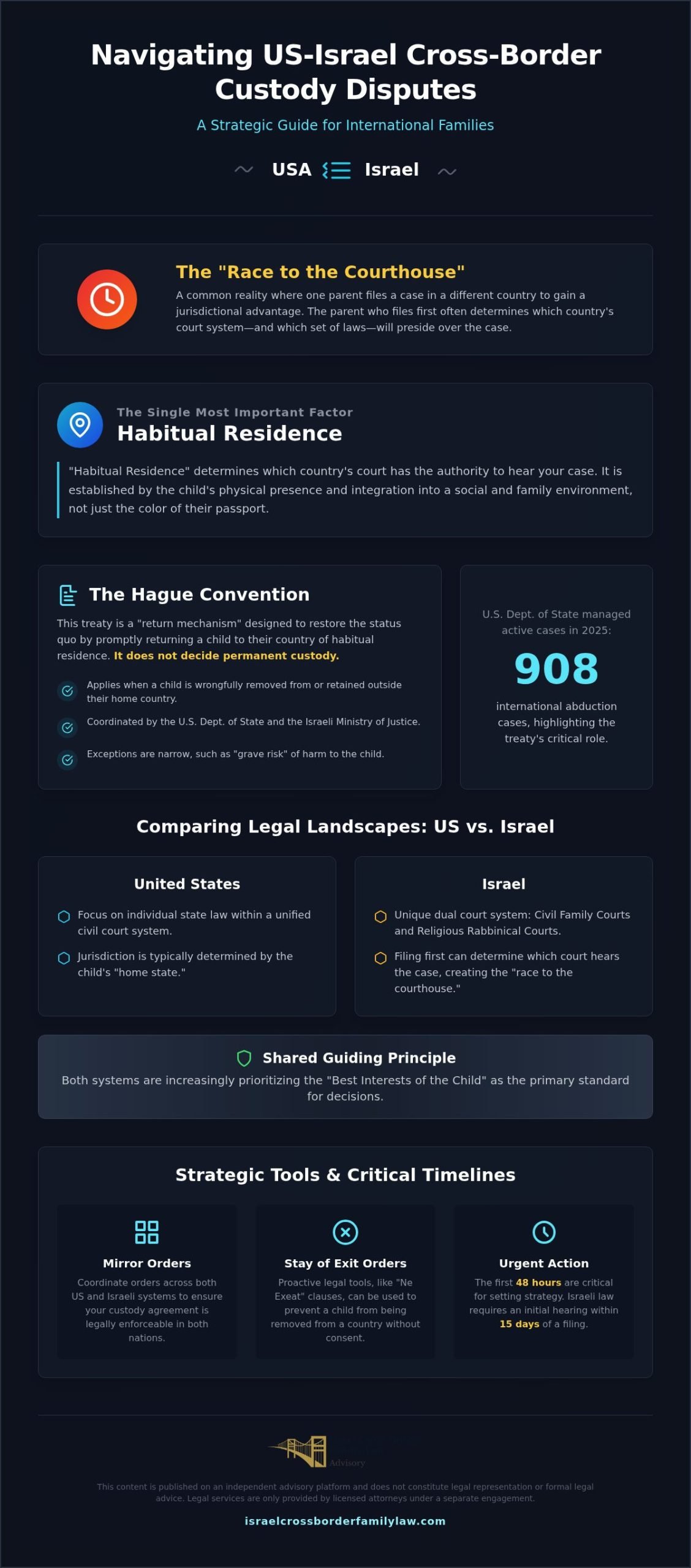
Israel maintains a unique dual court system that often confuses those familiar with the US system. Family matters can be heard in either the civil Family Court or the religious Rabbinical Court. This creates a “race to the courthouse” because the parent who files first typically determines which court will hear the case. As of January 2026, the filing fee for a mandatory “Settlement of Dispute” application is ₪119. While both courts now prioritize “joint parental responsibility” and the “Best Interests of the Child,” the procedural nuances between them can significantly impact the timeline and atmosphere of the proceedings. Understanding these differences is vital for any parent involved in Cross-Border Custody Disputes.
The Hague Convention and the Concept of Habitual Residence
The 1980 Hague Convention serves as the primary legal framework for resolving Cross-Border Custody Disputes where a child has been wrongfully removed or retained. It’s vital to understand that a Hague proceeding doesn’t decide who should have permanent custody. Instead, it functions as a “return mechanism” designed to restore the status quo and send the child back to their country of “habitual residence.” In 2025, the U.S. Department of State managed 908 active international abduction cases, highlighting the ongoing necessity of this treaty. When a petition is filed, the Central Authorities in both nations, the U.S. Department of State and the Israeli Ministry of Justice, coordinate to facilitate the legal process.
While the treaty generally mandates a child’s return, there are narrow exceptions. A court might refuse a return if there’s a “grave risk” that the child would be exposed to physical or psychological harm. Additionally, if a child is of sufficient age and maturity, the court may consider their objection to being returned. Because the legal standards for these exceptions are high, understanding your specific jurisdictional risks is a necessary first step in any international dispute. For a deeper look at the treaty’s mechanics, you can review our guide on Hague Convention Child Abduction.
Determining a Child’s Habitual Residence
Habitual residence is the “north star” of international family law, yet it’s not explicitly defined in the treaty. Courts look at the child’s degree of integration into their social and family environment. A move to Jerusalem or Haifa that was intended to be temporary can become “habitual” if the child enrolls in school, joins local youth groups, and establishes consistent medical care. Judges weigh the shared intent of the parents alongside these practical ties. If a child has spent the majority of their recent life in Israel, a US court may lose its authority to rule on custody, regardless of the child’s American citizenship.
The Hague Petition Process in Israel
The Israeli legal system is designed to handle these cases with extreme urgency. By 2026, procedural rules require an initial hearing for a Hague Convention petition to take place within 15 days of filing. This accelerated timeline means there’s little room for error or delay. During the hearing, the court focuses strictly on whether the removal was “wrongful” under the treaty’s definitions. You should expect a highly focused proceeding where the primary goal is determining the child’s previous residence rather than re-litigating every detail of the parents’ relationship. This speed underscores why gathering evidence of a child’s ties to their home state must happen well before the first court date.
Comparing Legal Standards: ‘Best Interests’ in the US vs. Israel
While both legal systems claim to prioritize the child’s welfare, the practical application of the “Best Interests” standard varies significantly between the US and Israel. In US jurisdictions like New York or California, courts typically apply a multi-factor test that examines the child’s emotional ties, the stability of the home environment, and the primary caregiver’s identity. The process is often adversarial, with each parent’s legal team presenting competing experts. In contrast, the Israeli system is notably mediation-heavy. Before a custody case can even be heard, parents must participate in a mandatory “Settlement of Dispute” process. This cultural emphasis on consensus over litigation is a significant shift for many international families.
A distinct feature of the Israeli system is the role of court-appointed social workers, known as Pkidot Saad. These professionals act as the court’s eyes and ears, conducting home visits and interviews that directly shape the judge’s decision. Their recommendations are rarely disregarded. Additionally, the legal landscape in Israel is evolving. As of August 2026, courts are increasingly moving away from the “Tender Years Presumption,” which traditionally favored mothers for children under age six, and are now prioritizing a standard of joint parental responsibility. Understanding these nuances is vital for anyone involved in Cross-Border Custody Disputes, as the same set of facts might lead to different outcomes depending on which side of the ocean the case is heard.
Jurisdictional Disputes: Where Should the Case Be Heard?
The “Race to the Courthouse” is a strategic reality in US-Israel cases. Because the first court to establish jurisdiction often retains it, filing early can be a decisive factor. However, a court may sometimes decline to hear a case under the principle of Forum Non Conveniens if it believes another country is better suited to handle the dispute. This often happens if the child’s records, schools, and primary witnesses are located elsewhere. For those considering a move, it’s essential to understand the rules surrounding International Custody and Relocation before a conflict escalates.
Enforcement of Foreign Custody Orders
It’s a common misconception that a US custody order is automatically valid in Israel. To be legally binding, a foreign judgment must go through a formal process called “domestication” in an Israeli court. This requires demonstrating that the order doesn’t contradict Israeli public policy and that the other parent was given a fair chance to present their case. In 2026, obtaining “Mirror Orders”, which are identical orders issued in both countries, has become the standard procedure to ensure a custody agreement is enforceable across borders. Without these synchronized protections, a parent may find themselves with a “paper victory” that has no legal teeth in the child’s new country of residence.
Preventing and Managing International Parental Child Abduction
Preventing a child’s unauthorized removal is far more effective than attempting to secure their return through litigation. In the context of Cross-Border Custody Disputes, proactive legal drafting is your first line of defense. One of the most powerful tools available is the ‘Ne Exeat’ clause. This is a specific provision in a custody agreement that prohibits a parent from removing a child from a particular jurisdiction without the written consent of the other parent or a court order. When these clauses are properly domesticated in both the US and Israel, they serve as a clear legal barrier that border authorities and courts can recognize immediately.
If you suspect a risk of abduction, it’s vital to avoid ‘self-help’ measures, such as attempting to hide the child or unilaterally cutting off contact. These actions often backfire in court. Judges in both nations view such behavior as a sign of parental alienation or a lack of respect for the law, which can severely damage your own custody claims. Instead, focus on establishing a clear legal framework. If you’re concerned about a potential move or a planned vacation that might turn into a permanent retention, request a confidential consultation to discuss preventative strategies tailored to the US-Israel corridor.
Travel Consent and Passport Controls
Managing travel documents is a practical necessity for international families. You should ensure that all international travel requires a notarized consent form signed by both parents, specifying the dates and locations of the trip. For American citizens, enrolling in the Children’s Passport Issuance Alert Program (CPIAP) is a critical step. In 2025, this program enrolled over 4,000 new children, bringing the total to more than 69,000. It allows the Department of State to notify a parent if a passport application is submitted for their child. In Israel, a parent can obtain a “Stay of Exit” order (Tsav Ikur Yetzia Min Haaretz). This order is registered with border control and physically prevents the child from leaving the country through any airport or seaport until the order is lifted.
Immediate Steps Following a Retention
If a child is not returned following a visit to Israel or the US, the first 48 hours are decisive. You must immediately gather evidence of the child’s habitual residence, including school records, medical appointments, and recent communications that show an intent to return. Contact the Central Authority in your home country to begin the Hague Convention process. Often, these disputes coincide with financial conflicts, making it necessary to understand Child Support Cross-Border Enforcement as well. Securing specialized advisory early ensures that your initial filings are accurate and that you don’t inadvertently waive your jurisdictional rights through delay.
Strategic Decision-Making: Seeking Clarity Before Legal Action
Strategic clarity is the most valuable asset a parent can possess during the initial stages of a conflict. In Cross-Border Custody Disputes, the first 48 hours often determine the trajectory of the entire case. This narrow window is when jurisdictional advantages are either secured or lost. Many parents react emotionally, rushing into local courts without realizing that a single filing in the wrong country can trigger a chain of events that is difficult to reverse. Decisions made in haste frequently lead to “fighting in the dark,” a situation where parents spend significant resources on multi-jurisdictional litigation without a clear understanding of which legal system actually holds the power to decide their child’s future.
An advisory approach differs fundamentally from traditional litigation. While litigation is inherently reactive and adversarial, a strategic advisory focus prioritizes risk management and long-term stability. It involves evaluating how a custody battle will impact the child over years, not just months. By seeking clarity before making legal commitments, you can identify whether a case should be heard in a civil Family Court or a Rabbinical Court in Israel, or if a US court maintains superior jurisdiction. This foresight prevents the high costs associated with redundant proceedings in two different countries.
The Weight of Early Decisions
Every communication during a dispute carries legal weight. A single email or text message can be used in court to establish “parental intent” or an agreement to a child’s relocation. In a US-Israel context, there’s also the significant danger of signing documents in a language you don’t fully understand. Hebrew legal forms in Israel may contain clauses that waive your rights to certain jurisdictional claims. You should never sign a document or commit to a “temporary” move to cities like Tel Aviv or Jerusalem without consulting a cross-border specialist. Early mistakes in communication or documentation can inadvertently establish a new “habitual residence,” fundamentally altering your legal standing.
Navigating the Path Forward
Successful resolution of international family matters requires a multi-jurisdictional team that understands both the US and Israeli systems. This team acts as a bridge, ensuring that “Mirror Orders” are properly drafted and that your strategy in one country doesn’t undermine your position in the other. Developing this roadmap starts with a comprehensive analysis of your specific situation. A Confidential Case Review allows you to explore these complexities in a protected environment, focusing on strategy and decision-making before an attorney-client relationship is formalized. This step ensures you move forward with confidence rather than reacting out of fear.
Get clarity before you commit. Request a confidential consultation.
This content is published on an independent advisory platform and does not constitute legal representation or formal legal advice. Legal services are only provided by licensed attorneys under a separate engagement.
Securing Your Child’s Future Across Borders
Managing Cross-Border Custody Disputes requires more than local legal knowledge; it demands a strategic roadmap that bridges the US and Israeli systems. As we’ve discussed, establishing “habitual residence” is the foundation of your case, and early decisions often dictate the final outcome. Protecting your rights involves using tools like “Mirror Orders” to ensure your custody arrangements are enforceable in both countries.
This platform provides a specialized focus on the US-Israel corridor, offering a strategic advisory perspective for families navigating multi-jurisdictional complexity. Our practitioners are licensed in multiple jurisdictions, providing the cross-cultural expertise needed to translate complex laws into clear plans. Understanding these rules now helps you avoid costly errors later.
Get clarity before you commit. Request a confidential consultation. With a calm, methodical approach, you can protect your family’s stability and find a clear path forward.
Frequently Asked Questions
Can I move my child from the US to Israel without the other parent’s consent?
No, you generally cannot move a child permanently without the other parent’s written consent or a court order. Doing so constitutes a wrongful removal under international law. If you move without authorization, the other parent can file a petition to have the child returned to their home country immediately. It’s essential to obtain a formal relocation order before making any international move.
How long does a Hague Convention case typically take in the Israeli court system?
Israeli law is designed for speed in these matters. An initial hearing must occur within 15 days of the petition being filed. Most Cross-Border Custody Disputes under the Hague Convention are resolved much faster than standard domestic cases. While the specific timeline varies, the court’s goal is to return the child to their country of habitual residence as quickly as possible to minimize disruption.
Does an Israeli court have to follow a US custody agreement?
An Israeli court isn’t legally bound by a US order unless it has been domesticated. You must petition an Israeli court to recognize and enforce the foreign judgment. To avoid enforcement gaps, many families use “Mirror Orders,” which are identical court orders issued in both the US and Israel. This ensures that your custody agreement has legal standing in both jurisdictions simultaneously.
What is the difference between legal custody and physical custody in Israel?
In Israel, legal custody is known as “Apotrosut” or guardianship, which involves long-term decisions like education and medical care. Physical custody refers to the child’s primary residence and daily care. Most Israeli courts now favor “joint parental responsibility” rather than awarding sole custody to one parent. This reflects a modern shift toward both parents remaining active in the child’s life regardless of their residence.
Can a parent be charged with kidnapping for taking their own child to Israel?
Yes, a parent can face serious legal consequences for unauthorized removal. While the Hague Convention is a civil mechanism for returning the child, the US or other home countries may issue criminal warrants for international parental kidnapping. These charges can lead to extradition or arrest upon re-entering the US. It’s vital to resolve jurisdictional issues through the court system rather than taking unilateral action.
What happens if a child is old enough to voice their own preference in a custody dispute?
Israeli courts do consider the views of a child who is of sufficient age and maturity. There is no specific age set by law, but judges often give significant weight to the objections of children aged 10 or older. A court-appointed professional usually interviews the child in a neutral setting to determine if their preference is independent or the result of pressure from one parent.
Is it possible to settle a cross-border custody dispute through mediation?
Settling through mediation is not only possible but often required. Israeli law mandates a “Settlement of Dispute” process where parents meet with social workers to try and reach an agreement before litigation begins. Mediation is particularly effective in Cross-Border Custody Disputes because it allows families to create flexible, customized “Mirror Orders” that address the unique challenges of living in two different countries.
How do Israeli Rabbinical courts handle custody for non-religious families?
Rabbinical courts have parallel jurisdiction with civil Family Courts. If a parent files a custody claim in the Rabbinical Court first, that court may hear the case even for secular families. However, Israeli Supreme Court rulings require Rabbinical courts to apply civil law principles, such as the “Best Interests of the Child,” when deciding custody matters. The choice of court is a critical strategic decision.

Article by
Gabriel Lior
A Personal Journey That Became a Mission
The advisory was founded by an American father Gabriel Lior, LLB, MBA , global entrepreneur, and cross-border advisor who spent more than a decade navigating the Israeli family court system firsthand and now lives in Singapore with his son.
As a divorced parent in a cross-border family, Gabriel faced nearly every legal challenge a foreign parent can encounter in Israel — including child custody disputes, child support proceedings, property matters in Israel and abroad, false accusations, and complex immigration and relocation proceedings.
Over the years, he learned the hard way how difficult it is for non-Israeli parents to understand the system, identify the right legal strategy, and choose the right legal representation — especially when language, culture, and jurisdictional differences are involved. He also witnessed how foreign parents and new immigrants are often disadvantaged or taken advantage of by service providers and institutions simply because they lack local knowledge or fluency.
From Client to Advisor
To truly understand — and survive — the system, Gabriel pursued formal legal education in Israel, completing two Israeli law degrees, alongside a BA and MBA earned in the United States. This was never about becoming a practicing attorney, but about gaining a deep, structural understanding of how the system works — and where it breaks down for foreign parents.
This rare combination of:
Firsthand client experience
Israeli legal and US business education
International business and negotiation training
Decades of commercial execution
created a unique perspective – one that understands both sides of the table.
After years of litigation, persistence, and at times self-representation, he ultimately succeeded in securing custody of his son and relocating abroad through a rare legal victory in the Israeli Supreme Court — becoming one of the first fathers in Israel to do so under these circumstances.
Disclaimer
Important Disclaimer:
The information provided on this website and in its content is for general informational and educational purposes only and does not constitute legal advice, legal opinion, or legal representation.
Gabriel Lior is not licensed to practice law in Israel (nor is he interested in doing so) and does not provide legal services, despite having completed 2 Law Degrees. The services offered are advisory in nature and are intended to provide general guidance, strategic insight, and information regarding cross-border family law considerations.
No attorney-client relationship is formed by accessing this website, reading its content, or communicating with us.
Any decisions made based on this information are at your own discretion and risk. For legal advice specific to your situation, you should consult a licensed attorney in the relevant jurisdiction.
Where appropriate, we may refer clients to independent, licensed attorneys or professionals. Such referrals do not constitute legal representation and no liability is assumed for services provided by third parties.