For individuals navigating the complexities of a multi-jurisdictional life, the process to enforce a foreign divorce decree in Israel can present a formidable legal challenge. You may possess a final judgment from a court abroad, only to discover it holds no automatic legal standing in Israel, creating significant obstacles to remarrying, managing assets, or securing critical child support and alimony payments. The uncertainty of whether to approach the Family Court or the Rabbinical Court further complicates an already demanding situation, leaving many feeling overwhelmed by the intricate bureaucracy.
This complete guide is engineered to provide clarity and direction through this sophisticated legal landscape. We will meticulously outline the essential legal steps, court-specific requirements, and the necessary documentation required to have your foreign divorce officially recognized by the Israeli Ministry of Interior. Our objective is to equip you with the knowledge to transform your international judgment into a legally binding and enforceable order in Israel, thereby securing your financial rights and achieving the legal finality you deserve.
Recognition vs. Enforcement: Understanding the Key Difference in Israel
When presenting a divorce judgment from a foreign jurisdiction to the Israeli legal system, it is crucial to understand that you may have two distinct, albeit related, legal objectives: recognition and enforcement. While often pursued concurrently, these terms represent separate processes with different outcomes. Mistaking one for the other can lead to significant complications, leaving your personal status ambiguous and your financial rights unprotected. Understanding this distinction is the foundational step in navigating Israel’s cross-border legal landscape.
What is ‘Recognition’ of a Foreign Judgment?
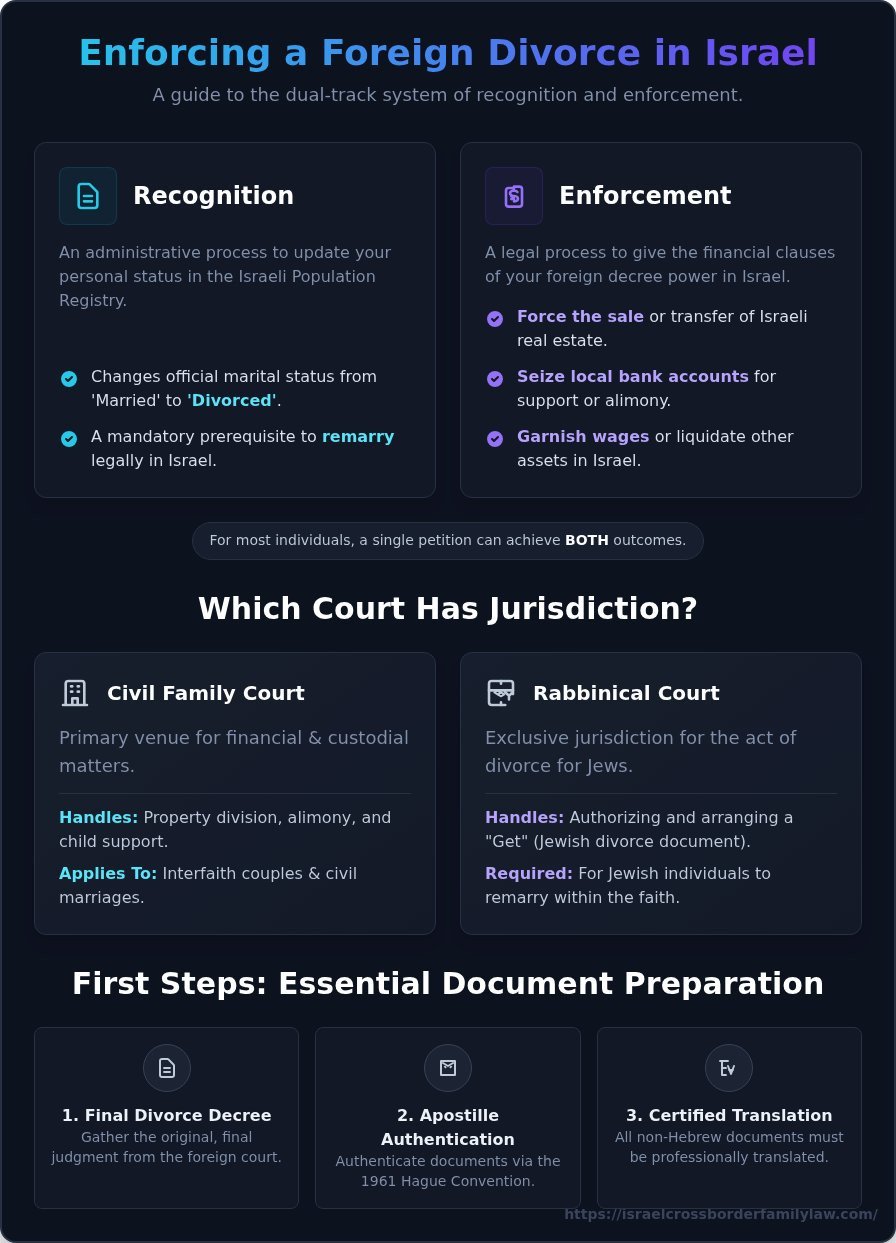
Recognition is primarily an administrative process concerned with your personal status. Its fundamental purpose is to have the State of Israel formally acknowledge your foreign divorce, thereby updating your official record from ‘married’ to ‘divorced’ within the Population Registry, managed by the Ministry of Interior (Misrad HaPnim). This administrative step is critical within the unique legal framework governing Marriage and divorce in Israel and is an absolute prerequisite for actions such as legally remarrying within the country.
What is ‘Enforcement’ of a Foreign Judgment?
Enforcement, in contrast, is the process that gives the financial and operative clauses of your foreign decree legal ‘teeth’ within Israel. Recognition alone does not compel your former spouse to act. The legal procedure to enforce foreign divorce decree Israel is the mechanism required to compel compliance with specific orders, such as:
- Forcing the sale or transfer of Israeli real estate.
- Seizing local bank accounts to satisfy child support or alimony arrears.
- Garnishing wages or liquidating other assets held in Israel.
Without an order of enforcement, the financial stipulations of your foreign divorce are merely declarative and have no binding power in Israel.
Why You Likely Need Both
For the vast majority of individuals with cross-border lives, both recognition and enforcement are necessary. It is the most common scenario to require both an official change in marital status and the execution of financial orders concerning assets or support payments located in Israel. Fortunately, a single, sophisticated legal petition can often be structured to achieve both outcomes simultaneously. Failing to properly enforce foreign divorce decree Israel can leave valuable assets in legal limbo, prevent the collection of vital support payments, and create a complex and costly situation to resolve in the future.
The Legal Framework: Which Israeli Court Has Jurisdiction?
One of the most complex aspects of Israeli family law for foreign nationals is its dual legal system, where civil and religious courts operate in parallel. Determining the correct judicial venue is the foundational step to successfully enforce a foreign divorce decree in Israel. The appropriate court is dictated by the religious affiliation of the parties and the nature of the original marriage, creating a multi-jurisdictional challenge that requires sophisticated legal analysis.
The Role of the Civil Family Court
For the majority of enforcement actions, the Civil Family Court is the primary and appropriate venue. This court holds broad authority over the financial and custodial components of a divorce. Its jurisdiction is essential when dealing with the enforcement of foreign orders concerning property division, spousal support (alimony), and child support payments. As explained by the official Israeli Family Courts administration, their mandate covers all family disputes not exclusively assigned to a religious tribunal. This jurisdiction is particularly clear-cut for interfaith couples or for any couple, regardless of religion, who were married in a civil ceremony abroad.
When is the Rabbinical Court’s Involvement Necessary?
While the Family Court handles financial matters, the Rabbinical Court (Beit Din Rabbanit) maintains exclusive jurisdiction over the act of marriage and divorce for Jewish citizens and residents of Israel. A civil divorce decree issued by a foreign court, while effective for civil purposes, is not sufficient to dissolve a marriage according to Jewish law (Halacha). For Jewish individuals to be considered divorced and free to remarry within the faith, they must obtain a Get, a Jewish divorce document, which can only be arranged and authorized through the Rabbinical Court.
Navigating the Dual System: A Practical Approach
A successful strategy often involves a two-pronged approach. The process typically begins by filing an action in the Family Court to recognize and enforce the financial and custodial provisions of the foreign decree. Concurrently or subsequently, proceedings are initiated in the Rabbinical Court to arrange for the issuance and acceptance of the Get. This ensures that the divorce is recognized both civilly and religiously, providing complete legal and personal finality. Navigating this dual system requires expert guidance. Contact our firm.
Step-by-Step Guide to Enforcing Your Foreign Decree in Israel
Navigating the Israeli legal system to recognize a foreign judgment is a structured process that demands meticulous attention to detail. The objective is not to re-litigate your divorce but to have the Israeli courts formally acknowledge and grant legal effect to the decree issued in another country. This transformation is essential for matters of personal status, property rights, and child custody within Israel. Successfully completing this multi-phase journey is the core of the challenge when you need to enforce foreign divorce decree Israel.
Phase 1: Document Preparation and Legal Translation
The foundation of a successful enforcement action is a flawlessly prepared documentary portfolio. This initial phase involves gathering all essential legal documents, chief among them being the original, final divorce decree. A critical and non-negotiable requirement is the authentication of these public documents via an Apostille, pursuant to the 1961 Hague Convention. Once authenticated, every single document not originally in Hebrew must be translated by a certified Israeli notary. This is not a mere translation but a legally binding certification that the Hebrew text is a true and accurate reflection of the original.
Phase 2: Filing a Claim with the Appropriate Court
With a complete and certified dossier, the next step is to initiate formal legal proceedings. This is accomplished by drafting and filing a “Statement of Claim” (Ktav Tvi’a) with the appropriate Israeli Family Court. This sophisticated legal document formally petitions the court to recognize and declare the foreign judgment enforceable. Following the filing, the claim and all supporting documents must be properly served upon the other party (the respondent), a crucial step that ensures compliance with the principles of due process and provides them an opportunity to respond.
Phase 3: The Court Hearing and Judgment
The court hearing is not a retrial of the divorce. Instead, the judge’s role is to verify that specific legal conditions have been met, as stipulated by Israel’s Foreign Judgments Enforcement Law of 1958. This legal framework is a cornerstone for enforcing foreign orders in Israel. The court will typically confirm that:
- The foreign court that issued the decree had the proper international jurisdiction to do so.
- The judgment is final and is no longer subject to appeal in its country of origin.
- The decree’s enforcement would not contradict Israeli public policy or sovereignty.
- The judgment was obtained with due process afforded to both parties.
Upon satisfaction of these conditions, the Israeli court will issue its own judgment. This final order declares the foreign decree enforceable, granting it the same legal validity and power as a divorce decree issued natively by an Israeli court.
Core Requirements Under the Foreign Judgments Enforcement Law, 1958
The enforcement of a foreign judgment in Israel is not an automatic process; it is governed by a specific statutory framework. The Foreign Judgments Enforcement Law, 1958, provides the legal foundation, establishing a series of mandatory conditions that a foreign divorce decree must satisfy to be recognized and made enforceable by an Israeli court. Navigating these requirements demands meticulous attention to detail, as failure to meet even one condition can result in the rejection of your application.
The 5 Legal Conditions for Enforcement
For an Israeli Family Court to grant an enforcement order, the foreign divorce decree must meet five critical statutory tests. These conditions are designed to ensure that the judgment was obtained fairly and that its enforcement aligns with Israeli legal principles.
- 1. Proper Jurisdiction: The decree must have been issued by a court that held competent jurisdiction according to the laws of the country where it was given. The Israeli court will not re-litigate the case but will verify the foreign court’s authority.
- 2. Finality of Judgment: The judgment must be final and no longer subject to appeal in its country of origin. A decree that can still be challenged or overturned is not considered ripe for enforcement in Israel.
- 3. Compatibility with Israeli Law: While the grounds for divorce may differ, the obligation created by the decree must be one that is enforceable under Israeli law. Furthermore, the content of the judgment must not be contradictory to Israeli law.
- 4. Adherence to Public Policy: Enforcing the decree must not contradict the public policy, security, or sovereignty of the State of Israel. A judgment that violates fundamental principles of justice or morality will not be upheld.
- 5. Reciprocal Enforceability: The judgment must be enforceable in the jurisdiction where it was originally granted. It cannot be a dormant or expired order.
Essential Document Checklist
A successful application to enforce a foreign divorce decree in Israel is heavily reliant on complete and accurate documentation. Your petition to the Family Court must be supported by a comprehensive file that includes the following:
- An original or a certified copy of the foreign divorce decree, authenticated with an Apostille stamp pursuant to the Hague Convention.
- A complete and certified translation of the foreign decree into Hebrew, prepared by a qualified notary.
- Verifiable proof that the other party (the respondent) was properly served and notified of the original court proceedings abroad, ensuring their right to due process was respected.
- A detailed legal affidavit, signed by you as the plaintiff, which outlines the facts of the case and confirms that the conditions for enforcement have been met.
- Proof of payment for the court filing fee, payable in Israeli Shekels (ILS).
The complexity of assembling this evidence and presenting a compelling case underscores the value of expert legal guidance. Our firm specializes in advising clients through every stage of this sophisticated cross-border process. For a confidential consultation, please contact our team of experienced attorneys.
Common Challenges and Strategic Solutions
Navigating the legal framework to enforce foreign divorce decree Israel can present sophisticated challenges that require strategic foresight and deep jurisdictional knowledge. While the process is structured, potential obstacles can arise, causing significant delays and complications. Understanding these potential pitfalls is the first step toward overcoming them, and securing experienced legal counsel is the most effective strategy for ensuring a successful outcome.
Challenge: The Other Party Objects to Enforcement
It is not uncommon for the other party to contest the enforcement of a foreign judgment. Objections are typically filed in a ‘Statement of Defense’ and may be based on several grounds, such as asserting the foreign court lacked proper jurisdiction, alleging the decree was obtained by fraud, or claiming inadequate notice of the original proceedings. Our legal team is adept at preemptively addressing and systematically countering these claims in court, presenting compelling evidence and legal arguments to validate the foreign decree and dismantle any opposition.
Challenge: The Decree Contradicts Israeli ‘Public Policy’
An Israeli court will not enforce a foreign judgment, or any part of it, that fundamentally contradicts Israel’s public policy (takkanat hatzibur). This doctrine is most often invoked in matters concerning child welfare. For example, a custody arrangement from a foreign decree that is deemed harmful to a child’s best interests or violates fundamental principles of justice will not be upheld. In such complex situations, our attorneys can argue for partial enforcement, strategically working to have the compliant sections of the decree recognized while addressing the contentious clauses separately.
The Importance of Proactive Legal Counsel
Attempting this multi-jurisdictional process without professional guidance is fraught with risk. Simple procedural errors, improperly authenticated documents, or a failure to present a persuasive case can lead to the dismissal of your application, costing you valuable time and resources. The value of an experienced attorney lies in their ability to ensure every document is meticulously prepared and every legal argument is strategically sound. We provide the authoritative guidance necessary to navigate the complexities of Israeli family law and international treaties. Avoid costly mistakes. Schedule a consultation to discuss your case.
Strategic Enforcement: Finalizing Your Foreign Divorce in Israel
Navigating the Israeli legal system to finalize the terms of a foreign divorce is a multi-faceted process demanding precision and strategic insight. As we’ve detailed, successfully enforcing your decree hinges on a clear understanding of the distinction between recognition and enforcement, adherence to the strict requirements of the Foreign Judgments Enforcement Law, 1958, and proficiently navigating the jurisdiction of the Family Affairs Court. The path to enforce foreign divorce decree israel is intricate, but with the correct legal guidance, it is entirely achievable.
Given the complexities of these multi-jurisdictional cases, securing expert legal counsel is paramount. Our firm offers deep expertise in both US and Israeli family law, backed by a proven track record in resolving sophisticated cross-border disputes. Our bilingual attorneys, fluent in both Hebrew and English, are uniquely positioned to bridge the legal and cultural divide, ensuring a seamless process. For expert guidance on enforcing your foreign divorce decree, contact our cross-border family law specialists today. Let us provide the authoritative support you need to move forward with confidence.
Frequently Asked Questions
How long does it take to enforce a foreign divorce decree in Israel?
The timeline for enforcing a foreign divorce decree is not fixed and is contingent upon several variables, including case complexity, court caseload, and the cooperation of the respondent. A straightforward case may conclude within six to twelve months. However, contested matters involving significant assets or complex custodial issues can extend the process considerably. Engaging experienced counsel is critical to navigating the Israeli Family Court system efficiently and mitigating potential delays in these cross-border proceedings.
What are the estimated legal costs and court fees for this process?
The financial investment for this legal process comprises two main components: statutory court fees and professional legal fees. Court filing fees are generally modest, typically amounting to several hundred shekels. Legal fees, however, are more substantial and reflect the complexity of the multi-jurisdictional matter. A comprehensive retainer can range from ₪15,000 to over ₪50,000, depending on the anticipated litigation, the nature of the assets involved, and whether the enforcement is contested by the other party.
Can I enforce a decree from any country, or only specific ones?
Israel generally recognizes and enforces final judgments from foreign courts, provided the country of origin has a functioning legal system and maintains diplomatic relations with Israel. The primary conditions for enforcement are that the foreign court had proper jurisdiction, the judgment is no longer appealable, and its enforcement does not contradict Israeli public policy. Our firm has extensive experience advising on the nuances of decrees from a wide range of global jurisdictions.
What happens if my ex-spouse has moved and is difficult to locate in Israel?
Locating a respondent is a critical preliminary step for the proper service of process, a challenge our firm is well-equipped to handle. We leverage a network of professional private investigators and utilize official channels, such as inquiries with the Population and Immigration Authority, to ascertain a current address. Should direct service prove impossible, we are adept at petitioning the court for alternative methods of service, ensuring the legal process can proceed without undue delay.
Can I enforce only specific parts of my divorce agreement, like child support?
Yes, it is both possible and common to enforce a foreign divorce decree in Israel by targeting specific, severable components. The legal system allows for the selective enforcement of monetary judgments, such as child support arrears or property division orders, without relitigating the entire divorce. This targeted approach provides an efficient mechanism for securing financial compliance from a party in Israel, ensuring your rights under the original multi-jurisdictional judgment are upheld in accordance with Israeli law.
Does Israel recognize and enforce prenuptial agreements from the United States?
Israeli courts generally recognize and will enforce a prenuptial agreement validly executed in the United States, provided two key conditions are met. First, the agreement must be legally valid and enforceable in the U.S. jurisdiction where it was created. Second, its terms must not contravene Israeli public policy. The court will undertake a sophisticated analysis to confirm its validity abroad before giving it legal effect in Israel, a process where our cross-border expertise is invaluable.

Article by
Gabriel Lior
A Personal Journey That Became a Mission
The advisory was founded by an American father Gabriel Lior, LLB, MBA , global entrepreneur, and cross-border advisor who spent more than a decade navigating the Israeli family court system firsthand and now lives in Singapore with his son.
As a divorced parent in a cross-border family, Gabriel faced nearly every legal challenge a foreign parent can encounter in Israel — including child custody disputes, child support proceedings, property matters in Israel and abroad, false accusations, and complex immigration and relocation proceedings.
Over the years, he learned the hard way how difficult it is for non-Israeli parents to understand the system, identify the right legal strategy, and choose the right legal representation — especially when language, culture, and jurisdictional differences are involved. He also witnessed how foreign parents and new immigrants are often disadvantaged or taken advantage of by service providers and institutions simply because they lack local knowledge or fluency.
From Client to Advisor
To truly understand — and survive — the system, Gabriel pursued formal legal education in Israel, completing two Israeli law degrees, alongside a BA and MBA earned in the United States. This was never about becoming a practicing attorney, but about gaining a deep, structural understanding of how the system works — and where it breaks down for foreign parents.
This rare combination of:
Firsthand client experience
Israeli legal and US business education
International business and negotiation training
Decades of commercial execution
created a unique perspective – one that understands both sides of the table.
After years of litigation, persistence, and at times self-representation, he ultimately succeeded in securing custody of his son and relocating abroad through a rare legal victory in the Israeli Supreme Court — becoming one of the first fathers in Israel to do so under these circumstances.
Disclaimer
Important Disclaimer:
The information provided on this website and in its content is for general informational and educational purposes only and does not constitute legal advice, legal opinion, or legal representation.
Gabriel Lior is not licensed to practice law in Israel (nor is he interested in doing so) and does not provide legal services, despite having completed 2 Law Degrees. The services offered are advisory in nature and are intended to provide general guidance, strategic insight, and information regarding cross-border family law considerations.
No attorney-client relationship is formed by accessing this website, reading its content, or communicating with us.
Any decisions made based on this information are at your own discretion and risk. For legal advice specific to your situation, you should consult a licensed attorney in the relevant jurisdiction.
Where appropriate, we may refer clients to independent, licensed attorneys or professionals. Such referrals do not constitute legal representation and no liability is assumed for services provided by third parties.