Facing a custody dispute that crosses international borders, particularly between the U.S. and Israel, is an exceptionally daunting challenge. The fear of losing contact with your child, compounded by the complexities of navigating two distinct legal systems, can make the emotional and financial toll feel insurmountable. Achieving peace of mind during an international custody battle may seem impossible when you are fighting for your rights from another country, feeling overwhelmed and uncertain of the path forward. This comprehensive guide is engineered to restore your sense of control. We provide actionable legal and emotional strategies, offering a sophisticated, step-by-step plan to confidently navigate the complexities of a US-Israel custody dispute. Our purpose is to equip you with the strategic knowledge required to protect your parental rights, ensure your child’s well-being is prioritized above all else, and work towards a fair custody arrangement without endless conflict. You will learn how to move from a position of uncertainty to one of empowered, informed action.
Understanding the Battlefield: Key Factors in US-Israel Custody Disputes
Facing a multi-jurisdictional custody dispute between the United States and Israel is an immensely stressful experience, characterized by uncertainty and emotional turmoil. The first step toward regaining control and achieving peace of mind during an international custody battle is to develop a clear understanding of the legal landscape. The complex rules governing these cases are not insurmountable obstacles; rather, they are the framework within which a successful strategy is built. Mastering these core concepts is essential for navigating the path ahead. To better understand the foundational principles of child custody, this overview may provide valuable insight:
Jurisdiction: Where Will Your Case Be Heard?
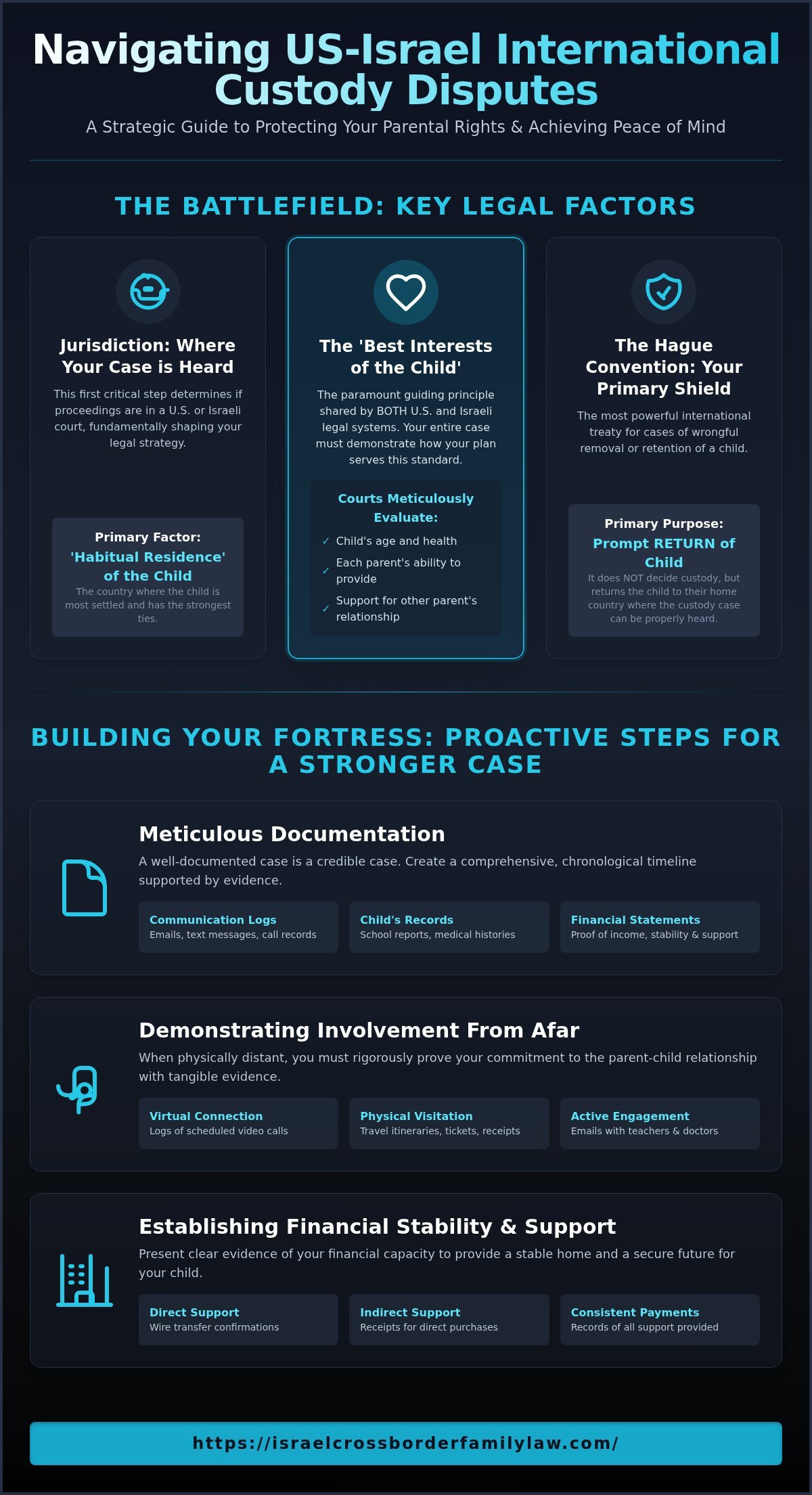
The critical first determination in any cross-border custody matter is jurisdiction-the authority of a court to hear the case. Whether proceedings are held in a US state court or an Israeli family court will fundamentally shape your legal strategy. This decision typically hinges on the child’s ‘habitual residence,’ the country where the child is most settled and has the strongest ties. Initiating simultaneous proceedings without a coordinated strategy can lead to conflicting orders and significant complications. Getting this foundational step right is crucial for securing any peace of mind during an international custody battle.
The ‘Best Interests of the Child’ Standard Across Borders
Both the American and Israeli legal systems share a paramount guiding principle: all custody decisions must be made in the ‘best interests of the child.’ Courts in both nations will meticulously evaluate a range of factors to determine the most stable and nurturing environment. These considerations often include the child’s age and health, each parent’s ability to provide for the child’s needs, and the willingness of each parent to support the other’s relationship with the child. Your entire case must be constructed to demonstrate how your proposed arrangement serves this fundamental standard, which is the cornerstone of finding resolution and peace of mind during an international custody battle.
The Hague Convention as Your Primary Shield
For parents facing the wrongful removal or retention of a child, the Hague Convention on the Civil Aspects of International Child Abduction is the most powerful international treaty available. Its primary purpose is not to decide custody but to secure the prompt return of a child to their country of habitual residence, where the proper custody case can then be heard. For many parents, invoking the Convention is the first concrete step toward finding peace of mind during an international custody battle, as it prevents a parent from gaining an unfair advantage by unilaterally changing a child’s country of residence. For a more thorough analysis, please see our detailed guide on The Hague Convention on Child Abduction.
Building Your Fortress: Proactive Steps for a Stronger Case
In the face of a complex international custody dispute, the natural response is often one of reactive fear. However, achieving a successful outcome and gaining a measure of peace of mind during an international custody battle requires a strategic shift to proactive preparation. The actions you take today-organizing evidence, documenting involvement, and demonstrating stability-build the foundational fortress for your legal case. Courts in these multi-jurisdictional matters rely heavily on clear, verifiable evidence to make determinations in the child’s best interest.
The Critical Role of Meticulous Documentation
A well-documented case is a credible case. We advise clients to construct a comprehensive and chronological timeline of key events, from the relationship’s history to the current dispute. Each point on this timeline should be substantiated with supporting evidence, creating an undeniable record of your parental role. Understanding the legal framework you are operating within is also critical; authoritative sources like the U.S. Department of State international child abduction resources provide essential context for cases involving the United States. Essential documents to collate include:
- Communication Logs: Detailed records of all emails, text messages, and call logs with the other parent.
- Child’s Records: School reports, medical histories, and attendance records that show your involvement.
- Financial Statements: Proof of income, stability, and any financial support provided for the child.
Demonstrating Parental Involvement From Afar
When physical distance is a factor, you must rigorously document your efforts to maintain a strong parent-child relationship. This is not merely about stating your commitment; it is about proving it with tangible evidence. This includes maintaining logs of scheduled video calls, retaining travel itineraries and receipts from visitation trips, and saving email correspondence with teachers and doctors regarding your child’s welfare. This consistent, documented engagement powerfully demonstrates to the court that your emotional bond and parental responsibility transcend international borders.
Establishing Financial Stability and Support
A court’s primary concern is the child’s well-being, which includes ensuring their financial needs are met. It is imperative to present clear evidence of your financial capacity to provide a stable home and a secure future. Systematically document all financial support you have provided, including wire transfer confirmations, receipts for direct purchases made for the child, and records of any payments in ILS or other relevant currencies. Proving consistent support reinforces your position as a responsible and capable parent. Our firm possesses deep experience in navigating the complexities of cross-border child support enforcement, ensuring these critical obligations are properly addressed within the legal framework.
Managing High-Conflict Communication Strategically
In any complex, multi-jurisdictional family law matter, communication between parents is a primary source of stress and a significant legal vulnerability. Emotional, accusatory, or inconsistent messages can be used to portray you unfavorably in Israeli or international courts. Adopting a strategic approach to all correspondence is therefore not merely advisable; it is essential for protecting your parental rights and your child’s well-being. The objective is to de-escalate conflict while methodically building a clear, factual, and unimpeachable record. Achieving peace of mind during an international custody battle often begins with controlling what you can-your own communication.
The ‘BIFF’ Method: Brief, Informative, Friendly, and Firm
This court-approved communication model provides a robust framework for all written exchanges. By structuring your emails and texts to be non-antagonistic and focused solely on child-related logistics, you create a record of being a reasonable and cooperative parent.
- Poor Communication: “You can’t just decide to change the travel plans! You are always doing this to undermine me. It’s not fair to our daughter.”
- Strategic (BIFF) Communication: “Thank you for the update. Per the court order, the flight for her return to Israel must be a direct flight. Please provide the updated itinerary by Friday so I can confirm the travel arrangements. Thanks.”
This strategic response is brief, contains only necessary information, maintains a neutral and friendly tone, and firmly states the required action and deadline.
Using Co-Parenting Apps for an Indisputable Record
To further secure your legal position, we strongly advise clients to use specialized co-parenting applications like OurFamilyWizard or AppClose. These platforms move critical communication away from standard text messages and email into a secure, unified environment. Every message is time-stamped and cannot be altered or deleted, creating an official log admissible in court. Key features often include shared calendars for visitation, expense tracking for child-related costs in ILS, and information storage for medical or school records, all of which contribute to your peace of mind during an international custody battle by minimizing disputes.
Shielding Your Child from the Legal Conflict
It is of paramount importance to insulate your child from the adult disputes inherent in a cross-border custody case. Involving a child, whether by speaking negatively about the other parent or discussing case details, can cause significant psychological harm. Israeli Family Courts, like their international counterparts, view any form of parental alienation with extreme seriousness. Demonstrating that you are actively protecting your child’s emotional health and fostering their relationship with the other parent is a critical component of a successful custody strategy and is central to acting in the child’s best interests. [ Download ](https://getautoseo.com/screenshots/getautoseocom_1769566116_QxwdwT4U.jpg) Feedback & Recreate Delete 
Assembling Your Team: Why Specialized Legal Counsel is Your Greatest Asset
When facing a multi-jurisdictional family law dispute, viewing legal representation as a mere cost is a fundamental miscalculation. Engaging specialized counsel is a strategic investment in a favorable outcome and, critically, in your own peace of mind during an international custody battle. International family law, particularly between the U.S. and Israel, is a sophisticated and highly niche field. An expert legal team is structured to manage this immense complexity, navigating international treaties like the Hague Convention alongside domestic court procedures, thereby allowing you to focus your energy where it matters most: on your child’s well-being.
Navigating Two Legal Systems and Cultures
A successful strategy requires absolute fluency in both U.S. and Israeli family law. Counsel must not only understand the statutes but also the procedural and cultural nuances of each country’s family court system-from evidentiary standards in a California court to the role of social workers in an Israeli proceeding. An attorney with deep cross-border experience acts as an essential bridge, translating legal requirements and cultural expectations to ensure your case is presented effectively and respectfully in both jurisdictions.
What to Demand from Your Cross-Border Family Lawyer
Your choice of legal representation will directly impact the trajectory of your case. Demand a firm that demonstrates not just competence, but mastery in this specific arena. Key criteria should include:
- Specific, Verifiable Experience: A proven track record of successfully handling U.S.-Israel custody and child abduction cases.
- Strategic Thinking: A proactive advisor who anticipates moves and builds a long-term strategy, rather than a litigator who simply reacts to filings.
- Clear and Consistent Communication: A commitment to keeping you informed and demystifying the complex legal process at every stage.
Understanding the methodology behind a firm’s approach is crucial. We invite you to learn about how our process works to provide clients with clarity and confidence from day one.
From Legal Strategy to Emotional Stability
The anxiety inherent in these disputes is often magnified by uncertainty. A clear, well-articulated legal plan directly mitigates this stress. Knowing that a seasoned expert is managing critical deadlines, multi-jurisdictional filings, and international communications provides the stability needed to endure this challenging period. The right lawyer offers realistic, grounded expectations, which is fundamental to maintaining your mental balance and achieving lasting peace of mind during an international custody battle. For a confidential consultation, contact our team of cross-border specialists.
Protecting Your Well-being: Mental and Emotional Resilience
In the complex and emotionally demanding arena of multi-jurisdictional family law, your personal well-being is not a luxury; it is a core strategic asset. A parent who is calm, rational, and composed is invariably a more effective client and, most importantly, a more stable presence for their child. Maintaining your emotional equilibrium is fundamental to navigating the protracted legal process with clarity and purpose. The objective is not to eliminate stress, but to manage it with sophisticated strategies that preserve your strength and focus, contributing directly to achieving peace of mind during an international custody battle.
Building Your Personal Support Network
Navigating this legal challenge in isolation can lead to significant emotional burnout, which can impair judgment. We strongly advise our clients to build a robust support system. This should include trusted friends and family who can provide emotional grounding, as well as professional support from a qualified therapist experienced in high-conflict family situations. Furthermore, connecting with formal support groups for parents in similar cross-border disputes can offer invaluable perspective and a sense of community, mitigating feelings of isolation.
Focusing on What You Can Control
A critical mindset shift involves delineating between factors within your sphere of influence and those that are external. This strategic focus moves you from a position of helplessness to one of empowerment. Concentrate your energy on:
- Your Preparation: Diligently gathering documents and working closely with your legal team.
- Your Communication: Maintaining a composed, factual, and respectful tone in all correspondence.
- Your Self-Care: Prioritizing sleep, nutrition, and physical activity to maintain resilience.
Conversely, acknowledge and release your attachment to uncontrollable variables, such as the other parent’s behavior, court administrative timelines, or the judicial temperament of a specific judge. This disciplined focus is key to your endurance.
Setting Boundaries for Your Mental Health
To prevent legal matters from consuming your life, it is essential to establish and enforce firm boundaries. Designate specific, scheduled times each day or week to address case-related tasks and communications with your legal counsel. Outside of these windows, consciously disengage. We recommend limiting your exposure to social media and discussions with mutual acquaintances that may provoke anxiety. Maintaining hobbies, professional responsibilities, and daily routines provides a crucial sense of normalcy and stability for both you and your child. Ultimately, safeguarding your mental and emotional health is a direct investment in your child’s well-being and the successful outcome of your case. Our firm is committed to guiding you through every facet of this complex process, providing the legal and strategic support necessary to secure your peace of mind during an international custody battle. For comprehensive guidance tailored to your unique situation, we invite you to contact our experienced team.
Achieving Stability in Complex Cross-Border Disputes
Navigating a multi-jurisdictional custody dispute between the United States and Israel demands a comprehensive strategy that encompasses proactive case preparation, strategic communication, and a steadfast commitment to your own resilience. Ultimately, achieving peace of mind during an international custody battle is intrinsically linked to the caliber and specialization of your legal counsel. The right team transforms uncertainty into a structured, forward-moving plan. With decades of combined experience in US-Israel cross-border family law, our team of bilingual and bicultural attorneys, licensed in both jurisdictions, is uniquely positioned to guide you through this complex process. We employ a strategic, client-focused approach designed to reduce conflict and achieve your objectives. Take the decisive first step towards protecting your parental rights and restoring stability for your family. Request a Confidential Case Review to Secure Your Peace of Mind
Frequently Asked Questions About International Custody
What are my first steps if I fear my co-parent will take my child to Israel/US without permission?
Immediate, decisive action is paramount. You must engage experienced cross-border legal counsel to petition the appropriate court for an emergency order. In Israel, this is an Exit Prevention Order (Tzav Ikuv Yetzia); in the US, a Temporary Restraining Order. Secure your child’s passports and document any threats. Taking these preemptive measures is the most critical step toward securing your legal position and achieving peace of mind during an international custody battle.
What if false allegations are made against me in a foreign court?
It is imperative that you do not ignore any allegations, regardless of their validity. You must retain qualified local counsel within that specific foreign jurisdiction to represent your interests and formally respond. Your legal team will guide you in systematically gathering and presenting evidence-such as communications, financial records, and witness testimony-to build a robust defense and counter the claims within the complex framework of that country’s legal system, ensuring your rights are vigorously protected.
How long does an international custody case typically take, and what are the costs?
The timeline for multi-jurisdictional custody litigation is highly variable, often ranging from several months to over two years. The duration depends on the complexity of the case, the level of cooperation between parties, and court backlogs in both Israel and the US. Costs are substantial, with legal fees in Israel potentially ranging from ₪30,000 to over ₪150,000, contingent on the specific demands of the case, including the need for expert witnesses and extensive discovery.
Can I get a temporary order to prevent my child from being relocated?
Yes, obtaining a temporary or emergency order is a standard and vital preventative strategy. In both Israeli and US courts, you can file an ex-parte motion to prohibit the other parent from removing the child from the jurisdiction pending a full hearing. These orders, designed to maintain the status quo and protect the child, can be secured rapidly with proficient legal action, providing a critical safeguard against the threat of international parental child abduction.
How do Israeli and US courts handle requests for parental relocation with a child?
Both Israeli and US judicial systems prioritize the “best interests of the child” as the determinative standard. Courts conduct a sophisticated analysis of numerous factors, including the relocating parent’s motives, the potential impact on the child’s relationship with the non-relocating parent, and the child’s existing ties to their community and school. Israeli courts, in particular, place significant weight on preserving the child’s stable connection with both parents when evaluating such a complex, life-altering request.
What role does my child’s preference play in the court’s decision?
A child’s stated preference is a relevant factor, but it is rarely the sole determinant in a custody or relocation decision. The weight afforded to the child’s wishes is directly correlated with their age and level of maturity. In these sensitive, cross-border matters, courts in both Israel and the US may appoint a neutral professional, such as a social worker or custody evaluator, to ascertain the child’s genuine, uninfluenced views and report them to the court for consideration.

Article by
Gabriel Lior
A Personal Journey That Became a Mission The advisory was founded by an American father Gabriel Lior, LLB, MBA , global entrepreneur, and cross-border advisor who spent more than a decade navigating the Israeli family court system firsthand and now lives in Singapore with his son.
As a divorced parent in a cross-border family, Gabriel faced nearly every legal challenge a foreign parent can encounter in Israel — including child custody disputes, child support proceedings, property matters in Israel and abroad, false accusations, and complex immigration and relocation proceedings. Over the years, he learned the hard way how difficult it is for non-Israeli parents to understand the system, identify the right legal strategy, and choose the right legal representation — especially when language, culture, and jurisdictional differences are involved. He also witnessed how foreign parents and new immigrants are often disadvantaged or taken advantage of by service providers and institutions simply because they lack local knowledge or fluency. From Client to Advisor To truly understand — and survive — the system, Gabriel pursued formal legal education in Israel, completing two Israeli law degrees, alongside a BA and MBA earned in the United States. This was never about becoming a practicing attorney, but about gaining a deep, structural understanding of how the system works — and where it breaks down for foreign parents. This rare combination of: Firsthand client experience Israeli legal and US business education International business and negotiation training Decades of commercial execution created a unique perspective – one that understands both sides of the table. After years of litigation, persistence, and at times self-representation, he ultimately succeeded in securing custody of his son and relocating abroad through a rare legal victory in the Israeli Supreme Court — becoming one of the first fathers in Israel to do so under these circumstances.
Disclaimer
Important Disclaimer: The information provided on this website and in its content is for general informational and educational purposes only and does not constitute legal advice, legal opinion, or legal representation. Gabriel Lior is not licensed to practice law in Israel (nor is he interested in doing so) and does not provide legal services, despite having completed 2 Law Degrees. The services offered are advisory in nature and are intended to provide general guidance, strategic insight, and information regarding cross-border family law considerations. No attorney-client relationship is formed by accessing this website, reading its content, or communicating with us. Any decisions made based on this information are at your own discretion and risk. For legal advice specific to your situation, you should consult a licensed attorney in the relevant jurisdiction. Where appropriate, we may refer clients to independent, licensed attorneys or professionals. Such referrals do not constitute legal representation and no liability is assumed for services provided by third parties.