For a custodial parent in the United States, a court-issued child support judgment represents a legal promise for their child’s financial security. When the obligor parent resides in Israel, however, that judgment can feel powerless-a distant decree lost in a complex and unfamiliar legal jurisdiction. The inherent challenges of cross-border family law often leave parents feeling uncertain about where to begin and concerned that the financial support their child is rightfully owed will remain uncollected.
This comprehensive guide is designed to eliminate that uncertainty. We provide an authoritative, step-by-step legal roadmap to successfully enforce a US child support order in Israel, navigating the intricate framework of international treaties and domestic Israeli law. By following this guide, you will gain a clear understanding of the precise procedures for having your U.S. judgment recognized and executed by Israeli courts, transforming it into a powerful, enforceable instrument that ensures your child receives the consistent support they are entitled to.
The Legal Framework: Why Your U.S. Order is Enforceable in Israel
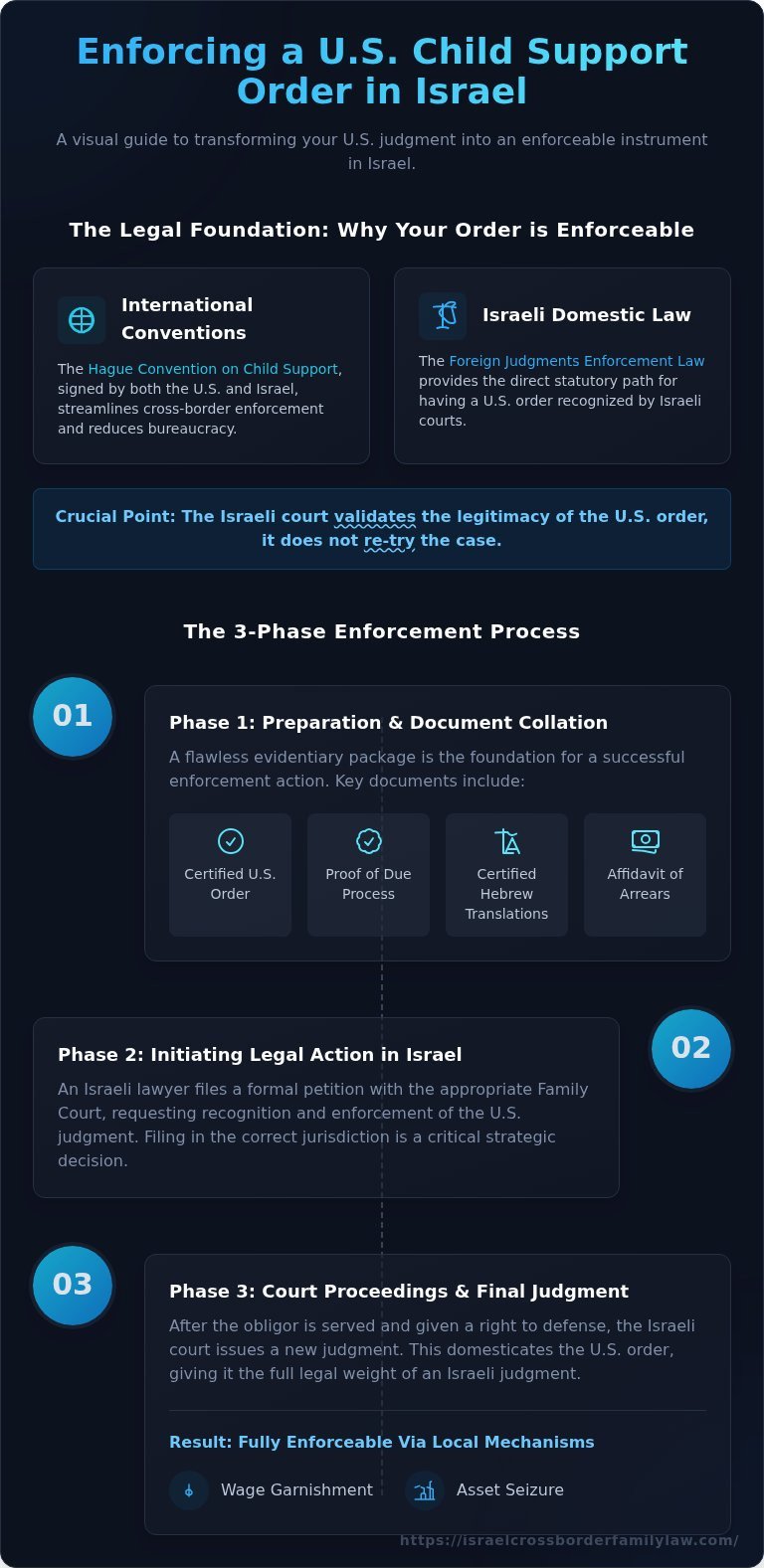
A common concern for custodial parents is whether a child support judgment issued by a U.S. court holds any legal authority in Israel. The answer is unequivocally yes. Israel’s legal system provides a robust framework for the recognition and enforcement of foreign civil judgments, including those pertaining to child support. It is crucial to understand that this process is not a re-trial of your case. The Israeli court will not re-examine the evidence or question the amount of support awarded. Instead, its role is to validate the legitimacy of the U.S. order, ensuring it was granted by a competent court and meets the necessary criteria for enforcement under Israeli law.
To better understand the practical application of these legal principles, the following overview is highly informative:
International Conventions and Bilateral Agreements
The foundation for cross-border cooperation is built on international law. Both the United States and Israel are signatories to the Hague Convention on the International Recovery of Child Support and Other Forms of Family Maintenance. This critical treaty streamlines the multi-jurisdictional process, making it more straightforward to enforce us child support order israel by establishing standardized procedures and direct lines of communication between the central authorities of member nations. This framework significantly reduces the bureaucratic and legal complexities that once hindered international enforcement, creating a more efficient path for families seeking financial support.
Key Israeli Domestic Law: The Foreign Judgments Enforcement Law
The primary domestic statute governing this process is Israel’s Foreign Judgments Enforcement Law, 5718-1958. This law provides the clear, statutory path to enforce us child support order israel by having it declared enforceable by a competent Israeli court. For a U.S. order to be recognized, it must generally satisfy several key conditions:
- The judgment was given by a court with the proper international jurisdiction.
- The judgment is no longer appealable in the United States (i.e., it is a final order).
- The obligation is enforceable under the laws of the state where it was issued and its enforcement does not contradict Israeli public policy.
Once these conditions are met and the order is recognized, it carries the same legal weight as a judgment issued by an Israeli court. It will then be enforced within the context of local procedures and Israeli child support laws, ensuring your rights are protected and upheld.
The Enforcement Process: A Step-by-Step Guide
Successfully navigating the legal framework to enforce a US child support order in Israel is not an administrative task but a formal judicial procedure. It demands meticulous preparation and representation by qualified legal counsel within the Israeli court system. This multi-jurisdictional process requires a methodical approach to transform a foreign decree into a locally enforceable judgment. The steps outlined below, which are reflected in the U.S. government’s official enforcement process guide, provide a clear roadmap for this complex undertaking.
Phase 1: Preparation and Document Collation
The foundation of a successful enforcement action is a comprehensive and flawlessly prepared evidentiary package. Before any legal action can commence in Israel, your legal team must assemble and verify a portfolio of critical documents. This preparatory phase is non-negotiable and directly impacts the efficiency of the subsequent court proceedings. Key documents include:
- A Certified Copy of the U.S. Order: Obtain an exemplified or certified copy of the final child support judgment from the originating U.S. court.
- Proof of Due Process: Collect evidence demonstrating that the non-paying parent (the obligor) was properly served with the original U.S. court documents and had an opportunity to participate in the proceedings.
- Certified Hebrew Translations: All essential legal documents, including the court order and affidavits, must be translated into Hebrew by a certified notary translator.
- Affidavit of Arrears: You must prepare a sworn affidavit that clearly details the history of payments, the total amount of arrears owed, and any other relevant circumstances.
Phase 2: Initiating Legal Action in Israel
With the documentary evidence collated, your Israeli lawyer will initiate formal legal proceedings by filing a petition with the appropriate Family Court in Israel. This petition formally requests that the Israeli court recognize the U.S. judgment as valid and issue a corresponding order to enforce it locally. Filing in the correct jurisdiction-typically where the obligor resides or works-is a critical strategic decision. The court will then conduct an initial review of the submitted file to ensure all procedural requirements have been met before the case proceeds.
Phase 3: The Israeli Court Proceedings
Once the petition is accepted, the Israeli legal process unfolds. The obligor is formally served with the lawsuit and is given a legal right to file a defense against the enforcement action. While defenses are limited, the court may schedule a hearing to consider arguments from both parties. This stage underscores the necessity of having experienced Israeli counsel to represent your interests and counter any legal challenges. The culmination of this process is the issuance of a new judgment by the Israeli court, which legally recognizes and domesticates the U.S. child support order, making it fully enforceable through local mechanisms like wage garnishment or asset seizure.
Crucial Requirements for a U.S. Order to be Enforceable
The Israeli legal system does not automatically domesticate every foreign judgment. Before an Israeli court will recognize and enforce a U.S. child support order, the order itself must satisfy a series of stringent legal criteria stipulated by Israel’s Foreign Judgments Enforcement Law, 5718-1958. Understanding these prerequisites is the foundational step in building a successful enforcement strategy and allows for a preliminary assessment of the strength of your case. Successfully navigating this process is paramount when seeking to enforce us child support order israel.
Failure to meet any of these core requirements can result in the dismissal of the enforcement application, leading to significant delays and additional costs. Our firm provides sophisticated guidance in evaluating your U.S. order against these critical Israeli legal standards.
Jurisdiction and Finality of the U.S. Court
First and foremost, the U.S. court that issued the child support order must have possessed proper jurisdiction over the matter and the parties involved, according to Israeli private international law rules. Furthermore, the order must be final and conclusive. This means it is no longer subject to appeal in the United States. While future child support obligations may be modifiable, a judgment for a specific sum of accumulated arrears is typically considered a final money judgment and is therefore enforceable.
Due Process and Public Policy Considerations
The enforcement action must align with fundamental principles of justice. This requires demonstrating that the defendant (the paying parent) was afforded due process in the original U.S. proceedings, including receiving reasonable notice and having an opportunity to be heard. Additionally, the substance of the U.S. order cannot contradict the public policy of Israel. Fortunately, an order compelling a parent to provide financial support for their child is fundamentally consistent with Israeli public values, making this a rare obstacle in child support cases.
The Principle of Reciprocity
A key element in this cross-border legal analysis is the principle of reciprocity. Israeli courts require confirmation that the courts in the originating jurisdiction-the specific U.S. state-would enforce a similar judgment from an Israeli court. This requirement is generally satisfied, as the legal framework for mutual enforcement is well-established through official U.S. International Child Support Arrangements, which include Israel. While it remains a necessary legal condition to be proven, it typically serves as a procedural checkpoint rather than a substantive barrier.
Navigating Potential Challenges and Defenses
While international treaties provide a robust framework, the process to enforce a US child support order in Israel is not without potential complexities. A sophisticated legal strategy involves anticipating the specific defenses an obligor (the non-paying parent) may raise, as well as overcoming the practical, cross-border hurdles inherent in such cases. Successfully managing these challenges is paramount to securing the financial support your child is entitled to.
Common Defenses Raised by the Obligor
An experienced legal team will be prepared to strategically counter arguments raised by the obligor in an Israeli court. These defenses, while frequently attempted, are subject to rigorous scrutiny by the judiciary. Common claims include:
- Lack of Proper Service: An assertion that the obligor was not properly notified of the original U.S. lawsuit, thereby violating their fundamental due process rights.
- Judgment Procured by Fraud: An allegation that the U.S. court order was secured through material misrepresentation or deceit.
- Violation of Israeli Public Policy: A claim that enforcing the U.S. order would contradict core principles of Israeli justice. This represents an exceptionally high legal bar and is rarely successful.
- Disputes Over Arrears: Contesting the total amount owed by producing evidence of unrecorded payments or challenging the calculation methodology.
Practical Hurdles in Cross-Border Cases
Beyond purely legal arguments, the multi-jurisdictional nature of these enforcement actions presents unique logistical challenges. Our firm provides comprehensive guidance in managing these practical aspects, which include locating the obligor and their income sources or assets within Israel. Furthermore, we navigate the complexities of currency conversion from USD to ILS and interface directly with the Israeli enforcement authority, the Hotzaa l’Poal, to execute the judgment through measures like wage garnishment, bank account levies, or asset seizure.
Overcoming these sophisticated legal defenses and logistical obstacles requires a legal partner with proven, dual-jurisdictional expertise. A proactive and knowledgeable approach can effectively dismantle defenses and streamline the enforcement process, ensuring your child receives the financial support they are rightfully owed. For guidance on your specific case, we invite you to consult with our cross-border legal team.
Why You Need a Specialized Cross-Border Family Lawyer
Attempting to enforce a foreign judgment in a different sovereign nation is an inherently complex legal undertaking. The process to enforce us child support order israel is not a procedural formality or a task suited for self-representation; it demands the sophisticated guidance of a legal professional well-versed in the multi-jurisdictional challenges of international family law. An experienced lawyer acts as your essential advocate, navigating an unfamiliar system on your behalf and safeguarding your child’s financial rights.
Investing in expert counsel is an investment in the outcome. A firm with a deep understanding of both U.S. and Israeli legal frameworks provides the strategic advantage necessary to overcome procedural hurdles and secure the financial support your child is owed. Without this specialized representation, you risk costly delays, procedural errors, and an ultimately unsuccessful petition.
Navigating Two Complex Legal Systems
A cross-border family lawyer serves as the critical bridge between the U.S. court that issued the order and the Israeli court tasked with enforcing it. Their role is to ensure all documentation-from the original court order to financial affidavits-is properly authenticated, translated, and presented in a manner that satisfies Israel’s stringent evidentiary standards. They manage all court filings, communications, and deadlines, and are prepared to strategically counter any legal defenses raised by the opposing party’s Israeli counsel, ensuring your case is presented with maximum authority and clarity.
From Judgment to Payment Collection
Securing a judgment from an Israeli court that recognizes your U.S. child support order is only half the battle. The true objective is the consistent collection of funds. An Israeli lawyer can leverage the full power of the local enforcement system, the Hotza’a LaPoal (Execution Office), to compel payment. This includes powerful legal tools unavailable from abroad:
- Wage garnishment orders (Ikul Maskoret) sent directly to the paying parent’s employer.
- Liens and freezes on Israeli bank accounts (Ikul Banim).
- Orders preventing the parent from leaving the country (Ikuv Yetzia Min Ha’aretz).
This is where legal representation transitions from theory to tangible results, closing the gap between a court order and the actual financial support your child receives. To discuss the specifics of your situation and begin the process, contact our firm for a consultation on your case.
Navigating Cross-Border Enforcement with Confidence
While your U.S. child support order is legally recognized in Israel, the path to enforcement is a sophisticated, multi-jurisdictional process demanding meticulous attention to detail. Successfully navigating the legal requirements to enforce us child support order israel hinges on a comprehensive understanding of both legal systems and the potential defenses that may arise, making expert legal guidance not just an advantage, but a necessity for a successful outcome.
Attempting this complex process alone can jeopardize your child’s financial security. Our firm provides the critical bridge between these two distinct legal worlds. With a proven track record in enforcing foreign judgments in Israel, our team of bilingual attorneys possesses deep expertise in both U.S. and Israeli family law, ensuring every facet of your case is managed with precision and authority.
Do not let distance and legal complexity stand in the way of securing what your child is rightfully owed. Schedule a confidential consultation to discuss your U.S.-Israel child support enforcement case. Let our dedicated cross-border legal team provide the guidance you need to achieve a successful resolution.
Frequently Asked Questions: Enforcing U.S. Orders in Israel
How long does it typically take to enforce a U.S. child support order in Israel?
The timeline for enforcing a U.S. child support order in Israel can vary significantly, contingent upon the complexity of the case and the court’s docket. Generally, the process of having the foreign judgment recognized by the Israeli Family Court can take between six to twelve months. Factors influencing this duration include the completeness of the submitted documentation, the respondent’s cooperation or opposition, and any procedural challenges that may arise during these sophisticated cross-border legal proceedings.
What are the estimated legal costs and fees for this process?
Legal costs are determined by the specific complexities of your case. Typically, engaging experienced counsel requires an initial retainer, which may range from ₪15,000 to ₪30,000, depending on the anticipated scope of work. Subsequent fees are often based on an hourly rate for handling court filings, appearances, and negotiations. It is imperative to obtain a detailed fee agreement that outlines all potential costs, including court fees and translation expenses for official documents.
Can I also enforce an alimony or spousal support order from the U.S. in Israel?
Yes, in addition to child support, a final and conclusive U.S. judgment for alimony or spousal support is generally enforceable in Israel. The legal mechanism is governed by Israel’s Foreign Judgments Enforcement Law, which applies to various monetary judgments. The Israeli court will review the U.S. order to ensure it meets the requisite criteria for recognition and enforcement, such as finality and proper jurisdiction, before it can be executed against the debtor in Israel.
What happens if the non-paying parent is not an Israeli citizen but resides there?
The legal authority to enforce a US child support order in Israel is primarily established by the obligor’s residence within the country, not their citizenship status. If the non-paying parent resides in Israel, the Israeli courts possess the jurisdiction to hear the enforcement case. Our firm is adept at navigating the procedural requirements for serving legal notice to non-citizen residents and ensuring the full power of the Israeli legal system is applied to compel compliance with the foreign order.
Can the amount of child support be modified by the Israeli court?
An Israeli court’s primary function in these matters is to recognize and enforce the existing U.S. order, not to modify its substantive terms. The court will typically enforce the child support amount as stipulated in the original American judgment. Any requests to modify the support amount due to a change in circumstances must generally be filed with and adjudicated by the court in the United States that retains original jurisdiction over the matter.
Once the Israeli court issues an enforcement order, what are the next steps to collect payment?
Upon receiving a favorable judgment from the Israeli Family Court, the next critical phase involves execution. The enforcement order is filed with the Israeli Execution Office (Hotza’a LaPoal), which functions as the state’s collection agency. This body is empowered to implement various collection mechanisms, including imposing liens on bank accounts and property, garnishing wages, and issuing a stay of exit order to prevent the debtor from leaving the country until the obligation is satisfied.

Article by
Gabriel Lior
A Personal Journey That Became a Mission
The advisory was founded by an American father Gabriel Lior, LLB, MBA , global entrepreneur, and cross-border advisor who spent more than a decade navigating the Israeli family court system firsthand and now lives in Singapore with his son.
As a divorced parent in a cross-border family, Gabriel faced nearly every legal challenge a foreign parent can encounter in Israel — including child custody disputes, child support proceedings, property matters in Israel and abroad, false accusations, and complex immigration and relocation proceedings.
Over the years, he learned the hard way how difficult it is for non-Israeli parents to understand the system, identify the right legal strategy, and choose the right legal representation — especially when language, culture, and jurisdictional differences are involved. He also witnessed how foreign parents and new immigrants are often disadvantaged or taken advantage of by service providers and institutions simply because they lack local knowledge or fluency.
From Client to Advisor
To truly understand — and survive — the system, Gabriel pursued formal legal education in Israel, completing two Israeli law degrees, alongside a BA and MBA earned in the United States. This was never about becoming a practicing attorney, but about gaining a deep, structural understanding of how the system works — and where it breaks down for foreign parents.
This rare combination of:
Firsthand client experience
Israeli legal and US business education
International business and negotiation training
Decades of commercial execution
created a unique perspective – one that understands both sides of the table.
After years of litigation, persistence, and at times self-representation, he ultimately succeeded in securing custody of his son and relocating abroad through a rare legal victory in the Israeli Supreme Court — becoming one of the first fathers in Israel to do so under these circumstances.
Disclaimer
Important Disclaimer:
The information provided on this website and in its content is for general informational and educational purposes only and does not constitute legal advice, legal opinion, or legal representation.
Gabriel Lior is not licensed to practice law in Israel (nor is he interested in doing so) and does not provide legal services, despite having completed 2 Law Degrees. The services offered are advisory in nature and are intended to provide general guidance, strategic insight, and information regarding cross-border family law considerations.
No attorney-client relationship is formed by accessing this website, reading its content, or communicating with us.
Any decisions made based on this information are at your own discretion and risk. For legal advice specific to your situation, you should consult a licensed attorney in the relevant jurisdiction.
Where appropriate, we may refer clients to independent, licensed attorneys or professionals. Such referrals do not constitute legal representation and no liability is assumed for services provided by third parties.