This article is published on an independent advisory platform and does not constitute a law firm relationship or legal advice. Legal services are only provided by licensed attorneys under a separate engagement.
Most international families in Israel believe that assets held in their home country are beyond the reach of local courts, but the reality of Property Division in Israeli Divorce is far more expansive. It’s natural to feel a sense of unease regarding the “race for jurisdiction” between the Family and Rabbinical courts, especially when significant foreign assets are at stake. You might worry that a lifetime of savings in a US-based 401k or a family inheritance could be lost in a system that feels unfamiliar and complex.
We provide the clarity you need to navigate these complexities with confidence and strategic foresight. This guide explains the “Resource Balancing” principle, identifies what truly constitutes marital property, and outlines how to protect separate assets from being commingled. You’ll gain a clear understanding of how Israeli courts treat international holdings and retirement funds. For more detailed visual explanations, you can also view our resources at https://www.youtube.com/@IsraelFamilyLaw. Get clarity before you commit. Request a confidential consultation.
Key Takeaways
- Understand how the “Resource Balancing” principle under the 1973 Financial Relations Law dictates Property Division in Israeli Divorce for assets accumulated during the marriage.
- Learn to distinguish between marital property and separate assets, including the specific risks of commingling inheritances or pre-marital savings with joint family funds.
- Gain clarity on how Israeli courts approach the valuation and division of foreign holdings, such as US-based 401ks, IRAs, and real estate located outside of Israel.
- Navigate the mandatory “Mahut” dispute resolution process to explore mediation as a strategic alternative to the complex “race for jurisdiction” between Family and Rabbinical courts.
- Develop a proactive strategy for protecting your financial future by identifying cross-border risks and multi-jurisdictional complexities before making legal commitments.
The Legal Framework: Resource Balancing and the Race for Jurisdiction
This article is published on an independent advisory platform and does not constitute a law firm relationship or legal advice. Legal services are only provided by licensed attorneys under a separate engagement.
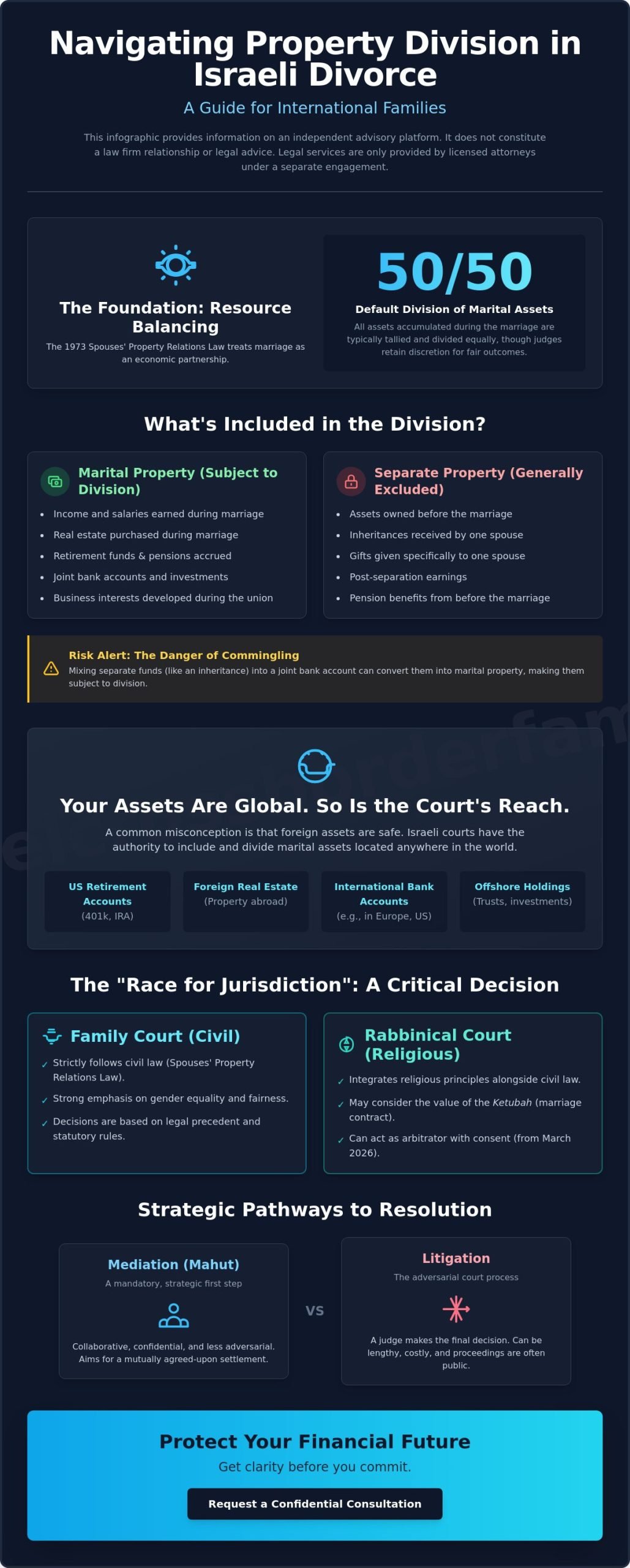
The foundation of Property Division in Israeli Divorce is the Spouses’ Property Relations Law of 1973. This statute establishes a default regime for couples who married after January 1, 1974, and did not sign a valid prenuptial agreement. It dictates that upon the termination of a marriage, assets acquired during the union are divided equally. For international families, this framework is particularly significant because it grants the Israeli court system the authority to include global assets in the final calculation, regardless of whether those assets are held in a foreign trust, a US brokerage account, or a European bank.
Timing is a critical factor in how these laws are applied. The law focuses on the “balancing of resources,” which generally occurs when the marriage ends through divorce or death. However, the court must first determine the specific “valuation date,” which is often the day the divorce petition was filed or the date the couple ceased cohabitation. Any assets accumulated after this point are typically considered separate, while everything earned between the wedding and this cutoff is subject to division. To better understand these concepts, watch this helpful video:
Family Court vs. Rabbinical Court: Key Differences
Israel maintains a dual jurisdictional system where both civil Family Courts and religious Rabbinical Courts have the authority to handle property matters. This creates what is known as the “race for jurisdiction.” The court where the case is first filed usually retains the authority to decide on property issues. For international clients, the choice of venue involves significant strategic considerations. Family Courts strictly follow civil law and emphasize gender equality. In contrast, Rabbinical Courts may integrate religious principles, such as considering the Ketubah (marriage contract) amount as part of the overall settlement. As of March 2026, new regulations also allow Rabbinical Courts to act as arbitrators in civil disputes if both parties provide written consent, adding another layer to the strategic landscape of divorce and separation for international families.
Resource Balancing: The 50/50 Starting Point
The principle of Izun Mashabim, or resource balancing, is the default mechanism for Property Division in Israeli Divorce. It views the marriage as an economic partnership where both spouses contribute equally to the family’s wealth, even if one spouse was the primary breadwinner. Under this rule, the value of all marital assets is tallied, and the spouse with more assets must “balance” the other by paying half the difference. While 50/50 is the starting point, judges have the discretion to deviate from this ratio in exceptional circumstances to ensure a fair outcome. It’s also important to note that as of January 2026, filing a property claim for a non-fixed sum in Family Court requires a mandatory filing fee of ₪3,447, reflecting the administrative weight of these complex financial evaluations.
Get clarity before you commit. Request a confidential consultation.
This article is published on an independent advisory platform and does not constitute a law firm relationship or legal advice. Legal services are only provided by licensed attorneys under a separate engagement.
Marital vs. Separate Property: What Stays and What Goes?
Distinguishing between marital and separate property is a pivotal step in Property Division in Israeli Divorce. Marital property encompasses nearly all assets earned or acquired during the marriage, regardless of which spouse’s name is on the title or account. This includes income from employment, business interests, and even debts incurred for family needs. In contrast, separate property generally refers to assets owned before the wedding, gifts received by one spouse individually, or inheritances. While these categories seem distinct, the boundaries often blur for international families who move assets between jurisdictions.
The “commingling trap” is a frequent source of conflict. If you use an inheritance to pay off a joint mortgage or deposit pre-marital savings into a shared bank account, those funds may lose their “separate” status. Israeli courts often view the intentional mixing of funds as evidence of a “shared intention” to make the asset part of the marital estate. For a deeper understanding of how these rules apply to your specific situation, you may want to request a confidential case review to assess your risks.
Another critical element is the valuation date. This is the specific point in time when the “economic partnership” officially ends. In many cases, this is the day one spouse files for divorce or the day of physical separation. Establishing this date is vital because it stops the clock on what is considered a shared asset. Any wealth generated after this date generally remains with the individual spouse.
Defining Marital Assets in 2026
Under current Israeli Financial Orders on Divorce, the scope of marital property is broad. As of 2026, assets subject to division typically include:
- Real Estate: This includes the primary family residence in Israel and any vacation homes or rental properties located abroad.
- Financial Portfolios: All bank accounts, savings, and joint investment portfolios are included. Transferring assets between spouses during divorce is exempt from capital gains tax (Mas Shevach) as a deferral, meaning the recipient assumes the original tax basis.
- Tangible Goods: Vehicles, furniture, and other household items are valued and divided.
Protecting Your Separate Assets
Maintaining the integrity of separate property requires proactive management. For those navigating divorce and separation for international families, keeping pre-marital funds in a dedicated, individual account is essential. Once these funds are moved into a joint account, proving they shouldn’t be divided becomes significantly harder. The only definitive protection for these assets is a court-approved Financial Agreement, often referred to as a prenup or postnup. The burden of proof for establishing that an asset is separate property lies entirely with the spouse making that claim.
Get clarity before you commit. Request a confidential consultation.
This article is published on an independent advisory platform and does not constitute a law firm relationship or legal advice. Legal services are only provided by licensed attorneys under a separate engagement.
Cross-Border Complexities: US Pensions, Foreign Real Estate, and High-Tech
Property Division in Israeli Divorce often involves a “shadow portfolio” of assets held outside of the country. Israeli courts generally view marriage as a global financial partnership. This means that property located in the US or Europe is not shielded from division just because it sits across an ocean. This includes residential homes, commercial real estate, and sophisticated high-tech compensation packages. For those managing a life between two cultures, understanding the challenges for expats and foreign nationals is the first step toward a fair settlement.
US Retirement Accounts and Israeli Law
One of the most significant challenges for international families is the treatment of US-based retirement accounts like 401ks and IRAs. Under the principle of resource balancing, the portion of these funds accrued during the marriage is considered a marital asset. This remains true even if the pension has not yet matured. However, a major legal friction exists because US financial institutions typically require a Qualified Domestic Relations Order (QDRO) issued by a US court to divide these accounts. An Israeli court order is not automatically recognized by US plan administrators. This creates a procedural hurdle where parties may need to mirror their Israeli settlement in a US jurisdiction to ensure the funds are actually transferred without triggering immediate tax penalties or early withdrawal fees. Strategic planning is required to avoid double taxation when transferring funds across borders.
High-Tech Equity and Startup Options
In the volatile high-tech economy of 2026, valuing unvested Restricted Stock Units (RSUs) and stock options requires a highly strategic approach. Israeli courts typically use a “linear” approach to vesting schedules. They determine which portion of the equity was earned during the marriage based on the time worked versus the time married. For founders or early employees, future “Exit” bonuses or liquidation events can be particularly contentious. Courts may look at the effort expended during the marriage to decide if a future payout should be shared. Valuing these complex interests usually requires the appointment of a specialist actuary. This professional calculates the present value of future pension rights and analyzes business interests to determine the balancing payment required. When it comes to foreign real estate, the court may order a sale or credit the value of the property against Israeli-based assets. Given that a property claim for a non-fixed sum carries a filing fee of ₪3,447, the cost of litigating these global portfolios can escalate quickly.
Get clarity before you commit. Request a confidential consultation.
This article is published on an independent advisory platform and does not constitute a law firm relationship or legal advice. Legal services are only provided by licensed attorneys under a separate engagement.
Strategic Resolution: Mediation vs. Litigation
The Israeli legal system requires a structured cooling-off period before parties can engage in full-scale litigation. Under the Mandatory Dispute Resolution law, the process begins with the filing of a “Request for Settlement of Dispute.” This action triggers four mandatory “Mahut” meetings with the court’s social services unit. During these sessions, couples are encouraged to explore alternatives to a contested trial. For Property Division in Israeli Divorce, this initial phase is critical because it prevents either party from filing a property claim for at least 60 days, unless specific emergency circumstances exist. This pause allows international families to assess their global portfolio before the “race for jurisdiction” escalates into a court battle.
Choosing litigation often leads to high financial and emotional costs. Research indicates that a contested divorce in Israel often starts at ₪50,000 per person and can exceed ₪200,000. In contrast, mediation typically ranges from ₪10,000 to ₪30,000 in total, a cost usually shared between the parties. Beyond the fees, litigation places your financial future in the hands of a judge who may exercise significant judicial discretion. For international families, the unpredictability of a court ruling can be daunting, especially when dealing with assets in multiple jurisdictions where a “lost in translation” error could lead to a permanent financial loss.
The Role of Financial Agreements
A negotiated settlement, known as a Heskem Mamon, is often the most effective way to secure a predictable outcome. These Financial Agreements allow couples to define their own rules for asset distribution, bypassing the default 50/50 split if they choose. In 2026, prenuptial agreements are generally enforceable in Israeli courts, provided they were signed voluntarily and the parties understood the consequences. Postnuptial agreements serve a similar purpose, allowing spouses to resolve property issues while the marriage is still intact. This proactive approach helps avoid the inherent risks of a court-imposed division.
Mediation for Cross-Border Families
Mediation is particularly valuable for “Anglo” families who may find the Hebrew-centric court system difficult to navigate. It allows for the drafting of a settlement that addresses specific cross-border needs, such as the treatment of US retirement funds or foreign tax obligations. A successful mediation requires a professional who understands both the Israeli and US financial landscapes. It’s essential that the final agreement includes “Plain English” summaries to ensure both parties fully comprehend the commitments they’re making. This approach helps create a document that is more likely to be recognized and enforced in both jurisdictions. Contact us to discuss your strategy and explore how mediation could protect your interests.
Get clarity before you commit. Request a confidential consultation.
This article is published on an independent advisory platform and does not constitute a law firm relationship or legal advice. Legal services are only provided by licensed attorneys under a separate engagement.
Protecting Your Future: The Anglo Advisory Approach
Approaching Property Division in Israeli Divorce with a strategy-first mindset is the most effective way to manage the inherent risks of cross-border asset distribution. This advisory platform serves as a vital bridge between legal systems, helping you understand the multi-jurisdictional complexities before you enter a formal legal engagement. By identifying friction points early, you can avoid the excessive costs and emotional fatigue associated with prolonged litigation. This proactive approach allows for a calm assessment of how local regulations interact with your foreign holdings, ensuring that your financial objectives remain the primary focus throughout the transition.
Seeking Clarity Before You Commit
One of the most significant risks for international families is the pressure to sign temporary agreements during the early stages of a separation. These documents are often presented as a way to maintain stability, but they can inadvertently create long-term financial consequences. For expats and foreign nationals, an early concession regarding the family residence or interim support can weaken your position when it is time to divide complex assets like high-tech equity or US-based pensions. Seeking clarity before you commit to any written statement ensures that your rights are protected under both Israeli and international frameworks. A thorough review of your global portfolio is essential before any binding commitments are made.
Next Steps for International Families
The path toward a secure financial future begins with organized documentation and professional insight. You should begin by gathering current records for all assets, including brokerage statements, property deeds, and high-tech vesting schedules. Having these documents ready allows for a more accurate assessment of the marital estate. It is also beneficial to work with specialists who bridge the cultural and legal gaps between Israel and the United States. This integrated approach saves time and reduces the likelihood of errors that could lead to double taxation or unenforceable court orders. Get clarity before you commit. Request a confidential consultation at Israel Cross Border Law Firm.
Securing Financial Stability Across Borders
The complexities of Property Division in Israeli Divorce demand more than just a surface-level understanding of local statutes. As we’ve explored, successfully managing a cross-border portfolio requires a strategic integration of the 1973 Financial Relations Law with an awareness of how foreign assets, such as US-based retirement accounts and high-tech equity, are treated in practice. By prioritizing mediation over litigation and identifying the risks of commingling separate property early, you can avoid the high costs and unpredictability often found in the court system. Decisions made at the start of this process will have a lasting impact on your global financial standing.
Our advisory platform specializes in supporting US-Israel cross-border families with a calm, strategy-based approach. We provide the expertise necessary to handle complex international asset portfolios while ensuring you maintain clarity throughout every stage of the process. Managing these multi-jurisdictional challenges is difficult, but with the right strategic framework, you can protect your assets and your future. Making informed choices today will define your financial independence tomorrow. Get clarity before you commit. Request a confidential consultation.
This article is published on an independent advisory platform and does not constitute a law firm relationship or legal advice. Legal services are only provided by licensed attorneys under a separate engagement.
Frequently Asked Questions
Is my house in the US subject to property division in an Israeli divorce?
Yes, Israeli courts have the authority to include foreign real estate in the marital estate if the property was acquired during the marriage. While the court cannot directly change a deed in a US land registry, it can calculate the property’s value and offset that amount against assets located in Israel. If no local assets exist for an offset, you may need to initiate a separate legal process in the US to enforce the Israeli ruling.
What happens to my high-tech stock options (RSUs) if I get divorced in Israel?
Unvested RSUs and stock options are considered marital property to the extent they were earned through labor performed during the marriage. The court typically applies a time-based formula to determine the marital portion of the grant. In the volatile 2026 tech market, an actuary is often appointed to determine the present value of these options or to suggest a “trust” mechanism where the spouse receives their share upon the actual vesting date.
Can an Israeli court divide my US-based 401k or IRA?
Israeli courts include US retirement accounts in the total pool for Property Division in Israeli Divorce, but they cannot directly order a US plan administrator to release funds. To divide a 401k without triggering early withdrawal penalties, you generally must obtain a Qualified Domestic Relations Order (QDRO) from a US court. This requires a coordinated strategy where your Israeli settlement is mirrored and approved by a court in the relevant US state.
How does the ‘Race for Jurisdiction’ affect my property rights?
The court that receives the first filing (Family Court or Rabbinical Court) generally gains the authority to decide all property matters. This choice is significant because Family Courts apply civil law strictly, focusing on gender equality and civil statutes. Rabbinical Courts, while also bound by the Spouses’ Property Relations Law, may consider religious elements like the Ketubah or a spouse’s “rebellion” when determining the final distribution of assets.
Does it matter whose name is on the bank account for property division?
The name on a bank account or asset title is generally irrelevant under the principle of the “partnership of assets.” If the funds were earned or accumulated during the marriage, the law views them as joint property regardless of whether the account is in one spouse’s name or both. The only way to keep such funds separate is through a valid, court-approved Financial Agreement that explicitly excludes those specific accounts from division.
What is ‘Resource Balancing’ and how does it work in 2026?
Resource balancing is the default legal mechanism that mandates an equal 50/50 split of all wealth accumulated during the marriage. As of 2026, this process involves a comprehensive valuation of all global assets, including pensions, businesses, and digital holdings. Filing a claim for a non-fixed property sum in the Family Court currently requires a mandatory filing fee of ₪3,447, reflecting the complexity of these financial evaluations.
Are inheritances received during the marriage divided 50/50?
Inheritances are legally classified as separate property and are typically excluded from the 50/50 division. However, this protection is lost if the inheritance is “commingled” with joint family assets. For example, using inherited funds to renovate a shared home or depositing them into a joint savings account can lead a judge to conclude that you intended to gift the asset to the marital partnership, making it subject to division.
How long does the property division process typically take in Israel?
The timeline for property division varies significantly based on whether the couple chooses mediation or litigation. A negotiated settlement through mediation can be finalized in 3 to 6 months. Contested litigation in the Family Court often lasts 18 to 36 months, partly due to the mandatory 60-day “Mahut” dispute resolution period and the time required for expert actuaries to value complex international portfolios.

Article by
Gabriel Lior
A Personal Journey That Became a Mission
The advisory was founded by an American father Gabriel Lior, LLB, MBA , global entrepreneur, and cross-border advisor who spent more than a decade navigating the Israeli family court system firsthand and now lives in Singapore with his son.
As a divorced parent in a cross-border family, Gabriel faced nearly every legal challenge a foreign parent can encounter in Israel — including child custody disputes, child support proceedings, property matters in Israel and abroad, false accusations, and complex immigration and relocation proceedings.
Over the years, he learned the hard way how difficult it is for non-Israeli parents to understand the system, identify the right legal strategy, and choose the right legal representation — especially when language, culture, and jurisdictional differences are involved. He also witnessed how foreign parents and new immigrants are often disadvantaged or taken advantage of by service providers and institutions simply because they lack local knowledge or fluency.
From Client to Advisor
To truly understand — and survive — the system, Gabriel pursued formal legal education in Israel, completing two Israeli law degrees, alongside a BA and MBA earned in the United States. This was never about becoming a practicing attorney, but about gaining a deep, structural understanding of how the system works — and where it breaks down for foreign parents.
This rare combination of:
Firsthand client experience
Israeli legal and US business education
International business and negotiation training
Decades of commercial execution
created a unique perspective – one that understands both sides of the table.
After years of litigation, persistence, and at times self-representation, he ultimately succeeded in securing custody of his son and relocating abroad through a rare legal victory in the Israeli Supreme Court — becoming one of the first fathers in Israel to do so under these circumstances.
Disclaimer
Important Disclaimer:
The information provided on this website and in its content is for general informational and educational purposes only and does not constitute legal advice, legal opinion, or legal representation.
Gabriel Lior is not licensed to practice law in Israel (nor is he interested in doing so) and does not provide legal services, despite having completed 2 Law Degrees. The services offered are advisory in nature and are intended to provide general guidance, strategic insight, and information regarding cross-border family law considerations.
No attorney-client relationship is formed by accessing this website, reading its content, or communicating with us.
Any decisions made based on this information are at your own discretion and risk. For legal advice specific to your situation, you should consult a licensed attorney in the relevant jurisdiction.
Where appropriate, we may refer clients to independent, licensed attorneys or professionals. Such referrals do not constitute legal representation and no liability is assumed for services provided by third parties.