Navigating the dissolution of a marriage presents a formidable challenge, one that is significantly magnified by the cross-border complexities of Jewish law. For individuals residing outside of Israel, the critical question of how to get a gett from abroad introduces a daunting layer of legal and religious bureaucracy, often compounded by uncertainty regarding travel requirements and the fear of a spouse’s refusal to cooperate. This intricate process can feel opaque, leaving you overwhelmed and unsure of the correct path forward toward resolution.
This comprehensive guide is engineered to provide clarity and strategic direction. We deliver an authoritative, step-by-step legal framework for successfully obtaining a valid Gett while living internationally, guiding you through the sophisticated, multi-jurisdictional procedures. Our objective is to demystify the process of engaging with a qualified Beth Din, coordinating with civil divorce proceedings, and managing the complexities of international Jewish divorce law, empowering you to achieve finality and move forward with confidence.
Understanding the Gett: What It Is and Why It’s Crucial in Jewish Law
Navigating the dissolution of a marriage under Jewish law involves a critical, non-negotiable step: the issuance of a Gett. A Gett is a Jewish religious divorce document, mandated by Halakha (Jewish Law), which formally terminates the marital bond between a husband and wife. Without this document, even with a government-issued civil divorce decree, the couple remains married in the eyes of Jewish law. This religious finality is essential, as it is the sole mechanism that permits both parties to remarry within the Jewish faith. Understanding the profound legal and religious weight of this document is the first step in the complex process, particularly for those trying to figure out how to get a gett from abroad. For a detailed exploration of its origins and legal framework, it is helpful to understand What is a Gett in Jewish Law, as the procedure is steeped in ancient tradition yet has severe modern-day consequences.
To better understand this complex legal and religious procedure, the following video provides a clear overview:
The Concept of ‘Agunah’ (Chained Woman)
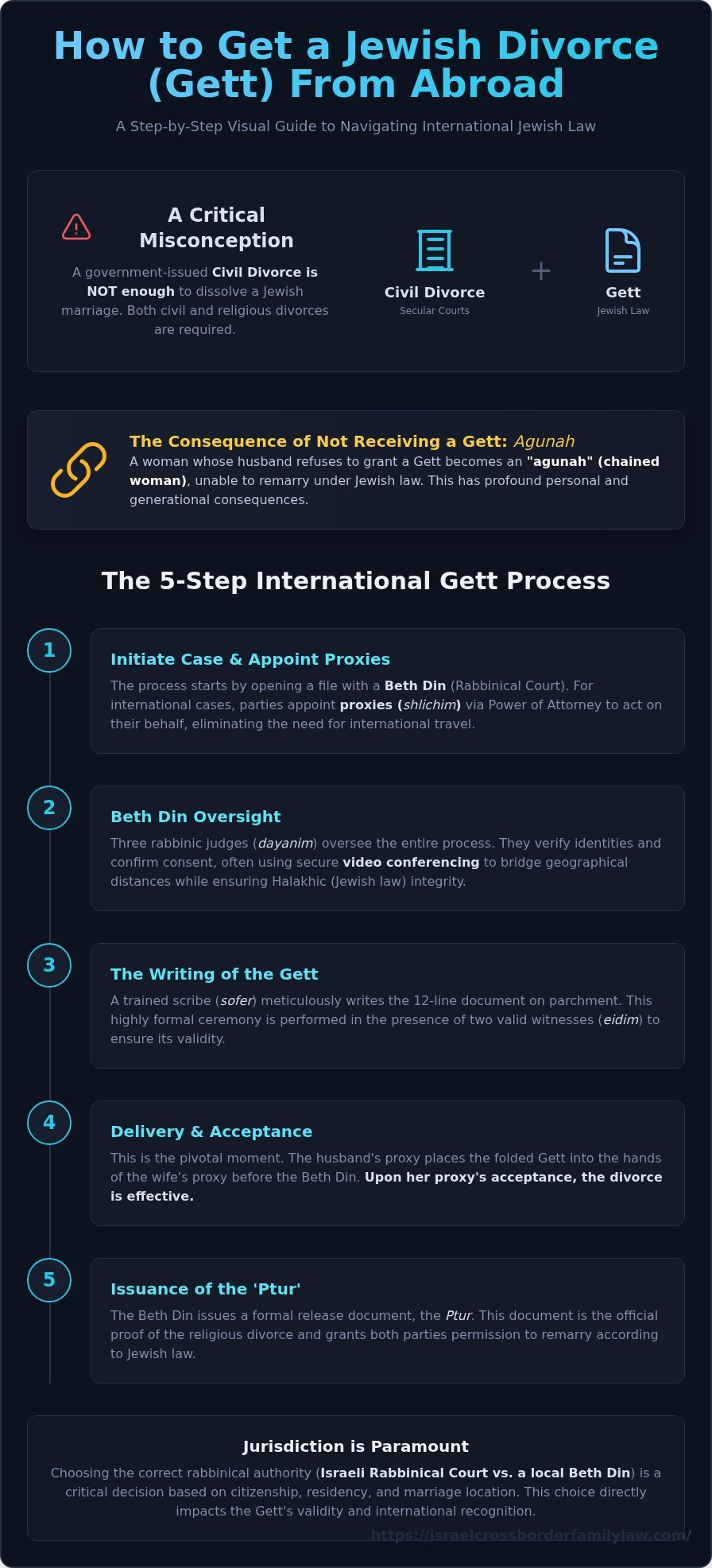
The failure to secure a Gett carries serious ramifications, most acutely for the woman. A woman whose husband refuses to grant a Gett, or who is unable to do so, becomes an agunah-a “chained woman.” In this status, she is unable to remarry under Jewish law. Furthermore, any children born from a subsequent relationship would be considered mamzerim, a status that severely restricts their ability to marry within the Jewish community. These profound consequences underscore why the Gett process must be managed with absolute legal and religious precision.
Civil Divorce vs. Religious Divorce: A Dual System
It is a common and critical misunderstanding that a civil divorce issued by a secular court finalizes the matter. A government decree does not dissolve a Jewish marriage. In Israel, this distinction is codified, as the Rabbinical Courts hold exclusive jurisdiction over matters of marriage and divorce for Jewish citizens. For international couples, this creates a complex, multi-jurisdictional challenge. Both the civil and religious divorce processes must be managed concurrently, a sophisticated legal task that is central to successfully obtaining a gett from abroad and achieving complete legal and religious freedom.
The Step-by-Step Process for Obtaining a Gett from Abroad
Navigating the procedural requirements for a religious divorce across international borders can be a sophisticated undertaking. The process is designed to uphold the stringent standards of Halakha (Jewish law) while accommodating the logistical realities of parties residing in different countries. Understanding this structured framework is the first step toward a successful resolution. The procedure hinges on the appointment of valid agents and the meticulous oversight of a recognized Rabbinical Court, ensuring every legal and religious requirement is satisfied.
Initiating the Case and Appointing Proxies
The process formally commences when one or both parties open a divorce file with a recognized Beth Din (Rabbinical Court), either in Israel or in a reputable court abroad. For parties residing overseas, the most critical step is the appointment of proxies (shlichim) to act on their behalf. This is executed through a formal Power of Attorney, empowering these representatives to perform the necessary actions. The husband’s proxy is authorized to deliver the Gett, and the wife’s proxy is authorized to accept it, making their physical presence in Israel unnecessary.
The Role of the Beth Din (Rabbinical Court)
The Beth Din, comprising three rabbinic judges (dayanim), serves as the central authority overseeing the entire process. Their primary function is to verify the identities of all parties, confirm their unequivocal consent to the divorce, and ensure that every halakhic detail is impeccably executed. In cross-border cases, the court often conducts proceedings via secure video conference to interact directly with the husband and wife. This modern approach is a key part of the solution for how to get a gett from abroad, bridging geographical distances while maintaining procedural integrity. The authority for such actions is well-established within the Israeli Rabbinical Court Jurisdiction, which has been clarified to handle complex cases where a Gett cannot be processed locally for one of the parties.
The Writing and Delivery Ceremony
The physical creation of the Gett is a highly formal and precise ceremony. A specially trained scribe (sofer) writes the twelve-line document on a piece of parchment using a quill and specially prepared ink, all in the presence of two valid witnesses (eidim). Once written and signed, the pivotal moment of the ceremony occurs. Before the Beth Din, the husband’s proxy formally places the folded Gett into the hands of the wife’s proxy. Upon her acceptance, the divorce is effective. The Beth Din then issues a formal release document (Ptur), which serves as official proof of the religious divorce and permits both parties to remarry according to Jewish law.
Jurisdiction: Israeli Rabbinical Court vs. Local Batei Din
A critical determination in the process of obtaining a Jewish divorce is selecting the proper rabbinical authority, or Beth Din. This multi-jurisdictional decision between filing in Israel or with a local Beth Din abroad is governed by complex factors, including citizenship, residency, and the location of the original marriage. Making the correct choice is paramount, as it directly impacts the validity and international recognition of the Gett.
When the Israeli Rabbinical Court is Necessary
The Israeli Rabbinical Courts hold exclusive jurisdiction in several key cross-border scenarios. Filing in Israel is not merely an option but a requirement in cases where:
- Either one or both spouses are Israeli citizens, even if they currently reside permanently outside of Israel.
- One spouse is physically present in Israel while the other resides in a foreign country.
- The original marriage was officiated by the Israeli Rabbinate.
Furthermore, orders issued by the Israeli Rabbinical Courts can often be enforced internationally through treaties and legal conventions, providing a powerful mechanism to compel a recalcitrant spouse to cooperate.
Using a Recognized Diaspora Beth Din
For couples who are not Israeli citizens and reside abroad, utilizing a recognized local Beth Din is a highly viable and often more practical path. Prominent and widely respected bodies, such as the Beth Din of America (BDA), the London Beth Din, or the Beth Din of Johannesburg, are equipped to handle these complex proceedings. The crucial step, however, is to verify that the chosen Beth Din is officially recognized by the Chief Rabbinate of Israel. This pre-verification ensures the Gett will be accepted in Israel for matters of personal status. The advantages include navigating the process in your native language and local time zone.
Coordinating Between Jurisdictions
Successfully navigating how to get a gett from abroad frequently requires seamless coordination between rabbinical courts in different countries. Experienced cross-border legal counsel is essential to act as a bridge, facilitating communication and ensuring all procedural requirements are met on both sides. Once a Gett is issued by a recognized foreign Beth Din, it must be formally registered with the Israeli Rabbinate to be legally valid within Israel. This final administrative step is critical for future remarriage or other personal status matters in the country. Navigating jurisdiction is complex. Consult with our experts for clarity.
[
Download
](https://getautoseo.com/screenshots/getautoseocom_1768783253_gJJx6rG6.jpg)
Feedback & Recreate
Delete

Navigating Common Challenges in International Gett Proceedings
Successfully obtaining a Jewish divorce across borders involves navigating a complex intersection of religious law (Halacha) and civil legal systems. The process of how to get a gett from abroad is frequently complicated by logistical hurdles and, most significantly, the potential for spousal non-cooperation. A strategic, multi-jurisdictional legal approach is paramount to overcoming these sophisticated challenges and ensuring a timely resolution.
Addressing ‘Get Recalcitrance’
The most profound challenge in any Gett proceeding is ‘Get recalcitrance’-the refusal of one spouse to participate, which can leave the other spouse in a state of legal and religious limbo. Fortunately, several powerful mechanisms exist to address this issue:
- Seruv (Contempt Order): A Beth Din (rabbinical court) can issue a seruv against a recalcitrant spouse. This is a formal order of contempt that carries significant social and religious sanctions within Jewish communities worldwide.
- Civil Court Enforcement: In many jurisdictions, including Israel and parts of the United States, civil courts can be petitioned to enforce clauses within marital agreements that compel cooperation in the Gett process. Failure to comply can lead to civil penalties, including fines or even imprisonment.
- Proactive Prenuptial Agreements: A well-drafted prenuptial or postnuptial agreement that explicitly obligates both parties to cooperate in a Gett proceeding provides a robust contractual basis for civil court enforcement.
The Role of Your Civil Divorce Agreement
Integrating the Gett process directly into your civil divorce negotiations is a critical strategic maneuver. Rather than treating them as separate matters, they should be intrinsically linked to create leverage and ensure compliance. A key strategy is to include a specific, unambiguous clause in the civil divorce agreement that makes the finalization of financial settlements or the distribution of marital assets contingent upon the successful delivery of the Gett. This creates a powerful financial incentive for cooperation.
This complex interplay between religious and civil law underscores the necessity of engaging a legal team with deep, cross-border expertise. Guiding clients on how to get a gett from abroad requires a firm that not only understands the intricacies of international family law but also has established relationships with Batei Din. Our professionals are adept at structuring agreements that protect your interests across both legal spheres. For comprehensive guidance on these multi-jurisdictional matters, contact our experienced legal team.
Why You Need an Experienced Cross-Border Family Lawyer
Securing a Jewish divorce (Gett) is a sophisticated, multi-jurisdictional process that intersects religious law (Halakha) with the civil laws of two or more countries. The question of how to get a gett from abroad is not merely logistical; it is a complex legal challenge requiring specialized expertise. Attempting to navigate this landscape without seasoned counsel can lead to critical errors, procedural delays, and outcomes that compromise your rights in both the civil and religious spheres.
An experienced cross-border family lawyer functions as a project manager, meticulously coordinating the intricate steps involved. This includes liaising between the Israeli Rabbinical Court (Beth Din), civil courts in your country of residence, opposing counsel, and both spouses. Their primary role is to ensure that every document is correctly filed, every deadline is met, and the final Gett is legally recognized in both jurisdictions, preventing future legal challenges to your marital status.
Crucially, your legal counsel acts as a shield, protecting your interests across all fronts. They ensure that the terms of your civil divorce-such as asset division, spousal support, and child custody-are structured in a way that does not conflict with, and may even facilitate, the religious divorce process. This dual-front representation is essential for a comprehensive and secure resolution.
Bridging the Gap Between Two Legal Systems
An adept cross-border attorney serves as a vital bridge between disparate legal and religious frameworks. They possess the nuanced understanding required to represent your interests effectively before both a US civil court and an Israeli Beth Din. This counsel ensures seamless communication between your US-based legal team and Israeli authorities, translating complex legal requirements and preventing a civil settlement from inadvertently creating an obstacle to receiving the Gett.
Strategic Negotiation and Advocacy
Effective legal representation extends beyond procedural management to strategic advocacy. An experienced lawyer can negotiate civil settlement terms that create powerful incentives for a recalcitrant spouse to cooperate in the Gett process. Should disputes or an outright refusal arise, your attorney becomes your staunchest advocate, employing legal tools to compel cooperation. This strategic oversight provides invaluable peace of mind during what is an inherently stressful and emotionally charged time. Engaging counsel early is the most effective strategy for a favorable outcome. Schedule a consultation to discuss your specific situation.
Securing Your Future: Finalizing Your Gett Across Borders
Obtaining a Gett is a critical step for religious and legal finality in a Jewish divorce. As this guide has detailed, understanding how to get a gett from abroad is a multi-jurisdictional challenge, demanding a sophisticated approach to navigating the procedural nuances between the Israeli Rabbinical Court and local Batei Din. The complexities of international law, coupled with the intricacies of Halacha, require meticulous and knowledgeable handling to prevent costly delays and ensure the validity of the process.
You do not have to face this complex process alone. Our firm provides specialized expertise in US-Israel cross-border family law, with extensive experience liaising with both Israeli and US Rabbinical Courts. We have a proven track record in resolving the most challenging international divorce cases, offering the strategic counsel necessary to protect your interests. Contact our firm to navigate your international Gett process with confidence and expert guidance.
Allow us to provide the clarity and strategic direction needed to close this chapter and move forward with your life.
Frequently Asked Questions About the International Gett Process
How long does it take to get a Gett from abroad?
The timeline for obtaining a Gett from abroad is contingent upon the level of spousal cooperation. In an amicable, uncontested scenario where both parties are responsive, the process can often be concluded within two to four months. However, in complex or contentious cases involving a recalcitrant spouse, the proceedings can extend significantly, potentially taking a year or more. Navigating these international complexities requires a strategic approach to expedite the resolution and ensure all rabbinical requirements are met.
What are the approximate costs involved in an international Gett process?
The total financial investment for a cross-border Gett procedure can vary substantially based on case complexity. Basic administrative and Beth Din fees typically range from ₪3,000 to ₪7,000. Should the matter require extensive legal intervention, representation before rabbinical courts in multiple jurisdictions, or the appointment of agents (shlichim), total costs can escalate. A comprehensive consultation is necessary to provide a precise financial projection tailored to your specific multi-jurisdictional circumstances.
Do I or my spouse ever need to be physically present in Israel?
In many instances, physical presence in Israel is not a prerequisite. The Gett can be facilitated through a duly appointed agent, known as a shaliach, who acts on behalf of the husband or wife before the Israeli Beth Din. This is a common and effective solution for those determining how to get a gett from abroad. However, in highly contested cases or situations with unique procedural complexities, the Rabbinical Court may, at its discretion, require the attendance of one or both parties.
What happens if my spouse is not Jewish or is non-observant?
A Gett is a religious divorce document required exclusively when both spouses are Jewish according to Halakha (Jewish Law). If one party is not Jewish, a Gett is neither required nor possible, and the marriage is dissolved solely through civil divorce proceedings. A spouse’s level of religious observance is irrelevant to the requirement for a Gett; as long as both parties are halakhically Jewish, the Gett is a necessary component for the dissolution of the marriage.
Can a U.S. court order my spouse to give or accept a Gett?
U.S. civil courts, adhering to the principle of separation of church and state, cannot directly compel an individual to participate in a religious act such as giving or receiving a Gett. However, courts can enforce secular contractual obligations. If the parties signed a prenuptial agreement with clauses pertaining to the Gett, a court may enforce those provisions. A court may also use its authority over civil matters like asset distribution to incentivize cooperation in the Gett process.
Is a Gett obtained from a U.S. Beth Din automatically valid in Israel?
Not necessarily. The Israeli Chief Rabbinate maintains a list of approved Batei Din (rabbinical courts) abroad whose procedures and documentation it recognizes. A Gett obtained from a non-recognized U.S. Beth Din may be rejected, creating significant complications for remarriage or personal status in Israel. It is therefore imperative to ensure that the chosen Beth Din has the requisite standing with the Israeli Rabbinate to guarantee the international validity and seamless registration of your divorce.

Article by
Gabriel Lior
A Personal Journey That Became a Mission
The advisory was founded by an American father Gabriel Lior, LLB, MBA , global entrepreneur, and cross-border advisor who spent more than a decade navigating the Israeli family court system firsthand and now lives in Singapore with his son.
As a divorced parent in a cross-border family, Gabriel faced nearly every legal challenge a foreign parent can encounter in Israel — including child custody disputes, child support proceedings, property matters in Israel and abroad, false accusations, and complex immigration and relocation proceedings.
Over the years, he learned the hard way how difficult it is for non-Israeli parents to understand the system, identify the right legal strategy, and choose the right legal representation — especially when language, culture, and jurisdictional differences are involved. He also witnessed how foreign parents and new immigrants are often disadvantaged or taken advantage of by service providers and institutions simply because they lack local knowledge or fluency.
From Client to Advisor
To truly understand — and survive — the system, Gabriel pursued formal legal education in Israel, completing two Israeli law degrees, alongside a BA and MBA earned in the United States. This was never about becoming a practicing attorney, but about gaining a deep, structural understanding of how the system works — and where it breaks down for foreign parents.
This rare combination of:
Firsthand client experience
Israeli legal and US business education
International business and negotiation training
Decades of commercial execution
created a unique perspective – one that understands both sides of the table.
After years of litigation, persistence, and at times self-representation, he ultimately succeeded in securing custody of his son and relocating abroad through a rare legal victory in the Israeli Supreme Court — becoming one of the first fathers in Israel to do so under these circumstances.
Disclaimer
Important Disclaimer:
The information provided on this website and in its content is for general informational and educational purposes only and does not constitute legal advice, legal opinion, or legal representation.
Gabriel Lior is not licensed to practice law in Israel (nor is he interested in doing so) and does not provide legal services, despite having completed 2 Law Degrees. The services offered are advisory in nature and are intended to provide general guidance, strategic insight, and information regarding cross-border family law considerations.
No attorney-client relationship is formed by accessing this website, reading its content, or communicating with us.
Any decisions made based on this information are at your own discretion and risk. For legal advice specific to your situation, you should consult a licensed attorney in the relevant jurisdiction.
Where appropriate, we may refer clients to independent, licensed attorneys or professionals. Such referrals do not constitute legal representation and no liability is assumed for services provided by third parties.