The discovery that your child has been wrongfully removed to or retained in Israel represents a profoundly distressing and disorienting event for any parent. Facing a complex, multi-jurisdictional legal challenge can feel overwhelming, leaving you uncertain of the critical first steps and fearful of procedural errors that could jeopardize your case. In these difficult circumstances, it is imperative to understand that a powerful international legal framework is in place to protect your parental rights and secure your child’s prompt return. This framework is The Hague Convention on the Civil Aspects of International Child Abduction. This guide provides a definitive, strategic overview of the hague convention application process israel. We will walk you through each critical stage, from preparing the initial application with the Central Authority to navigating the specific procedures within the Israeli family court system. Our purpose is to provide you with a clear action plan, demystifying the legal requirements and timelines involved. By understanding this established procedure, you can confidently initiate the necessary actions to facilitate the safe and expeditious return of your child.
Understanding the Hague Convention and Its Role in Israel
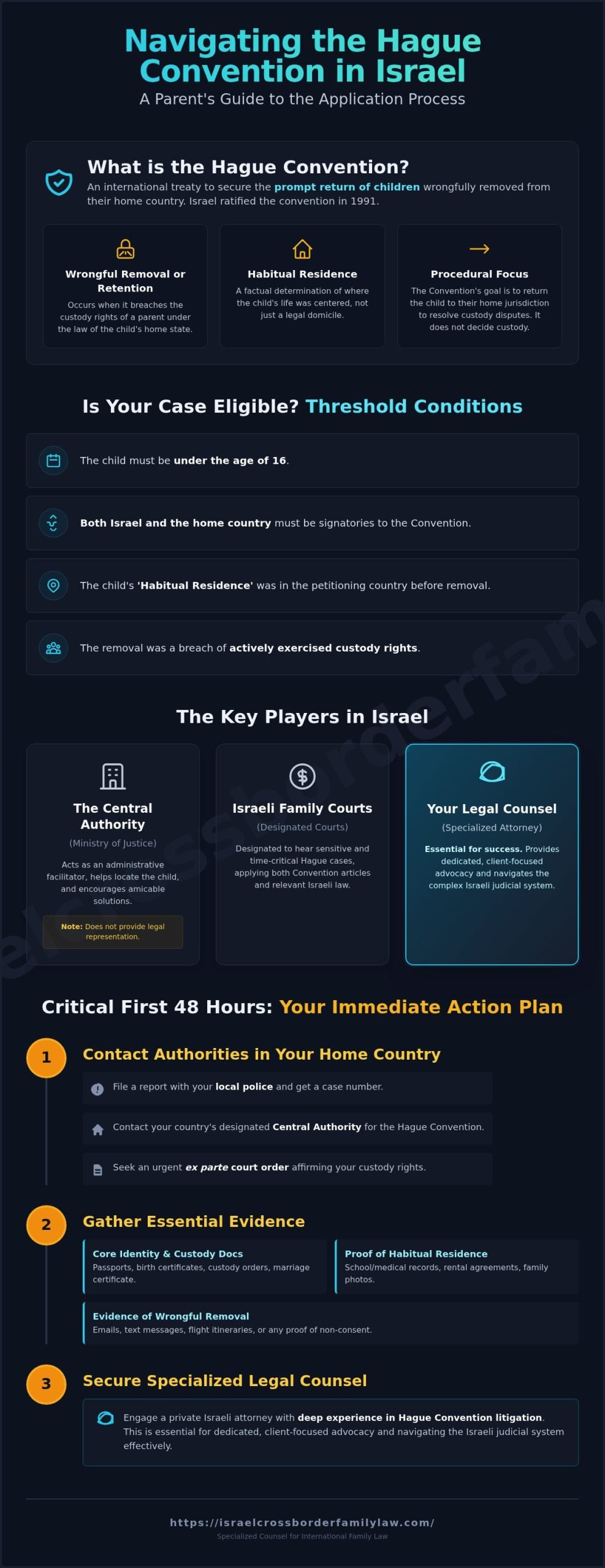
In the complex landscape of international family law, the Hague Convention on the Civil Aspects of International Child Abduction stands as a paramount international treaty. Its primary and urgent objective is to secure the prompt return of children who have been wrongfully removed from, or retained outside of, their country of habitual residence. The State of Israel, having ratified the Convention in 1991, is a committed signatory and its judicial system actively enforces the treaty’s provisions to protect the rights of children and parents caught in cross-border disputes. To better understand how these principles are applied within Israel’s legal framework, the following video offers a valuable overview:
It is crucial to understand the Convention’s specific terminology. A ‘wrongful removal’ or ‘retention’ occurs when it breaches the custody rights of a person or institution under the law of the state where the child was habitually resident immediately before the removal. The concept of ‘habitual residence’ is a factual determination of where the child’s life was centered, not merely a question of legal domicile. Importantly, the Convention’s focus is procedural, not substantive; it is designed to return the child to their home jurisdiction, which is deemed the proper venue to resolve any underlying custody disputes. It does not, in itself, decide who should have custody.
When Does the Hague Convention Apply?
For the Convention’s mechanisms to be invoked in an Israeli case, several threshold conditions must be met:
- The child involved must be under the age of 16.
- Both Israel and the country from which the child was removed (or to which the child was taken) must be signatories to the Convention.
- The child’s ‘habitual residence’ was in the petitioning country immediately prior to the wrongful removal or retention.
- The removal or retention was in breach of the petitioner’s custodial rights, which were being actively exercised at the time.
Key Players in the Israeli Process
Successfully navigating the hague convention application process israel requires a clear understanding of the key institutional and professional players involved:
- The Central Authority: In Israel, this function is managed by the International Department of the Ministry of Justice. It acts as the administrative facilitator, assisting with locating the child and encouraging amicable resolutions, though it does not provide legal representation.
- The Israeli Family Courts: Specific Family Courts in Israel are designated to hear these sensitive and time-critical cases, applying both the Convention’s articles and relevant Israeli law.
- Your Legal Counsel: Engaging a specialized Israeli attorney with deep experience in Hague Convention litigation is not merely advisable-it is essential for effectively representing your interests and ensuring all procedural requirements are meticulously met.
Immediate First Steps: What to Do Before You File
In cases of international child abduction, the actions taken within the first 24 to 48 hours are profoundly consequential. Swift, strategic, and methodical action is paramount to establishing a strong foundation for the return of your child. This initial phase is not about emotional reactions but about initiating a multi-jurisdictional legal response and preserving critical evidence. A misstep here can create significant challenges later in the hague convention application process israel. It is essential to act with urgency while avoiding any direct communication or actions that could be misconstrued or unintentionally harm your case.
Contacting the Authorities in Your Home Country
Your first official step should be to establish a clear legal record in your country of habitual residence. Immediately file a report with your local police department, ensuring you receive a copy of the report and a case number. Concurrently, contact the designated Central Authority for the Hague Convention in your country to formally initiate the process. We also strongly advise seeking an urgent, ex parte court order from your local family court that explicitly affirms your custody rights and declares the child’s removal as wrongful.
Gathering Essential Evidence
The core of a Hague Convention case rests on proving the child’s “habitual residence” was in your home country prior to the wrongful removal. Begin compiling a comprehensive file immediately. Your evidence should be organized and irrefutable, including:
- Core Identity and Custody Documents: The child’s and parents’ birth certificates, passports, your marriage certificate, and any existing custody orders or divorce decrees.
- Proof of Habitual Residence: School enrollment records, letters from teachers, medical and dental records, rental agreements or property deeds, and family photographs showing an established life.
- Evidence of Wrongful Removal: Any communication, such as emails, text messages, or recorded conversations, that indicates the removal was without your consent. Include flight itineraries, ticket purchases, or any other travel details you can obtain.
Securing Specialized Legal Counsel
Navigating the Israeli judicial system requires sophisticated, on-the-ground expertise. While the Central Authority provides crucial government-to-government assistance, engaging private counsel specializing in Israeli Hague Convention litigation offers dedicated, client-focused advocacy. Your lawyer will work in tandem with the state apparatus, including Israel’s Central Authority, to represent your specific interests in court. When selecting an attorney, prioritize those with a demonstrable track record in cross-border family law, fluency in both English and Hebrew, and deep familiarity with the judges and procedures of the Israeli Family Courts.
The Application Process: A Detailed Walkthrough for Israel
Navigating the hague convention application process israel requires a meticulous and structured approach to ensure all procedural requirements are met efficiently. The framework is designed to be systematic, facilitating cross-border cooperation between signatory nations. Understanding this process is the first critical step toward securing the prompt return of a wrongfully removed or retained child. The journey begins with the formal submission of an application, which can be initiated through two distinct, yet interconnected, pathways.
Initiating the Application via Your Central Authority
The most common and highly recommended method for initiating a return application is through the designated Central Authority in your country of habitual residence. This body acts as your official intermediary, responsible for reviewing your application for completeness, arranging necessary translations, and formally transmitting the entire file to Israel’s Central Authority for the Hague Convention within the Ministry of Justice. This official channel ensures the application is properly formatted and contains the requisite information, increasing the likelihood of a swift response from Israeli authorities.
Completing the Hague Convention Application Form
The application form is the foundational document of your case, and its accuracy is paramount. You will be required to provide comprehensive and factual information, supported by clear evidence. While the specific form may vary slightly by country, the core information required remains consistent. Meticulous preparation is essential.
- Identity of the Child and Parents: Full names, dates of birth, and passport details.
- Grounds for the Application: A clear, factual statement detailing the circumstances of the wrongful removal or retention, including relevant dates.
- Child’s Habitual Residence: Strong evidence establishing the child’s country of habitual residence prior to the abduction, such as school records, medical reports, and affidavits.
- Location of the Child: Any known information about the child’s and the abducting parent’s current whereabouts in Israel.
- Supporting Documents: Attach copies of birth certificates, marriage certificates, court orders regarding custody, and any relevant correspondence.
What Happens After Submission?
Once your application is received and registered, the Israeli Central Authority will open a file and acknowledge receipt. Their immediate objective is to locate the child and the abducting parent. Upon location, they will initiate contact to seek a voluntary and amicable return. Should the abducting parent refuse to cooperate, the Central Authority will not adjudicate the dispute but will facilitate the next critical step: providing you with a list of specialized local attorneys and assisting in the formal filing of your return petition with the competent Israeli Family Court.
Navigating the Israeli Court Proceedings
Once your application is filed with the Israeli Central Authority and submitted to the appropriate Family Court, the judicial phase of the Hague Convention application process in Israel commences. These proceedings are, by design, expedited to ensure a swift resolution for the child. However, this accelerated timeline does not bypass the rigorous legal standards and procedural safeguards required. The process involves a collaborative effort between the presiding judge, who orchestrates the case; the lawyers for both parents, who present the legal arguments; and often, court-appointed social services professionals who provide expert assessments.
The First Hearing and Legal Representation
The Israeli Family Court will schedule an urgent first hearing, typically within a few days of the case being filed. The primary objectives of this initial meeting are to confirm that the responding parent (the alleged abductor) has been properly served and to ensure they have secured competent legal representation. To protect the child and the jurisdiction of the court, the judge may issue immediate temporary orders, such as seizing the child’s and parent’s passports or establishing a temporary contact schedule.
The Main Evidentiary Hearing
The core of the legal case unfolds during the main evidentiary hearing. Here, legal counsel for both parents will present evidence, witness testimony, and legal arguments. It is critical to understand that the court’s focus is narrowly confined to the criteria set forth by the Hague Convention. The hearing is not a general custody dispute; rather, the judge will exclusively consider questions of wrongful removal, habitual residence, and any applicable defenses, such as grave risk of harm to the child upon return.
The Court’s Decision and Enforcement
Following the presentation of evidence, the court will issue a final judgment. The decision is typically binary: either an order for the child’s immediate return to their country of habitual residence or a denial of the application. If a return is ordered, the judgment will provide specific, practical details regarding the timing and logistics of the transfer. Key outcomes and characteristics of the judgment include:
- Clear Mandate: The decision will either grant or deny the petition for return.
- Specific Terms: A return order will outline the precise arrangements for the child’s travel.
- Immediate Enforceability: The judgment is effective immediately to prevent delays, though avenues for appeal to the District Court and Supreme Court exist.
The Israeli court process is complex and demands sophisticated legal strategy. Ensure you have expert representation to effectively navigate these challenging proceedings.
Common Defenses to a Return Order and How to Prepare
Successfully navigating the Hague Convention return proceedings requires more than simply filing an application; it demands a strategic anticipation of the arguments the abducting parent might raise. While the Convention provides for limited and specific defenses, understanding them is critical to building a robust case. It is important to note that Israeli Family Courts interpret these defenses very narrowly, prioritizing the child’s prompt return. Your legal counsel’s primary role is to prepare compelling evidence to systematically counter these potential claims, fortifying your position throughout the hague convention application process israel.
Defense 1: Grave Risk of Harm
The most frequently cited defense is that a return would expose the child to a grave risk of physical or psychological harm. However, the threshold of proof is exceptionally high. This defense is not a forum to debate which parent is ‘better’ or compare the economic or social conditions of the two countries. The court requires clear and convincing evidence of a severe, intolerable situation, not merely the challenges of readjustment or a change in living standards.
Defense 2: The Child’s Objections
A court may decline to order a return if the child objects and has attained an age and degree of maturity at which it is appropriate to take their views into account. The Israeli court will rigorously assess whether the child’s stated objections are independent and not the product of influence from the abducting parent. Typically, this evaluation involves a formal report from a court-appointed social worker or a direct, private interview with the judge.
Defense 3: Lack of Custody Rights or Acquiescence
This defense presents two distinct arguments: first, that the left-behind parent was not actually exercising their custody rights at the time of the removal, or second, that they consented to or subsequently acquiesced in the removal or retention. Refuting these claims requires strong documentary evidence. This can include court orders, school records, communication logs, and other materials that clearly demonstrate your active parental role and your immediate objection to the abduction. These defenses underscore the complex, multi-jurisdictional nature of international child abduction cases. Successfully countering them is a pivotal part of the hague convention application process israel. It requires a sophisticated and proactive legal strategy, grounded in a deep understanding of how Israeli courts apply the Convention’s principles. Our firm is dedicated to guiding clients through these challenges, ensuring their case is presented with the utmost clarity and strength.
Secure Expert Guidance for Your Hague Convention Matter in Israel
Successfully navigating the intricate framework of the Hague Convention demands immediate, strategic action and a meticulous approach to every stage. From the initial filings to anticipating common defenses within Israeli courts, understanding the complete process is paramount. The hague convention application process israel is a time-sensitive and legally sophisticated challenge where the stakes for your family are immeasurably high and expert legal counsel is not a luxury, but a necessity. When facing such a profound cross-border family law crisis, you should not have to navigate it alone. Our firm brings decades of combined experience in US-Israel cross-border family law, with a proven track record in complex Hague Convention cases. Our team of bilingual attorneys, uniquely qualified to practice in both Israel and the U.S., provides the nuanced, multi-jurisdictional expertise required for these sensitive matters. Facing an international child abduction case? Contact our expert legal team for a consultation. With the right representation, you can confidently take the necessary steps to protect your child’s best interests and work towards their swift and safe return.
Frequently Asked Questions
How long does the Hague Convention process take in Israel?
The Hague Convention mandates an expedited process, ideally concluding within six weeks from the commencement of proceedings. However, the practical timeline in Israeli courts can vary based on case complexity and judicial dockets. While the judiciary prioritizes these sensitive matters, a realistic timeframe from filing to a first-instance decision is typically between two to four months. Experienced counsel is crucial for navigating these proceedings to ensure they are advanced as swiftly as the system permits.
What are the estimated costs of a Hague Convention case in Israel?
The financial investment for a Hague Convention case is multi-faceted and depends significantly on the litigation’s complexity. Legal fees can range from ₪40,000 to over ₪90,000, exclusive of VAT. Additional expenses include court filing fees, costs for certified translation of foreign documents, and fees for formal service of process. Should expert witnesses or psychological evaluations be required by the court, these will represent further disbursements that must be factored into the overall budget.
Can I get access to or see my child while the case is ongoing in Israel?
Yes, it is standard practice within the Israeli Family Court system to consider applications for interim contact orders, also known as visitation rights, while the primary Hague Convention proceedings are pending. The court’s paramount consideration is the child’s welfare, which generally includes maintaining a stable relationship with both parents. Securing such an order ensures the left-behind parent can have meaningful access to their child, mitigating the emotional impact of the separation during the legal process.
Does the Hague Convention decide who gets permanent custody of the child?
It is imperative to understand that the Hague Convention does not adjudicate substantive matters of permanent custody. The Convention’s sole and limited purpose is to determine the child’s country of habitual residence and to order the prompt return of a wrongfully removed or retained child to that jurisdiction. Once the child is returned, any and all disputes regarding long-term custody, guardianship, or parental rights must be litigated in the appropriate courts of that home country.
What happens if the other parent appeals the return order in Israel?
A decision issued by the Israeli Family Court granting a return order is subject to appeal. An appeal is typically filed with the District Court and, in exceptional circumstances, a further appeal can be sought from the Supreme Court. An appeal will inevitably extend the overall timeline and increase legal costs. However, Israeli appellate courts generally handle Hague Convention appeals on an expedited basis, recognizing the urgent nature of these multi-jurisdictional disputes and the treaty’s mandate for a swift resolution.
Can I file criminal kidnapping charges alongside the Hague application?
While Israeli law permits the filing of criminal charges for parental kidnapping, this is a separate legal track from the civil return mechanism of the Hague Convention. Pursuing criminal proceedings concurrently can sometimes complicate or delay the civil case focused on the child’s return. A sophisticated legal assessment is required to determine the most effective strategy. Advising on the interplay between these actions is a key component of the hague convention application process israel.
What if the country my child was taken from is not a Hague Convention signatory?
If a child was removed from a non-signatory country, the streamlined procedures of the Hague Convention are not applicable. In such complex cross-border cases, legal action must be initiated under Israeli domestic family law. This typically involves filing a comprehensive custody lawsuit in the Israeli Family Court, where the court will adjudicate based on the “best interests of the child” standard, a significantly more intricate and lengthy process than a Hague return application.

Article by
Gabriel Lior
A Personal Journey That Became a Mission The advisory was founded by an American father Gabriel Lior, LLB, MBA , global entrepreneur, and cross-border advisor who spent more than a decade navigating the Israeli family court system firsthand and now lives in Singapore with his son.
As a divorced parent in a cross-border family, Gabriel faced nearly every legal challenge a foreign parent can encounter in Israel — including child custody disputes, child support proceedings, property matters in Israel and abroad, false accusations, and complex immigration and relocation proceedings. Over the years, he learned the hard way how difficult it is for non-Israeli parents to understand the system, identify the right legal strategy, and choose the right legal representation — especially when language, culture, and jurisdictional differences are involved. He also witnessed how foreign parents and new immigrants are often disadvantaged or taken advantage of by service providers and institutions simply because they lack local knowledge or fluency. From Client to Advisor To truly understand — and survive — the system, Gabriel pursued formal legal education in Israel, completing two Israeli law degrees, alongside a BA and MBA earned in the United States. This was never about becoming a practicing attorney, but about gaining a deep, structural understanding of how the system works — and where it breaks down for foreign parents. This rare combination of: Firsthand client experience Israeli legal and US business education International business and negotiation training Decades of commercial execution created a unique perspective – one that understands both sides of the table. After years of litigation, persistence, and at times self-representation, he ultimately succeeded in securing custody of his son and relocating abroad through a rare legal victory in the Israeli Supreme Court — becoming one of the first fathers in Israel to do so under these circumstances.
Disclaimer
Important Disclaimer: The information provided on this website and in its content is for general informational and educational purposes only and does not constitute legal advice, legal opinion, or legal representation. Gabriel Lior is not licensed to practice law in Israel (nor is he interested in doing so) and does not provide legal services, despite having completed 2 Law Degrees. The services offered are advisory in nature and are intended to provide general guidance, strategic insight, and information regarding cross-border family law considerations. No attorney-client relationship is formed by accessing this website, reading its content, or communicating with us. Any decisions made based on this information are at your own discretion and risk. For legal advice specific to your situation, you should consult a licensed attorney in the relevant jurisdiction. Where appropriate, we may refer clients to independent, licensed attorneys or professionals. Such referrals do not constitute legal representation and no liability is assumed for services provided by third parties.