The discovery that your child has been wrongfully removed to or from another country is a moment of profound fear and helplessness. For parents navigating the complex, cross-border legal landscape between the United States and Israel, this distress is compounded by an unfamiliar legal system and the daunting prospect of an international custody dispute. Understanding the framework of the Hague Convention on Child Abduction in Israel is the critical first step toward reclaiming control and securing your child’s return. The fear that Israeli courts may be biased or that international law is too convoluted to navigate can be paralyzing, leaving you feeling powerless and unsure of who to call first.
This definitive guide is engineered to replace that uncertainty with a clear, strategic path forward. We provide authoritative, step-by-step instructions on how to initiate a Hague Convention application for the prompt return of a child. You will learn the precise legal definition of wrongful removal, the immediate actions you must take to protect your rights, and how to effectively engage with the Central Authorities in both the US and Israel. Our objective is to empower you with the crucial knowledge needed to navigate this multi-jurisdictional challenge and secure expert legal representation adept in both US and Israeli law.
Understanding the Hague Convention: Core Principles for Israel-US Cases
Navigating the complexities of international family law requires a sophisticated understanding of the governing treaties, particularly in cases of parental kidnapping. The primary international instrument designed to address these sensitive cross-border disputes is the Hague Convention on the Civil Aspects of International Child Abduction. Its paramount objective is not to litigate long-term custody but to secure the prompt return of a child wrongfully removed to, or retained in, any member country. This treaty operates on the principle of restoring the status quo, mandating that custody disputes be resolved in the jurisdiction of the child’s “habitual residence”-a critical legal concept referring to the country where the child was living before the abduction. Both the United States and Israel are active signatories, establishing a robust framework for cooperation in hague convention child abduction israel cases. It is essential to recognize that this is a civil, not a criminal, remedy focused exclusively on the child’s swift return.
To better understand the core mechanisms of this treaty, the following video provides a helpful overview:
What Legally Constitutes a ‘Wrongful Removal or Retention’?
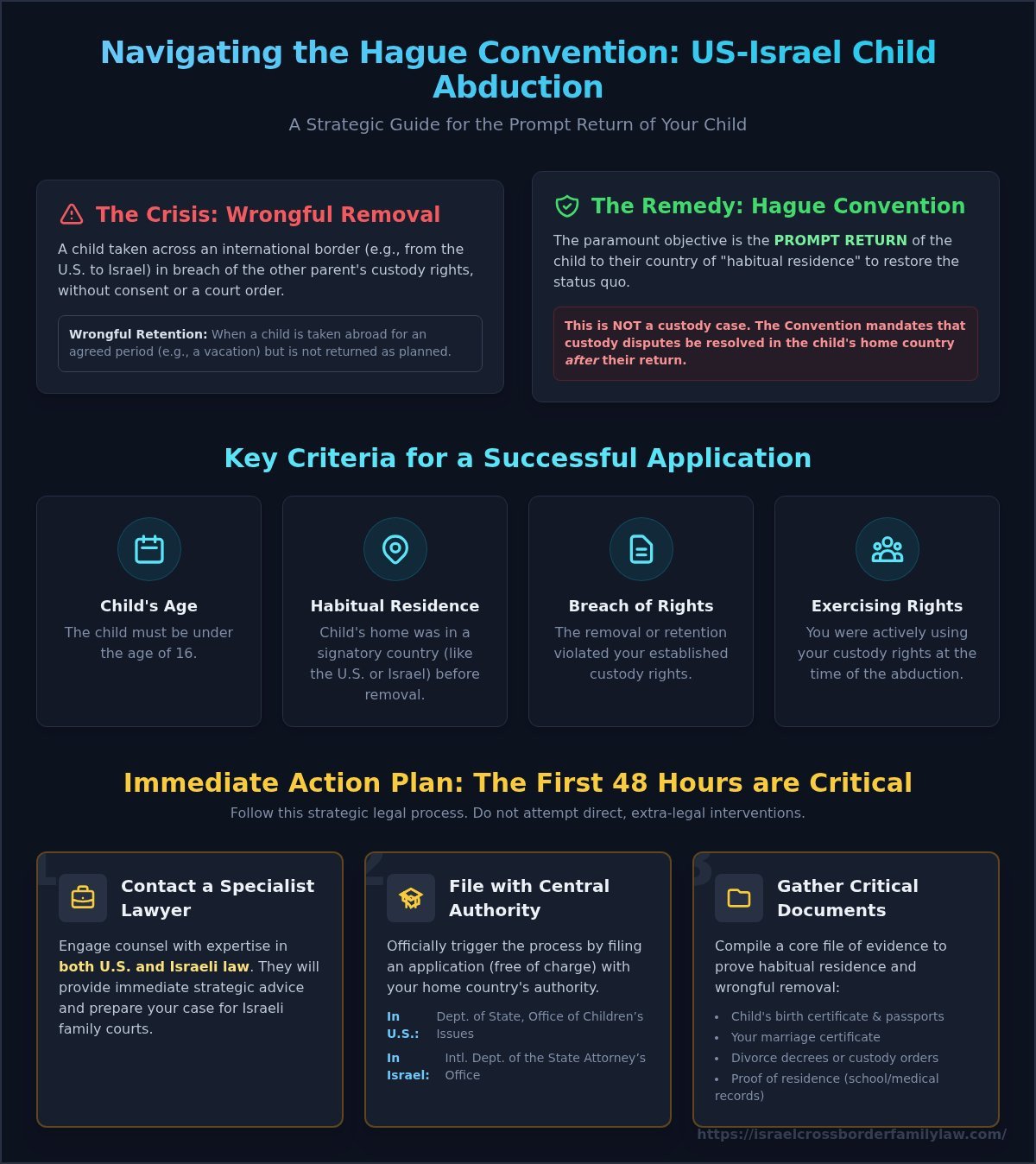
A “wrongful removal or retention” under the Convention occurs when a child is taken across an international border in breach of the custody rights of the other parent or legal guardian. For example, if one parent permanently relocates a child from their habitual residence in the U.S. to Israel without the other parent’s consent or a court order, it constitutes a wrongful removal. This is distinct from a pre-approved international vacation. “Wrongful retention” applies when a child is taken abroad for an agreed-upon period but is not returned at the end of that time.
The Role of the Central Authorities in Israel and the U.S.
Each signatory nation designates a Central Authority to act as the primary point of contact for processing applications and facilitating multi-jurisdictional cooperation. In the United States, this function is managed by the Department of State’s Office of Children’s Issues. In Israel, the corresponding body is the International Department of the State Attorney’s Office. These authorities guide left-behind parents, help locate children, and encourage amicable resolutions while ensuring the efficient transmission of legal documents between nations.
Key Criteria for a Successful Hague Application
To initiate a successful claim under the Hague Convention, several core criteria must be met. These non-negotiable prerequisites form the foundation of any petition for a child’s return:
- The child involved must be under the age of 16.
- The child’s habitual residence, prior to the abduction, was in a signatory country (e.g., the U.S. or Israel).
- The removal or retention was in direct breach of established custody rights.
- The left-behind parent was actively exercising their custody rights at the time of the abduction.
Immediate First Steps if Your Child is Abducted to or from Israel
In the event of an international parental abduction, a situation governed by the hague convention child abduction israel framework, the actions taken within the first 24 to 48 hours are of paramount importance and can substantially influence the outcome of the case. This is a time-critical legal emergency that demands a measured, strategic response. It is imperative to resist any impulse toward direct, extra-legal interventions, as such actions can irrevocably compromise your legal standing. The primary objective is to correctly and formally initiate the multi-jurisdictional legal process to secure the prompt return of your child.
Step 1: Contact a Specialized Cross-Border Family Lawyer
Engaging counsel with specific expertise in cross-border family law is the most critical first step. A specialized attorney provides immediate, strategic advice tailored to the complexities of the Israeli legal system. They will guide you meticulously through the Central Authority application process, ensuring all information is presented accurately and persuasively. Crucially, they begin preparing the substantive legal case for presentation before the Israeli family courts, which will ultimately adjudicate the return order under the Convention’s framework.
Step 2: File an Application with Your Home Country’s Central Authority
Simultaneously, you must file a formal application with the designated Central Authority in your country of habitual residence. For parents in the United States, this entity is the U.S. Department of State’s Office of Children’s Issues. Filing this application, which is free of charge, is the official trigger for international cooperation under the treaty. Your home country’s Central Authority will then formally transmit the case to its counterpart, Israel’s Central Authority on International Child Abduction, officially commencing the proceedings.
Step 3: Gather Critical Documentation
A robust application is built upon comprehensive and clear documentation. Your legal counsel will require you to immediately begin compiling a core file of evidence to establish the child’s habitual residence and the wrongful nature of the removal or retention. This file should include:
- The child’s birth certificate and all passports (yours, the child’s, and the other parent’s).
- Your marriage certificate and any pre-existing divorce decrees or custody orders from a competent court.
- Verifiable evidence of the child’s habitual residence, such as school enrollment records, medical reports, and rental agreements.
- All written communications (emails, text messages, social media messages) that demonstrate the abduction was non-consensual or that prove the other parent’s intent to wrongfully retain the child.
The Hague Convention Process in Israeli Family Courts
Israel has established a robust and expedited legal framework for adjudicating international child abduction cases under its domestic implementing legislation, the Hague Convention Law 5751-1991. Recognizing the urgency of these matters, the process is designed for swift resolution, with a target of reaching a final judgment within six to eight weeks. These sophisticated cases are heard exclusively in specialized Family Courts, ensuring that judges possess the requisite expertise in navigating the complexities of the Convention.
While the Israeli State Attorney, acting as the Central Authority, formally represents the application in court, their role is to uphold the Convention’s principles rather than to advocate for the left-behind parent’s personal interests. Therefore, securing experienced private counsel is critical for effectively representing the parent, presenting evidence, and navigating the nuances of the Hague Convention child abduction Israel legal process.
Initiating the Case in Israel
Upon receiving a formal application, Israel’s Central Authority promptly files a petition for the child’s return with the appropriate Family Court. The court then serves the taking parent with the lawsuit and an order to appear at an initial hearing. Crucially, the court has the authority to issue immediate interim orders, such as a stay of exit order preventing the child from being removed from Israel and orders to seize passports, to secure the court’s jurisdiction and prevent further flight.
The Court Hearings: What to Expect
The initial hearing primarily serves to establish a tight schedule for the submission of evidence and set a date for the main evidentiary hearing. The court’s focus during these proceedings is deliberately narrow and does not delve into the merits of custody. The judge’s inquiry is strictly limited to determining:
- Whether the child was “habitually resident” in the country from which they were taken.
- Whether the removal or retention was “wrongful” in breach of the left-behind parent’s custody rights.
- Whether any of the Convention’s limited defenses apply.
Enforcing a Return Order
If the petition is successful, the Family Court will issue a definitive and enforceable order for the child’s immediate return to their country of habitual residence. This order will specify the precise terms and a strict timeline for compliance. Should the taking parent fail to comply voluntarily, Israeli enforcement authorities, including the police and the Execution Office (Hotza’a Lapoal), are empowered to enforce the order. Any appeal of a return order is subject to extremely short deadlines, underscoring the finality and urgency of the court’s decision.
Common Defenses Raised in Israeli Hague Abduction Cases
While the Hague Convention’s primary objective is the prompt return of a wrongfully removed child, it provides for a limited set of specific exceptions. It is critical to understand that the burden of proof for any defense rests squarely and heavily upon the abducting parent. Israeli Family Courts are known for their rigorous application of the Convention and interpret these defenses very narrowly, prioritizing the child’s return to their country of habitual residence for custody matters to be adjudicated there.
Successfully navigating a petition for return requires a sophisticated legal strategy that anticipates and systematically refutes these potential defenses. Proactive preparation is paramount in any case involving hague convention child abduction israel.
Article 13(b): Grave Risk of Physical or Psychological Harm
This is the most frequently argued defense in Israeli courts, yet it carries an exceptionally high evidentiary threshold. The respondent must prove that returning the child would expose them to a grave risk of physical or psychological harm or otherwise place them in an intolerable situation. Mere allegations of parental conflict, financial instability, or a less desirable living situation are insufficient. The court requires concrete, compelling evidence of serious abuse or neglect, and may even order the child’s return with protective measures or undertakings in place to mitigate any perceived risks.
Article 13(a): Consent or Subsequent Acquiescence
This defense asserts that the left-behind parent either consented to the child’s removal or relocation beforehand, or subsequently acquiesced to it. To succeed, the abducting parent must present clear, unequivocal, and unambiguous evidence of consent. A vague conversation or misunderstood intention will not suffice. Acquiescence refers to a later acceptance of the new situation, often inferred from a significant and unexplained delay by the left-behind parent in initiating legal action to secure the child’s return.
The Child’s Objection and ‘Settled’ Defenses
Two other defenses are occasionally raised:
- Child’s Objection: If a child has attained an age and degree of maturity at which it is appropriate to take account of their views, the court may refuse to order their return. The Israeli court will conduct a careful assessment to determine the child’s maturity and whether their stated objections are genuine and not the result of influence from the abducting parent.
- Child is ‘Settled’: This defense may apply if proceedings are initiated more than one year after the date of the wrongful removal and the child is now settled in their new environment. This one-year timeline underscores the critical importance of taking immediate and decisive legal action.
Effectively countering these complex defenses requires experienced counsel adept at the nuances of international family law. If you are facing a cross-border child abduction issue, our firm is positioned to provide the strategic guidance necessary to navigate these challenging legal proceedings. For a confidential consultation, please contact our legal team.
Why a US-Israel Cross-Border Lawyer is Essential for Your Case
Navigating an international child abduction case under the Hague Convention is a sophisticated legal challenge that extends far beyond the scope of a standard family law practitioner. The outcome of your petition often hinges less on the emotional aspects of the dispute and more on the precise application of international law within two distinct domestic legal frameworks. When facing a hague convention child abduction israel case, retaining a lawyer with multi-jurisdictional expertise is not merely an advantage-it is the most critical factor for success.
A general practitioner, while skilled in domestic custody matters, often lacks the specific procedural and strategic experience required for these expedited, high-stakes proceedings. Success demands a legal team capable of operating seamlessly across borders, a role only a true US-Israel cross-border specialist can fulfill.
Mastery of Two Distinct Legal Systems
An effective Hague Convention strategy requires a profound and integrated understanding of both American and Israeli law. Your legal counsel must be adept at building a case that is legally sound in the United States and persuasive within the Israeli Family Court system. This dual mastery includes:
- A comprehensive understanding of US state custody laws to definitively establish your “rights of custody” under the Convention.
- Deep, practical knowledge of Israeli Family Court procedures, judicial precedents, and the specific evidentiary standards they apply.
- The ability to coordinate and execute a unified legal strategy, liaising with authorities and legal professionals in both countries simultaneously.
Strategic Evidence Gathering and Presentation
Presenting a compelling case in Israel requires more than just translating documents. It involves a strategic approach to evidence, tailored to the expectations of Israeli judges. A cross-border expert knows precisely what evidence is most persuasive, how to prepare affidavits and testimony that withstand international scrutiny, and how to effectively cross-examine the other party on key defenses like “grave risk of harm.” Protecting your parental rights starts with a robust, well-prepared legal case. Schedule a confidential consultation to protect your rights.
Bilingual and Bicultural Advocacy
In the complex field of hague convention child abduction israel litigation, communication is paramount. True advocacy goes beyond legal arguments; it involves bridging cultural divides. An attorney fluent in both English and Hebrew can articulate the nuances of your case directly to Israeli judges and opposing counsel without the risk of mistranslation. This bicultural understanding allows your representative to navigate subtle cultural dynamics that can significantly influence court perceptions and, ultimately, the final ruling on your child’s return.
Strategic Guidance for Your Hague Convention Case
Navigating a case of hague convention child abduction israel requires a profound understanding of both the treaty’s core objective-the prompt return of a wrongfully removed child-and the intricate procedural landscape of the Israeli Family Courts. As this guide has outlined, the immediacy of your response and the strategic handling of potential legal defenses are paramount factors that significantly influence the outcome of your petition. Success in these complex, multi-jurisdictional matters hinges on securing representation that is adept in both US and Israeli law.
Our firm is uniquely positioned to provide this sophisticated level of representation. With a team of bilingual attorneys licensed in both the United States and Israel, we leverage our extensive experience and strategic offices in Tel Aviv and New York to champion your case. We possess a deep, practical knowledge of the Israeli Family Court system, ensuring your petition is managed with the precision and authority it demands.
While the path ahead may seem daunting, with the right legal partner, you can take decisive action toward securing your child’s safe return.
Frequently Asked Questions About the Hague Convention in Israel
How long does a Hague Convention case typically take in Israel?
While the Convention itself advocates for a resolution within six weeks, the practical timeline in Israel is often longer. A typical case may take several months to conclude in the Family Court, which has exclusive jurisdiction. Complex cases involving extensive evidence, psychological evaluations, or appeals can extend this timeframe to 6-12 months. Israeli courts do treat these cases with urgency, but procedural requirements and judicial schedules must be accommodated, demanding strategic and patient legal navigation.
Who is responsible for the legal fees and travel costs for a Hague case?
Generally, each party is responsible for their own legal and associated costs. The left-behind parent must fund their legal representation in Israel, in addition to their own travel and accommodation expenses. While an Israeli court has the discretion to order the abducting parent to cover some or all of these costs upon the conclusion of the case, such an award is not guaranteed. It is crucial to budget accordingly for these complex cross-border proceedings.
If my child is returned, does that mean I get full custody?
No. A return order under the Hague Convention is not a determination of custody rights. The Convention’s sole and specific purpose is to return a child to their country of habitual residence, thereby restoring the status quo. All substantive decisions regarding custody, guardianship, and visitation rights remain under the exclusive jurisdiction of the courts in that home country. The Israeli court’s role is strictly limited to deciding on the child’s prompt return.
What can be done if the abducting parent is hiding with the child in Israel?
Immediate legal action is imperative. Experienced counsel can petition the Israeli Family Court for ex-parte (one-sided) orders to locate the child and prevent their further removal. These orders can empower the Israeli Police and welfare authorities to actively search for the child. The Central Authority within Israel’s Ministry of Justice can also be engaged to assist. Providing all known information about the abducting parent’s potential whereabouts and contacts is critical to the success of these efforts.
Can I have the other parent arrested for international parental kidnapping?
The Hague Convention provides a civil, not a criminal, remedy. Its objective is the child’s return, not the punishment of the abducting parent. While parental kidnapping is a criminal offense under Israeli law, pursuing criminal charges is a separate legal track from the civil Hague application. A criminal investigation does not typically expedite the return process, and the decision to prosecute rests with the State Attorney’s Office, not the aggrieved parent, requiring a distinct legal strategy.
Is Israel a difficult country from which to have a child returned under the Convention?
Israel has a well-established legal framework for implementing the Convention and its judiciary is highly experienced in these matters. However, success is never guaranteed. Israeli courts rigorously examine all asserted defenses, particularly the “grave risk of harm” defense. Prevailing in a Hague Convention child abduction Israel case requires sophisticated legal representation capable of presenting a compelling evidentiary case and effectively navigating the nuances of the Israeli family law system to secure a return order.
What happens to my child’s passport during a Hague case in Israel?
Upon initiating Hague proceedings, one of the first and most critical steps is for legal counsel to seek an immediate interim injunction from the court. This order typically prohibits the child’s removal from Israel and mandates that the abducting parent surrender the child’s Israeli and any foreign passports to the court or a designated authority. This preventative measure is standard procedure to secure the court’s jurisdiction and prevent further international flight while the case is being adjudicated.

Article by
Gabriel Lior
A Personal Journey That Became a Mission
The advisory was founded by an American father Gabriel Lior, LLB, MBA , global entrepreneur, and cross-border advisor who spent more than a decade navigating the Israeli family court system firsthand and now lives in Singapore with his son.
As a divorced parent in a cross-border family, Gabriel faced nearly every legal challenge a foreign parent can encounter in Israel — including child custody disputes, child support proceedings, property matters in Israel and abroad, false accusations, and complex immigration and relocation proceedings.
Over the years, he learned the hard way how difficult it is for non-Israeli parents to understand the system, identify the right legal strategy, and choose the right legal representation — especially when language, culture, and jurisdictional differences are involved. He also witnessed how foreign parents and new immigrants are often disadvantaged or taken advantage of by service providers and institutions simply because they lack local knowledge or fluency.
From Client to Advisor
To truly understand — and survive — the system, Gabriel pursued formal legal education in Israel, completing two Israeli law degrees, alongside a BA and MBA earned in the United States. This was never about becoming a practicing attorney, but about gaining a deep, structural understanding of how the system works — and where it breaks down for foreign parents.
This rare combination of:
Firsthand client experience
Israeli legal and US business education
International business and negotiation training
Decades of commercial execution
created a unique perspective – one that understands both sides of the table.
After years of litigation, persistence, and at times self-representation, he ultimately succeeded in securing custody of his son and relocating abroad through a rare legal victory in the Israeli Supreme Court — becoming one of the first fathers in Israel to do so under these circumstances.
Disclaimer
Important Disclaimer:
The information provided on this website and in its content is for general informational and educational purposes only and does not constitute legal advice, legal opinion, or legal representation.
Gabriel Lior is not licensed to practice law in Israel (nor is he interested in doing so) and does not provide legal services, despite having completed 2 Law Degrees. The services offered are advisory in nature and are intended to provide general guidance, strategic insight, and information regarding cross-border family law considerations.
No attorney-client relationship is formed by accessing this website, reading its content, or communicating with us.
Any decisions made based on this information are at your own discretion and risk. For legal advice specific to your situation, you should consult a licensed attorney in the relevant jurisdiction.
Where appropriate, we may refer clients to independent, licensed attorneys or professionals. Such referrals do not constitute legal representation and no liability is assumed for services provided by third parties.