Imagine discovering that a single filing in a Jerusalem court could fundamentally alter your rights to property located thousands of miles away in the United States. For many international families, the realization that two distinct legal systems are competing for jurisdiction over their lives comes as a shock. It’s natural to feel overwhelmed by the conflicting rules of the US and Israel, especially when your assets, your home, and your children’s future are at stake. The stress of high-stakes litigation is often compounded by the fear that a jurisdictional error could lead to a permanent loss of assets.
By consulting with specialized experts like Irit Reichman & Co., you can gain the clarity needed to protect your interests across borders. You’ll learn how to manage the “race to court” and understand why early decisions carry so much weight in cross-border cases. Please note that this content is published on an independent advisory platform, not a law firm, and is intended for informational purposes rather than formal legal advice. This guide provides a strategic roadmap for divorce and inheritance matters, helping you bridge the gap between Israeli and US legal standards. For more visual insights, you can also explore the resources available on our YouTube channel.
Key Takeaways
- Understand the strategic significance of the “race to court” and how the choice between civil and rabbinical jurisdictions can fundamentally alter your case outcome.
- Learn how to manage the division of multi-jurisdictional assets, including businesses and real estate located in both the US and Israel.
- Gain a clear roadmap for navigating international child custody disputes under the frameworks of the Hague Convention.
- Recognize why the specialized cross-border experience of Irit Reichman & Co. is essential for bridging the cultural and legal gaps between two distinct systems.
- Discover the essential steps for drafting wills that are enforceable in both jurisdictions to protect your family’s global inheritance.
Who is Irit Reichman & Co. in the Israeli Legal Landscape?
Irit Reichman & Co. is a prominent fixture in the Israeli family law arena, known for its focus on high-stakes litigation and complex personal status cases. The firm doesn’t just practice law; it has actively shaped the legal landscape by establishing precedents that influence how courts handle property division and child welfare. This content is published on an independent advisory platform, not a law firm, and focuses on strategy and decision-making guidance rather than a formal attorney-client relationship. For international families, the firm serves as a vital resource when standard legal advice isn’t enough to address the complexities of living between two different nations.
The firm’s reputation is built on a foundation of managing cases that involve intricate financial portfolios and sensitive family dynamics. Their practitioners are often called upon to resolve disputes where the stakes are exceptionally high, requiring a deep understanding of both civil and religious law. You can learn more about the strategic approach used in these matters by visiting our about the advisory page.
To better understand this concept, watch this helpful video:
A Legacy of Family Law Expertise
With decades of experience navigating the Israeli family court system, Irit Reichman & Co. has maintained a consistent presence in top-tier legal directories. This recognition isn’t just about longevity; it reflects a commitment to a specific philosophy of practice. They prioritize clarity and strategic planning over aggressive litigation, helping clients understand the long-term consequences of their legal choices. This approach is particularly helpful for those unfamiliar with the local system, providing a sense of security during a period of significant personal transition.
The Cross-Border Specialty
The firm’s true differentiator is its expertise in multi-jurisdictional family law. When assets or parties are split between the US and Israel, the legal challenges multiply. The firm acts as a bridge, aligning cultural expectations with the rigid requirements of the law. They are well-versed in the Hague Convention on the Civil Aspects of International Child Abduction, ensuring that international custody matters are handled with the necessary technical precision. This awareness is essential for families who need to ensure their rights are protected in both jurisdictions simultaneously. You can find further details on how these treaties are applied on our Hague Convention page.
International Divorce and Complex Asset Division
Dividing a life is complicated, but dividing a life spread across two continents presents unique logistical and legal hurdles. For high-net-worth Anglo families, assets aren’t just bank accounts; they often include US-based 401(k) plans, real estate in multiple states, and business interests that operate under different regulatory frameworks. Israeli courts generally follow the Spouses’ Property Relations Law (1973), which mandates an equal division of assets accumulated during the marriage. However, the way a court in Israel views a tech startup in California or a trust in New York can differ significantly from US standards. The specialized expertise of Irit Reichman & Co. is essential for ensuring that foreign-held assets are accurately valued and that the division is enforceable in both jurisdictions.
Strategic planning is the only way to avoid the pitfalls of double taxation or the loss of asset value due to jurisdictional errors. For those living abroad, our guide for expats and foreign nationals provides a deeper look into how these laws apply to your specific situation. It’s often wise to seek a strategic review of your specific asset portfolio before any legal filings occur.
Strategic Asset Protection
The first step in any international divorce is identifying and valuing the global “marital pot.” This process is rarely straightforward. You might have a prenuptial agreement drafted in the US that you assume is ironclad, but if it doesn’t meet specific Israeli legal requirements, it may be challenged in a local court. Protecting business interests requires a nuanced approach; an Israeli court might award a spouse a share of the value of a US business, creating a complex debt that must be settled without dismantling the company. Irit Reichman & Co. works to ensure that valuations reflect the reality of both markets, preventing one party from being disadvantaged by fluctuating exchange rates or differing accounting standards.
Alimony and Spousal Support
One of the most striking differences between the two systems is how they handle spousal support. In the US, alimony is often seen as a way to maintain a standard of living or provide rehabilitative support. In Israel, for Jewish couples, spousal support (Mezonot Isha) is governed by religious law and typically ends once the divorce is finalized with a “get.” This distinction can lead to significant financial shifts depending on which court handles the case. While financial disputes are the primary focus here, they often intersect with broader family concerns, such as those detailed by the U.S. Department of State on International Parental Child Abduction. Understanding how a court determines support levels for an international family is vital, as the “standard of living” may be calculated based on costs in a different country entirely.
Jurisdictional Conflicts: The ‘Race to Court’
In Israel, the decision of where to file your divorce petition is one of the most critical steps you’ll take. This is due to the “race to court,” a unique feature of the Israeli legal system where the court that first receives a petition often gains the authority to decide all related matters, including property division and child support. For international families, this race is even more complex because you aren’t just choosing between two local buildings; you’re often choosing between two entirely different legal philosophies. This content is published on an independent advisory platform, not a law firm, and focuses on strategy, risks, and decision-making guidance rather than a formal attorney-client relationship.
The risks of litigating in the wrong forum are significant. You could face conflicting orders or find yourself unable to move assets between jurisdictions due to a lack of mutual recognition. Understanding how it works is the first step toward protecting your interests. Early strategic planning with experts like Irit Reichman & Co. is essential to ensure that your case is heard in the forum most likely to respect your international rights and assets.
Civil vs. Rabbinical Courts
Jewish couples in Israel navigate a dual-court system where the civil Family Court and the religious Rabbinical Court have concurrent jurisdiction. While the Family Court applies civil law, the Rabbinical Court operates under religious principles (Halakha). A law passed in November 2025 temporarily expanded the jurisdiction of rabbinical courts to rule on all matters of child support, a change set as a two-year interim measure. For a US expat, this shift can be confusing. Filing first in a court that doesn’t align with your long-term goals could lead to an outcome that a US court might find difficult to recognize or enforce. Irit Reichman & Co. provides the necessary expertise to navigate these competing systems, ensuring that your rights aren’t lost in a jurisdictional shuffle.
The US-Israel Legal Bridge
Success in a cross-border case requires a coordinated strategy that accounts for both US and Israeli legal standards simultaneously. If you have assets or custody orders in both countries, your legal team must act as a bridge. This often involves using expert witnesses to explain foreign law to the court or ensuring that an Israeli judgment is drafted in a way that US authorities will accept. This level of coordination is similar to the multi-jurisdictional alignment discussed in the Forbes guide to cross-border estate planning. To begin building your strategic roadmap, you can request a confidential case review to clarify your legal standing.
Child Custody and the Hague Convention
When a family’s life is split between the US and Israel, child custody becomes a matter of international treaty as much as personal preference. It’s a common misconception that a parent can move a child back to their home country without formal consent or a court order. In reality, such a move can trigger a complex legal response under the Hague Convention. This content is published on an independent advisory platform, not a law firm, and focuses on strategy and risks rather than a formal attorney-client relationship. Understanding the concept of “habitual residence” is essential; it’s the legal standard used to determine which country has the authority to make decisions about a child’s future. It isn’t just about where the child is currently staying, but where their “center of life” has been established.
Israeli courts are increasingly prioritizing joint parental responsibility, moving away from older sole custody models. This trend means that even if one parent is the primary caregiver, the other parent’s rights to be involved in major life decisions are strictly protected. If you’re considering a relocation or facing a custody dispute, it’s vital to speak with a strategic advisor before taking any action that could be seen as a violation of these rights.
Hague Convention Protections
The Hague Convention is designed to ensure the prompt return of children who have been wrongfully removed from their country of habitual residence. Israel is a signatory to this treaty, and its courts generally uphold the principle that custody decisions should be made in the child’s home jurisdiction. However, these cases are rarely simple. There are specific defenses, such as a “grave risk” of harm, that can complicate the return process. Irit Reichman & Co. provides the technical precision required to navigate these high-stakes disputes, ensuring that parental rights are balanced with the child’s best interests. For a detailed look at how these protections are applied, you can explore our resources on Hague Convention Child Abduction.
International Custody Agreements
Drafting a custody agreement that works across an eight-hour time difference requires more than just good intentions. It requires a strategic roadmap that accounts for school holidays, travel costs, and digital visitation. A standard Israeli custody order might not be easily recognized by a US court unless it’s drafted with specific language that satisfies both legal systems. Irit Reichman & Co. specializes in bridging these gaps, helping families create sustainable schedules that respect both cultures. You can find more information on managing these transitions on our page regarding International Custody & Relocation. Ensuring your orders are enforceable in both countries is the only way to provide long-term stability for your children.
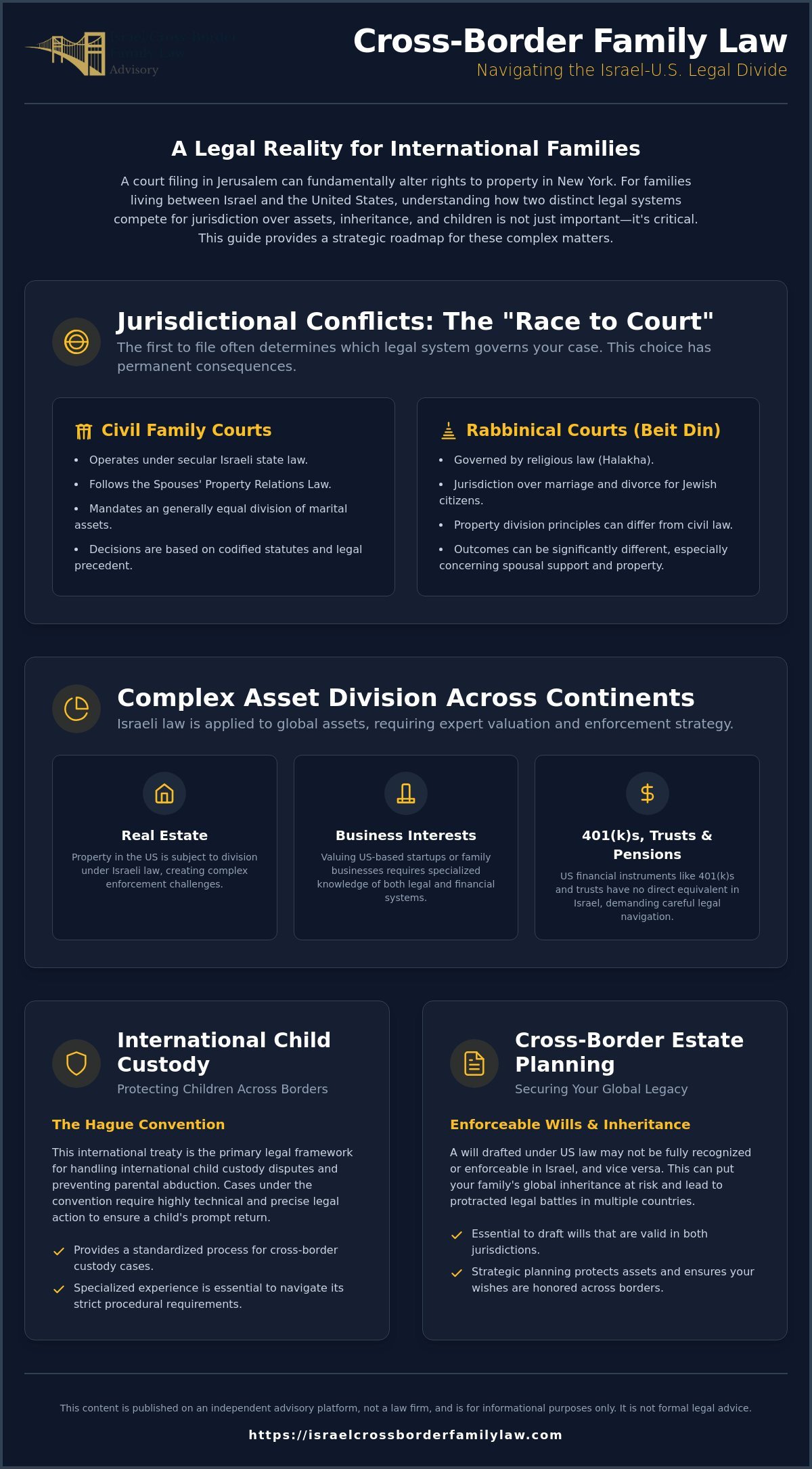
Cross-Border Estate Planning and Inheritance
Managing an estate across borders requires a keen understanding of how two distinct tax systems interact. While Israel abolished its inheritance tax in 1981, US citizens remain subject to federal estate taxes on their worldwide assets. As of July 2026, the US federal estate tax exemption stands at approximately $13.99 million per individual, with a 40% rate applied to amounts above that threshold. For families with property in Israel, the specialized expertise of Irit Reichman & Co. is vital to ensure that assets are transferred efficiently without triggering unnecessary tax liabilities or legal delays. This content is published on an independent advisory platform, not a law firm, and focuses on strategy rather than a formal attorney-client relationship.
One of the most significant differences involves capital gains tax on inherited property, known in Israel as Mas Shevach. Unlike the US system, Israel doesn’t offer a “step-up in basis.” When an inherited property is sold, the 25% capital gains tax is calculated based on the original purchase price paid by the deceased, not the value at the time of inheritance. This can lead to a substantial tax burden for heirs who aren’t prepared for the calculation. Navigating these nuances requires a strategic roadmap that accounts for the long-term financial impact on your beneficiaries. Practitioners with decades of experience can help you bridge the gap between these emerging family needs and established global legal standards.
Wills for Dual-Country Assets
A single will drafted in the US may not be sufficient to cover assets located in Israel. While Israeli courts do recognize foreign wills, the probate process for such documents is often more complex and typically takes between 8 to 12 months in uncontested cases. Drafting a separate Israeli will, which often costs between 2,500 and 5,000 NIS, can significantly simplify this process. Since May 2026, all petitions to the Inheritance Registrar involving foreign residents must be submitted through a mandatory digital portal. This trend toward digitalization means that many processes can be handled remotely, but it also requires technical precision to avoid administrative rejections. Irit Reichman & Co. ensures that your Israeli estate plan is fully integrated with your global objectives.
Strategic Inheritance Advice
Avoiding common pitfalls in cross-border estate administration starts with seeking clarity before assets are transferred. Early decisions regarding trusts and asset protection can prevent high-stakes litigation among heirs. The inherent complexity of multi-jurisdictional estates means that a “one size fits all” approach rarely works. You must consider how a trust established in New York will be viewed by the Israeli Inheritance Registrar or how a business interest in Tel Aviv impacts your US tax filing. It’s essential to work with cross-cultural practitioners who understand both business cultures. Get clarity before you commit. Request a confidential case review.
Securing Your Family’s Future Across Borders
Managing family legal matters between the United States and Israel requires more than just local knowledge; it demands a strategic bridge between two distinct legal cultures. We have explored how early decisions in the “race to court” and the precise coordination of international assets can fundamentally alter your long-term security. This independent advisory platform focuses on high-stakes cross-border strategy, offering the clarity needed to navigate complex jurisdictional conflicts with confidence. By leveraging the specialized expertise of Irit Reichman & Co., you gain access to practitioners with a physical presence and deep local engagement in both markets.
It’s essential to remember that this content is published for informational purposes and does not constitute formal legal representation. Decisions made early in a divorce or inheritance process carry significant weight, and seeking professional guidance is the best way to protect your interests. You don’t have to face these multi-jurisdictional complexities alone. Taking the time to understand your options today will provide the stability your family needs for tomorrow.
Get clarity before you commit. Request a confidential consultation.
Frequently Asked Questions
Is Irit Reichman & Co. a cross-border law firm?
Irit Reichman & Co. is an established Israeli firm known for its multi-jurisdictional proficiency in family law. While they maintain a physical presence in Israel, their practitioners are skilled in bridging the cultural and legal gaps between the US and Israel. This advisory platform serves as a strategic resource to help you understand their specialized capabilities before you commit to a formal engagement.
Can an Israeli family law order be enforced in the US?
Yes, enforcement is possible through international comity or specific state laws, but it isn’t automatic. US courts generally respect foreign judgments if they meet certain criteria for due process and fairness. However, the order must be drafted with specific language that accounts for both legal systems to ensure local authorities recognize its validity. It’s essential to coordinate with experts who understand the requirements of both jurisdictions.
What happens if a divorce is filed in both Israel and the US?
This creates a jurisdictional conflict that usually results in a race to see which court rules first or which jurisdiction is more appropriate. The timing of the filings is critical, as the first court to establish authority may claim the right to decide all related matters. This often requires coordinated legal strategies in both countries to prevent conflicting orders and protect your global assets.
How does the Hague Convention apply to US-Israel custody cases?
The treaty ensures that children wrongfully removed from their habitual residence are promptly returned to that jurisdiction. Both the US and Israel are signatories, meaning their courts work together to resolve abduction cases. This process prioritizes the child’s established center of life over the personal preferences of the parents during a dispute. It’s a technical area of law that requires precise strategic planning.
Do I need a separate will for my assets in Israel and the US?
Having a separate Israeli will is highly recommended to simplify the probate process for local assets. While a US will can be recognized, the digital portal requirements and translation needs can delay the transfer of property by many months. A local document ensures that your Israeli assets are handled according to current regulations without unnecessary administrative hurdles. This is particularly important for avoiding long delays in the Israeli Inheritance Registrar.
How much does international family law representation cost?
Costs vary based on the complexity of the multi-jurisdictional issues and the specific financial assets involved. Readers should check with practitioners directly, as fee structures are determined by the unique requirements of each case. It’s important to understand that high-stakes litigation involving foreign law typically requires a more significant investment than a standard domestic divorce. Seeking clarity on these costs before committing is a vital part of your strategy.
Can I divorce in Israel if I am a US citizen?
Yes, you can divorce in Israel if you or your spouse meet certain residency or religious requirements. For Jewish citizens, the Rabbinical Court has exclusive authority over the marriage and divorce itself, while other matters like property can be handled in Family Court. Being a US citizen doesn’t prevent the Israeli system from claiming jurisdiction over your personal status. You should be aware of how these decisions might be viewed by US authorities later.
What is the role of an international family law advisor?
An advisor acts as a strategic guide who helps you navigate the risks and complexities of competing legal systems. They focus on decision-making guidance rather than direct legal representation, helping you build a roadmap for your case. By working with experts like Irit Reichman & Co., you can gain clarity on how early choices impact your global assets and family rights. This platform provides that strategic oversight to ensure you don’t make critical errors early in the process.

Article by
Gabriel Lior
A Personal Journey That Became a Mission
The advisory was founded by an American father Gabriel Lior, LLB, MBA , global entrepreneur, and cross-border advisor who spent more than a decade navigating the Israeli family court system firsthand and now lives in Singapore with his son.
As a divorced parent in a cross-border family, Gabriel faced nearly every legal challenge a foreign parent can encounter in Israel — including child custody disputes, child support proceedings, property matters in Israel and abroad, false accusations, and complex immigration and relocation proceedings.
Over the years, he learned the hard way how difficult it is for non-Israeli parents to understand the system, identify the right legal strategy, and choose the right legal representation — especially when language, culture, and jurisdictional differences are involved. He also witnessed how foreign parents and new immigrants are often disadvantaged or taken advantage of by service providers and institutions simply because they lack local knowledge or fluency.
From Client to Advisor
To truly understand — and survive — the system, Gabriel pursued formal legal education in Israel, completing two Israeli law degrees, alongside a BA and MBA earned in the United States. This was never about becoming a practicing attorney, but about gaining a deep, structural understanding of how the system works — and where it breaks down for foreign parents.
This rare combination of:
Firsthand client experience
Israeli legal and US business education
International business and negotiation training
Decades of commercial execution
created a unique perspective – one that understands both sides of the table.
After years of litigation, persistence, and at times self-representation, he ultimately succeeded in securing custody of his son and relocating abroad through a rare legal victory in the Israeli Supreme Court — becoming one of the first fathers in Israel to do so under these circumstances.
Disclaimer
Important Disclaimer:
The information provided on this website and in its content is for general informational and educational purposes only and does not constitute legal advice, legal opinion, or legal representation.
Gabriel Lior is not licensed to practice law in Israel (nor is he interested in doing so) and does not provide legal services, despite having completed 2 Law Degrees. The services offered are advisory in nature and are intended to provide general guidance, strategic insight, and information regarding cross-border family law considerations.
No attorney-client relationship is formed by accessing this website, reading its content, or communicating with us.
Any decisions made based on this information are at your own discretion and risk. For legal advice specific to your situation, you should consult a licensed attorney in the relevant jurisdiction.
Where appropriate, we may refer clients to independent, licensed attorneys or professionals. Such referrals do not constitute legal representation and no liability is assumed for services provided by third parties.