For a woman whose husband resides in another country, the refusal to grant a get-a Jewish religious divorce-can create an insurmountable legal and emotional prison, trapping her in a marriage against her will. This deeply distressing situation is further complicated when it spans multiple jurisdictions, placing victims at the complex intersection of religious tradition and civil jurisprudence. Successfully navigating the challenging field of agunah international law demands a sophisticated understanding of how secular courts, particularly in the United States and Israel, can be leveraged to secure your freedom from a recalcitrant spouse who may be using the get for extortion.
This definitive guide is engineered to provide that clarity and actionable direction. We will dissect the legal implications of being an agunah in a cross-border context, present concrete legal strategies to apply pressure for a get, and detail the procedural interactions between U.S. and Israeli courts on this critical issue. Our purpose is to illuminate a strategic path forward, empowering you with the knowledge to dismantle these barriers and reclaim your right to remarry and begin anew.
Understanding the Agunah Crisis in an International Context
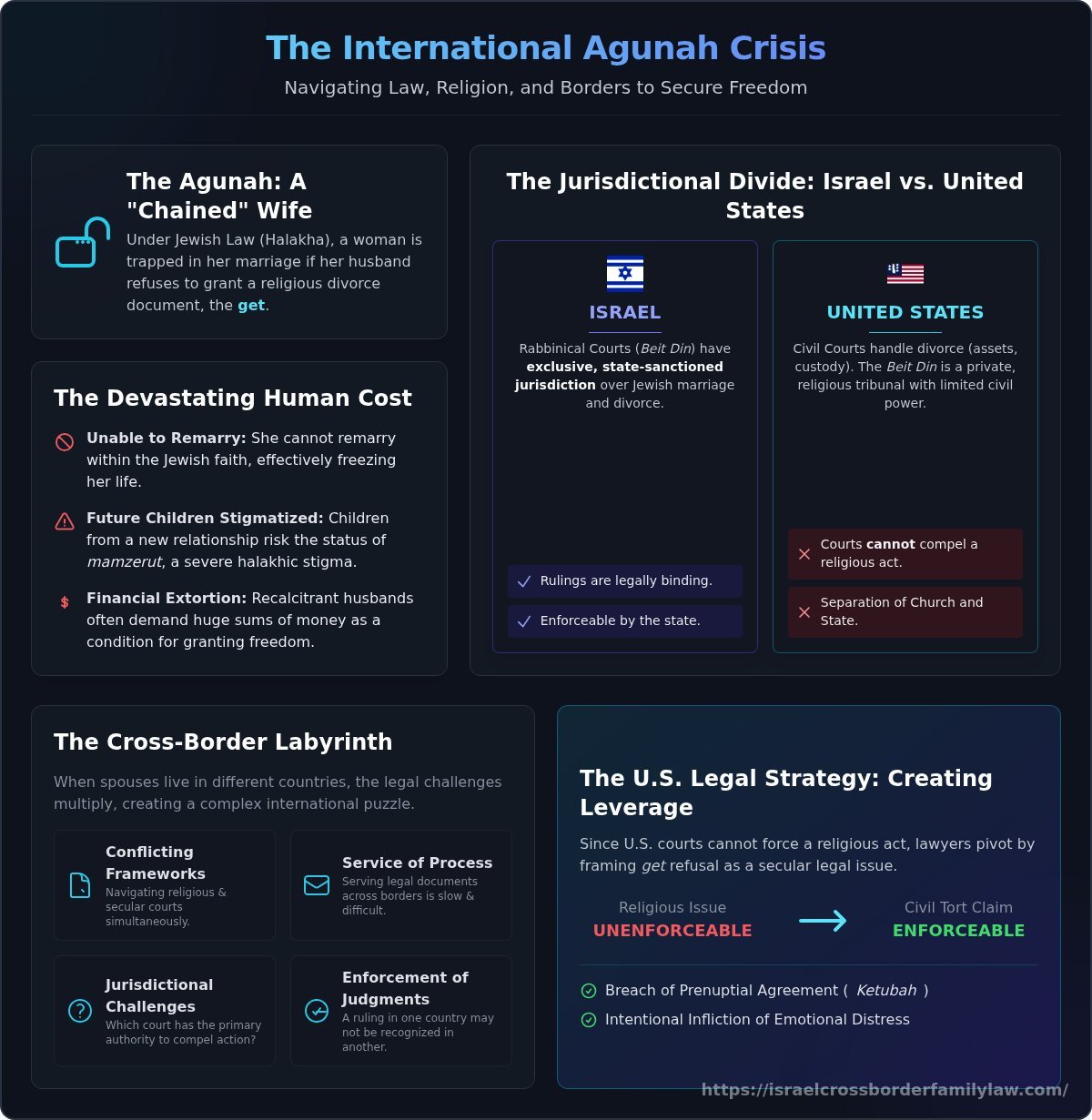
The term agunah (plural: agunot) refers to a woman “chained” to her marriage under the principles of Halakha (Jewish law). The dissolution of a Jewish marriage requires the issuance of a get, a religious divorce document that, according to traditional Halakha, can only be granted by the husband. A crisis emerges when a husband refuses to grant the get, a practice known as get refusal, which effectively prevents his wife from remarrying within the Jewish faith. For a more detailed exploration of its historical and legal foundations, Understanding the Agunah Crisis provides essential background. This situation becomes exponentially more complex when international borders separate the spouses, creating a sophisticated legal challenge at the intersection of religious and secular global law.
To provide further perspective on this complex issue, the following discussion offers valuable insights:
The Human Cost of Get Refusal
The consequences of get refusal are severe and multi-faceted. Legally, the agunah cannot remarry within the Jewish faith. Any children born from a subsequent relationship risk being designated with the status of mamzerut, a deeply stigmatizing label with significant halakhic ramifications. Beyond these legal and religious implications, the emotional and psychological toll is immense. This state of limbo is frequently exploited by recalcitrant husbands for financial extortion, who may demand significant assets or payments, sometimes amounting to hundreds of thousands of shekels (₪), as a condition for granting freedom.
Why Cross-Border Cases are Uniquely Complex
The challenges intensify dramatically when spouses reside in different countries, such as Israel and the United States. These multi-jurisdictional disputes require navigating a sophisticated legal labyrinth where religious law, Israeli family law, and foreign secular law intersect. The practice of agunah international law involves addressing several critical complexities:
- Conflicting Legal Frameworks: Parties must simultaneously navigate the Israeli Rabbinical Court system and the secular family court system of another nation, each with its own procedures and remedies.
- Service of Process: The logistical and legal hurdles of serving court orders, summons, or other legal documents across international borders can cause significant delays and complications.
- Jurisdictional Challenges: A primary conflict often arises over which court-Israeli or foreign-has the primary authority to compel action or enforce sanctions against a non-compliant spouse abroad.
- Enforcement of Judgments: A ruling or sanction issued by a court in one country may not be recognized or readily enforceable in the jurisdiction where the other spouse resides, potentially creating a legal stalemate.
The Intersection of Halakha and Secular International Law
The plight of the agunah exists at a complex legal crossroads where ancient religious law, or Halakha, directly conflicts with modern principles of individual civil rights. For an observant Jewish woman, a civil divorce decree from a secular court is legally insufficient; without a get (a Jewish writ of divorce) granted by her husband, she remains married under religious law and is unable to remarry. This fundamental requirement creates a profound tension, particularly in international cases, forcing a delicate navigation between religious freedom and the prevention of civil rights abuses like coercive control.
This dynamic is further complicated by how different legal systems view the get itself. While it is unequivocally a religious document, its refusal can be framed as a secular legal issue. The core challenge in matters of agunah international law is bridging the chasm between a religious obligation and a civilly enforceable right, a task that demands a sophisticated, multi-jurisdictional legal strategy.
Jurisdiction of Rabbinical Courts vs. Civil Courts
The authority to adjudicate divorce proceedings varies dramatically between jurisdictions, creating significant challenges for cross-border cases. This jurisdictional dichotomy is most pronounced when comparing Israel and the United States.
- In Israel: Rabbinical courts (the Beit Din) possess exclusive, state-sanctioned jurisdiction over the marriage and divorce of Jewish citizens. Their rulings are legally binding and enforceable by the state.
- In the U.S. and other diaspora nations: Civil courts handle all legal aspects of divorce, such as asset division and custody. The Beit Din operates as a private religious tribunal whose authority is based on the consent of the parties, making its decisions difficult to enforce civilly.
The challenge intensifies when a civil court order, for instance, mandates cooperation in the religious divorce process, as it may be viewed as unenforceable by a religious tribunal in another country.
Separation of Church and State in the U.S. Context
In the United States, the First Amendment’s Establishment Clause creates a high wall between church and state, preventing civil courts from compelling a purely religious act, such as the granting of a get. Consequently, U.S. courts cannot order a husband to give his wife a get. However, skilled legal practitioners focus on the civil and contractual aspects of the marriage to create leverage. By framing the refusal to grant a get not as a religious issue but as a breach of a prenuptial agreement (ketubah) or as a tool for extortion in civil negotiations, lawyers can introduce powerful tort claims like intentional infliction of emotional distress. This strategic approach transforms the issue into a matter of civil rights and contractual obligations that a secular court can adjudicate, sometimes compelling a recalcitrant spouse to cooperate by imposing significant financial sanctions. This is one of many complex issues to consider when Enforcing Judgments in Israel or abroad in the pursuit of justice for an agunah.
Legal Strategies in U.S. Courts to Combat Get Refusal
While U.S. courts are constitutionally prohibited from compelling a religious act such as the granting of a get, they possess significant authority to adjudicate the secular, tangible consequences stemming from its refusal. The overarching objective of these civil strategies is not to interfere with religious doctrine but to create a legal and financial environment where the cost of continued refusal becomes prohibitively high for the recalcitrant spouse. This approach requires deeply experienced counsel capable of navigating complex, cross-border litigation, particularly when assets and parties are split between the U.S. and Israel. The core principle is to shift the dynamic, making compliance with the Beth Din’s ruling the most logical and financially sound course of action.
Enforcing Ketubah and Prenuptial Agreement Clauses
A primary strategy involves the civil enforcement of marital agreements. In certain jurisdictions, such as New York, courts have shown a willingness to treat the Ketubah as a civilly enforceable contract, focusing on its financial support clauses. More potent, however, is the “Halachic Prenup,” a sophisticated prenuptial agreement designed specifically to prevent the agunah problem. These binding agreements typically contain clauses that impose substantial, escalating daily financial obligations (e.g., $150 USD per day) on a spouse who refuses to cooperate in the get process after a civil divorce, making the agreement directly enforceable in a secular court.
Filing Civil Tort Claims for Damages
Beyond contract law, a recalcitrant spouse may face significant liability through civil tort claims. The most common and powerful of these is a suit for Intentional Infliction of Emotional Distress (IIED), which argues that withholding a get is an extreme and outrageous act calculated to cause severe emotional harm. Other potential claims include fraud, if the husband made false promises about granting the get to gain advantages in the divorce settlement. This complex legal maneuvering, which leverages secular law to resolve a religious impasse, is an area of growing study by institutions like the Fordham Law Agunah Project, which examines these multi-jurisdictional challenges. Furthermore, the discovery process in such litigation can be used to investigate and secure a spouse’s global assets, adding substantial financial pressure.
Equitable Distribution and Alimony as Leverage
Within the divorce proceedings themselves, family law judges can be petitioned to use financial instruments as leverage. Counsel can argue that a husband’s refusal to grant a get should be considered a significant factor in the equitable distribution of marital assets, warranting a larger share for the wife to compensate for the economic and personal damage inflicted. Similarly, the amount or duration of spousal support (alimony) can be linked to the delivery of the get. The success of these arguments varies significantly by state, as each has distinct statutes governing marital property and spousal support, underscoring how domestic family law intersects with the complex field of agunah international law.
Enforcing Judgments and Seeking Remedies in Israel
Israel’s legal framework is unique, vesting exclusive jurisdiction over the marriage and divorce of Jewish citizens in the Rabbinical Courts. This dual system creates a complex dynamic when seeking to enforce both domestic and foreign judgments, particularly in matters of get refusal. Successfully navigating this landscape requires a deep understanding of the sophisticated interplay between Israel’s religious and civil legal authorities, a core challenge within agunah international law.
Sanctions Available to the Israeli Rabbinical Courts
The Rabbinical Courts are empowered by law to impose a range of severe sanctions against a recalcitrant spouse to compel the granting of a get. While these measures provide a robust framework for enforcement, their practical application can be subject to significant procedural delays and judicial discretion. The most common sanctions include:
- Imposing substantial financial penalties, which can accrue daily until the get is given.
- Freezing bank accounts, restricting credit card use, and placing liens on property and other assets.
- Revoking an Israeli driver’s license or passport and issuing a stay-of-exit order to prevent the spouse from leaving the country.
- In extreme cases of continued refusal, imprisonment until compliance is achieved.
Recognition of Foreign Court Orders in Israel
It is critical to understand that a civil divorce decree from a foreign jurisdiction, such as the United States, does not terminate the religious marriage in the eyes of the Israeli Rabbinate. While Israeli civil courts will generally recognize and enforce foreign monetary judgments related to divorce settlements, the religious component remains entirely separate and requires action within the Rabbinical Court system.
The process of domesticating a foreign financial award involves filing a specific claim in the Israeli Family Court to have the judgment recognized and enforced. However, this action can be challenged if the original order is found to contradict Israeli public policy or if the foreign court is deemed to have lacked proper jurisdiction under Israeli law. Navigating these multi-jurisdictional complexities requires a sophisticated legal strategy; expert guidance is crucial for cross-border enforcement.
Proactive Measures: How International Prenuptial Agreements Can Prevent Agunah Status
While legal remedies exist for an agunah after a marriage has broken down, the most effective strategy is unquestionably preventative. For couples with connections to both Israel and the United States, a meticulously drafted international prenuptial agreement serves as the most powerful tool to preclude the possibility of get-refusal. By addressing the religious divorce process directly and contractually before the marriage begins, both parties can establish a clear, legally binding framework that protects their interests across jurisdictions. This proactive legal planning is the cornerstone of securing a future free from the devastating circumstances of being “chained” in a marriage.
Key Clauses for a Cross-Border Halachic Prenup
A sophisticated prenuptial agreement designed to prevent agunah status must contain specific, robust clauses that are enforceable under both Israeli and U.S. civil law, as well as being compliant with Halakha (Jewish law). The essential components include:
- Arbitration Agreement: A clause mandating that any disputes related to the granting of a get will be submitted to a specified, reputable Beit Din for binding arbitration.
- Financial Support Stipulation: A provision for significant daily or monthly support payments (e.g., ₪500 per day) that the recalcitrant spouse must pay to the other, commencing from the time a civil divorce is finalized until the get is delivered.
- Choice of Law Clause: Clear language specifying which jurisdiction’s laws will govern the interpretation and enforcement of the agreement, preventing ambiguity in a cross-border dispute.
Ensuring the language of these clauses is carefully vetted is critical to its dual validity, a complex task at the heart of agunah international law.
The Importance of Dual Counsel
Drafting an agreement of this complexity is not a task for a single-jurisdiction lawyer. It is imperative to engage dual-qualified legal counsel with deep expertise in both Israeli family law and the relevant U.S. state’s contract law. A provision enforceable in Tel Aviv may be deemed void as against public policy in New York, and vice versa. Experts qualified in both legal systems can navigate these multi-jurisdictional challenges, ensuring the prenuptial agreement is not vulnerable to being invalidated. This integrated approach provides international couples with the ultimate peace of mind, knowing their future is secured by a comprehensive and unassailable legal strategy. For guidance on drafting a cross-border prenuptial agreement tailored to the unique challenges of agunah international law, it is essential to consult with a specialized legal team.
Securing Your Future: Strategic Guidance for Agunah Resolution
The challenge of the agunah in cross-border divorces is formidable, residing at the complex intersection of Halakha and secular legal frameworks. As we have explored, achieving resolution demands a multi-jurisdictional strategy that leverages both proactive measures like international prenuptial agreements and decisive legal action in civil courts. Understanding the nuances of agunah international law is not merely academic; it is the critical first step toward securing your freedom and future.
These sophisticated legal cases demand strategic guidance from a team with proven experience. Our firm offers deep expertise in US-Israel family law, possessing the critical experience necessary for navigating the intricate proceedings of both Rabbinical and Civil court systems. If you are facing the complexities of a cross-border divorce and the potential for get refusal, do not navigate this path alone. Schedule a consultation to discuss your cross-border family law matter. Your path to resolution and personal liberty is possible with the right legal partner by your side.
Frequently Asked Questions
Can a U.S. court order my husband to give me a get?
U.S. courts are constitutionally prohibited from compelling a religious act, including the granting of a get. However, they can enforce secular provisions within a valid prenuptial or postnuptial agreement that contractually obligate a spouse to cooperate. Furthermore, certain states have “Get Laws” that permit courts to consider a party’s refusal to remove barriers to remarriage as a factor when determining matters like the equitable distribution of marital assets, creating a powerful financial incentive for compliance.
What is the difference between a civil divorce and a Jewish divorce (get)?
A civil divorce is a legal decree issued by a state court that dissolves a marriage under secular law, addressing matters such as asset division, support, and child custody. In contrast, a get is a religious document mandated by Jewish law (Halakha) to terminate a marriage from a religious perspective. Without a get, a Jewish woman is considered an agunah (“chained woman”) and is prohibited from remarrying within the Jewish faith, regardless of her civil marital status.
Is a prenuptial agreement that mentions a get valid in Israel?
Yes, prenuptial agreements (heskem mamon) that incorporate clauses pertaining to the issuance of a get are generally recognized and enforceable by both Israeli Rabbinical Courts (Batei Din) and civil family courts. These sophisticated agreements often stipulate substantial daily financial sanctions against a recalcitrant spouse. A properly executed, multi-jurisdictional agreement is a critical strategic tool for preventing get refusal in complex cross-border family law matters involving Israel and other nations.
How long does it take to get a get if my husband is refusing in another country?
The timeline for resolving a cross-border get refusal is highly variable and can be protracted, often extending for several years. The duration depends on the specific legal frameworks of both jurisdictions, the existence of an enforceable prenuptial agreement, and the level of international cooperation. Navigating the complexities of agunah international law demands a coordinated legal strategy, potentially involving concurrent actions in an Israeli Rabbinical Court and the civil courts of the foreign country to compel cooperation.
What happens if I remarry civilly without a get?
While you can legally remarry in a civil ceremony in a foreign jurisdiction without a get, under Jewish law (Halakha), you are still considered married to your first husband. Consequently, this new union is deemed adulterous from a religious standpoint. Any children born from this subsequent relationship would have the status of mamzerim, a designation that carries severe restrictions regarding their ability to marry within the traditional Jewish community, underscoring the critical necessity of obtaining a get.
Are there organizations that can help me if I cannot afford a lawyer?
Yes, several non-profit and advocacy organizations in Israel provide vital support and legal aid to agunot. Prominent organizations such as Mavoi Satum and The Center for Women’s Justice offer pro bono or subsidized legal representation, guiding women through the intricate Rabbinical Court system. These entities are instrumental in providing essential resources to individuals who cannot afford the significant legal costs, which can range from thousands to tens of thousands of shekels (₪).

Article by
Gabriel Lior
A Personal Journey That Became a Mission
The advisory was founded by an American father Gabriel Lior, LLB, MBA , global entrepreneur, and cross-border advisor who spent more than a decade navigating the Israeli family court system firsthand and now lives in Singapore with his son.
As a divorced parent in a cross-border family, Gabriel faced nearly every legal challenge a foreign parent can encounter in Israel — including child custody disputes, child support proceedings, property matters in Israel and abroad, false accusations, and complex immigration and relocation proceedings.
Over the years, he learned the hard way how difficult it is for non-Israeli parents to understand the system, identify the right legal strategy, and choose the right legal representation — especially when language, culture, and jurisdictional differences are involved. He also witnessed how foreign parents and new immigrants are often disadvantaged or taken advantage of by service providers and institutions simply because they lack local knowledge or fluency.
From Client to Advisor
To truly understand — and survive — the system, Gabriel pursued formal legal education in Israel, completing two Israeli law degrees, alongside a BA and MBA earned in the United States. This was never about becoming a practicing attorney, but about gaining a deep, structural understanding of how the system works — and where it breaks down for foreign parents.
This rare combination of:
Firsthand client experience
Israeli legal and US business education
International business and negotiation training
Decades of commercial execution
created a unique perspective – one that understands both sides of the table.
After years of litigation, persistence, and at times self-representation, he ultimately succeeded in securing custody of his son and relocating abroad through a rare legal victory in the Israeli Supreme Court — becoming one of the first fathers in Israel to do so under these circumstances.
Disclaimer
Important Disclaimer:
The information provided on this website and in its content is for general informational and educational purposes only and does not constitute legal advice, legal opinion, or legal representation.
Gabriel Lior is not licensed to practice law in Israel (nor is he interested in doing so) and does not provide legal services, despite having completed 2 Law Degrees. The services offered are advisory in nature and are intended to provide general guidance, strategic insight, and information regarding cross-border family law considerations.
No attorney-client relationship is formed by accessing this website, reading its content, or communicating with us.
Any decisions made based on this information are at your own discretion and risk. For legal advice specific to your situation, you should consult a licensed attorney in the relevant jurisdiction.
Where appropriate, we may refer clients to independent, licensed attorneys or professionals. Such referrals do not constitute legal representation and no liability is assumed for services provided by third parties.