A tech entrepreneur in Tel Aviv recently discovered that a Delaware-based subsidiary, once thought to be a separate corporate entity, was suddenly at the center of an Israeli family court dispute. At Israel Cross Border Law Firm, we understand that you’ve worked hard to scale your operations across the Atlantic, and it’s natural to feel that your professional success should be shielded from personal volatility. However, when you hold Business Interests in Multiple Countries, the boundary between your corporate structure and your personal estate often becomes blurred under the heat of legal scrutiny. This lack of clarity can lead to expensive delays and unexpected tax liabilities that threaten your global stability.
This guide, presented by Israel Cross Border Law Firm, explains the framework for cross-border asset protection and the specific nuances of the US-Israel tax treaty. You’ll learn how to navigate dual jurisdictions, protect your equity from double taxation, and gain clarity on separating business liabilities from your personal life. While this information is intended for educational purposes to help you focus on strategy and risk management, it should not be considered formal legal advice or an attorney-client relationship for your specific situation. By the end, you’ll have a strategic roadmap to ensure your international interests remain secure and compliant.
Key Takeaways
- Understand how conflict of laws determines which court governs your assets when holding Business Interests in Multiple Countries.
- Learn how the US-Israel Tax Treaty functions as a safeguard against double taxation on corporate dividends and international income.
- Recognize how business equity is treated as marital property in Israeli courts to prevent “double dipping” in alimony and support calculations.
- Follow a practical risk management checklist that includes cross-border legal audits and the proper notarization of international corporate documents.
- Gain clarity on why the weight of early decisions impacts the long-term protection of your assets within the US-Israel corridor.
What Are Cross-Border Business Interests?
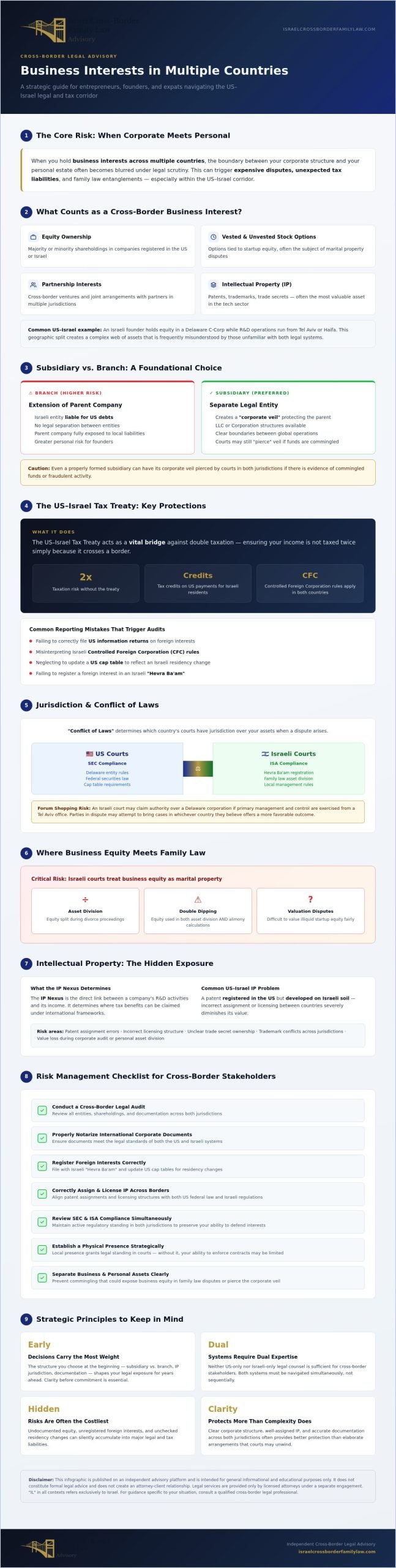
Owning a business in one country is a significant undertaking, but managing Business Interests in Multiple Countries introduces layers of legal and financial friction. These interests aren’t limited to 100% ownership of a company. They often include minority shareholdings, vested or unvested stock options, and partnership interests in ventures that span the US-Israel corridor. In the “Startup Nation” context, it’s common for an Israeli founder to hold equity in a Delaware C-Corp while the operational R&D happens in Tel Aviv or Haifa. This geographic split creates a complex web of assets that are often misunderstood by those who aren’t familiar with both legal systems.
A common pitfall occurs when these interests are not documented with cross-border scrutiny. For example, failing to register a foreign interest in an Israeli “Hevra Ba’am” or neglecting to update a US cap table to reflect an Israeli residency change can create massive tax headaches. Without clear documentation, these assets can become entangled in personal disputes, making them difficult to value or transfer. For those living as expats or foreign nationals, the weight of these early documentation decisions cannot be overstated.
Common Structures: Subsidiaries vs. Branches
Choosing between a branch and a subsidiary is a foundational decision for any international stakeholder. A branch is merely an extension of the parent company, which means the Israeli entity could be held liable for US debts. Conversely, a US subsidiary acts as a separate legal entity, creating a “corporate veil” that shields the parent company from liability. While this veil is designed to be robust, courts in both jurisdictions may “pierce” it if they find evidence of commingling funds or fraudulent activity. Most strategic planners prefer the subsidiary model, using structures like an LLC or a Corporation to maintain clear boundaries between global operations and Business Interests in Multiple Countries.
The Role of Intellectual Property (IP)
In the tech-heavy US-Israel corridor, intellectual property (IP) is frequently the most valuable asset a business holds. Managing patents, trademarks, and trade secrets requires a dual approach that respects both US federal law and Israeli regulations. An IP Nexus refers to the direct link between a company’s research and development activities and the resulting income, which determines where tax benefits can be claimed under international frameworks. If the IP isn’t correctly assigned or licensed between countries, its value can be severely diminished during a corporate audit or a personal asset division. This is particularly relevant when a founder’s primary value is tied to a patent registered in the US but developed on Israeli soil.
The Legal Complexity of Multi-Country Operations
Managing Business Interests in Multiple Countries requires a sophisticated understanding of how different judicial systems interact. When a dispute arises, the first hurdle is often the “Conflict of Laws.” This legal principle determines which country’s courts have jurisdiction over your assets. For instance, an Israeli court may claim authority over a Delaware corporation if the primary management and control are exercised from an office in Tel Aviv. This jurisdictional tug-of-war can lead to “forum shopping,” where parties attempt to bring cases in the country they believe will offer a more favorable outcome.
Beyond the courtroom, regulatory compliance is a constant demand. You must satisfy the requirements of the US Securities and Exchange Commission (SEC) while simultaneously adhering to the Israel Securities Authority (ISA). Establishing a physical presence in your target market is more than a business strategy; it’s a legal marker that grants you standing in local courts. Without active, local engagement, your ability to defend your interests or enforce contracts in a foreign jurisdiction may be severely limited.
Navigating the US-Israel Tax Treaty
The US-Israel Tax Treaty serves as a vital bridge, protecting your revenue from being eroded by double taxation. It provides specific rules for how business dividends and individual income are handled across borders. For shareholders residing in Israel, the treaty allows for tax credits on payments made to the US government, ensuring you aren’t penalized for your international reach. However, reporting mistakes are frequent. Failing to correctly file US information returns or misinterpreting Israeli “controlled foreign corporation” (CFC) rules can trigger audits in both countries. If you’re unsure about your current reporting status, you might want to request a confidential review of your tax position.
Compliance and Corporate Governance
Maintaining the integrity of your corporate veil requires strict adherence to formalities in both jurisdictions. You must keep distinct financial records and document board resolutions for each entity to preserve your limited liability protection. Cross-border employment law adds further complexity. Managing a team that spans Tel Aviv and New York means navigating two sets of rules for severance, social benefits, and intellectual property assignment. For expats and foreign nationals, these administrative burdens are best managed through a unified strategy that accounts for the differences in legal culture and enforcement between the US and Israel.
The Intersection of Business and Family Law
When personal relationships dissolve, the corporate structures you’ve built often fall under the scrutiny of family courts. In a cross-border divorce, Business Interests in Multiple Countries are typically categorized as marital property if they were developed or increased in value during the marriage. Israeli law generally follows the principle of “Resource Balancing,” which aims for an equitable division of assets. However, determining what is “equitable” becomes difficult when dealing with a Delaware C-Corp or an Israeli R&D center. The court must decide if the business is a separate entity or an extension of the individual’s marital wealth.
A significant risk in these proceedings is “double dipping.” This occurs when a business is valued as a capital asset for division, but the income generated by that same business is then used to calculate alimony or child support. Without a clear strategy, a business owner might effectively pay for the same asset twice. Valuation itself is a hurdle; while a US court might rely on market-based EBITDA multiples, an Israeli court-appointed expert might use a different methodology for a pre-revenue tech startup. These discrepancies can lead to vastly different settlement figures depending on which country’s laws take precedence.
Divorce and the International Business Owner
Protecting your professional legacy requires proactive financial agreements. A well-drafted prenuptial or postnuptial agreement can specify that business equity remains separate property, regardless of where the couple resides. In Israel, the religious divorce process, known as the ‘Gett’, can sometimes be used as leverage in business negotiations, adding a layer of complexity not found in the US. These personal disputes frequently overlap with logistical challenges like international custody and relocation, making a unified strategy essential for long-term stability.
Inheritance and Estate Planning for Business Assets
The weight of early decisions extends far beyond divorce. Many business owners assume a US-based Will automatically covers their shares in an Israeli company, but the reality of international probate is often more restrictive. Israeli authorities may not recognize a foreign Will without a lengthy validation process, potentially freezing operations during a transition. Using a Trust can help bypass these hurdles, allowing for the seamless management of Business Interests in Multiple Countries across generations. For those involved in corporate transitions, understanding these personal implications is as vital as navigating US-Israel M&A effectively.
Risk Management Checklist for Cross-Border Stakeholders
Protecting your professional legacy while managing Business Interests in Multiple Countries requires a proactive approach to risk. A simple corporate shield is rarely enough when personal and professional liabilities cross the Atlantic. You need a strategy that prioritizes your individual legal standing rather than just the company’s bottom line. Taking the time to align your structures now prevents the “legal friction” that often occurs when one jurisdiction’s rules contradict another’s.
- Regular Cross-Border Audits: Review your compliance status in both the US and Israel annually to catch discrepancies before they escalate into formal investigations.
- Document Localization: Ensure all shareholder agreements, bylaws, and board minutes are translated and carry the necessary apostilles. A document recognized in Delaware may be dismissed in an Israeli court without proper notarization.
- International Buy-Sell Agreements: Draft clauses that specifically address what happens to equity if a stakeholder faces a cross-border divorce or an estate dispute.
- The Bridge Approach: Seek counsel that understands the intersection of both legal cultures to prevent the “silo effect” where two separate firms offer conflicting advice.
The Due Diligence Process
Hidden liabilities often lurk in foreign subsidiaries, ranging from unpaid Israeli social benefits to overlooked US state-level tax filings. Verifying the ‘good standing’ of your entities in both jurisdictions is a basic but essential step for any stakeholder. Local knowledge of the specific regulatory environment in each jurisdiction serves as your most effective defense against crippling fines and administrative penalties.
Protecting Against Multi-Jurisdictional Litigation
Lawsuits that span Tel Aviv and US federal courts are notoriously expensive and complex. Implementing international arbitration clauses in your commercial contracts can help you avoid the unpredictability of foreign courtrooms and provide a more controlled environment for dispute resolution. Understanding how the advisory works to coordinate these multi-country efforts can save you significant time. If you’re concerned about the current exposure of your international assets, contact us for a strategic evaluation of your corporate and personal standing.
Getting Clarity: The Strategic Path Forward
The long-term security of your international holdings depends heavily on the foresight applied during the initial setup phase. When you manage Business Interests in Multiple Countries, the complexity isn’t just additive; it’s exponential. Decisions made in a vacuum, such as choosing a corporate structure in Delaware without considering Israeli family law implications, can create significant friction years later. Achieving a state of “clarity before commitment” is the only reliable way to ensure your professional success doesn’t become a personal liability.
Adopting a neutral, educational approach is vital for protecting your assets across the US-Israel corridor. Rather than reacting to crises, a strategic path forward involves building a unified bridge between your US and Israeli professional teams. This collaborative environment ensures that your accountants, corporate lawyers, and estate planners are working toward a single, cohesive objective. For those seeking a deeper understanding of these dynamics, we invite you to watch the detailed guidance available on the Israel Family Law YouTube channel, where we break down the nuances of cross-border legal systems.
Clarity Before Commitment
Next Steps for Business Owners
Your first step toward securing your legacy is a thorough review of your current entity structures to identify hidden family law risks. A comprehensive asset map should detail how each interest is held, its current valuation methodology, and how it would be treated under both US and Israeli probate or divorce laws. Requesting a confidential review of this map allows you to address vulnerabilities before they are exposed by a legal dispute. Get clarity before you commit. Request a confidential consultation.
Securing Your Global Professional Legacy
Success in the US-Israel corridor requires more than just corporate growth; it demands a strategic alignment of your professional and personal legal standing. You’ve seen how jurisdictional conflicts can arise and why the US-Israel tax treaty is a critical shield for your revenue. Managing Business Interests in Multiple Countries means staying ahead of regulatory shifts while ensuring that family law risks don’t undermine your commercial achievements. By prioritizing clarity today, you prevent the expensive legal friction that often accompanies international operations.
We provide authoritative guidance specifically for Anglo-Israelis and expats, acting as a steady bridge between divergent legal systems. Our expertise in multi-jurisdictional tech and startup deals allows us to coordinate seamlessly with your existing professional teams in both countries. This information is published on an independent advisory platform to help you focus on strategy and risk management. Get clarity before you commit. Request a confidential consultation.
With a unified framework in place, you can protect your hard-earned assets and focus on the future growth of your global ventures.
Frequently Asked Questions
Can a US citizen own a business in Israel without living there?
Yes, a US citizen can own an Israeli business while living abroad. You’ll typically register a private company, known as a Hevra Ba’am, and appoint a local representative for tax and regulatory filings. It’s vital to coordinate with a tax professional to manage your US reporting requirements, such as Form 5471, to avoid significant penalties from the IRS.
How does the US-Israel tax treaty prevent double taxation on my business?
The US-Israel tax treaty prevents double taxation by allowing you to claim foreign tax credits on your annual returns. It sets specific withholding rates for dividends and interest, ensuring you aren’t taxed at the full rate by both governments on the same income. Proper documentation is necessary to prove your residency and eligibility for these benefits under the established agreement.
What happens to my international business interests if I get divorced in Israel?
Your Business Interests in Multiple Countries are typically considered marital assets if they were acquired or increased in value during your marriage. Israeli courts use a process called Resource Balancing to calculate an equitable division. This often involves a court-appointed expert who will value your foreign shares and options to determine the final settlement amount between spouses.
Is an Israeli ‘Hevra Ba’am’ the same as a US LLC for liability purposes?
While both structures offer limited liability, an Israeli Hevra Ba’am is not identical to a US LLC. A Hevra Ba’am is always a separate corporation for tax purposes, whereas a US LLC is often a pass-through entity. This distinction is critical because it changes how the US-Israel tax treaty treats your business income and your personal tax credits.
Do I need two separate Wills if I have business assets in both the US and Israel?
Having separate Wills for each jurisdiction is a strategic move to avoid the delays of international probate. Israeli authorities often require a foreign Will to undergo a validation process that can freeze your business operations for months. Localizing your estate plan ensures your Israeli shares and US interests are handled according to each country’s specific legal standards without friction.
How can I protect my Israeli startup from US litigation risks?
Creating a US subsidiary is the most effective way to shield your Israeli startup from American litigation. This structure acts as a legal barrier, ensuring that lawsuits in US federal courts target only the subsidiary’s assets. You must maintain separate bank accounts and board minutes for each entity to prevent a court from piercing this corporate veil during a dispute.
Can I use an international trust to hold my business shares?
You can use an international trust to manage your Business Interests in Multiple Countries, providing both asset protection and a smoother transition for heirs. Trusts help you avoid the public and lengthy probate process in multiple jurisdictions. However, you must ensure the trust is compliant with Israeli tax laws and US reporting requirements to avoid unexpected administrative penalties.
What is the biggest mistake business owners make when expanding between the US and Israel?
The most common mistake is failing to seek integrated advice before expanding your operations across borders. Many owners set up a Delaware corporation without realizing how it impacts their Israeli tax status or their family law exposure. Coordinating between your US and Israeli teams from the start is the only way to ensure your global structure remains secure and compliant.

Article by
Gabriel Lior
A Personal Journey That Became a Mission
The advisory was founded by an American father Gabriel Lior, LLB, MBA , global entrepreneur, and cross-border advisor who spent more than a decade navigating the Israeli family court system firsthand and now lives in Singapore with his son.
As a divorced parent in a cross-border family, Gabriel faced nearly every legal challenge a foreign parent can encounter in Israel — including child custody disputes, child support proceedings, property matters in Israel and abroad, false accusations, and complex immigration and relocation proceedings.
Over the years, he learned the hard way how difficult it is for non-Israeli parents to understand the system, identify the right legal strategy, and choose the right legal representation — especially when language, culture, and jurisdictional differences are involved. He also witnessed how foreign parents and new immigrants are often disadvantaged or taken advantage of by service providers and institutions simply because they lack local knowledge or fluency.
From Client to Advisor
To truly understand — and survive — the system, Gabriel pursued formal legal education in Israel, completing two Israeli law degrees, alongside a BA and MBA earned in the United States. This was never about becoming a practicing attorney, but about gaining a deep, structural understanding of how the system works — and where it breaks down for foreign parents.
This rare combination of:
Firsthand client experience
Israeli legal and US business education
International business and negotiation training
Decades of commercial execution
created a unique perspective – one that understands both sides of the table.
After years of litigation, persistence, and at times self-representation, he ultimately succeeded in securing custody of his son and relocating abroad through a rare legal victory in the Israeli Supreme Court — becoming one of the first fathers in Israel to do so under these circumstances.
Disclaimer
Important Disclaimer:
The information provided on this website and in its content is for general informational and educational purposes only and does not constitute legal advice, legal opinion, or legal representation.
Gabriel Lior is not licensed to practice law in Israel (nor is he interested in doing so) and does not provide legal services, despite having completed 2 Law Degrees. The services offered are advisory in nature and are intended to provide general guidance, strategic insight, and information regarding cross-border family law considerations.
No attorney-client relationship is formed by accessing this website, reading its content, or communicating with us.
Any decisions made based on this information are at your own discretion and risk. For legal advice specific to your situation, you should consult a licensed attorney in the relevant jurisdiction.
Where appropriate, we may refer clients to independent, licensed attorneys or professionals. Such referrals do not constitute legal representation and no liability is assumed for services provided by third parties.