The discovery that your child has been wrongfully removed to or from Israel without your consent initiates a period of profound crisis, marked by a sense of powerlessness and fear. Navigating the intricate web of international and Israeli family law can feel overwhelming, where every moment is critical and the risk of a procedural misstep is immense. For parents facing this complex, cross-border challenge, understanding the immediate legal framework is not just important-it is the essential first step toward securing their child’s return.
This comprehensive guide is designed to provide that critical clarity and direction. We will expertly guide you through the complexities of the hague convention process israel, delivering a clear, step-by-step action plan for initiating a case for the prompt return of your child. Our objective is to demystify the legal proceedings, restore your confidence in the available remedies, and equip you with the foundational knowledge required to engage an experienced legal team. This article serves as your authoritative roadmap to taking decisive and effective action.
Understanding the Hague Convention and Its Application in Israel
The Hague Convention on the Civil Aspects of International Child Abduction is a multilateral treaty providing a robust and expeditious framework for the return of children wrongfully removed to, or retained in, a foreign country. Its paramount objective is to secure the prompt return of children to their country of habitual residence. As a signatory since 1991, Israel is deeply committed to upholding the treaty’s principles, making the hague convention process israel a critical area of international family law.
For a foundational overview of how international legal processes are managed under the Convention, the following video provides valuable context:
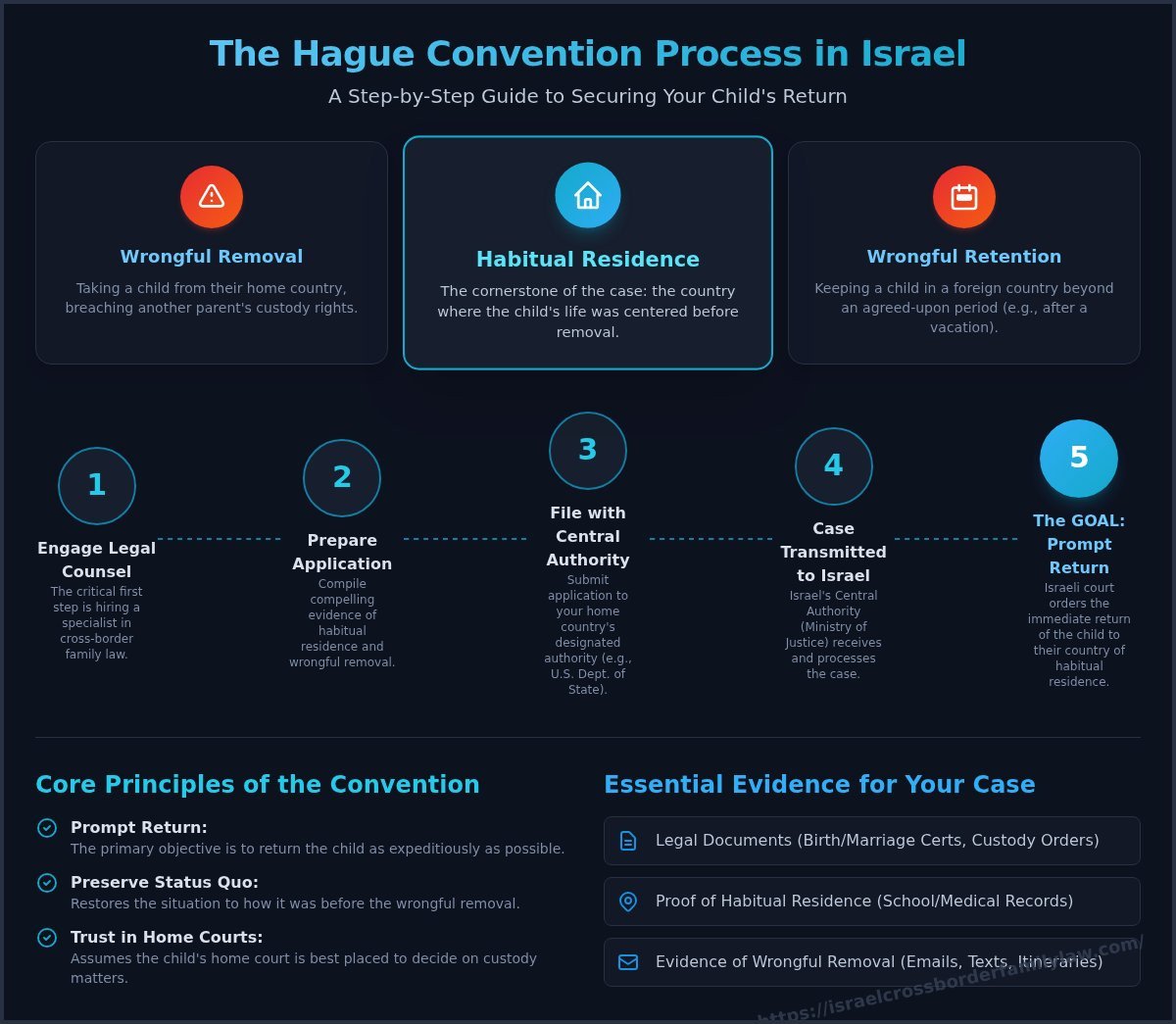
Central to any Hague Convention case are three key legal concepts. Wrongful removal refers to the act of taking a child from their country of habitual residence in breach of another parent’s or guardian’s custody rights. Wrongful retention occurs when a child is kept in a foreign country beyond an agreed-upon period, such as after a vacation. The determination of the child’s habitual residence-the country where their life was centered before the abduction-is the cornerstone of the entire proceeding.
It is crucial to understand that a Hague Convention hearing is not a custody battle. The Israeli court’s role is not to determine which parent should have custody or where the child would be better off. Rather, it serves as a jurisdictional mechanism focused on a single question: Was the child wrongfully removed or retained from their habitual residence? If so, the court’s primary duty is to order the child’s immediate return.
Core Principles of the Convention
The Convention operates on a foundation of mutual trust between member states, guided by several key principles designed to protect children from the harmful effects of international abduction.
- Preserving the Status Quo: The Convention aims to restore the factual situation that existed before the wrongful removal, preventing abductors from gaining a legal advantage.
- Deterrence: By providing a clear and swift return mechanism, the treaty seeks to deter parents from unilaterally removing children across borders.
- Prompt Return: The core function is to ensure the child is returned to their country of habitual residence as expeditiously as possible.
- Trust in Home Courts: The Hague Convention on the Civil Aspects of International Child Abduction presumes that the courts of the child’s habitual residence are best placed to adjudicate complex custody and welfare disputes.
Israel’s Central Authority: The Ministry of Justice
To facilitate the complex hague convention process israel relies on its designated Central Authority, which is a division within the Ministry of Justice. This body acts as the administrative hub for all incoming and outgoing applications. Its functions include receiving petitions from parents abroad (such as from the U.S. Department of State, its American counterpart), assisting in locating the abducted child within Israel, facilitating access to legal representation, and encouraging amicable, voluntary resolutions between the parties whenever feasible.
Initiating a Hague Application: A Step-by-Step Procedural Guide
When a child has been wrongfully removed to or retained in Israel, immediate and decisive action is imperative. The initial and most critical step is to engage legal counsel specializing in cross-border family law. The subsequent procedure is highly structured, beginning with the formal submission of an application through your home country’s designated Central Authority. This is not merely administrative; it is the foundational act that sets the entire international legal mechanism in motion.
Once your application and supporting evidence are compiled, your country’s Central Authority reviews the file for completeness and formally transmits it to its Israeli counterpart. The comprehensive management of the hague convention process israel falls under the purview of the Israel’s Central Authority for Hague Convention, a specialized department within the Ministry of Justice. Upon receipt, this authority takes the necessary steps to locate the child and abducting parent, facilitate legal representation, and initiate the court proceedings required to secure the child’s swift return.
Preparing Your Application and Evidence
A successful Hague Convention application is built upon a foundation of clear, comprehensive, and compelling evidence. The thoroughness of your initial submission can significantly impact the trajectory and speed of your case. Your legal team will guide you in assembling a robust evidentiary file, which must include:
- The official Hague Convention application form, completed with meticulous accuracy.
- Core legal documents: The child’s birth certificate, the parents’ marriage certificate (if applicable), and crucially, any pre-existing court orders or agreements concerning custody and parental rights.
- Proof of habitual residence: Substantial evidence establishing the child’s life and ties to their home country, such as school enrollment records, medical and dental reports, rental agreements, and affidavits from teachers or community members.
- Evidence of wrongful removal: Documentation that proves the removal or retention was unilateral and in breach of your custody rights. This can include emails, text messages, flight itineraries, or witness statements.
The Role of Your Legal Counsel
Navigating this complex, multi-jurisdictional framework requires sophisticated legal expertise. An experienced attorney does more than simply file paperwork; they ensure your application is strategically prepared to be persuasive within the Israeli legal context. Your counsel will serve as the primary liaison between you and both Central Authorities, managing communications and advocating on your behalf. Furthermore, they provide critical preparation for the unique procedures and expectations of the Israeli family court system, positioning your case for a successful outcome. Contact our experts for immediate assistance with your application.
The Hague Convention Process in Israeli Family Courts
Once a Hague Convention application is initiated, the case is assigned to one of Israel’s specialized Family Courts, which possess exclusive jurisdiction over these sensitive, cross-border matters. The entire hague convention process israel is designed for celerity, operating under exceptionally strict and expedited timelines, often concluding within six weeks. A defining feature of the Israeli system is the immediate court appointment of a legal guardian, known as an Apoptropos L’Din, to independently represent the child’s best interests throughout the proceedings. The court’s inquiry is deliberately narrow and focused: its primary and often sole objective is to determine whether the child’s removal or retention was “wrongful” under the Convention’s definitions. The judge will not delve into complex, long-term custody arrangements or adjudicate which parent is better suited for guardianship; those substantive issues are deferred to the courts in the child’s country of habitual residence.
Key Stages of the Court Proceedings
The judicial timeline is swift and structured, reflecting the urgency mandated by the Convention. The process unfolds through several distinct, non-negotiable stages:
- Filing the Lawsuit: The left-behind parent, often with assistance from Israel’s Central Authority for the Hague Convention, files an official claim in the appropriate Family Court jurisdiction where the child is located.
- Statement of Defense: The abducting parent is required to submit a formal written response, or Statement of Defense, outlining their legal arguments against the child’s return, typically within a very short timeframe.
- The Main Hearing: A consolidated hearing is scheduled quickly where both parties present their evidence, witnesses are cross-examined, and legal arguments are made.
- Issuance of Judgment: The court delivers a final, binding judgment that either orders the immediate return of the child to their country of habitual residence or denies the application based on one of the Convention’s limited exceptions.
Evidence and Testimony in Israeli Court
Evidence in the hague convention process israel is presented in a highly structured manner. The foundation of each party’s case rests on comprehensive affidavits-sworn written statements detailing their factual and legal positions. During the main hearing, both parents undergo cross-examination on their affidavits, a procedure that can be facilitated via video conference to accommodate international parties. While the focus is on parental testimony, the court may also consider expert reports, such as psychological evaluations, if they are directly relevant to a specific defense. Furthermore, depending on the child’s age and level of maturity, the judge may decide to hear the child’s views, either directly or through the appointed Apoptropos L’Din, to gain a fuller perspective without making the child the ultimate arbiter.
Common Defenses Raised in Israeli Hague Convention Cases
While the Hague Convention’s primary objective is the swift return of a wrongfully removed child, it provides for a limited set of defenses. It is crucial to understand that Israeli courts interpret these exceptions narrowly, placing a significant burden of proof squarely on the abducting parent. A successful defense is an exception, not the rule, in the hague convention process israel and requires compelling, specific evidence to overcome the presumption in favor of return.
Article 13(b): Grave Risk of Harm
This defense argues that returning the child would expose them to a grave risk of physical or psychological harm or otherwise place them in an intolerable situation. The threshold for this defense in Israel is exceptionally high. Courts require clear and convincing evidence of serious danger, such as documented abuse or severe neglect, not mere speculation about a less advantageous environment or the emotional distress of a second relocation.
Article 13(a): Consent or Acquiescence
A respondent may claim the left-behind parent either consented to the removal before it happened or subsequently acquiesced to the new arrangement. To succeed, the proof of consent must be clear, positive, and unequivocal; ambiguous statements or a failure to immediately object are not enough. Furthermore, any active steps taken by the left-behind parent to secure the child’s return will effectively negate a claim of acquiescence.
Article 12: Child is ‘Well-Settled’
This defense becomes available only if Hague proceedings are initiated more than one year after the date of the wrongful removal. The court will assess the degree to which the child has become physically and emotionally integrated into their new environment in Israel. However, even if a child is found to be well-settled, the court retains its discretion and can, and often does, still order a return if it is deemed appropriate.
The Child’s Objections Defense
If a child has attained a sufficient age and degree of maturity, the court may take their objections to being returned into account. Israeli courts handle this defense with great care, often appointing a professional to assess the child’s views. The court’s primary task is to determine whether the child’s objections are independent and genuinely held, or if they are a reflection of the abducting parent’s influence.
The complexity and strict judicial scrutiny applied to these defenses underscore the challenges involved. Successfully navigating these complex matters demands sophisticated legal counsel with a deep understanding of how Israeli courts apply these international principles.
After the Judgment: Enforcement, Appeals, and Next Steps
Receiving a judgment from the Israeli Family Court marks a critical turning point, but it is not the conclusion of the matter. The post-judgment phase involves a series of structured legal actions, whether enforcing the child’s return, navigating the appellate system, or shifting legal strategy if a return is denied. Understanding these next steps is imperative for successfully concluding the hague convention process israel.
Enforcing a Return Order
Upon issuing a return order, the court expects immediate compliance. The judgment will meticulously detail the terms for the child’s safe and prompt return, including coordinating travel arrangements, passport handover, and the specific time and place for the transfer of the child. Should the abducting parent refuse to comply, enforcement mechanisms are activated. This can involve the Israeli Police and other enforcement authorities to ensure the court’s decision is respected. Concurrently, it is a crucial strategy to secure ‘mirror orders’ from the court in the child’s home country to formalize the return and prevent further jurisdictional disputes.
The Appeals Process in Israel
Both parties retain the right to challenge the Family Court’s decision. This is not an automatic right but requires filing for a leave to appeal with the Israeli Supreme Court. The deadlines for such applications are exceptionally short and strictly enforced. It is critical to understand that filing an appeal does not typically stay the execution of the original return order. A separate, urgent motion must be filed to request a stay, and the Supreme Court grants these requests only in rare and exceptional circumstances, underscoring the convention’s emphasis on a swift return.
If a Return is Denied
In cases where the court denies the petition for return, often citing one of the Convention’s narrow exceptions, the legal focus must pivot immediately. The first step is a thorough analysis of the court’s reasoning with your legal counsel to determine the viability of an appeal. If an appeal is not pursued or is unsuccessful, the legal battle over custody is no longer a Hague matter but transitions to a domestic one. The left-behind parent must then initiate standard custody and visitation proceedings within the Israeli family court system to establish their parental rights under Israeli law.
Navigating these final, complex stages requires sophisticated legal guidance and strategic planning. If you are involved in the hague convention process israel and require expert representation, we advise you to act promptly. Facing a complex Hague case? Schedule a consultation today.
Navigating Your Cross-Border Hague Convention Case with Confidence
The journey through the Hague Convention on the Civil Aspects of International Child Abduction is inherently complex, involving expedited yet intricate proceedings within Israeli family courts. As we have detailed, understanding the procedural steps, from initiating the application to anticipating common defenses and planning for post-judgment enforcement, is paramount. Successfully navigating the hague convention process israel requires not only legal knowledge but a sophisticated understanding of the multi-jurisdictional challenges involved.
Our firm is uniquely positioned to guide you through this demanding terrain. With extensive experience in US-Israel cross-border family law and a proven track record in the most challenging international child abduction cases, our team provides unparalleled support. Our bilingual attorneys, qualified in both US and Israeli law, offer the nuanced, bicultural perspective essential for a successful outcome.
For expert guidance on your US-Israel Hague Convention case, contact our firm immediately. The path forward may seem daunting, but with dedicated and experienced counsel, a secure resolution for your family is within reach.
Frequently Asked Questions About the Hague Convention in Israel
How long does the Hague Convention process take in Israel?
The Hague Convention process in Israel is designed to be expedited. Israeli law mandates that a final judgment should be rendered within six weeks of the application’s filing. However, the timeline can be extended due to case complexities, such as the need for extensive evidence, expert testimony, or subsequent appeals. While the goal is a swift resolution, it is not uncommon for contested proceedings to last for several months before a final, non-appealable decision is reached.
What are the estimated legal costs for a Hague Convention case in Israel?
Legal costs for these complex cross-border cases are variable. Attorney’s fees can range significantly, often from ₪50,000 to over ₪150,000, depending on the intricacy of the legal arguments, the duration of the proceedings, and whether an appeal is necessary. Additional costs may include court fees, expert witness reports (e.g., from child psychologists), and translation services. It is imperative to obtain a detailed fee structure from your representing counsel at the outset.
Can I get a custody or visitation order as part of the Hague Convention case?
No. The scope of a Hague Convention proceeding is intentionally narrow. Its sole objective is to determine whether a child was wrongfully removed or retained from their country of habitual residence and, if so, to order their prompt return. The Israeli court will not adjudicate on underlying custody disputes or establish visitation rights. Such matters must be resolved by the competent courts in the child’s home jurisdiction following their return.
Will I have to travel to Israel for the court hearings?
While not strictly mandatory in every instance, it is strongly recommended that the petitioning parent travels to Israel to attend the court hearings. Your physical presence demonstrates the gravity of your petition to the court and allows for direct, impactful testimony. In limited circumstances, and with prior court approval, arrangements may be made for testimony via video-conference. Your legal team will provide strategic guidance based on the specific circumstances of your case.
What happens to my child’s passport during the proceedings in Israel?
As a standard preliminary measure, the court will typically issue an order preventing the child from leaving the country. This order often includes a directive for the taking parent to surrender the child’s passport(s) to the court or the police, where they will be held for the duration of the legal proceedings. This is a critical step in the Hague Convention process in Israel to ensure the court’s jurisdiction is maintained and to prevent further international flight.
Does the Hague Convention apply if my child was born in Israel?
The child’s birthplace is not the decisive factor. The core legal issue is the child’s “habitual residence” immediately prior to the alleged wrongful removal or retention. If it can be proven that the child’s established life and home were in another signatory country before they were brought to or kept in Israel without your consent, the Convention may still apply. The court undertakes a detailed factual analysis to determine where the child was habitually resident.

Article by
Gabriel Lior
A Personal Journey That Became a Mission
The advisory was founded by an American father Gabriel Lior, LLB, MBA , global entrepreneur, and cross-border advisor who spent more than a decade navigating the Israeli family court system firsthand and now lives in Singapore with his son.
As a divorced parent in a cross-border family, Gabriel faced nearly every legal challenge a foreign parent can encounter in Israel — including child custody disputes, child support proceedings, property matters in Israel and abroad, false accusations, and complex immigration and relocation proceedings.
Over the years, he learned the hard way how difficult it is for non-Israeli parents to understand the system, identify the right legal strategy, and choose the right legal representation — especially when language, culture, and jurisdictional differences are involved. He also witnessed how foreign parents and new immigrants are often disadvantaged or taken advantage of by service providers and institutions simply because they lack local knowledge or fluency.
From Client to Advisor
To truly understand — and survive — the system, Gabriel pursued formal legal education in Israel, completing two Israeli law degrees, alongside a BA and MBA earned in the United States. This was never about becoming a practicing attorney, but about gaining a deep, structural understanding of how the system works — and where it breaks down for foreign parents.
This rare combination of:
Firsthand client experience
Israeli legal and US business education
International business and negotiation training
Decades of commercial execution
created a unique perspective – one that understands both sides of the table.
After years of litigation, persistence, and at times self-representation, he ultimately succeeded in securing custody of his son and relocating abroad through a rare legal victory in the Israeli Supreme Court — becoming one of the first fathers in Israel to do so under these circumstances.
Disclaimer
Important Disclaimer:
The information provided on this website and in its content is for general informational and educational purposes only and does not constitute legal advice, legal opinion, or legal representation.
Gabriel Lior is not licensed to practice law in Israel (nor is he interested in doing so) and does not provide legal services, despite having completed 2 Law Degrees. The services offered are advisory in nature and are intended to provide general guidance, strategic insight, and information regarding cross-border family law considerations.
No attorney-client relationship is formed by accessing this website, reading its content, or communicating with us.
Any decisions made based on this information are at your own discretion and risk. For legal advice specific to your situation, you should consult a licensed attorney in the relevant jurisdiction.
Where appropriate, we may refer clients to independent, licensed attorneys or professionals. Such referrals do not constitute legal representation and no liability is assumed for services provided by third parties.