Moving your children across international borders is more than a change of scenery; it’s a legal event that can permanently alter your parental rights before you even finish packing. If you feel overwhelmed by the prospect of the Israeli Family Court or fear being unfairly accused of international child abduction, your concerns are valid. It’s natural to feel anxious when the “Best Interests of the Child” standard feels subjective and the stakes involve your family’s future. Seeking guidance from a relocation lawyer in Israel is about more than filing paperwork. It’s about building a proactive strategy that protects your bond with your children while respecting the strict requirements of international law.
This article provides clarity on the complexities of moving children into or out of the country. We’ll explore the shifting “Tender Years Doctrine,” the 2026 expansion of religious court authority, and how to navigate the 45 to 90-day timeline typical of Hague Convention cases in Israel. You’ll learn how to establish a clear legal path that prevents unauthorized removals and ensures compliance with global standards. Please note that this content is published on an independent advisory platform and does not constitute legal representation or formal legal advice. Our focus is on providing the strategic guidance you need to make informed decisions before you commit to a life-altering move.
Key Takeaways
- Learn why relocation is viewed as a high-stakes legal shift in Israel, requiring a proactive strategy long before you begin the physical move.
- Understand how Israeli judges apply the “Best Interests of the Child” standard to prioritize a child’s stability over a parent’s personal reasons for moving.
- Discover how a relocation lawyer in Israel helps you manage Hague Convention risks and protects you from being unfairly accused of international child abduction.
- Gain insights into building a detailed relocation plan that effectively gathers the specific evidence needed to support your case in the Israeli Family Court.
- Recognize the value of using an independent advisory platform to bridge the gap between the Israeli legal system and your family’s international expectations.
Understanding Relocation in the Context of Israeli Family Law
Relocation in Israel is often misunderstood as a simple administrative step, similar to obtaining a work visa or completing Aliyah. In the context of family law, however, relocation is a high-stakes legal event that involves shifting a child’s “center of life” to another country. Israeli courts view these cases with extreme caution because a move often disrupts the child’s existing routine and their relationship with the parent staying behind. This content is published on an independent advisory platform, not a law firm, and is intended for informational purposes only. Legal services are only provided by licensed attorneys under a separate engagement.
The legal system uses a rigorous process to decide if a move is permissible. Both the Family Court and the Rabbinical Court may have a say, depending on where the initial filing occurs. A law passed in March 2026 expanded the authority of religious courts in certain civil areas, making it even more vital to understand which system will handle your case. To better understand the logistical side of moving to Israel, watch this helpful video:
The Definition of Legal Relocation
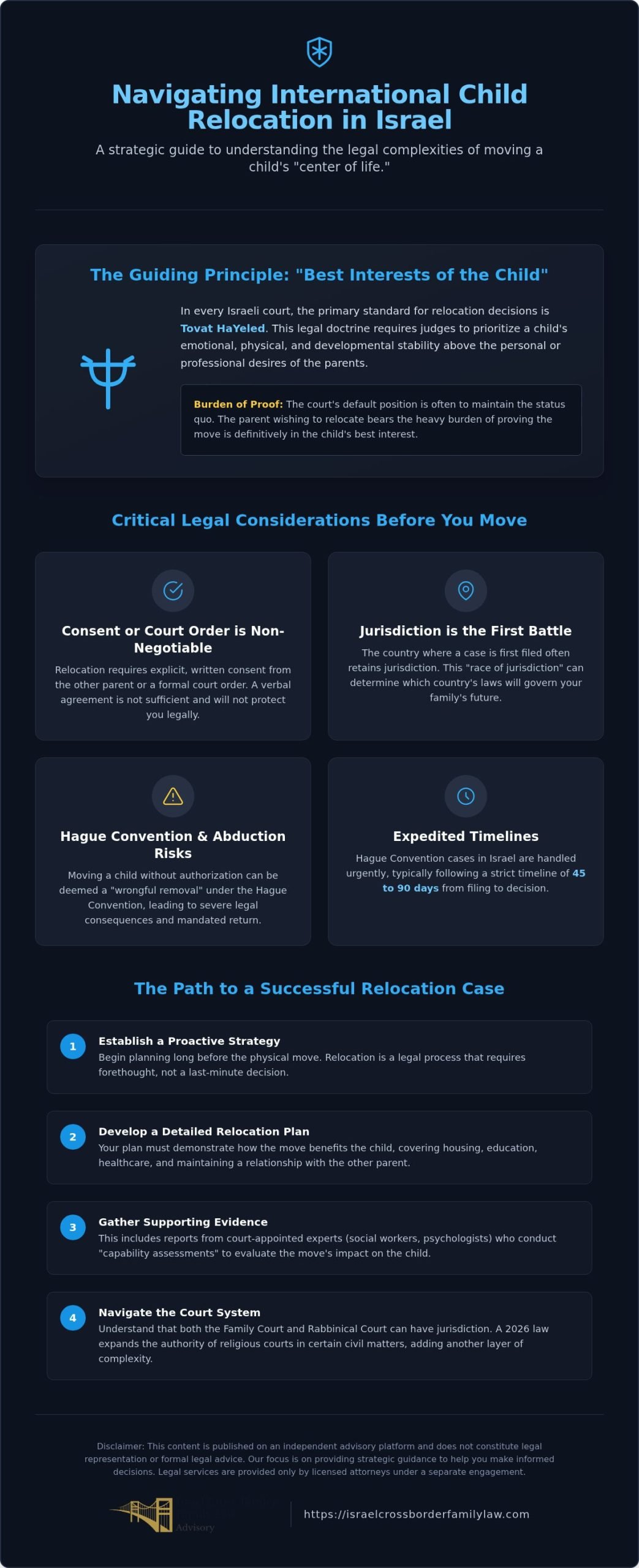
Securing explicit, written consent or a formal court order is non-negotiable before moving a child across borders. Under the Hague Convention on International Child Abduction, moving a child without authorization can be classified as a wrongful removal. This is why a relocation lawyer in Israel focuses on securing clear legal permission before any travel occurs. There’s a sharp distinction between a temporary holiday and a permanent move. Crossing that line without a formal agreement can lead to immediate legal intervention and long-term consequences for your parental rights.
Jurisdictional Complexity: Israel vs. the US
Cross-border families frequently encounter friction between different legal systems. Determining which country has jurisdiction over the children is often the most critical first step. Israeli judges prioritize the child’s stability and their connection to their current home. The “race of jurisdiction” is a real factor; the court that receives the first filing often retains the power to make life-altering decisions. Consulting a relocation lawyer in Israel early in the process helps families understand these risks before they commit to a path that’s difficult to reverse. Our advisory acts as a bridge, helping you navigate the cultural and legal differences between the US and Israel.
The “Best Interests of the Child” Standard in Israel
In every Israeli courtroom, from the Family Court to the Rabbinical Court, the North Star for any relocation decision is Tovat HaYeled, or the “Best Interests of the Child.” This isn’t just a vague sentiment; it’s a rigorous legal standard that requires judges to prioritize a child’s emotional, physical, and developmental stability over the personal or professional desires of the parents. When you consult a relocation lawyer in Israel, the primary goal is to demonstrate how a proposed move aligns with this standard. The court’s default position often leans toward maintaining the status quo, meaning the burden of proof rests heavily on the parent wishing to move.
To evaluate these cases, judges rely on reports from court-appointed experts, including social workers and psychologists. These professionals conduct “capability assessments” to determine how the move will impact the child’s well-being. A U.S. government guide to Israeli family law cases details the procedural cooperation between Israeli and American authorities, reflecting the seriousness with which these cross-border evaluations are handled. As of 2026, the “Tender Years Doctrine,” which previously presumed children under six should stay with their mother, is no longer an absolute rule. Israeli law now takes a more gender-neutral approach, focusing on the actual caregiving reality and the child’s “center of life.”
Criteria for Evaluating a Move
Israeli judges look at several concrete factors when deciding whether to grant a relocation request. These include:
- The existing parental bond: How involved has each parent been in the child’s daily life before the request?
- Quality of life: Does the new location offer genuine educational, medical, or social advantages that outweigh the disruption of moving?
- Connection maintenance: Is there a realistic, detailed plan to ensure the child maintains a deep and frequent connection with the parent staying in Israel?
Establishing these facts requires a clear international custody and relocation strategy that addresses the court’s concerns before they become obstacles. Before moving forward with a relocation plan, it’s helpful to speak with an advisor to understand how these standards might apply to your specific family dynamic.
The Role of the Child’s Voice
As children grow older, the court gives more weight to their personal preferences. While there’s no fixed age, children typically around 10 to 12 years old are often given the opportunity to speak. This isn’t done in an open courtroom; instead, they meet with a specialized committee, known as the “Gal” committee, in a neutral setting. The goal is to hear the child’s perspective without them feeling caught between their parents’ conflicting interests. The court balances this “voice” against the child’s overall welfare, ensuring that a child’s preference isn’t the result of parental pressure or “alienation.” Working with a relocation lawyer in Israel helps parents navigate these sensitive interviews while protecting the child’s emotional health.
Navigating the Hague Convention and Abduction Risks
This content is published on an independent advisory platform, not a law firm, and focuses on strategy and risk guidance. Legal services are only provided by licensed attorneys under a separate engagement. When a parent moves a child across international borders without the other parent’s explicit consent, they risk triggering the Hague Convention on the Civil Aspects of International Child Abduction. This international treaty is designed to return children to their “habitual residence” so that custody disputes can be resolved in the proper jurisdiction. It’s a procedural tool, not a final custody determination, but its impact is immediate and often overwhelming. In Israel, the practical timeline for a Hague decision in 2026 typically spans 45 to 90 days, with an initial hearing scheduled within 15 days of filing.
Falling into the “wrongful removal” trap is easier than many parents realize. Even if you believe you’re moving for a better job or to be closer to supportive family, leaving Israel without a notarized agreement or a court order can be legally classified as abduction. Israeli courts and U.S. authorities cooperate closely to enforce these orders. Attempting to bypass the system doesn’t just lead to a return order; it severely damages your credibility in future litigation. A relocation lawyer in Israel helps you avoid these pitfalls by ensuring every step of your move is documented and authorized before you leave the country.
Preventing International Child Abduction
For parents who fear their child might be removed from Israel without their knowledge, the legal system provides specific preventive measures. The most common tool is the “Stay of Exit” order, known in Hebrew as Tzav Ikur Yetzia. This order is registered with border control and prevents the child from leaving the country through any airport or seaport. It’s a proactive step that provides peace of mind while a larger relocation strategy is being negotiated. You can learn about Hague Convention Abduction and how these protective orders function within the broader context of Israeli family law to ensure your parental rights remain intact.
The Consequences of Non-Compliance
The risks of unauthorized relocation extend far beyond a simple court-ordered return. Non-compliance can lead to civil penalties, the loss of primary custody, and in some cases, criminal charges for kidnapping. Once a “wrongful removal” is established, the parent who moved may be ordered to pay the other parent’s legal fees and travel expenses. More importantly, it creates a record of instability that Israeli judges weigh heavily when eventually deciding the child’s long-term “center of life.” Working with a relocation lawyer in Israel allows you to build a transparent, legally sound case from the beginning. It’s always safer to seek clarity and court approval early rather than attempting to justify a move after the fact.
Strategic Planning: How to Build a Successful Relocation Case
A successful move starts long before you reach the airport. In the Israeli legal system, the parent who initiates the process often sets the procedural tone for the entire case. This content is published on an independent advisory platform and is for informational purposes only. Legal services are only provided by licensed attorneys under a separate engagement. Because contested international relocation cases in Israeli Family Courts can last between 18 and 24 months, having a clear strategy from day one is essential to avoid prolonged uncertainty and emotional strain.
Building a case requires more than just a desire to move. You must provide the court with a concrete roadmap that proves the transition will be seamless for the child. A relocation lawyer in Israel helps you identify specific evidentiary gaps in your plan before they’re exploited by the opposing side. Judges look for stability; any ambiguity in your housing, financial, or educational plans can lead to a denial of your request. You’ll need to demonstrate that the move isn’t just a personal preference but a strategic step that serves the child’s long-term welfare.
Developing a Comprehensive Relocation Plan
To meet the court’s high evidentiary threshold, your plan should address every facet of the child’s future life. The court won’t accept vague promises. It requires verified details. Focus on these three pillars:
- Housing and Education: Secure specific housing options and research schools that match the child’s current educational level. Provide brochures, registration requirements, and proof of availability to show the move is ready for execution.
- Financial Viability: Demonstrate that your income or support system in the new location is sufficient to maintain the child’s current standard of living. This includes health insurance and extracurricular activities.
- The Visitation Schedule: This is often the most contentious point. Propose a workable, detailed schedule that includes flight logistics, holiday rotations, and digital communication. Showing that you’re committed to the other parent’s relationship with the child can significantly strengthen your position in the eyes of a judge.
Mediation and Negotiation Options
Court litigation isn’t the only path. The Family Cases Litigation Arrangement Law of 2016 requires a dispute settlement process that has successfully reduced family litigation in Israel by approximately 20%. Settling through mediation allows you to draft a relocation agreement that’s tailored to your family’s unique needs. This document must be carefully structured to be enforceable in both Israel and the target country, such as the US, to prevent future jurisdictional disputes.
By focusing on an International Custody and Relocation Strategy, you can often reach a compromise that avoids the stress of a full trial. If you’re ready to explore your options and build a solid foundation for your move, you can request a confidential consultation to see how a strategic approach can protect your family’s future.
Why a Cross-Border Advisory is Essential for Relocation
This content is published on an independent advisory platform (not a law firm) and is for informational purposes only. Legal services are provided exclusively by licensed attorneys under a separate engagement. While a relocation lawyer in Israel handles the mechanics of a court case, a cross-border advisory acts as a strategic bridge between two distinct legal systems. International families often face a cultural gap when they encounter the Israeli Family Court system. They may expect procedures that mirror US standards, only to find that the “race of jurisdiction” or the authority of religious courts creates an entirely different set of risks.
A strategist looks beyond the immediate court hearing. They analyze how a decision made in Israel will affect your assets, your tax status, and your future legal rights in your home country. This multi-jurisdictional perspective is critical when you manage family law issues that span continents. Without this bird’s-eye view, a victory in one court can lead to a complication in another. Seeking a relocation lawyer in Israel is a necessary step for representation, but the strategy behind your filing determines your long-term success.
The Role of Strategy in International Disputes
Expats often make the mistake of waiting until a crisis occurs before seeking guidance. Early decisions, such as where you first file for custody or how you frame your “center of life” in documents, carry immense weight. If you don’t account for how Israeli law interacts with your US rights, you might find yourself trapped in a legal framework you didn’t anticipate. Our Services for Expats and Foreign Nationals are designed to help you understand these complexities before you commit to a specific course of action. We focus on ensuring that your international interests are protected while you live or relocate within Israel.
Clarity Before Commitment
High-conflict relocation disputes require a calm, measured approach rather than an aggressive one. The goal is to lower the temperature of the conflict so that rational, strategic decisions can be made. We encourage families to go through a confidential case review process to understand the strengths and weaknesses of their position. This allows you to build a strategy based on facts rather than anxiety. For those who want to learn more about the nuances of the system, we provide educational resources on our YouTube channel: @IsraelFamilyLaw. Understanding the system is the first step toward protecting your family’s future.
Securing Your Family’s Future Across Borders
Navigating an international move with children is a complex undertaking that requires more than just logistical preparation. It demands a sophisticated understanding of how the Israeli Family Court evaluates a child’s “center of life” and the legal risks inherent in cross-border transitions. By prioritizing the “Best Interests of the Child” and addressing Hague Convention requirements proactively, you can build a relocation strategy that minimizes conflict and protects your parental rights. This content is published on an independent advisory platform and is informational in nature; legal services are only provided by licensed attorneys under a separate engagement.
While a relocation lawyer in Israel provides essential legal representation in court, a strategic advisory acts as the bridge between jurisdictions to ensure your plan is robust and enforceable. We offer specialized cross-border expertise for US-Israel families and a calm, strategic approach to even the most complex disputes. It’s vital to seek professional guidance before making commitments that are difficult to reverse. Get clarity before you commit. Request a confidential consultation. You don’t have to navigate these complexities alone; the right strategy can provide the peace of mind your family deserves.
Frequently Asked Questions
Do I need my ex-spouse’s permission to move our child out of Israel?
You must obtain written, notarized consent from the other parent or a formal order from the Israeli Family Court before moving. Moving a child without this authorization is legally classified as “wrongful removal” under international law. This content is published on an independent advisory platform and provides strategic guidance rather than legal representation. Decisions regarding a child’s center of life are high-stakes, and attempting to move without permission can lead to immediate legal intervention.
What happens if I relocate with my child without a court order?
Relocating without a court order often triggers a petition under the Hague Convention. This can result in a court-ordered return of the child to Israel, often within 45 to 90 days. You may also be held liable for the other parent’s legal fees and travel costs. More importantly, it creates a record of instability that a relocation lawyer in Israel will have to address in future custody proceedings, as judges prioritize stability.
How long does a relocation case typically take in the Israeli Family Court?
A contested international relocation case in the Israeli Family Court typically lasts between 18 and 24 months. However, if the case involves a Hague Convention claim for child abduction, the timeline is significantly shorter. Israeli courts usually schedule an initial hearing within 15 days of filing, with a final decision expected within 90 days. The duration depends heavily on the complexity of the “Best Interests of the Child” evaluation and expert reports.
Can a US court order my child to be returned from Israel?
If a child is wrongfully removed from their habitual residence in the United States to Israel, a US court can issue an order for their return. Israeli courts generally respect and enforce these orders through the Hague Convention framework. The focus is on returning the child so that the proper jurisdiction can determine custody. A relocation lawyer in Israel can assist in navigating the procedural cooperation between the two nations to ensure the child’s safety.
Is the Hague Convention always applicable in US-Israel relocation cases?
The Hague Convention is almost always the governing framework for relocation disputes between the US and Israel. Both countries are active signatories and work together to prevent international child abduction. It applies whenever a child is taken across borders without the consent of a parent who has custody rights. Understanding these rules is essential for any expat family, as the convention’s procedural mandates override local custody preferences until the child is returned.
What is a “Stay of Exit” order and how does it affect relocation?
A “Stay of Exit” order, or Tzav Ikur Yetzia, is a preventive legal tool that stops a child from leaving Israel. It is registered with border control at all airports and seaports. This order remains in effect until a judge explicitly cancels it or approves a relocation plan. It is often the first line of defense for a parent who fears the other parent might move the child without permission.
Does the Rabbinical Court handle relocation cases differently than the Family Court?
The Rabbinical Court applies religious law, which can differ from the civil standards used in the Family Court. Under a law passed in March 2026, religious courts have expanded authority over certain civil matters. Because of the “race of jurisdiction,” the court where the case is first filed usually retains control. This can significantly impact the outcome, as religious and civil courts may evaluate the “Best Interests of the Child” through different lenses.
How can I protect my visitation rights if the other parent is moving to the US?
Protecting your rights requires a detailed, enforceable visitation agreement that accounts for international travel. You should propose a specific schedule that includes long holiday visits and regular digital communication. It is also important to ensure the agreement is recognized by both Israeli and US authorities. Working with a relocation lawyer in Israel helps you draft these complex documents to ensure your bond with your child remains strong despite the geographic distance.

Article by
Gabriel Lior
A Personal Journey That Became a Mission
The advisory was founded by an American father Gabriel Lior, LLB, MBA , global entrepreneur, and cross-border advisor who spent more than a decade navigating the Israeli family court system firsthand and now lives in Singapore with his son.
As a divorced parent in a cross-border family, Gabriel faced nearly every legal challenge a foreign parent can encounter in Israel — including child custody disputes, child support proceedings, property matters in Israel and abroad, false accusations, and complex immigration and relocation proceedings.
Over the years, he learned the hard way how difficult it is for non-Israeli parents to understand the system, identify the right legal strategy, and choose the right legal representation — especially when language, culture, and jurisdictional differences are involved. He also witnessed how foreign parents and new immigrants are often disadvantaged or taken advantage of by service providers and institutions simply because they lack local knowledge or fluency.
From Client to Advisor
To truly understand — and survive — the system, Gabriel pursued formal legal education in Israel, completing two Israeli law degrees, alongside a BA and MBA earned in the United States. This was never about becoming a practicing attorney, but about gaining a deep, structural understanding of how the system works — and where it breaks down for foreign parents.
This rare combination of:
Firsthand client experience
Israeli legal and US business education
International business and negotiation training
Decades of commercial execution
created a unique perspective – one that understands both sides of the table.
After years of litigation, persistence, and at times self-representation, he ultimately succeeded in securing custody of his son and relocating abroad through a rare legal victory in the Israeli Supreme Court — becoming one of the first fathers in Israel to do so under these circumstances.
Disclaimer
Important Disclaimer:
The information provided on this website and in its content is for general informational and educational purposes only and does not constitute legal advice, legal opinion, or legal representation.
Gabriel Lior is not licensed to practice law in Israel (nor is he interested in doing so) and does not provide legal services, despite having completed 2 Law Degrees. The services offered are advisory in nature and are intended to provide general guidance, strategic insight, and information regarding cross-border family law considerations.
No attorney-client relationship is formed by accessing this website, reading its content, or communicating with us.
Any decisions made based on this information are at your own discretion and risk. For legal advice specific to your situation, you should consult a licensed attorney in the relevant jurisdiction.
Where appropriate, we may refer clients to independent, licensed attorneys or professionals. Such referrals do not constitute legal representation and no liability is assumed for services provided by third parties.