Navigating a multi-jurisdictional family law matter that spans both the United States and Israel presents a uniquely complex and often overwhelming set of legal challenges. For individuals facing issues of divorce, child custody, or asset division across these two distinct legal systems, the initial feelings of uncertainty are profound. Questions of jurisdiction, applicable law, and the sheer complexity of a cross-border case can create significant anxiety before the process has even begun. A successful outcome, therefore, hinges on a well-prepared and strategic approach from the very outset. Your initial israeli family law consultation is the foundational step in developing this strategy. It is the critical opportunity to gain clarity on your rights, assess your options, and find an expert attorney capable of navigating both the Israeli and U.S. legal landscapes. This guide is designed to demystify the process, equipping you with the essential knowledge on what to expect, how to prepare, and the key questions to ask to ensure you transform uncertainty into a confident and actionable plan for the future.
Understanding the Unique Complexities of US-Israel Family Law
Family law matters that span both the United States and Israel present a multi-jurisdictional challenge that demands sophisticated legal counsel. These cross-border cases are fundamentally different from domestic disputes, involving a complex interplay of conflicting laws, international treaties, and distinct cultural norms. The initial and most critical determination is jurisdiction-which country’s courts will preside over your case. This decision alone can profoundly influence the outcome of matters ranging from divorce and asset division to child custody. Successfully navigating this landscape requires an attorney with deep, specific experience in this niche, making a specialized israeli family law consultation an essential first step. To better understand the intricacies of the Israeli divorce process, we invite you to watch the following overview:
Israel’s Dual Court System: Family Courts vs. Rabbinical Courts
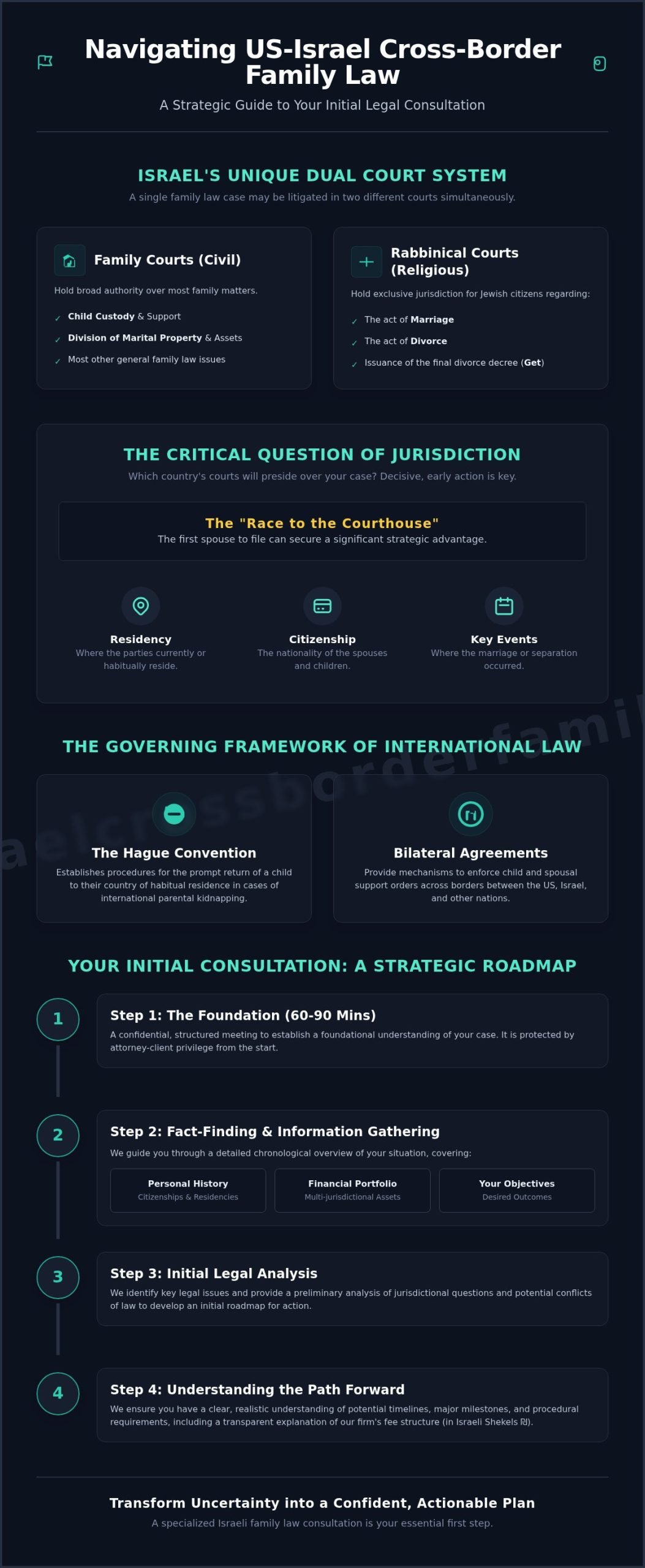
A primary complexity arises from Israel’s judicial system, which operates with parallel civil and religious courts. The civil Family Courts have broad authority over most family matters, including child custody, support, and the division of marital property. However, the Rabbinical Courts hold exclusive jurisdiction over the marriage and divorce of Jewish citizens. This duality means that a single divorce proceeding may be litigated in two different forums simultaneously, each with its own rules and precedents, significantly impacting strategies for spousal support and the final divorce decree (get). Your legal representative must be adept at navigating both systems to protect your interests.
The Critical Question of Jurisdiction
Before any substantive issues are addressed, the court must establish its authority to hear the case. Jurisdiction is determined by factors such as the residency and citizenship of the parties, and where key events, like the marriage or separation, occurred. In international cases, this often leads to a “race to the courthouse,” where the first spouse to file in their preferred country can secure a significant strategic advantage. An immediate israeli family law consultation can be critical to assessing your jurisdictional options and acting decisively.
The Role of International Treaties and Agreements
Cross-border family law is governed by a framework of international conventions. The Hague Convention on the Civil Aspects of International Child Abduction is paramount in cases involving parental kidnapping, establishing procedures for the prompt return of a child to their country of habitual residence. Similarly, bilateral and multilateral agreements exist to enforce child and spousal support orders across borders. A comprehensive understanding of these treaties is essential for effectively litigating custody and financial disputes between the US and Israel.
What to Expect During Your Initial Cross-Border Consultation
Your initial israeli family law consultation is a structured, confidential engagement designed for a comprehensive strategic assessment of your case. The primary objective is not to provide immediate, definitive legal solutions, but to establish a foundational understanding of the complex facts and jurisdictional issues at play. This meeting, which typically lasts 60 to 90 minutes and can be conducted in person or via a secure video conference, is protected by attorney-client privilege from the moment it begins. Our role is to listen intently, ask precise questions, and gather the critical information needed to chart a viable path forward.
The Fact-Finding Process
To build a robust case strategy, we must first understand the complete history and context of your situation. Be prepared to provide a detailed chronological overview of your relationship and the key events that have led to this point. We will guide you through a discussion covering several critical areas, including:
- Personal and Family History: The citizenships and residencies of all parties involved, including spouses and children.
- Financial and Asset Portfolio: A comprehensive review of finances, including multi-jurisdictional assets such as real estate, investments, and business interests in Israel and abroad.
- Your Primary Objectives: A clear articulation of your desired outcomes regarding matters of divorce, child custody, asset division, or spousal support.
Initial Legal Analysis and Strategy
Once we have a firm grasp of the facts, our attorneys will begin to identify the key legal issues and potential conflicts of law inherent in your cross-border case. We will provide a preliminary analysis of the pivotal jurisdictional questions-determining which country’s laws and courts will govern your proceedings. This analysis involves navigating international treaties and domestic laws, including the complex protocols for processing child support cases with Israel and other nations. You will receive an overview of potential legal strategies, which serves not as a final plan but as an initial roadmap for action.
Understanding the Path Forward
The consultation concludes by ensuring you have a clear and realistic understanding of the next steps. We will discuss potential timelines, major milestones in the Israeli legal process, and the procedural requirements for initiating your case. This includes a transparent explanation of our firm’s fee structure and retainer agreement, with all costs articulated in Israeli Shekels (₪). You will leave the meeting equipped with the clarity and confidence needed to make informed decisions about protecting your interests across international borders.
How to Prepare for a Productive Consultation
An international family law matter is inherently complex, involving multiple legal systems and personal sensitivities. To maximize the value of your initial meeting, thorough preparation is not just recommended-it is essential for a cost-efficient and strategically effective engagement. The primary objective is to provide our legal team with a comprehensive, organized overview of your circumstances. This allows us to move beyond basic fact-gathering and dedicate our time to providing substantive analysis and outlining a strategic path forward for your case. A well-prepared client ensures that the israeli family law consultation is focused, productive, and directly addresses your most pressing priorities.
Gather Key Documents
Assembling all relevant documentation is a critical first step. This provides the factual foundation upon which legal strategy is built. We recommend organizing a file containing the following, where applicable:
- Identification and Status: Passports, birth certificates for all family members, marriage certificates, and current visa information for residence in Israel or abroad.
- Existing Legal Agreements: Any prenuptial, postnuptial, or separation agreements that have been executed.
- Financial Overview: A concise summary of major assets and liabilities, clearly delineating their location (e.g., in Israel, the United States, or elsewhere).
- Prior Legal History: Copies of any previous court orders, judgments, or significant legal correspondence pertaining to your family law matter.
Create a Chronological Timeline
A clear timeline of events provides invaluable context for understanding the evolution of your situation. Draft a straightforward, chronological list of key dates and events. This timeline should include the date of marriage, the birthdates of any children, dates of significant international moves between countries, and any major financial events or changes in employment for either party. This narrative structure helps our attorneys quickly grasp the multi-jurisdictional history of your case.
Define Your Goals and Write Down Questions
Before the consultation, take time to reflect on your primary objectives. What are your most important goals regarding child custody, financial support, and the division of property? Articulating these priorities helps focus our discussion. Furthermore, compile a comprehensive list of every question you have. Your questions should cover all areas of concern, from financial arrangements to the specific jurisdictional complexities of Israeli religious courts. It is crucial to understand these nuances, as highlighted in the official U.S. State Department advisory on Israeli religious court jurisdiction, which details how foreign nationals can become subject to local family law. Having a written list ensures no critical point is overlooked during our meeting. Feeling overwhelmed by the complexity? Contact us to schedule a preliminary chat.
Essential Questions to Ask Your Prospective Israeli Family Lawyer
Engaging in an israeli family law consultation is a critical step toward resolving your complex, cross-border legal matter. This initial meeting is not merely for the attorney to assess your case; it is your opportunity to interview them and determine if their expertise, strategy, and approach align with your needs. A reputable international law firm will welcome your questions, viewing them as the foundation of a transparent and effective partnership. The answers you receive will be instrumental in making an informed and confident choice for your legal representation.
Questions About Experience and Specialization
The multi-jurisdictional nature of your case demands a legal team with proven, specific experience. An attorney’s background in navigating the intricate legal landscapes of both Israel and other nations, particularly the US, is paramount. Inquire directly about their track record with matters similar to yours.
- How many US-Israel cross-border family law cases have you successfully managed?
- Are you, or is a senior member of your team, dually licensed to practice law in both Israel and the United States?
- What is your depth of experience in both the Israeli Family Courts and the Rabbinical Courts (Batei Din Rabbani’im)?
- Have you previously represented clients in cases involving the Hague Convention on International Child Abduction?
Questions About Strategy and Communication
Understanding your potential lawyer’s strategic philosophy and communication protocols is essential for a productive working relationship, especially when managing a case from abroad. A clear plan and consistent updates provide the reassurance needed during a challenging time.
- Based on the preliminary details I have shared, what is your initial strategic assessment of my case?
- How will your firm keep me informed of case progress across different time zones?
- Who will serve as my primary point of contact, and what is their role in handling my case?
- What is your firm’s philosophy on negotiation and mediation versus pursuing litigation in complex international disputes?
Questions About Fees and Billing
Financial transparency is a hallmark of a professional and trustworthy legal practice. You should have a comprehensive understanding of the fee structure and billing procedures before signing a retainer agreement. Do not hesitate to ask for detailed financial information.
- What is your hourly rate in Israeli Shekels (₪), and what are the rates of associates or paralegals who may work on my case?
- What is the required initial retainer fee, and what specific services does it cover?
- How often will I receive invoices, and what level of detail can I expect in the billing statements?
- Can you provide an estimated range for the total cost, in ILS, for a case of this nature and complexity?
A productive israeli family law consultation should provide clear, substantive answers to these critical questions. Securing this clarity from the outset is the first step toward building a successful attorney-client relationship. Our team is prepared to provide the detailed guidance you require to navigate your international case with confidence.
Why Our Firm is Uniquely Positioned for US-Israel Family Law Matters
Navigating a family law dispute across international borders presents a unique set of legal, financial, and cultural challenges. The stakes are profoundly high, and the margin for error is nonexistent. Our firm was established to address this specific, complex reality, offering a sophisticated and fully integrated solution that a traditional domestic practice simply cannot provide. We bridge the gap between two distinct legal systems, ensuring your rights are protected on both continents.
A Team on the Ground in Both Tel Aviv and New York
Engaging separate law firms in the United States and Israel creates logistical friction and strategic dissonance. Our integrated structure eliminates this fundamental problem. With fully-staffed offices in both Tel Aviv and New York, we operate as one cohesive team. This ensures a seamless legal strategy, direct access to expert counsel in your time zone, and an efficient process that prevents the costly delays and miscommunications inherent in managing two uncoordinated legal teams.
Dual-Qualified, Bicultural Attorneys
Success in multi-jurisdictional family law requires more than just legal knowledge; it demands deep cultural fluency. Our attorneys are not only licensed to practice in both the US and Israel but are also bicultural, possessing an innate understanding of the subtle nuances that drive negotiations and judicial decisions in both countries. We confidently navigate the complexities of both Israeli Rabbinical Courts and American civil court systems, preventing the critical misunderstandings and strategic errors that can jeopardize your case.
A Strategic, Holistic Approach to Your Case
We recognize that your case involves more than legal statutes; it encompasses your family’s future, your financial security, and your personal well-being. Our approach is therefore strategic and holistic, developing tailored solutions that align with your specific long-term goals. With extensive experience representing high-net-worth individuals in complex cross-border disputes, we possess the sophistication required to handle intricate asset division and protect significant financial portfolios. An initial israeli family law consultation with our team is the first step toward architecting a comprehensive strategy for your future. The complexity of your situation demands a legal team built for the challenge. We invite you to discover the strategic advantage of our integrated, dual-qualified approach. Schedule your confidential consultation with our cross-border team today.
Your Strategic Next Step in US-Israel Family Law
Navigating the intricate landscape of US-Israel family law requires a sophisticated understanding of two distinct legal systems and a clear strategy from the outset. As this guide has illustrated, thorough preparation and asking targeted questions are paramount to transforming your initial meeting into a decisive step toward resolution. The complexities of multi-jurisdictional disputes demand more than just legal advice; they demand specialized, bicultural expertise. Your first israeli family law consultation is the cornerstone of your legal journey. Our firm is uniquely positioned to provide the authoritative guidance required for these sensitive matters. With attorneys licensed to practice in both the U.S. and Israel and established offices in Tel Aviv and New York, we offer a seamless professional home for your case. Our extensive experience in complex international custody disputes, including Hague Convention proceedings, ensures your case is managed with the highest level of strategic insight. Protecting your family’s future across international borders is a profound responsibility. Take the definitive step toward securing a favorable outcome. Schedule Your Confidential Consultation with Our Cross-Border Team today and let us provide the clarity and direction you need to move forward with confidence.
Frequently Asked Questions About International Family Law in Israel
Do I need to be physically present in Israel to start a family law case or have a consultation?
No, your physical presence is not required to initiate legal proceedings or for an initial consultation. Our firm is structured to represent international clients seamlessly, utilizing secure video conferencing and digital platforms to manage your case effectively from any global location. While certain specific court hearings may eventually require your attendance, all preliminary stages, including strategic planning and initial filings, can be handled remotely by our cross-border legal team to ensure your matter progresses without delay.
How much does an initial Israeli family law consultation typically cost?
The investment for a comprehensive initial israeli family law consultation with our senior attorneys typically ranges between ₪1,500 and ₪3,000, plus VAT. This strategic session is designed to provide a thorough analysis of your multi-jurisdictional matter, outline potential legal pathways, and establish a clear, actionable plan. We consider this foundational meeting essential for navigating the complexities of international family law and empowering you to make informed, strategic decisions for your future.
Is my U.S. prenuptial or postnuptial agreement enforceable in Israel?
A prenuptial or postnuptial agreement executed in the United States can be recognized by Israeli courts, provided it meets specific legal criteria. Under Israel’s Spouses’ Property Relations Law, a foreign agreement is generally upheld if it was validly created in its jurisdiction of origin and does not contradict Israeli public policy. The court will scrutinize the agreement for fairness, evidence of full financial disclosure, and proof of independent legal representation for both parties before affirming its enforceability.
How are assets acquired during the marriage typically divided in an Israeli divorce?
In Israel, marital assets are divided according to the principle of “Balancing of Resources,” which presumes an equal partnership. All property and rights accumulated by either spouse during the marriage, including real estate, business interests, pensions, and investments, are considered joint property and are subject to a 50/50 division. However, assets received via gift or inheritance, pension rights accrued before the marriage, and assets explicitly excluded by a valid prenuptial agreement are typically exempt from this arrangement.
What is the difference between legal custody and physical custody under Israeli law?
Under Israeli law, “legal custody” (Apotropsut) refers to the joint authority and responsibility of both parents to make major decisions concerning a child’s education, health, and general welfare; this is presumptively shared. “Physical custody” (Mishmoret), conversely, pertains to the child’s day-to-day residence and living arrangements. While legal custody is nearly always granted jointly, physical custody can be sole or joint, with one parent often designated as the primary physical custodian who determines the child’s main residence.
Can a divorce decree issued by a U.S. court be recognized and enforced in Israel?
Yes, a final divorce decree issued by a U.S. court can be formally recognized and enforced in Israel, but it requires a specific legal action. A petition must be filed with the Israeli Family Court to declare the foreign judgment enforceable. The court will then verify that the U.S. court had proper jurisdiction and that the judgment does not contravene Israeli law or public policy. Obtaining this recognition is a critical step in resolving complex international cases.

Article by
Gabriel Lior
A Personal Journey That Became a Mission The advisory was founded by an American father Gabriel Lior, LLB, MBA , global entrepreneur, and cross-border advisor who spent more than a decade navigating the Israeli family court system firsthand and now lives in Singapore with his son.
As a divorced parent in a cross-border family, Gabriel faced nearly every legal challenge a foreign parent can encounter in Israel — including child custody disputes, child support proceedings, property matters in Israel and abroad, false accusations, and complex immigration and relocation proceedings. Over the years, he learned the hard way how difficult it is for non-Israeli parents to understand the system, identify the right legal strategy, and choose the right legal representation — especially when language, culture, and jurisdictional differences are involved. He also witnessed how foreign parents and new immigrants are often disadvantaged or taken advantage of by service providers and institutions simply because they lack local knowledge or fluency. From Client to Advisor To truly understand — and survive — the system, Gabriel pursued formal legal education in Israel, completing two Israeli law degrees, alongside a BA and MBA earned in the United States. This was never about becoming a practicing attorney, but about gaining a deep, structural understanding of how the system works — and where it breaks down for foreign parents. This rare combination of: Firsthand client experience Israeli legal and US business education International business and negotiation training Decades of commercial execution created a unique perspective – one that understands both sides of the table. After years of litigation, persistence, and at times self-representation, he ultimately succeeded in securing custody of his son and relocating abroad through a rare legal victory in the Israeli Supreme Court — becoming one of the first fathers in Israel to do so under these circumstances.
Disclaimer
Important Disclaimer: The information provided on this website and in its content is for general informational and educational purposes only and does not constitute legal advice, legal opinion, or legal representation. Gabriel Lior is not licensed to practice law in Israel (nor is he interested in doing so) and does not provide legal services, despite having completed 2 Law Degrees. The services offered are advisory in nature and are intended to provide general guidance, strategic insight, and information regarding cross-border family law considerations. No attorney-client relationship is formed by accessing this website, reading its content, or communicating with us. Any decisions made based on this information are at your own discretion and risk. For legal advice specific to your situation, you should consult a licensed attorney in the relevant jurisdiction. Where appropriate, we may refer clients to independent, licensed attorneys or professionals. Such referrals do not constitute legal representation and no liability is assumed for services provided by third parties.