For international families with ties to both the United States and Israel, navigating a separation or divorce presents a unique set of complex challenges. The prospect of determining financial obligations within an unfamiliar legal system can be a source of significant apprehension, particularly concerning how foreign income will be treated by an Israeli court. This uncertainty often leads to fears of an inequitable outcome. Understanding the methodology behind the child support calculation Israel utilizes is therefore not just beneficial-it is critical for strategic planning and achieving a fair resolution for your family. This definitive guide provides the clarity you require. We will deconstruct the sophisticated legal principles that govern child support in Israel, guiding you through the key factors courts assess, the pivotal differences between old and new legal standards, and the specific financial documentation required from parents with multi-jurisdictional assets. By reading, you will gain a comprehensive understanding of the process, enabling you to anticipate likely financial outcomes and confidently engage with expert legal counsel to protect your interests.
The Legal Foundations of Child Support in Israel
Navigating the framework for child support calculation in Israel requires a sophisticated understanding of its unique dual legal system. Matters of personal status, including child maintenance for Jewish couples, are governed by their ‘personal law’-in this case, Jewish religious law (Halakha). Consequently, jurisdiction is shared between the civil Family Courts and the Rabbinical Courts. This complex interaction between religious doctrine and modern civil jurisprudence forms the basis of all child support determinations for expats and locals alike. To better understand the general principles involved in these calculations, this overview provides valuable context:
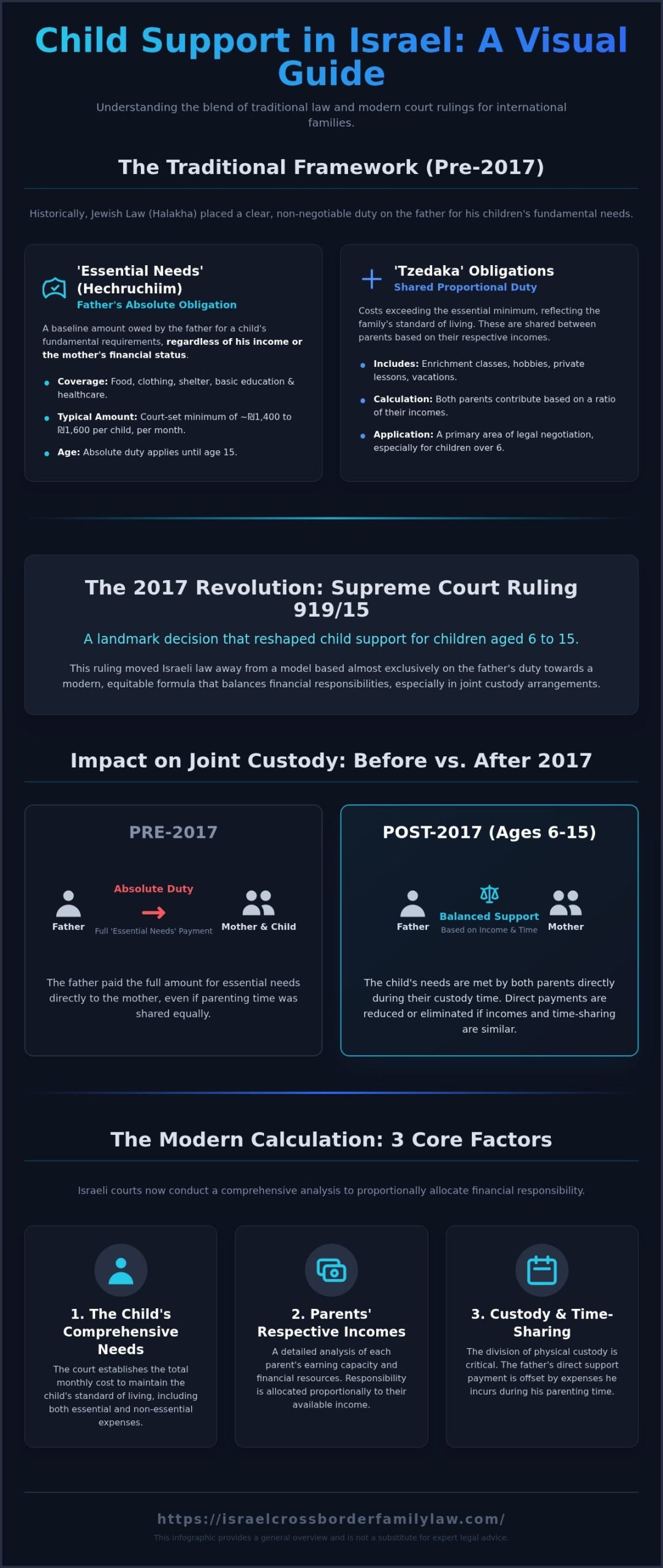
Historically, Jewish law places an absolute and primary duty on the father to provide for the ‘essential needs’ of his children until the age of 15. This principle has been the traditional starting point for all support orders. However, this foundational concept has been significantly modified by modern case law, most notably by a landmark 2017 Supreme Court ruling that introduced a more equitable approach for children between the ages of 6 and 15, especially in joint custody arrangements. Understanding these Legal Foundations of Child Support in Israel is the first step in advising international clients on their rights and obligations.
Defining ‘Essential Needs’ (Hechruchiim)
The father’s absolute obligation covers what are known as ‘essential needs’ or Hechruchiim. This is a baseline amount established by the court to cover a child’s most fundamental requirements. These typically include:
- Food and basic necessities
- Clothing and footwear
- A portion of housing and utility costs (shelter)
- Basic education and healthcare expenses
Critically, this minimum amount, often cited in the range of ₪1,400 to ₪1,600 per child per month, is owed by the father regardless of his income level or the mother’s financial standing. The court can set this amount without requiring detailed proof of every expense.
Support Beyond Essentials: ‘Tzedaka’ Obligations
Costs that exceed the essential minimum fall under the category of ‘Tzedaka’ obligations, which translates loosely to ‘charity’ or ‘righteousness’. This category includes non-essential yet important expenses like enrichment classes, private lessons, hobbies, vacations, and other costs that reflect the family’s standard of living. For these expenses, particularly for children over the age of 6, both parents are obligated to contribute proportionally based on their respective incomes and the amount of time the child spends with each parent. This is a primary area where the modern child support calculation in Israel deviates from tradition and often becomes a point of significant legal negotiation.
The 2017 Revolution: A Shift Towards Equality (Ruling 919/15)
In July 2017, the Israeli Supreme Court delivered a landmark decision in case 919/15 that fundamentally reshaped the landscape of child support for children aged 6 to 15. This ruling represented a significant departure from centuries of tradition, introducing a more equitable and modern framework that directly impacts expats and locals alike, particularly those with shared parenting arrangements. The decision moved away from a model based almost exclusively on the father’s absolute duty and established a new formula that balances the financial responsibilities between both parents in cases of joint physical custody.
The Old vs. The New Formula
Historically, Israeli law mandated that the father was solely responsible for the child’s essential needs (mezonot hechrachi’im), while non-essential expenses (known as ‘Tzedaka’ needs) were shared. The 2017 ruling did not abolish this principle but radically reinterpreted its application. The new formula for the child support calculation israel now considers both parents’ respective incomes and the amount of time the children spend in each parent’s care. The father’s obligation for essential needs is now offset by his direct expenses during his custody time, effectively reducing the direct payment to the mother.
Implications for Parents with Joint Custody
The most profound impact of this ruling is felt by parents with joint or near-equal physical custody. Under the new framework, if parents have similar incomes and share custody on a 50/50 basis, child support payments may be significantly reduced or even eliminated entirely. The legal focus has shifted towards ensuring the child enjoys a comparable standard of living in both homes. This modern approach, which aligns with the broader principles of Israeli Family Law Foundations, makes transparent financial disclosure and a precisely defined custody schedule critical components of any divorce or separation agreement. This evolution brings Israeli law more in line with the legal standards found in many Western jurisdictions, providing a more familiar framework for international and cross-border families navigating this complex process.
The Modern Calculation: Key Factors Examined
While the Israeli Family Court retains discretion in its rulings, the modern framework for determining child support obligations is guided by a comprehensive analysis of three core factors. For expatriates and Israeli nationals alike, understanding these components is critical for preparing for negotiation or litigation. The overarching goal is to accurately assess the child’s needs and then proportionally allocate the financial responsibility for meeting those needs based on each parent’s capacity. This section serves as a strategic checklist for parents navigating this complex process.
Factor 1: The Child’s Comprehensive Needs
The court conducts a thorough examination of all expenses required to maintain the child’s standard of living, aiming to preserve the quality of life they were accustomed to prior to the parents’ separation. This assessment extends far beyond basic necessities. A comprehensive list of needs includes:
- Essential Costs: Housing and utilities (a proportional share), food, clothing, and all direct educational expenses.
- Medical Expenses: Standard healthcare costs, orthodontics, therapy, and any specialized medical requirements.
- Enrichment and Lifestyle Costs: Extracurricular activities (chugim), private lessons, vacations, entertainment, and other non-essential but customary expenses.
Meticulous documentation of these expenses, supported by receipts and financial records, is paramount to justifying the amount of support requested.
Factor 2: The Parents’ Respective Incomes
The court evaluates the complete financial capacity of each parent, not merely their salaried income. This holistic financial review considers all available resources, including business profits, investment returns, rental income, government benefits, and, significantly, earning potential. For expats, foreign-denominated income (e.g., in USD or EUR) is converted to Israeli Shekels (ILS) to provide a clear picture for the court. Both parties are required to submit sworn financial affidavits, providing a transparent and documented basis for the child support calculation Israel courts undertake.
Factor 3: The Division of Parenting Time
The physical custody arrangement, or the amount of time each parent spends with the child, directly influences the final support amount. Under the landmark 2017 Supreme Court ruling (919/15), for children aged 6-15 in a joint physical custody arrangement, both parents share the costs of the child’s needs proportionally to their incomes, in addition to the direct costs incurred during their respective parenting time. In primary custody arrangements, the non-custodial parent’s financial obligation is typically higher. These considerations become even more complex in cross-border disputes. It is essential to learn more about navigating international custody and relocation issues, as they are intrinsically linked to financial support obligations. Effectively presenting these factors requires sophisticated legal guidance. For assistance with your specific cross-border family law matter, contact our experienced team for a consultation.
Navigating Cross-Border Child Support Calculations: US-Israel Specifics
For American citizens in Israel or Israeli expats with ties to the United States, child support matters introduce a layer of multi-jurisdictional complexity. The process involves navigating disparate legal systems, evidentiary standards, and financial conventions. A primary challenge is accurately presenting US-based income and assets to an Israeli Family Court, which must then contend with currency conversions, fluctuating exchange rates, and the enforceability of orders across international borders. A successful outcome depends on a legal strategy that is both sophisticated and seamlessly integrated between both jurisdictions.
Proving Foreign Income and Assets
The Israeli Family Court requires comprehensive and verifiable proof of income, regardless of its origin. For a party earning in the United States, this typically involves submitting official documentation such as:
- Federal and state tax returns (e.g., Form 1040)
- Pay stubs and W-2 or 1099 forms
- Corporate financial statements for business owners
- US bank and investment account statements
These documents must be professionally translated into Hebrew and authenticated, often via a Notary Apostille, to be admissible in court. Should a party attempt to obscure their true financial standing, the court is empowered to impute income based on earning potential and lifestyle, which can lead to a less favorable outcome. Our firm is designed to assist expats and foreign nationals with navigating these intricate evidentiary requirements.
Enforcement of Foreign vs. Israeli Orders
International families face a critical decision: whether to seek a new child support order in Israel or to domesticate and enforce an existing US order. Enforcing a US judgment is governed by Israel’s Foreign Judgments Enforcement Law of 1959 and international treaties, most notably the Hague Convention on the International Recovery of Child Support and Other Forms of Family Maintenance. Each path has distinct procedural hurdles and strategic implications. Obtaining a new Israeli order may provide more clarity under local law, while enforcing a foreign order leverages a pre-existing legal determination. You can explore this topic further in our guide to cross-border child support enforcement.
Strategic Considerations for International Families
The choice of jurisdiction-whether to litigate in an Israeli or a US court-can profoundly impact the final child support calculation israel. Factors such as differing legal standards, discovery rules, and judicial discretion must be carefully weighed. A well-drafted prenuptial or postnuptial agreement that addresses child support can provide a framework, though it may be subject to judicial review to ensure it serves the child’s best interests. Ultimately, managing a US-Israel family law case demands a coordinated legal strategy, often involving counsel in both countries working in concert to protect your rights and your child’s future. Feeling overwhelmed? Request a Confidential Case Review to assess your unique situation.
Securing a Fair Outcome in Your International Child Support Case
As we have detailed, the landscape of child support in Israel has been fundamentally reshaped by the landmark 919/15 ruling, shifting the focus towards a more equitable model based on parental income and custodial time. For international families, particularly those with ties to the United States, this modern framework introduces significant complexity. Successfully navigating the intricacies of a child support calculation israel case requires more than a general understanding of the law; it demands specialized, multi-jurisdictional expertise. Our firm is uniquely positioned to provide this sophisticated counsel. With deep expertise in multi-jurisdictional family law, a comprehensive understanding of both US and Israeli legal systems, and a proven track record in complex international divorce and custody cases, we are committed to protecting your interests. We guide our clients through every step, ensuring all factors are meticulously considered to achieve a fair and enforceable resolution. We invite you to Schedule a Confidential Consultation to Discuss Your Cross-Border Child Support Case. Allow our dedicated team to provide the strategic guidance and reassurance you need to secure a stable future for your family.
Frequently Asked Questions About Child Support in Israel for Expats
What is the age of majority for child support in Israel?
Under Israeli law, the primary child support obligation extends until a child reaches the age of 18. Following this, a reduced obligation, typically one-third of the original amount, continues until the child completes their mandatory military or national service, or until the age of 21, whichever is later. This framework provides for the child’s needs during the critical post-secondary transition period and is a key component of family law in Israel.
How are extraordinary expenses like major medical bills or private school tuition handled?
Extraordinary expenses, which encompass significant costs such as major medical treatments, orthodontic care, or private educational tuition, are handled separately from the base child support amount. The Israeli Family Court typically orders these costs to be divided between the parents, often in proportion to their respective incomes. It is imperative to have these potential liabilities clearly defined in any court order or private agreement to prevent future cross-border financial disputes.
Can a child support order in Israel be modified if my or my ex-spouse’s income changes?
A child support order in Israel is not immutable and can be modified. A party seeking modification must petition the Family Court and demonstrate a substantial and material change in circumstances since the original order was issued. This could include a significant, involuntary change in either parent’s income or a notable change in the child’s needs. Guiding clients through these modification proceedings is essential to ensure the support order accurately reflects current financial realities.
Does the Israeli court consider a new spouse’s income when calculating child support?
The Israeli Family Court does not directly include a new spouse’s income when calculating a parent’s child support obligation. However, the new spouse’s financial contribution to the household’s overall economic standing may be considered indirectly. This can influence the court’s assessment of the parent’s disposable income and overall financial capacity. This nuanced approach requires sophisticated legal analysis to ensure a fair representation of a parent’s ability to provide support.
How is income from a US-based business or trust treated by the Israeli Family Court?
For expats, the Israeli Family Court adopts a global perspective on income. All worldwide assets and revenue streams, including income from a US-based business or distributions from trusts, are relevant to the child support calculation israel. Proper disclosure and valuation of these complex, cross-border assets are critical. Failure to provide a comprehensive financial picture can lead to adverse rulings and imputed income assessments by the court, underscoring the need for experienced international counsel.
Can parents reach a private child support agreement and have it approved by the court?
Parents are indeed permitted and often encouraged to negotiate a private child support agreement. However, for such an agreement to be legally binding and enforceable, it must be submitted to and approved by the Israeli Family Court or Rabbinical Court. The court will review the agreement to ensure it adequately protects the child’s best interests and rights before granting it the full force of a judicial verdict. This process provides certainty and a formal mechanism for enforcement.

Article by
Gabriel Lior
A Personal Journey That Became a Mission The advisory was founded by an American father Gabriel Lior, LLB, MBA , global entrepreneur, and cross-border advisor who spent more than a decade navigating the Israeli family court system firsthand and now lives in Singapore with his son.
As a divorced parent in a cross-border family, Gabriel faced nearly every legal challenge a foreign parent can encounter in Israel — including child custody disputes, child support proceedings, property matters in Israel and abroad, false accusations, and complex immigration and relocation proceedings. Over the years, he learned the hard way how difficult it is for non-Israeli parents to understand the system, identify the right legal strategy, and choose the right legal representation — especially when language, culture, and jurisdictional differences are involved. He also witnessed how foreign parents and new immigrants are often disadvantaged or taken advantage of by service providers and institutions simply because they lack local knowledge or fluency. From Client to Advisor To truly understand — and survive — the system, Gabriel pursued formal legal education in Israel, completing two Israeli law degrees, alongside a BA and MBA earned in the United States. This was never about becoming a practicing attorney, but about gaining a deep, structural understanding of how the system works — and where it breaks down for foreign parents. This rare combination of: Firsthand client experience Israeli legal and US business education International business and negotiation training Decades of commercial execution created a unique perspective – one that understands both sides of the table. After years of litigation, persistence, and at times self-representation, he ultimately succeeded in securing custody of his son and relocating abroad through a rare legal victory in the Israeli Supreme Court — becoming one of the first fathers in Israel to do so under these circumstances.
Disclaimer
Important Disclaimer: The information provided on this website and in its content is for general informational and educational purposes only and does not constitute legal advice, legal opinion, or legal representation. Gabriel Lior is not licensed to practice law in Israel (nor is he interested in doing so) and does not provide legal services, despite having completed 2 Law Degrees. The services offered are advisory in nature and are intended to provide general guidance, strategic insight, and information regarding cross-border family law considerations. No attorney-client relationship is formed by accessing this website, reading its content, or communicating with us. Any decisions made based on this information are at your own discretion and risk. For legal advice specific to your situation, you should consult a licensed attorney in the relevant jurisdiction. Where appropriate, we may refer clients to independent, licensed attorneys or professionals. Such referrals do not constitute legal representation and no liability is assumed for services provided by third parties.