This article is published on an independent advisory platform and is for informational purposes only. It does not constitute legal representation or an attorney-client relationship. Legal services are only provided by licensed attorneys under a separate engagement.
Choosing the court in your home country might actually be the most expensive mistake you make in an international divorce. If you’re an expat or part of a multi-jurisdictional family, you probably feel overwhelmed by the “race to the court” and the high stakes of cross-border divorce litigation in Israel. It’s natural to feel anxious about the complexity of managing global assets while trying to understand which country’s laws will actually protect your future. With court fees for property claims in Israel reaching ₪3,447 or more, the financial risks of a misstep are concrete and immediate.
This guide provides a clear framework for strategic forum selection and risk management to help you avoid the pitfalls of multi-jurisdictional disputes. You’ll gain a strategy for selecting the right forum and protecting your assets across borders. We’ll examine how Israeli family courts interact with foreign systems, the impact of early decisions on property division, and how to maintain clarity before you commit to a legal path. Get clarity before you commit. Request a confidential consultation.
Key Takeaways
- Learn how to evaluate which legal system offers the most equitable protection for your assets before initiating formal proceedings.
- Understand the strategic implications of the “race to the court” and how it shapes the trajectory of cross border divorce litigation israel.
- Identify the essential qualifications for legal counsel, specifically the necessity of dual-licensing and cultural fluency in both Israeli and American systems.
- Discover how early strategic planning can mitigate the significant emotional and financial costs associated with multi-jurisdictional family law disputes.
- Gain clarity on the criteria Israeli courts use to determine if they are the most appropriate venue for your specific case.
Understanding Cross Border Litigation in Israel
This article is published on an independent advisory platform (not a law firm) and does not imply an attorney-client relationship. Legal services are only provided by licensed attorneys under a separate engagement.
Cross border divorce litigation israel involves much more than just filing papers in a local court. It represents a legal dispute where the parties, their children, or their financial assets are tied to multiple countries, most commonly Israel and the United States. These cases require a specialized strategy because they don’t just follow the standard Israeli civil procedure. They exist at the intersection of two different cultures and legal philosophies. Managing these situations requires an understanding of how Israeli law interacts with the laws of foreign jurisdictions.
To understand the foundation of these disputes, one must start with Understanding Marriage and Divorce in Israel. This framework is unique because it blends civil law with religious authority. When you add international treaties and bilateral agreements into the mix, the situation becomes even more nuanced. These agreements, such as the Hague Convention, provide the rules for international cooperation. However, they also require precise execution to be effective. Relying on local rules alone often leaves international families vulnerable to jurisdictional traps that can derail a case before it truly begins.
To better understand how these international rules apply in practice, watch this helpful video:
The Complexity of Multi-Jurisdictional Disputes
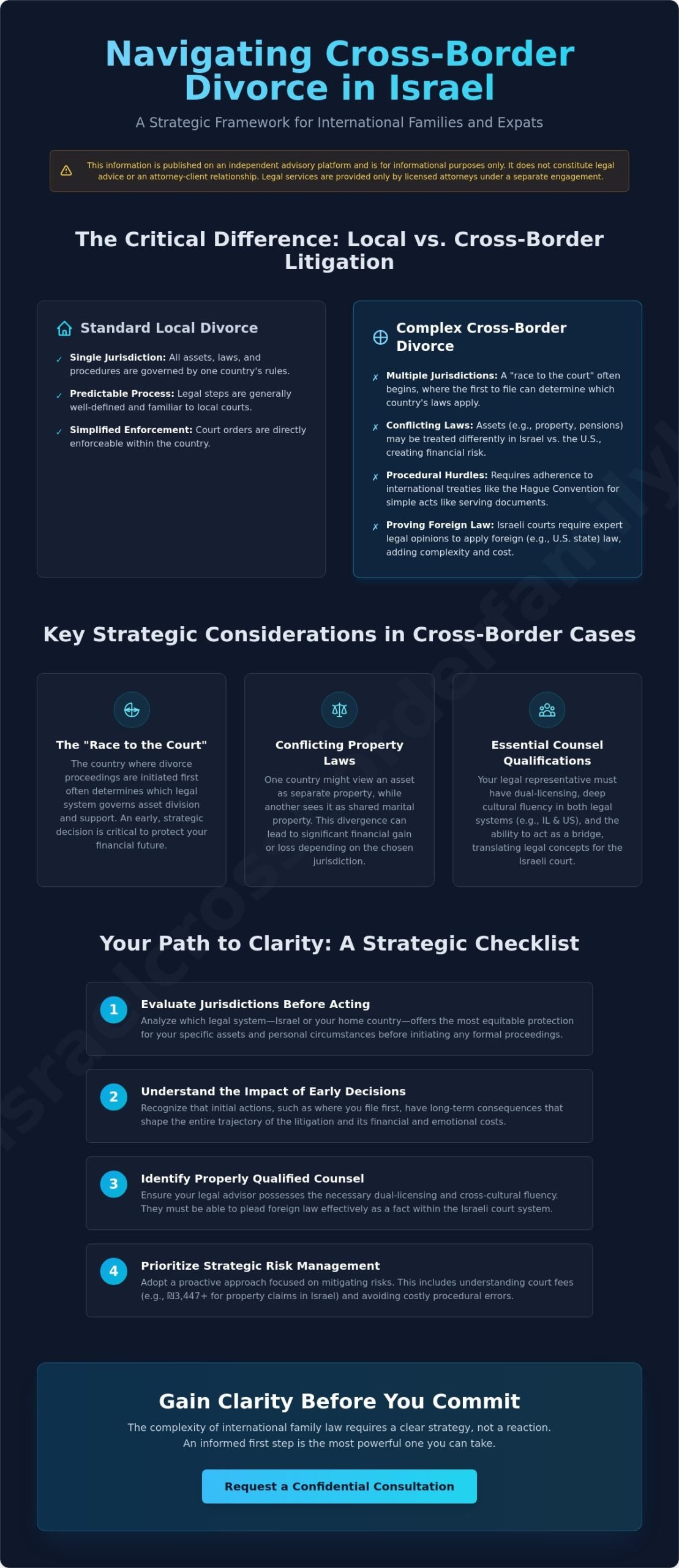
Standard litigation tactics often fail when your life is spread across borders. For instance, the simple act of serving legal process becomes a major hurdle. You must adhere to the Hague Service Convention, which is a formal international protocol for delivering legal documents. If you skip these steps, your entire case could be dismissed years later due to a technicality. Conflicting laws between Israel and various US states often create legal deadlocks. One country might view an asset as separate property, while the other views it as shared. Without a clear strategy for divorce and separation for international families, people often find themselves trapped in expensive, parallel proceedings that drain resources without providing a resolution.
Pleading Foreign Law in Israeli Courts
One of the most surprising aspects for many expats is that Israeli judges don’t simply know foreign law by default. If you want a judge to apply the laws of a US state to your assets, you must prove that law as a fact. This is done by submitting a formal expert opinion from an attorney qualified in that specific jurisdiction. An Israeli court might apply US law if a prenuptial agreement was signed there or if the couple’s center of life was primarily in America. Cross-cultural practitioners are essential here. They act as a bridge, translating complex American legal concepts into a format the Israeli court can accept and act upon. This ensures your rights aren’t lost in translation during the litigation process.
Get clarity before you commit. Request a confidential consultation.
This article is published on an independent advisory platform (not a law firm) and does not imply an attorney-client relationship. Legal services are only provided by licensed attorneys under a separate engagement.
Common Scenarios in International Litigation
While the legal framework provides the rules, the actual application of cross border divorce litigation israel often manifests in specific, high-pressure scenarios that impact an individual’s financial and personal security. For many expats, the dispute isn’t just a local matter; it’s a conflict that spans continents and legal cultures. Understanding these common patterns allows international families to move from a defensive posture to a proactive strategy. These cases typically involve a mix of personal status issues and complex asset management that requires a steady, authoritative hand.
Family Law and International Custody
Decisions regarding children require a highly specialized approach that balances local laws with international treaties. Strategic considerations for international custody and relocation must be addressed early, as a move without proper authorization can trigger the Hague Convention framework. For families managing ongoing financial support, the U.S.-Israel Child Support Caseworker’s Guide serves as a vital resource for understanding how child support orders are enforced between these two nations. These early decisions are critical, as they dictate long-term family stability and the child’s future residence.
Business and Investment Disputes
International families in Israel are often deeply integrated into the global tech and real estate markets. We frequently see litigation involving US real estate investments held by Israeli residents, where the laws of a specific US state must be reconciled with Israeli property relations. Representing Israeli tech companies in US court proceedings requires a nuanced understanding of divergent legal frameworks to protect intellectual property. If you’re managing complex assets across these jurisdictions, it’s helpful to review your specific situation with a professional who understands the inherent risks. This proactive step helps you protect your commercial interests before they become entangled in a legal deadlock.
Get clarity before you commit. Request a confidential consultation.
This article is published on an independent advisory platform (not a law firm) and does not imply an attorney-client relationship. Legal services are only provided by licensed attorneys under a separate engagement.
Strategic Jurisdictional Challenges in Israel
Determining the right court system is the most critical tactical decision in cross border divorce litigation israel. This process, often called forum shopping, involves analyzing which country’s laws and procedures offer the most equitable outcome for your specific circumstances. It isn’t just about which court is faster. It’s about which system understands your assets and your family’s unique international footprint. For a broader look at the regulatory landscape, the Israel Family Law Guide offers a detailed overview of how these local rules function.
Israeli courts use a principle called forum non conveniens to decide if they are the appropriate place for a trial. Even if a case is filed in Israel, a judge may dismiss it if they believe a US court is better suited to handle the matter. This often happens if the majority of assets or witnesses are located abroad. Choice of law clauses in prenuptial agreements or contracts also play a major role. These sections of fine print dictate which country’s laws apply, regardless of where the case is actually heard. Managing parallel proceedings, where cases are active in both Israel and the US at once, requires a strategy that prevents conflicting judgments and avoids doubling your legal costs.
The Impact of Early Decisions
Many people believe that filing first guarantees an advantage. In reality, the race to the court can backfire if you haven’t first evaluated the center of life test. Israeli courts look at where you work, where your children go to school, and where you pay taxes. If your center of life is clearly in the US, filing in Israel might lead to a jurisdictional dismissal. Strategic planning helps you avoid conflicting judgments. These occur when two different countries issue opposing orders on the same issue, creating a legal stalemate that is difficult to resolve.
Enforcement of Foreign Judgments in Israel
Obtaining a US court order is only half the battle. To make that order enforceable in Israel, you must meet specific legal requirements. The judgment must be final, and the defendant must have had a fair chance to present their case. Additionally, the order cannot contradict Israeli public policy. This is particularly relevant for child support cross-border enforcement. Defenses against enforcement often focus on whether the foreign court actually had the authority to issue the ruling. Understanding these hurdles early allows you to build a stronger case from the start.
Get clarity before you commit. Request a confidential consultation.
This article is published on an independent advisory platform (not a law firm) and does not imply an attorney-client relationship. Legal services are only provided by licensed attorneys under a separate engagement.
What to Look for in a Cross Border Attorney
Finding the right professional for cross border divorce litigation israel requires moving beyond local expertise. You need a practitioner who functions as a bridge between two distinct legal systems. Dual-licensing is perhaps the most significant strategic advantage you can find. When an attorney is licensed in both Israel and a US jurisdiction, they possess a firsthand understanding of the procedural rules in both countries. They can anticipate how an Israeli court order will be viewed by a US judge. This is essential for protecting assets like retirement accounts or real estate located abroad.
Cultural fluency is equally vital. The legal and business cultures in Israel and the United States differ significantly. This is especially true regarding how evidence is handled and how negotiations are conducted. A professional who understands these nuances can navigate the friction that often arises in international cases. They should also prioritize plain English communication. You deserve an explanation of complex Israeli laws without confusing jargon. Finally, look for a focus on strategic risk assessment. A skilled strategist aims to resolve disputes through informed, risk-based decision-making rather than defaulting to aggressive litigation.
The Value of an Advisory Approach
You need a strategist who evaluates your global situation as a whole. A local litigator might win a specific motion in an Israeli court but inadvertently damage your standing in a parallel US proceeding. It’s essential to spend time understanding how the process works before you commit to a specific path. Seeking clarity on pricing and the expected costs of managing international legal teams is also a key part of this advisory stage. This transparency helps you manage your budget and set realistic expectations for the outcome of your case.
Questions to Ask During a Consultation
Your initial meeting is the best time to gauge a professional’s experience with multi-jurisdictional complexity. Consider asking specific questions to test their strategic depth:
- How do you manage communication and coordination between legal teams operating in two different time zones?
- Have you handled cases involving the specific US state laws that govern my assets or prenuptial agreement?
- What are the inherent risks of litigating this specific matter in Israel versus the United States?
The answers to these questions will reveal if the practitioner truly understands the stakes of international family law. If you’re ready to explore your options, you can connect with a professional today to discuss your specific situation.
Get clarity before you commit. Request a confidential consultation.
This article is published on an independent advisory platform (not a law firm) and does not imply an attorney-client relationship. Legal services are only provided by licensed attorneys under a separate engagement.
Gaining Clarity Before You Commit
Engaging in cross border divorce litigation israel is a high-stakes endeavor that requires more than just a reaction to a crisis. It demands a proactive, risk-based approach. Early strategic planning can prevent years of expensive and emotionally draining international litigation. In 2025, 11,093 couples divorced in Israel, and a significant portion of these cases involved complex international elements. For these families, honest explanations of risks are far more valuable than guaranteed outcomes. In the complex world of multi-jurisdictional law, guarantees are often unrealistic. Early intervention remains the most effective way to protect your assets and family rights across borders.
Education is a vital component of this early planning phase. Gaining a foundational understanding of the Israeli system helps you ask the right questions and set realistic goals. You can find more in-depth discussions on these topics by visiting the Israel Family Law YouTube Channel. This resource provides further context on how these systems operate in practice, helping you move from a state of anxiety to a position of informed decision-making.
Risk-Based Decision Making
Before you file any documents, you must evaluate the cost-benefit ratio of an international legal battle. Litigation is rarely the only path, but it’s often the most expensive one. You must understand the significant differences between the legal systems and cultures in Israel and the United States. For example, the dual court system in Israel, where religious and civil courts share authority, has no direct equivalent in the American system. Seeking an independent confidential case review allows you to weigh these factors without the pressure of immediate litigation. This step ensures you’re choosing a path that aligns with your long-term financial and personal goals.
Next Steps for International Families
If you’re facing a potential multi-jurisdictional dispute, organization is your best defense. Start by gathering all relevant international documents, including prenuptial agreements, employment contracts, and records of global financial holdings. You’ll also need to identify the primary jurisdiction where your children or major assets are currently located. This information is the bedrock of any jurisdictional strategy. Once you have a clear picture of your situation, you can begin to assess which legal system offers the most appropriate protections for your family.
Get clarity before you commit. Request a confidential consultation.
This article is published on an independent advisory platform (not a law firm) and does not imply an attorney-client relationship. Legal services are only provided by licensed attorneys under a separate engagement.
Securing Your Future Through Strategic Planning
Managing a multi-jurisdictional dispute requires more than just local legal knowledge. It demands a strategy-first advisory approach that considers the impact of every decision on your global assets and family stability. You’ve learned that selecting the right forum and understanding the “center of life” test are foundational steps. These early choices often determine whether you face years of conflict or a structured resolution.
The complexities of cross border divorce litigation israel are best handled by those with specific expertise in multi-jurisdictional IL-US law. By focusing on the unique needs of international families and expats, you can navigate the friction between divergent legal cultures with confidence. Protecting your rights shouldn’t be a matter of chance. It should be the result of informed, risk-based decision-making. Get clarity before you commit. Request a confidential consultation. You have the ability to move forward with clarity and purpose.
This article is published on an independent advisory platform (not a law firm) and does not imply an attorney-client relationship. Legal services are only provided by licensed attorneys under a separate engagement.
Frequently Asked Questions
Can an Israeli court hear a case if the contract was signed in the US?
Israeli courts can hear cases involving contracts signed in the US if there is a sufficient link to Israel, such as one party living here or assets being located within the country. The court will evaluate whether it has the authority to intervene based on residency and the nature of the dispute. In these instances, the judge might still apply the laws of the US state where the contract was signed to interpret the agreement’s terms.
What is the difference between a local Israeli lawyer and a cross-border attorney?
A local lawyer typically specializes in domestic Israeli law and procedure, whereas a cross-border attorney manages the friction between two different legal systems. Practitioners with expertise in cross border divorce litigation israel often hold dual licenses, allowing them to anticipate how a decision in an Israeli court will impact your legal standing in the United States. This broader perspective is essential for families with global assets and interests.
How long does it take to enforce a US court judgment in Israel?
Enforcing a US court judgment in Israel generally takes between six months and eighteen months, depending on the complexity of the case and whether the other party contests the application. The process involves a formal recognition procedure where the Israeli court confirms the foreign order meets local legal standards. This includes verifying that the defendant was given a fair opportunity to be heard in the original US proceeding before the order was issued.
Can I be sued in Israel if I live in the United States?
You can be sued in Israel even if you reside in the United States, provided the Israeli court finds it has jurisdiction over the subject matter. This often happens in family law cases where one spouse or the children live in Israel. For the lawsuit to proceed, you must be served with legal papers according to strict international protocols, such as the Hague Service Convention, to ensure your right to a defense is protected.
What does ‘Forum Non Conveniens’ mean in the Israeli legal system?
‘Forum Non Conveniens’ is a legal principle where an Israeli court decides that another country is the more appropriate place to resolve a dispute. Even if the court technically has the power to hear your case, a judge might dismiss it if they believe a US court has a closer connection to the evidence, witnesses, or assets involved. It’s a strategic tool used to ensure the cross border divorce litigation israel happens in the most logical location.
Do I need two separate lawyers for a US-Israel legal dispute?
Most international disputes require a coordinated effort between legal professionals in both countries. While you might need local attorneys to appear in each court, working with a cross-border strategist helps ensure your US and Israeli teams aren’t working at cross-purposes. This integrated approach prevents conflicting strategies that could lead to expensive mistakes or contradictory court orders. It’s about maintaining a unified legal front across both jurisdictions.
Is US law ever applied in an Israeli courtroom?
US law is frequently applied in Israeli courtrooms when an agreement, such as a prenuptial contract, specifically chooses a US state’s law to govern the relationship. To use foreign law, you must provide the Israeli judge with a formal expert opinion from a lawyer qualified in that US jurisdiction. The judge treats this foreign law as a fact that must be proven before it can be used to decide the case according to those specific rules.
How are child custody disputes handled when parents live in different countries?
Child custody disputes involving parents in different countries are primarily guided by the best interests of the child and international treaties. If a child is moved across borders without consent, the Hague Convention provides a framework for their return to their home country. In standard relocation cases, Israeli courts focus on which environment will best support the child’s welfare, often requiring a detailed social worker’s report before making a final determination on residency.

Article by
Gabriel Lior
A Personal Journey That Became a Mission
The advisory was founded by an American father Gabriel Lior, LLB, MBA , global entrepreneur, and cross-border advisor who spent more than a decade navigating the Israeli family court system firsthand and now lives in Singapore with his son.
As a divorced parent in a cross-border family, Gabriel faced nearly every legal challenge a foreign parent can encounter in Israel — including child custody disputes, child support proceedings, property matters in Israel and abroad, false accusations, and complex immigration and relocation proceedings.
Over the years, he learned the hard way how difficult it is for non-Israeli parents to understand the system, identify the right legal strategy, and choose the right legal representation — especially when language, culture, and jurisdictional differences are involved. He also witnessed how foreign parents and new immigrants are often disadvantaged or taken advantage of by service providers and institutions simply because they lack local knowledge or fluency.
From Client to Advisor
To truly understand — and survive — the system, Gabriel pursued formal legal education in Israel, completing two Israeli law degrees, alongside a BA and MBA earned in the United States. This was never about becoming a practicing attorney, but about gaining a deep, structural understanding of how the system works — and where it breaks down for foreign parents.
This rare combination of:
Firsthand client experience
Israeli legal and US business education
International business and negotiation training
Decades of commercial execution
created a unique perspective – one that understands both sides of the table.
After years of litigation, persistence, and at times self-representation, he ultimately succeeded in securing custody of his son and relocating abroad through a rare legal victory in the Israeli Supreme Court — becoming one of the first fathers in Israel to do so under these circumstances.
Disclaimer
Important Disclaimer:
The information provided on this website and in its content is for general informational and educational purposes only and does not constitute legal advice, legal opinion, or legal representation.
Gabriel Lior is not licensed to practice law in Israel (nor is he interested in doing so) and does not provide legal services, despite having completed 2 Law Degrees. The services offered are advisory in nature and are intended to provide general guidance, strategic insight, and information regarding cross-border family law considerations.
No attorney-client relationship is formed by accessing this website, reading its content, or communicating with us.
Any decisions made based on this information are at your own discretion and risk. For legal advice specific to your situation, you should consult a licensed attorney in the relevant jurisdiction.
Where appropriate, we may refer clients to independent, licensed attorneys or professionals. Such referrals do not constitute legal representation and no liability is assumed for services provided by third parties.