For international families navigating the complexities of divorce, custody, or property division in Israel, the dual jurisdiction of civil and religious courts presents a formidable challenge. A common, and deeply concerning, misconception is that a decision rendered by a Rabbinical Court is absolute and unchallengeable, leaving fundamental civil rights unprotected. This landscape, however, is not without a powerful arbiter. Understanding the pivotal role of israeli supreme court family law is therefore a critical component of any successful legal strategy, providing a vital check on the authority of religious tribunals and ensuring that principles like equality and the best interests of the child are rigorously defended at the nation’s highest judicial level.
This comprehensive guide is designed to demystify this complex judicial dynamic. We will explore the specific circumstances under which the Supreme Court intervenes in family law matters, analyze landmark decisions that have shaped cross-border family disputes, and provide the clarity necessary for you to protect your rights. Our objective is to equip you with the knowledge to confidently navigate your case, secure in the understanding that Israel’s highest court stands as a guardian of universal legal principles for all families.
Israel’s Unique Dual System: Why the Supreme Court’s Role is Critical
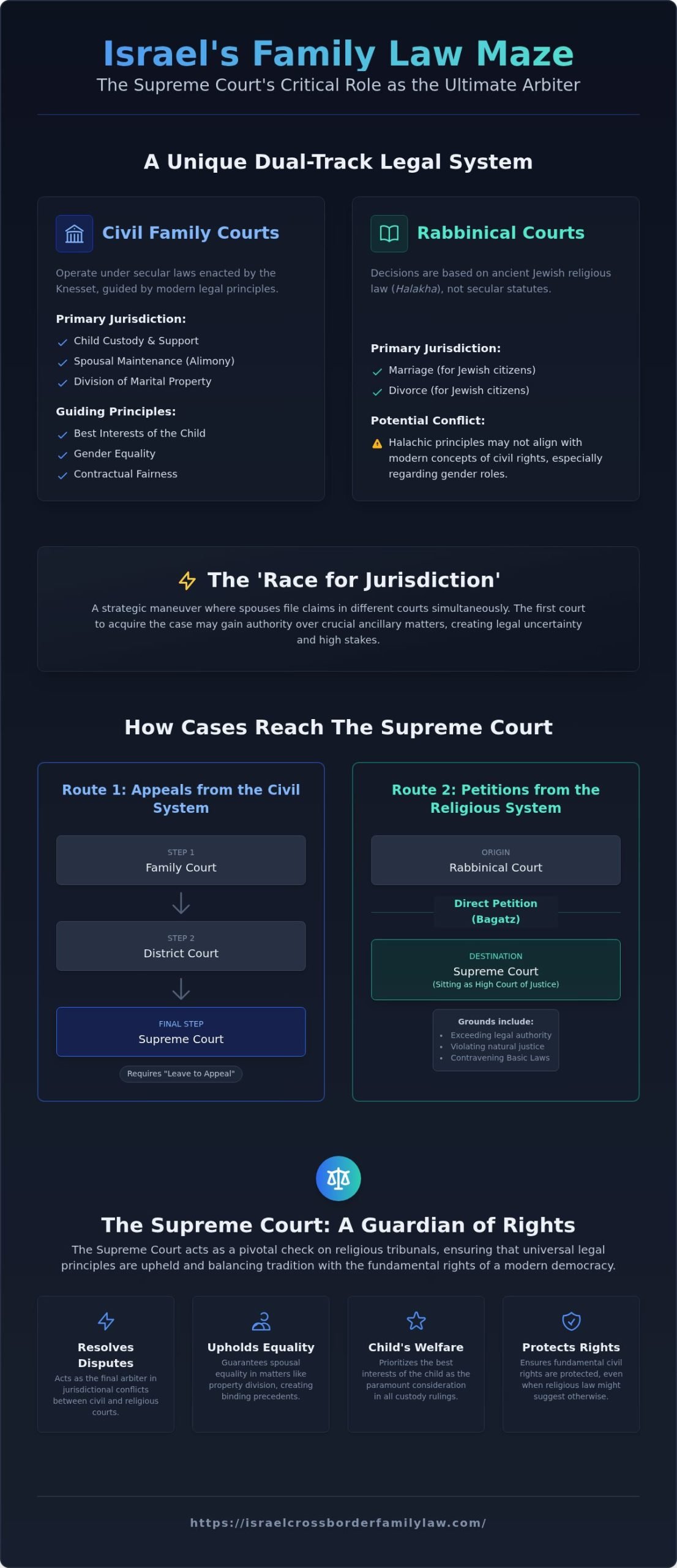
Navigating family law in Israel presents a uniquely complex challenge due to its dual-track legal system, where secular civil courts operate in parallel with religious courts. This structure, a foundational component of the Judiciary of Israel, creates a sophisticated legal environment where jurisdiction is often contested. Matters of personal status are bifurcated, with different judicial bodies holding authority over distinct aspects of family life. This division necessitates a final appellate authority to harmonize conflicting principles and resolve jurisdictional disputes, a role capably filled by the Supreme Court.
To better understand how these principles apply in practice, particularly concerning child custody, the following video offers valuable insights:
The Civil Family Courts: Jurisdiction and Principles
Established to handle the civil aspects of family disputes, Israel’s Family Courts have jurisdiction over critical matters such as child custody, child support, spousal maintenance (alimony), and the division of marital property. These courts operate exclusively under secular laws enacted by the Knesset. Their rulings are guided by modern legal principles, including the paramountcy of the child’s welfare, gender equality, and contractual fairness, ensuring that decisions reflect contemporary societal values.
The Rabbinical Courts: Authority and Halachic Law
For Jewish citizens, the Rabbinical Courts hold exclusive and absolute jurisdiction over the acts of marriage and divorce. Unlike the civil courts, their decisions are not based on secular statutes but on ancient Jewish religious law (Halakha). This can create significant tension, as Halachic principles may not always align with modern concepts of civil and human rights, particularly concerning gender roles in divorce proceedings. The critical role of the Israeli Supreme Court family law jurisprudence is often to bridge this gap.
The ‘Race for Jurisdiction’ Explained
The parallel system gives rise to a phenomenon known as the "race for jurisdiction." This strategic legal maneuver occurs when estranged spouses simultaneously file claims in different courts-one in the Civil Family Court and the other in the Rabbinical Court. The court that first acquires jurisdiction may gain the authority to rule on ancillary matters, such as property division or spousal support. This high-stakes race creates legal uncertainty and underscores the essential need for a supervising judicial body to establish clear legal precedent and act as the ultimate arbiter.
How Family Law Cases Reach the Supreme Court
It is a common misconception that family law disputes are initially heard by the Supreme Court. In reality, the Court does not have original jurisdiction over these matters. Instead, it serves two distinct and critical functions at the apex of Israel’s judicial system, intervening only at the final stages of a legal conflict. Litigants must first navigate the complex dual-track system of civil Family Courts and religious tribunals, a structure detailed by the Israel’s Ministry of Justice on family law. The path a case takes to the Supreme Court depends entirely on whether it originates in the civil or the religious court system.
Appeals from the Civil Court System
The most conventional route is through the appellate process. A case begins in a Family Court, which has broad jurisdiction over matters such as divorce, child custody, and property division for civil proceedings. A party dissatisfied with the Family Court’s judgment may appeal to the relevant District Court. Only after the District Court has rendered its decision can a party seek to bring the case before the Supreme Court. Crucially, this is not an automatic right; in most instances, one must first obtain "leave to appeal," demonstrating a significant error of law or a matter of public importance.
Petitions to the High Court of Justice (Bagatz)
A more unique and powerful avenue involves the Supreme Court sitting as the High Court of Justice (Bagatz). This is not an appeal but a direct petition, primarily used to challenge the decisions of religious tribunals, such as the Rabbinical Courts. A petition can be filed on specific grounds, including that the religious court exceeded its legal authority, violated principles of natural justice, or issued a ruling that contravenes Israel’s Basic Laws. This function is a cornerstone of israeli supreme court family law, providing a crucial check on the power of religious tribunals and ensuring that fundamental rights are upheld within the complex framework of personal status law.
Landmark Rulings: How the Supreme Court Has Shaped Modern Israeli Family Law
The Israeli Supreme Court, sitting as the High Court of Justice, has served as a pivotal and progressive force in the evolution of modern family law in Israel. In a jurisdiction where personal status matters are often governed by religious law, the Court has consistently intervened to uphold principles of equality, fairness, and individual rights. Its seminal rulings have created binding precedents, providing clarity and establishing civil norms that profoundly impact the lives of families across the country. The sophisticated jurisprudence of the israeli supreme court family law decisions demonstrates a commitment to balancing tradition with the fundamental rights expected in a modern democracy.
Property Division and Spousal Equality
A critical area of the Court’s influence has been in establishing spousal equality in property division. While the Spouses’ Property Relations Law of 1973 mandates an equal division of assets accumulated during marriage, its application has been contested. The Supreme Court has decisively intervened in cases where Rabbinical Courts, which have concurrent jurisdiction within the Israeli Family Court System, have attempted to link a spouse’s share of property to their personal conduct, such as infidelity. The Court has consistently ruled that marital property rights are civil, contractual rights, establishing that a spouse’s entitlement to their half of the marital assets is not contingent on "fault" and cannot be used as a punitive measure.
Child Custody, Relocation, and the ‘Best Interests of the Child’
In all matters concerning minors, the Supreme Court has unequivocally established the "best interests of the child" as the paramount consideration, overriding other parental or legal concerns. This principle guides its rulings in complex and sensitive cases, including international child abduction under the Hague Convention, where it balances the need for a child’s swift return with a thorough assessment of their welfare. Similarly, in parental relocation disputes, the Court meticulously weighs a parent’s right to freedom of movement against the child’s need for stability and meaningful contact with both parents. See how these principles apply in international custody and relocation cases.
Marriage, Divorce, and Personal Status
Perhaps one of the Court’s most significant impacts has been on the institution of marriage itself. With no civil marriage available within Israel, the Supreme Court created a vital pathway for countless couples by ruling that the Ministry of Interior must recognize and register civil marriages legally performed abroad. This landmark decision provided a solution for interfaith couples, same-sex couples, and others unable to marry via the Rabbinate. Furthermore, the Court has issued key rulings recognizing non-Orthodox conversions for the purposes of the Law of Return and has consistently upheld the contractual validity of divorce agreements, ensuring they are enforced by the civil court system.
[
Download
](https://getautoseo.com/screenshots/getautoseocom_1769645123_o5dstZ5X.jpg)
Feedback & Recreate
Delete

The Supreme Court’s Impact on Expats and Foreign Nationals
For expats, foreign nationals, and families navigating multi-jurisdictional legal matters, the Israeli Supreme Court serves as a vital arbiter, providing clarity and stability in an often complex environment. Its decisions create a predictable legal framework, ensuring that international agreements and foreign legal principles are applied with consistency and in accordance with Israeli public policy. The precedents established by the Israeli Supreme Court in family law are particularly critical for those dealing with assets, children, and agreements that span multiple countries.
Enforcement of Foreign Judgments and Orders
A judgment from a U.S. or other foreign court is not automatically enforceable in Israel. It must first be recognized by an Israeli court, a process guided by principles solidified by the Supreme Court. The Court requires that several conditions be met before a foreign order will be given effect. These criteria ensure fairness and protect the integrity of the Israeli legal system. Key requirements include:
The foreign court must have had proper international jurisdiction to issue the order.
The judgment must be final and no longer appealable in its country of origin.
Enforcement must not contradict Israeli laws or fundamental principles of public policy.
This judicial oversight is essential for matters such as cross-border child support enforcement, where a clear legal pathway is necessary to protect the financial well-being of children.
Hague Convention on Child Abduction Cases
As the final appellate body for international child abduction cases, the Supreme Court plays a determinative role in interpreting Israel’s obligations under the Hague Convention. The Court has issued numerous landmark rulings that clarify the application of key defenses, such as the "grave risk of harm" exception. These decisions demonstrate a strong commitment to the treaty’s primary goal-the prompt return of wrongfully removed children-while carefully weighing the specific circumstances of each case. This judicial diligence provides reassurance that Israel takes its international treaty obligations seriously, a critical consideration for parents involved in these distressing disputes. Our firm has extensive experience representing clients in Hague Convention Child Abduction cases.
Recognition of Foreign Prenuptial Agreements
The Supreme Court generally upholds the validity of prenuptial and postnuptial agreements executed abroad, provided they were entered into validly according to the laws of that jurisdiction. However, the Court will scrutinize such agreements to ensure they do not violate Israeli public policy. For a foreign prenup to be recognized, it is imperative that it was drafted with precision, that both parties received independent legal counsel, and that there was full financial disclosure. This highlights the necessity of engaging legal experts who are proficient in the laws of both jurisdictions to ensure your agreement is robust and enforceable in Israel.
Navigating these complex cross-border issues requires specialized expertise. Contact our firm to discuss your specific international family law matter.
Navigating Your Case: Strategic Considerations for the Supreme Court
Approaching the Supreme Court of Israel represents the final stage of judicial recourse and is a significant legal undertaking, not a routine appeal. This is not a ‘do-it-yourself’ process; it demands a sophisticated legal strategy, substantial financial investment often amounting to tens of thousands of shekels (₪), and a clear understanding that the Court’s intervention is exceptional, not automatic.
Is a Supreme Court Petition Right for Your Case?
A petition for leave to appeal to the Supreme Court is not granted lightly. The Court’s primary function is not to re-examine factual disputes but to address broader legal principles. A thorough review of lower court proceedings is essential to determine if your case possesses the requisite grounds for intervention. A viable petition is typically predicated on one or more of the following criteria:
A Clear Error of Law: The lower court made a significant and demonstrable mistake in applying or interpreting the law.
A Violation of Fundamental Rights: The decision infringes upon a fundamental right protected by Israel’s Basic Laws, such as the right to dignity or property.
A Matter of Public Importance: The case raises a novel legal question or has implications that extend beyond the individual litigants, affecting the public at large.
Critically, disagreements with a lower court’s factual findings or its assessment of witness credibility are rarely sufficient grounds for a successful petition.
The Indispensable Role of Expert Counsel
Navigating the procedural complexities of a Supreme Court petition requires specialized knowledge and experience. The process involves intricate filing requirements, strict deadlines, and the articulation of sophisticated legal arguments designed to persuade the Justices that the case warrants their attention. An experienced lawyer’s role extends beyond drafting documents; it begins with a rigorous, objective assessment of the merits to determine if the high threshold for intervention can be met. This strategic analysis is paramount to avoiding a costly and fruitless endeavor.
For matters involving international elements, it is crucial to engage counsel fluent in both the Israeli legal system and the multi-jurisdictional dynamics of cross-border disputes. Our advisory possesses the deep expertise required for advising on complex matters of israeli supreme court family law. We are uniquely positioned to guide you through these challenges, ensuring your case is presented with the clarity and authority it demands. Request a confidential case review to understand your options.
Strategic Counsel for Complex Cross-Border Family Disputes
As this guide has illustrated, the Israeli Supreme Court serves as a critical arbiter in the sophisticated interplay between civil and religious law, a role of paramount importance for international families. Landmark rulings from this high court continually shape the legal landscape, directly impacting cross-border child custody, the recognition of foreign judgments, and the division of multi-jurisdictional assets. A comprehensive understanding of israeli supreme court family law is therefore not merely academic-it is a strategic imperative for navigating high-stakes family litigation successfully.
When facing such complex legal challenges, securing representation with a proven history of success is essential. Our firm offers decades of specialized experience in US-Israel cross-border litigation, grounded in a deep understanding of the interplay between civil and religious courts. With a proven track record in the most complex international custody and asset division cases, we are positioned to protect your interests at every level of the Israeli legal system. We invite you to Schedule a Confidential Consultation to Discuss Your Cross-Border Family Law Matter and take the first step toward a strategic resolution.
Frequently Asked Questions
Can the Israeli Supreme Court overrule a decision made by a Rabbinical Court?
Yes, the Supreme Court, sitting as the High Court of Justice (Bagatz), possesses the authority to intervene and set aside a decision from a Rabbinical Court. This judicial review is not a standard appeal but is exercised in specific circumstances, primarily when the Rabbinical Court has exceeded its legal jurisdiction, violated principles of natural justice, or issued a ruling that contravenes the civil laws of the State of Israel by which it is bound.
What is the practical difference between appealing to the Supreme Court and petitioning the High Court of Justice (Bagatz)?
While the same justices preside over both, the functions are distinct. An appeal to the Supreme Court is the final stage of litigation within the civil court system, reviewing a judgment from a District Court that has already heard an appeal from the Family Court. In contrast, a petition to the High Court of Justice (Bagatz) is an original action filed directly against a public or state authority, including Rabbinical Courts, for allegedly acting unlawfully or beyond their authority.
How long does a family law appeal or petition to the Supreme Court typically take?
The timeline for a family law matter to be resolved by the Supreme Court can vary substantially based on the complexity of the legal issues, the court’s caseload, and the urgency of the relief sought. A typical appeal or petition may take anywhere from several months to over two years to reach a final judgment. Matters requiring urgent intervention, such as international child abduction cases under the Hague Convention, may be expedited, but the full hearing process remains a deliberate and lengthy one.
Are U.S. court orders regarding child custody or support binding in Israel?
U.S. court orders are not automatically enforceable in Israel. To become binding, the foreign judgment must be formally recognized by an Israeli Family Court through a specific legal process governed by the Foreign Judgments Enforcement Law. The Israeli court will assess critical factors, including whether the U.S. court had proper jurisdiction and whether the enforcement of the order would contradict Israel’s public policy. This process ensures foreign orders align with Israeli legal standards before they are enforced.
What are the primary reasons the Supreme Court would refuse to hear a family law case?
The Supreme Court exercises significant discretion and may refuse to grant "leave to appeal" if the case does not present a novel legal question of broad public importance that extends beyond the specific dispute. The court’s role is not to re-litigate factual findings but to address principled legal errors and establish precedent. A petition will likely be denied if the lower court’s decision is not considered a gross miscarriage of justice or if the appellant has not exhausted all other legal remedies.
How does the Supreme Court handle cases involving non-Jewish foreign nationals?
In cases involving non-Jewish foreign nationals, the Supreme Court applies Israeli civil law alongside relevant international treaties to which Israel is a signatory. The court meticulously adjudicates complex jurisdictional questions and ensures that the fundamental rights of all parties are protected. The sophisticated nature of israeli supreme court family law demands a careful navigation of multi-jurisdictional legal conflicts to deliver a just and enforceable resolution, regardless of the parties’ nationality or religious affiliation.

Article by
Gabriel Lior
A Personal Journey That Became a Mission
The advisory was founded by an American father Gabriel Lior, LLB, MBA , global entrepreneur, and cross-border advisor who spent more than a decade navigating the Israeli family court system firsthand and now lives in Singapore with his son.
As a divorced parent in a cross-border family, Gabriel faced nearly every legal challenge a foreign parent can encounter in Israel — including child custody disputes, child support proceedings, property matters in Israel and abroad, false accusations, and complex immigration and relocation proceedings.
Over the years, he learned the hard way how difficult it is for non-Israeli parents to understand the system, identify the right legal strategy, and choose the right legal representation — especially when language, culture, and jurisdictional differences are involved. He also witnessed how foreign parents and new immigrants are often disadvantaged or taken advantage of by service providers and institutions simply because they lack local knowledge or fluency.
From Client to Advisor
To truly understand — and survive — the system, Gabriel pursued formal legal education in Israel, completing two Israeli law degrees, alongside a BA and MBA earned in the United States. This was never about becoming a practicing attorney, but about gaining a deep, structural understanding of how the system works — and where it breaks down for foreign parents.
This rare combination of:
Firsthand client experience
Israeli legal and US business education
International business and negotiation training
Decades of commercial execution
created a unique perspective – one that understands both sides of the table.
After years of litigation, persistence, and at times self-representation, he ultimately succeeded in securing custody of his son and relocating abroad through a rare legal victory in the Israeli Supreme Court — becoming one of the first fathers in Israel to do so under these circumstances.
Disclaimer
Important Disclaimer:
The information provided on this website and in its content is for general informational and educational purposes only and does not constitute legal advice, legal opinion, or legal representation.
Gabriel Lior is not licensed to practice law in Israel (nor is he interested in doing so) and does not provide legal services, despite having completed 2 Law Degrees. The services offered are advisory in nature and are intended to provide general guidance, strategic insight, and information regarding cross-border family law considerations.
No attorney-client relationship is formed by accessing this website, reading its content, or communicating with us.
Any decisions made based on this information are at your own discretion and risk. For legal advice specific to your situation, you should consult a licensed attorney in the relevant jurisdiction.
Where appropriate, we may refer clients to independent, licensed attorneys or professionals. Such referrals do not constitute legal representation and no liability is assumed for services provided by third parties.