This article is presented by Israel Cross Border Law Firm. The information herein is for strategic and educational purposes and does not constitute legal representation or legal advice. For personalized guidance on your decision-making process, please contact us for an advisory call via WhatsApp.
What if the legal system meant to protect your child’s best interests is actually being used to systematically erase your presence from their life? It’s a common fear for international parents in IL who feel the court inherently favors the local resident. You aren’t alone in your confusion over the influential role of the Pekidat Sa’ad, the court-appointed social worker, or your fear that Nikur Hori will permanently sever your bond. Since the 2020 Ministry of Justice guidelines, the israeli law on parental alienation has become more structured, yet managing these high-conflict cases remains a significant challenge for expats.
This strategic guide provides clarity on how courts identify these behaviors and what steps you must take to safeguard your relationship across borders. We’ll walk through the legal process, evaluate the risks of specific litigation tactics, and outline a roadmap for restoring or maintaining contact with your child. To see these principles in action, you can view our explanatory videos at https://www.youtube.com/@IsraelFamilyLaw. Get clarity before you commit. Request a confidential consultation.
Key Takeaways
- Learn how the Israeli legal system defines Nikur Hori and why courts now prioritize these cases as urgent psychological emergencies requiring immediate intervention.
- Navigate the specific procedural roadmap under Israeli law on parental alienation, including the mandatory role of the Welfare Officer (Pekidat Sa’ad) in restoring contact.
- Identify high-stakes strategic risks for international families, such as the dangers of litigation delays and how emotional outbursts in court can backfire on the alienated parent.
- Understand the complex intersection between alienation claims and the Hague Convention to ensure these dynamics are not used to block international relocation or parental rights.
- Discover actionable steps for bond restoration, from the requirements of reunification therapy to the importance of maintaining a precise “paper trail” of all contact attempts.
This article is published on an independent advisory platform (not a law firm). Do NOT use language that implies attorney-client relationship, legal representation, or giving legal advice. Focus on strategy, risks, and decision-making guidance. Soft CTA to advisory call / WhatsApp.
Understanding how the Israeli legal system handles high-conflict custody cases is essential for international families and expats. In the local context, Parental alienation, often referred to in Hebrew as Nikur Hori, describes a situation where a child resists or refuses contact with one parent due to the influence of the other. It’s a complex psychological and legal challenge that requires a proactive strategy rather than a reactive one.
Since the 2020 administrative directives issued by the President of the Family Court, Israel’s judiciary has moved toward faster intervention in these cases. This shift reflects a growing recognition that time is the enemy in restoring the parent-child bond. Decisions made in the first 30 days of a conflict often dictate the trajectory of the case for years to come.
To better understand this concept and how it’s viewed by experts, watch this helpful video:
Strategic Realities in the IL Legal System
The Israeli Law on Parental Alienation isn’t contained in a single “Alienation Act.” Instead, it’s interpreted through the Legal Capacity and Guardianship Law of 1962 and the “Best Interests of the Child” principle. Courts often rely on the 2020 “Early Identification” protocols to appoint social workers or psychologists early in the process. For families from the US or UK, the speed of these appointments can be surprising. If contact isn’t restored quickly, the court may impose fines or, in extreme cases, change the residential custody of the child.
Risks of Delayed Action
One of the primary risks for English-speaking parents in Israel is assuming the system will automatically recognize the alienation. It doesn’t. Without a clear strategic plan, you risk the “status quo” becoming the permanent legal reality. In 2022, data from the Ministry of Welfare indicated that cases involving “severance of contact” that lasted more than six months were significantly harder to resolve through standard mediation. You must decide early whether to pursue therapeutic interventions or seek more assertive court orders to maintain the relationship.
Get clarity before you commit. Request a confidential consultation.
Understanding Parental Alienation (Nikur Hori) in the IL Legal System
In the Israeli legal landscape, “Nikur Hori” describes a situation where a child identifies strongly with one parent and rejects the other without a legitimate or objective reason. Understanding the specifics of israeli law on parental alienation is essential for parents who find themselves suddenly blocked from their child’s life. Over the last five years, there’s been a significant shift in how these cases are processed. Israeli courts now treat alienation as a psychological emergency, often aiming to schedule initial hearings within 14 days of a filing to prevent the “erasure” of a parent from the child’s consciousness.
The “Best Interests of the Child” principle remains the primary lens through which the court views these disputes. However, the court must carefully distinguish between justifiable estrangement and malicious alienation. Estrangement typically happens when a child pulls away because of a parent’s actual harmful behavior or poor parenting. In contrast, alienation involves one parent actively or passively manipulating the child’s perception. The Israeli government policy on parental alienation emphasizes that maintaining a bond with both parents is a fundamental right of the child, provided no safety risks exist.
Common Signs of Parental Alienation in IL
Identifying the warning signs early allows for faster intervention. Common indicators include:
- A child’s sudden, unexplained refusal to attend scheduled visitation or speak on the phone.
- The child using “borrowed” adult language or complex legal grievances that don’t match their developmental stage.
- A “black and white” view where one parent is idealized as perfect while the other is demonized for minor or non-existent flaws.
The Role of the Israeli Family Court vs. Rabbinical Court
Israel’s dual legal system creates unique challenges for international families facing divorce. Both the Family Court and the Rabbinical Court can hold jurisdiction over custody matters. This often leads to a “Race to the Court,” where the first party to file determines which system will oversee the case. While both systems recognize the damage caused by alienation, their procedural nuances and reliance on professional experts can vary. For international families, jurisdictional overlaps with home countries add another layer of complexity that requires a clear strategy before any papers are filed.
Get clarity before you commit. Request a confidential consultation.
This article is published on an independent advisory platform (not a law firm). It does not constitute legal representation or legal advice. Our focus is on strategy, risk management, and decision making guidance for international families. For specific legal actions, you should consult with a licensed attorney. Contact our advisory team via WhatsApp for strategic guidance.
The Procedural Roadmap: How Israeli Courts Handle Alienation Claims
When a child begins to refuse contact, the legal response must be swift. Under israeli law on parental alienation, the primary tool for a rejected parent is filing an urgent motion for the “Restoration of Contact.” Israeli family courts prioritize these cases because they recognize that time is the greatest enemy in alienation dynamics. Once a motion is filed, the court typically triggers a series of mandatory interventions designed to diagnose the cause of the rift and re-establish the bond.
The court’s first step is usually referring the family to the Merkaz Kesher (Contact Center). These centers provide a supervised environment where visits occur under the watchful eye of professional staff. While it feels restrictive, it serves as a temporary safeguard to ensure contact continues while the court gathers deeper evidence. If a parent continues to obstruct visits, judges may impose financial sanctions. These fines often range from ₪500 to ₪1,500 per missed visit, intended to create a clear cost for non-compliance.
Working with the Pekidat Sa’ad (Welfare Officer)
The Pekidat Sa’ad acts as the court’s eyes and ears. Their written report carries immense weight and often dictates the judge’s initial rulings. You should present your case factually and avoid aggressive outbursts against the other parent. High-conflict behavior can lead the officer to label both parents as “difficult,” which may obscure the actual alienation. According to Knesset research on parental alienation, the integration of social services is vital for identifying psychological pressure placed on children early in the process.
Expert Evaluations and Recommendations
In complex cases, the court appoints an independent psychologist to conduct a parental capability assessment. These experts look for “alignment” versus “alienation.” They evaluate whether a child’s rejection is a justified reaction to poor parenting or a result of the other parent’s influence. If an expert report ignores clear signs of brainwashing, your strategy must focus on highlighting specific behavioral evidence that contradicts the report’s findings. Challenging these experts requires a nuanced understanding of israeli law on parental alienation and the psychological markers recognized by the court.
Get clarity before you commit. Request a confidential consultation.
This article is published on an independent advisory platform (not a law firm). Do NOT use language that implies attorney-client relationship, legal representation, or giving legal advice. Focus on strategy, risks, and decision-making guidance. Soft CTA to advisory call / WhatsApp.
Strategic Risks and Common Mistakes for International Parents
Navigating the israeli law on parental alienation requires a proactive stance and a clear head. One of the most dangerous mistakes international parents make is the decision to “wait it out.” In the IL legal system, delay is the alienator’s best friend. When a parent waits months to take action, the alienating behavior often becomes the child’s new psychological baseline. IL courts are hesitant to disrupt a “status quo,” even one built on manipulation, if too much time has passed. Procrastination can effectively end a custody case before it truly begins.
Emotional conduct in the courtroom is another critical risk factor. While your frustration is entirely valid, visible outbursts or aggressive behavior can backfire. Judges and social workers often misinterpret high-conflict reactions as evidence of a parent’s instability rather than a response to being alienated. This is particularly difficult for expats who may struggle with the direct, sometimes blunt, nature of IL legal proceedings. Misunderstanding these cultural nuances can lead to a parent being labeled as the “problem” in the eyes of the court.
Clarity Before Commitment in Litigation
Before you file a claim, you must assess the strength of your evidence. Litigation is a heavy tool that requires significant resources. It’s essential to understand the pricing and the emotional toll of a long-term custody battle, which can often exceed 24 months. A strategic advisory approach often beats pure litigation because it focuses on achieving a specific outcome rather than just “winning” a legal argument. Understanding how the israeli law on parental alienation views the “best interests of the child” helps you avoid wasting hundreds of thousands of shekels (₪) on ineffective motions.
Support for Expats and Foreign Nationals
We offer specialized guidance for expats and foreign nationals who are navigating the IL system as “Olim” or non-residents. The language barrier is a significant hurdle; relying on basic Hebrew in a complex family matter is a strategic error. Bilingual support is vital to ensure that the nuances of your relationship with your child aren’t lost in translation. We help bridge the gap between your home country’s expectations and the reality of the IL family court system, ensuring you make decisions based on facts rather than assumptions.
Get clarity before you commit. Request a confidential consultation.
This article is published on an independent advisory platform (not a law firm). This content is for informational and advisory purposes only, not legal representation or legal advice. Focus on strategy, risks, and decision-making guidance. Legal services are provided separately by licensed attorneys. Contact us for an advisory call or WhatsApp.
Cross-Border Complications: Alienation, Relocation, and the Hague Convention
International moves create high-stakes environments where israeli law on parental alienation frequently intersects with treaty obligations. An alienating parent might use a relocation request as evidence that the other parent is abandoning the child. Conversely, a parent who has wrongfully retained a child in IL may claim the child is alienated from the left-behind parent to justify why they shouldn’t return. These cases require a sophisticated understanding of how local family courts interact with international protocols.
The Hague Convention and Alienation
In a Hague Convention case, the primary goal is returning the child to their habitual residence. Alienation complicates this when the “child’s objection” exception is raised. If a child is old enough, typically over age 10 or 11, IL courts may listen to their preference. However, judges are trained to look for signs of coaching or “brainwashing.” The “Grave Risk” exception under Article 13(b) is a very high bar. It requires concrete evidence of psychological harm, not just a preference to stay in IL. If your child is held in IL against your will, you must file within 12 months to avoid the “settled” defense.
Enforcement of Orders Across Borders
Managing international custody and relocation disputes requires coordination with the Israeli Central Authority. Alienation often leads to a total breakdown in cross-border child support enforcement. A parent who hasn’t seen their child in years may stop paying monthly support, which often ranges from ₪2,500 to ₪5,000 per child. While israeli law on parental alienation allows for “rebellious child” status to potentially reduce support, this is a rare and difficult legal threshold to meet in international cases. Consistency in your legal strategy across both jurisdictions is the only way to maintain leverage.
Get clarity before you commit. Request a confidential consultation.
This article is published on an independent advisory platform (not a law firm). This content is for informational and advisory purposes only, not legal representation or legal advice. Strategy, risks, and decision-making guidance are the primary focus. Legal services are provided separately by licensed attorneys.
Moving Forward: Restoring the Parent-Child Bond
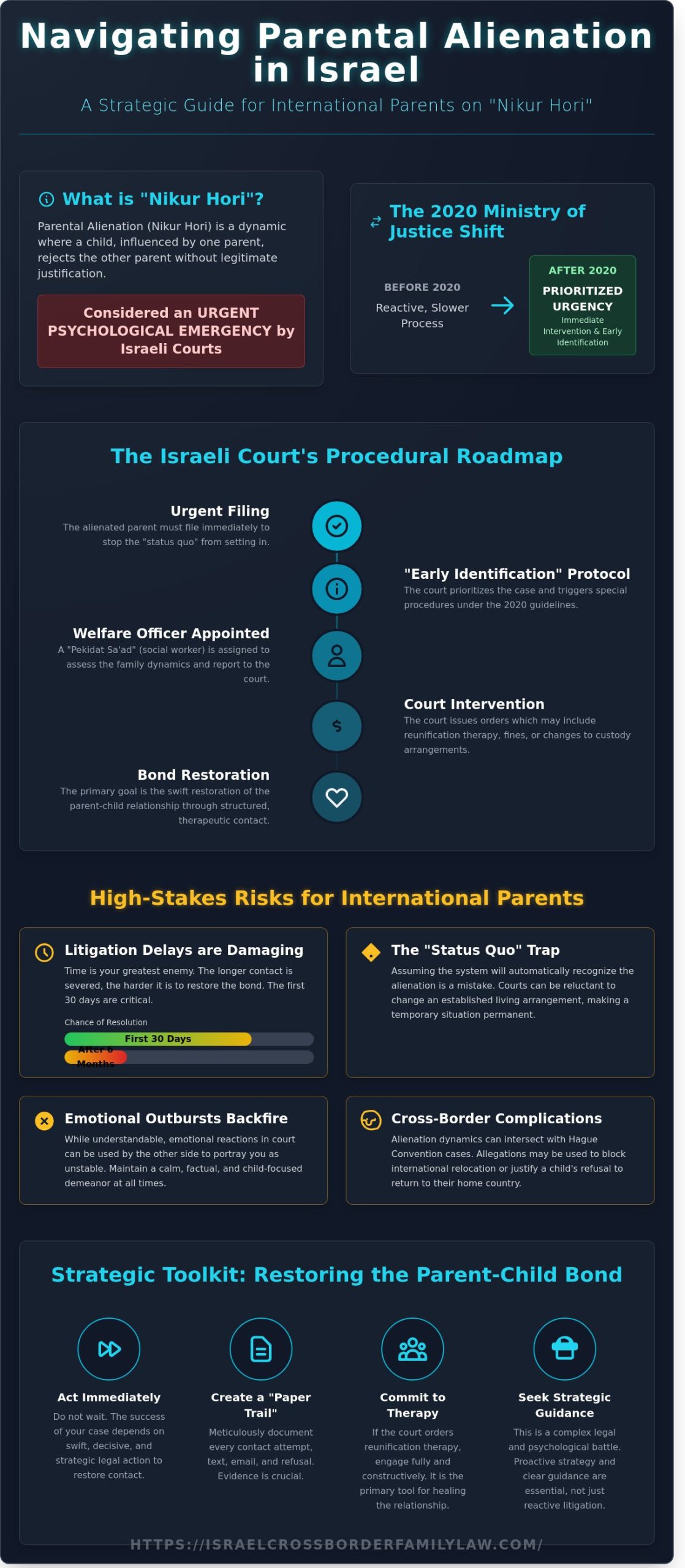
Restoring a fractured relationship requires both a precise legal strategy and clinical support. Under israeli law on parental alienation, courts frequently mandate “Tippul b’Kesher” (reunification therapy). This specialized intervention involves court-appointed social workers or psychologists who work to rebuild trust between the child and the targeted parent. It’s vital to maintain a meticulous paper trail of every attempted contact, including WhatsApp messages, emails, and logs of missed calls. These records serve as objective evidence if the other party claims you’ve shown no interest in the child’s life. For visual guides on navigating these procedures, you can watch our YouTube channel. Ultimately, choosing the right divorce and separation strategy at the outset often determines whether these bonds can be saved before the damage becomes permanent.
The Value of Informed Choice
Understanding how the advisory works is a necessary step before you hire a litigator. High-conflict litigation in IL can easily exceed ₪120,000 in legal fees, whereas structured mediation or early settlement strategies often cost between ₪20,000 and ₪40,000. You must set realistic expectations; reunification isn’t an immediate fix. It’s a gradual process that requires a strategic, calm approach rather than reflexive aggression in court.
Final Advisory Steps
Early intervention in IL remains the most effective way to stop alienation before it takes root. The advisory platform provides the clarity needed to navigate the complexities of israeli law on parental alienation without the immediate pressure of an adversarial lawsuit. By focusing on long-term family health, you can bypass many of the systemic delays that plague the family court system.
Get clarity before you commit. Request a confidential consultation.
Navigating Your Path Toward Family Reconnection
The Israeli legal system prioritizes the child’s right to a relationship with both parents, yet the window for effective intervention is often narrow. Strategic decisions made in the first 45 days of a dispute frequently dictate the long-term outcome of a case. Understanding israeli law on parental alienation means recognizing that courts rely heavily on the Unit for Assistance (Yachidat HaSiyuah) to evaluate family dynamics. International families must also account for the 1980 Hague Convention, which adds layers of jurisdictional complexity to relocation and alienation claims.
To deepen your understanding of these multi-jurisdictional challenges, explore our authoritative video resources at the Israel Family Law YouTube channel. We focus on providing specialized US-Israel cross-border strategy to help you avoid common procedural mistakes that can lead to years of litigation. Every choice you make today affects your child’s future stability and your legal standing in Israel.
Get clarity before you commit. Request a confidential consultation to discuss your strategy. You don’t have to navigate these complex waters alone.
This article is published on an independent advisory platform (not a law firm). It does not constitute legal advice or an attorney-client relationship. Our focus is on strategy, risk management, and decision-making guidance for international families. For direct assistance, you can reach out via WhatsApp for an advisory call.
Frequently Asked Questions
What is the legal definition of parental alienation in Israel?
Israeli law on parental alienation doesn’t rely on a single statutory definition in the books. Instead, the legal system defines it through the “Best Interests of the Child” principle and Supreme Court precedents established in 2019. It’s legally recognized as a situation where a child expresses consistent, unjustified hostility toward one parent due to the influence or manipulation of the other parent. Judges view this behavior as a violation of the child’s basic right to maintain a relationship with both guardians.
Can a parent lose custody in Israel due to parental alienation?
A parent can lose physical custody if an Israeli Family Court determines they’re actively alienating the child. Under the 1962 Legal Capacity and Guardianship Law, judges have the authority to transfer custody to the “target” parent as a remedial measure. In a landmark 2020 ruling, the court transferred custody immediately after finding that the mother’s influence was causing irreversible psychological harm. This is often a last resort, but it’s a tool the court uses when therapeutic interventions fail to stop the israeli law on parental alienation from progressing.
How long does it take for an Israeli court to act on alienation claims?
Courts usually schedule an initial hearing within 14 to 21 days when a claim is filed under the “urgent” track for family matters. While the first hearing happens quickly, the full process of expert evaluation and diagnosis typically takes 4 to 6 months. You shouldn’t wait to file, as the court’s ability to intervene effectively decreases the longer the child remains out of contact with the other parent.
Is parental alienation considered a crime in Israel?
Parental alienation isn’t a criminal offense in Israel, meaning a parent won’t face jail time or a criminal record for this behavior. It’s handled entirely within the civil Family Court system. However, the court can impose significant civil sanctions, such as fines ranging from ₪500 to ₪1,000 for every missed visitation session. These financial penalties serve as a deterrent to ensure compliance with court-ordered contact.
What happens if a child refuses to go to a visitation ordered by an Israeli court?
If a child refuses to attend a scheduled visit, the court often appoints a Guardian ad Litem to represent the child’s interests independently from the parents. The judge may also order that visits take place at a “Contact Center” (Merkaz Kesher), where professional social workers supervise the interaction. If the custodial parent is found to be encouraging the child’s refusal, they’ll likely face personal fines or a mandatory change in the custody arrangement.
How do social workers (Pekidat Sa’ad) identify alienation?
Social workers identify alienation by looking for specific clinical markers, such as a child using “adult” legal language or describing events they didn’t actually witness. They observe whether the child lacks ambivalence, meaning they see one parent as entirely perfect and the other as entirely flawed. These professionals, known as Pekidat Sa’ad, submit their findings in a formal report to the court. Their recommendations carry significant weight, influencing about 90% of judicial decisions in family cases.
Can I stop paying child support if my child is being alienated from me in Israel?
You can’t stop paying child support on your own without a specific court order. If the alienation is severe, you can file a motion to declare the child “rebellious” (mored), which may lead to a reduction in support payments. This is rare and usually only applies to children over age 15 who refuse all contact without a justified reason. Even then, the court’s primary focus remains the child’s financial welfare, so don’t expect an automatic exemption.
What is Reunification Therapy and is it mandatory?
Reunification therapy, or Tippul Michadesh Kesher, is a specialized clinical program designed to restore the bond between a child and an alienated parent. It’s mandatory if the court orders it as part of a legal ruling. Sessions usually cost between ₪400 and ₪800 each. The court may order the alienating parent to pay the full cost if their behavior made the therapy necessary in the first place.
For more insights on navigating the Israeli family court system, you can watch our detailed guides here: https://www.youtube.com/@IsraelFamilyLaw
Get clarity before you commit. Request a confidential consultation.

Article by
Gabriel Lior
A Personal Journey That Became a Mission
The advisory was founded by an American father Gabriel Lior, LLB, MBA , global entrepreneur, and cross-border advisor who spent more than a decade navigating the Israeli family court system firsthand and now lives in Singapore with his son.
As a divorced parent in a cross-border family, Gabriel faced nearly every legal challenge a foreign parent can encounter in Israel — including child custody disputes, child support proceedings, property matters in Israel and abroad, false accusations, and complex immigration and relocation proceedings.
Over the years, he learned the hard way how difficult it is for non-Israeli parents to understand the system, identify the right legal strategy, and choose the right legal representation — especially when language, culture, and jurisdictional differences are involved. He also witnessed how foreign parents and new immigrants are often disadvantaged or taken advantage of by service providers and institutions simply because they lack local knowledge or fluency.
From Client to Advisor
To truly understand — and survive — the system, Gabriel pursued formal legal education in Israel, completing two Israeli law degrees, alongside a BA and MBA earned in the United States. This was never about becoming a practicing attorney, but about gaining a deep, structural understanding of how the system works — and where it breaks down for foreign parents.
This rare combination of:
Firsthand client experience
Israeli legal and US business education
International business and negotiation training
Decades of commercial execution
created a unique perspective – one that understands both sides of the table.
After years of litigation, persistence, and at times self-representation, he ultimately succeeded in securing custody of his son and relocating abroad through a rare legal victory in the Israeli Supreme Court — becoming one of the first fathers in Israel to do so under these circumstances.
Disclaimer
Important Disclaimer:
The information provided on this website and in its content is for general informational and educational purposes only and does not constitute legal advice, legal opinion, or legal representation.
Gabriel Lior is not licensed to practice law in Israel (nor is he interested in doing so) and does not provide legal services, despite having completed 2 Law Degrees. The services offered are advisory in nature and are intended to provide general guidance, strategic insight, and information regarding cross-border family law considerations.
No attorney-client relationship is formed by accessing this website, reading its content, or communicating with us.
Any decisions made based on this information are at your own discretion and risk. For legal advice specific to your situation, you should consult a licensed attorney in the relevant jurisdiction.
Where appropriate, we may refer clients to independent, licensed attorneys or professionals. Such referrals do not constitute legal representation and no liability is assumed for services provided by third parties.