Navigating a family law matter in Israel presents a unique set of complexities, particularly for international clients confronting the dual civil and religious court systems. For expatriates or those with multi-jurisdictional assets and child custody concerns, the challenge is magnified. Language barriers and an unfamiliar legal framework can feel overwhelming, making the selection of a proficient family law lawyer in Israel not just a necessity, but the most critical step toward protecting your interests.
This comprehensive guide is engineered to provide clarity and strategic direction. We will explore the intricate landscape of Israeli family law, from divorce proceedings and spousal support to complex international child custody disputes. You will gain a deep understanding of your rights, learn the critical criteria for selecting an expert, English-speaking attorney, and be empowered to secure a fair and efficient resolution that protects both your financial assets and your parental rights across borders.
The Unique Landscape of Family Law in Israel
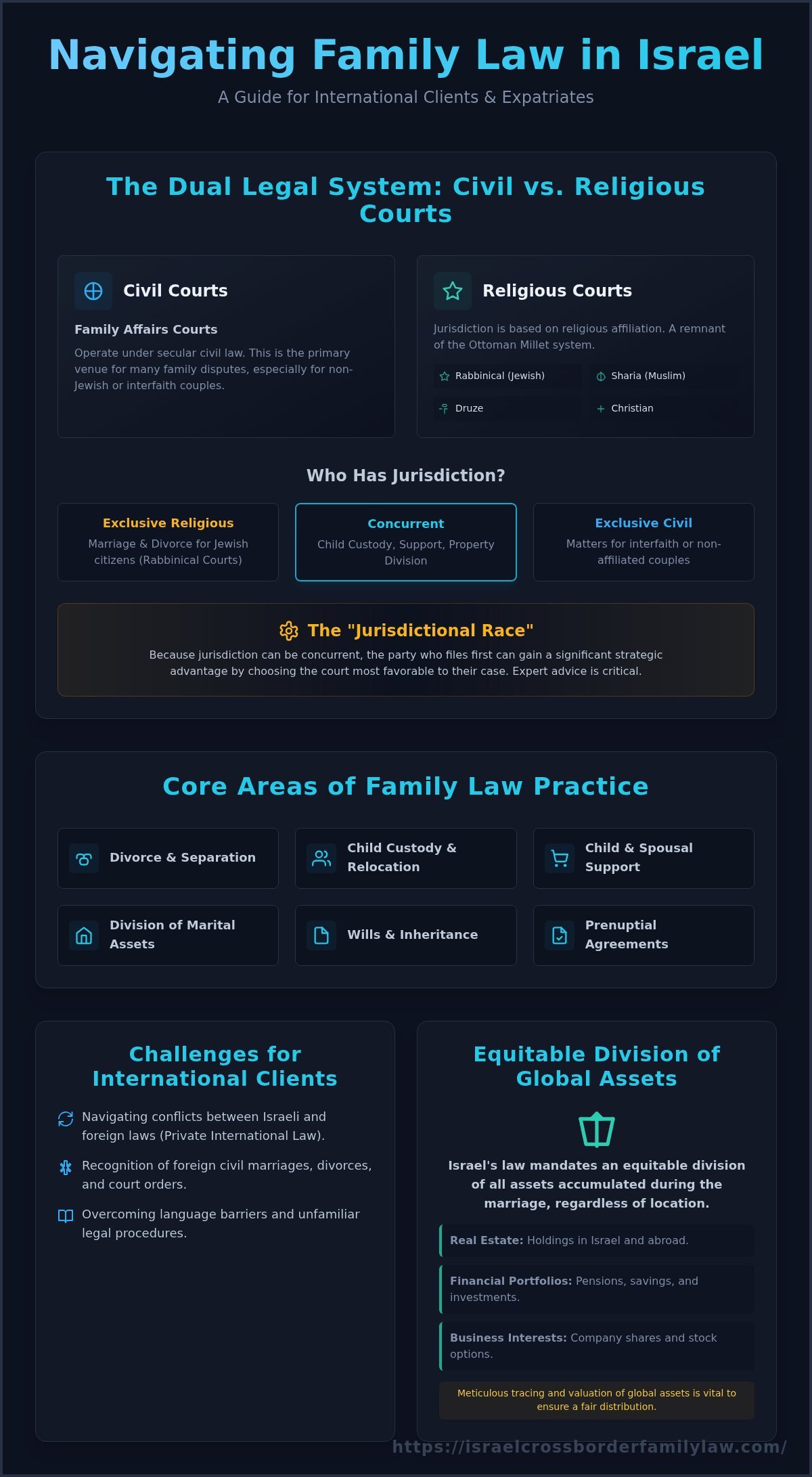
Navigating family law in Israel presents a sophisticated and unique challenge due to its dual legal system, where secular civil law and religious law operate in parallel. This structure, a remnant of the Ottoman Millet system, means that personal status matters are often determined by an individual’s religious affiliation. Understanding this complex framework is the first critical step in any family law matter, as jurisdiction can significantly impact the outcome of a case. The interplay between these court systems is a core component of the Judiciary of Israel and requires strategic guidance from a seasoned legal professional.
To better understand some of the financial complexities involved, watch this helpful video overview:
Civil Courts vs. Religious Courts: Who Has Jurisdiction?
Jurisdiction is divided primarily between the Family Affairs Courts (civil) and the various religious courts. The Rabbinical Courts hold exclusive authority over marriage and divorce for Jewish citizens. Similarly, Sharia, Druze, and recognized Christian courts have jurisdiction for their respective communities. However, matters such as child custody, spousal support, and property division often fall under concurrent jurisdiction. This can create a “jurisdictional race,” where the party who files first in their preferred court can gain a strategic advantage. An experienced family law lawyer israel is essential for advising on the most favorable venue for your specific circumstances.
Key Areas Governed by Israeli Family Law
Our firm provides comprehensive legal representation across the full spectrum of family law, guiding clients through complex and emotionally charged proceedings. Key practice areas include:
- Divorce and legal separation
- Child custody, visitation rights, and relocation
- Child support and spousal support (alimony)
- Division of marital assets, property, and business interests
- Inheritance, wills, and succession matters
- Prenuptial and postnuptial agreements
Special Considerations for Expats and Foreign Nationals
The complexities of Israeli family law are magnified for international clients. Issues of private international law, the recognition of foreign civil marriages or divorces, and multi-jurisdictional asset division require specialized expertise. Navigating these cross-border disputes demands a deep understanding of how Israeli courts interact with foreign legal systems. This is particularly vital for expats & foreign nationals, who must contend with a legal landscape that may be vastly different from their country of origin.
Navigating Divorce and Separation for International Families
The dissolution of a marriage involving international parties in Israel presents unique jurisdictional and legal challenges. The process is governed by a sophisticated legal framework that differs significantly from many Western countries, making expert legal counsel essential. For Jewish couples, matters of divorce are under the exclusive jurisdiction of the Rabbinical Courts, which operate based on Halakha (Jewish law). For interfaith or non-Jewish couples, The Family Courts have jurisdiction over the proceedings.
The Process of Filing for Divorce in Israel
Initiating a divorce requires opening a file in the appropriate court. For Jewish citizens, this involves the Rabbinical Court, where the husband must grant, and the wife must accept, a “Get”-a Jewish bill of divorce. Without this, the marriage is not legally dissolved under Jewish law. The process can be pursued by mutual consent or as a contested action. A comprehensive divorce and separation agreement is the most efficient path, resolving all ancillary matters such as property division, child custody, and support, thereby minimizing conflict and cost.
Equitable Division of Marital Property
Israel’s Spouses’ Property Relations Law mandates an equitable division of all assets accumulated during the marriage. This principle applies to all property, including:
- Real estate holdings in Israel and abroad
- Pension funds, savings, and investment portfolios
- Business interests and stock options
The division of multi-jurisdictional assets requires meticulous legal and financial planning to address differing tax laws and enforcement mechanisms. A skilled family law lawyer in Israel is critical for tracing and valuing a global asset portfolio to ensure a fair distribution.
Understanding Spousal Support (Alimony)
In Israel, spousal support (alimony) is determined based on the personal law of the couple. For Jewish couples, the husband has a traditional obligation to support his wife until the Get is granted. The courts consider factors such as the parties’ earning capacity, the standard of living during the marriage, and the duration of the union. Israel is also a signatory to conventions that facilitate the enforcement of foreign alimony orders, providing a crucial mechanism for international families seeking financial stability post-divorce.
Child Custody, Support, and International Relocation
Navigating matters involving children during a divorce requires a sophisticated understanding of Israeli law, where the paramount legal principle is the “best interests of the child” (טובת הילד). This doctrine guides all judicial decisions concerning a child’s welfare, from living arrangements to financial support. These issues become exponentially more complex in cross-border disputes, demanding the guidance of a seasoned family law lawyer israel with multi-jurisdictional experience.
Determining Child Custody and Visitation
In Israel, custody is divided into physical custody (where the child lives) and legal guardianship (decision-making authority). While sole custody was once standard, joint custody arrangements are increasingly common. The Israeli Family Courts, which have jurisdiction over these matters, assess numerous factors to determine the optimal arrangement, including:
- The child’s age, needs, and (if applicable) preference.
- Each parent’s ability to provide a stable and nurturing environment.
- The importance of maintaining a meaningful relationship with both parents.
- Any history of violence or neglect.
A detailed and practical parenting plan is crucial for outlining schedules, holidays, and communication protocols, thereby minimizing future conflict.
Child Support Obligations in Israel
Child support (mezonot) is calculated based on the child’s essential needs and the parents’ respective financial capacities. For Jewish families, the father’s obligation is rooted in Jewish law, though civil law governs the specifics for all citizens. These payments are mandatory until the child reaches age 18 and are typically reduced by two-thirds during their mandatory military or national service. When one parent resides abroad, securing payments requires a deep understanding of international treaties and procedures for cross-border child support enforcement.
International Relocation and The Hague Convention
Relocating a child to another country requires either the express written consent of the other parent or a court order. Unilaterally moving a child across international borders without consent is considered parental abduction under The Hague Convention on the Civil Aspects of International Child Abduction, an international treaty to which Israel is a signatory. The convention provides an expedited legal mechanism for the return of a wrongfully removed child. Navigating these high-stakes, time-sensitive proceedings demands immediate and expert legal intervention from counsel experienced in international custody and relocation cases.
Wills, Inheritance, and Estate Planning for Cross-Border Assets
Navigating the complexities of estate planning becomes significantly more challenging when assets are held across multiple jurisdictions. For individuals with property, investments, or bank accounts in Israel, a comprehensive understanding of Israeli Inheritance Law is paramount to ensure the orderly and intended distribution of their estate. The absence of strategic planning can lead to protracted legal disputes, unforeseen tax liabilities, and the frustration of testamentary intent. A proficient family law lawyer israel is essential for structuring a robust estate plan that addresses these multi-jurisdictional intricacies.
Inheritance Law for Foreign Residents and Citizens
Israel’s Inheritance Law, 1965, dictates that in the absence of a valid will (intestacy), an estate is distributed by a statutory order. The primary heirs are the deceased’s surviving spouse, who typically inherits half of the estate, and the children, who share the remaining half. If there are no children, the spouse shares the estate with the deceased’s parents or siblings. Critically for foreign residents, Israeli courts may apply the inheritance laws of the deceased’s last domicile to movable assets, but Israeli law exclusively governs the succession of real estate located within Israel.
Drafting an Israeli Will
To override the default statutory distribution, a valid will is crucial. Israeli law recognizes several forms of wills, including a handwritten will, a will made before two witnesses, or a will made before a judicial or public authority. For individuals with a global asset portfolio, drafting a specific Israeli will to govern only their Israeli assets is a highly effective strategy. This approach, known as creating “situs wills,” prevents conflicts of law and streamlines the probate process in each respective country, avoiding costly delays and legal ambiguity.
The Probate and Estate Administration Process
Following a person’s death, their will must be validated through a formal legal process in Israel. An application for a probate order (Tzav Kiyum Tzavah) is submitted to the Inheritance Registrar. If no will exists, the heirs must apply for a succession order (Tzav Yerusha) to legally establish their rights to the estate. This process can be complicated by challenges such as will contests from disinherited relatives or claims from creditors, underscoring the need for precise legal execution. Navigating these procedural requirements demands specialized legal guidance to secure and distribute estate assets efficiently.
How to Choose the Right Family Law Lawyer in Israel
Selecting legal representation for a multi-jurisdictional family matter is a critical strategic decision. The complexity of cross-border cases, involving differing legal systems and international treaties, demands a professional with a specific and sophisticated skill set. A successful outcome hinges on engaging a practitioner who not only understands Israeli statutes but can also navigate the intricate landscape of international law.
Essential Qualifications and Experience
When evaluating a potential family law lawyer in Israel, especially for cases with international dimensions, verify their credentials against this checklist:
- Bilingual Proficiency: Complete fluency in both English and Hebrew is non-negotiable for clear communication and precise legal interpretation.
- International Law Acumen: The lawyer must demonstrate substantial experience with relevant international treaties, such as the Hague Convention, and a deep understanding of private international law principles.
- Multi-Faceted Skill Set: Seek a professional adept in a range of dispute resolution methods, from strategic negotiation and mediation to assertive litigation in both the Family Court and the Rabbinical Court.
- Dual Jurisdictional Familiarity: Your counsel should possess a working knowledge of the legal systems in both Israel and your home country, serving as a critical bridge between the two.
Key Questions for Your Consultation
An initial consultation is an opportunity to assess a lawyer’s suitability. Be prepared to ask targeted questions to gauge their expertise and approach:
- What is your specific experience with cross-border divorce, custody, or relocation cases similar to mine?
- How would you strategically approach my case, and what are the potential challenges you foresee?
- Who will be my primary point of contact, and will other attorneys or paralegals be involved?
- What is your firm’s policy for providing regular case updates and responding to client inquiries?
Understanding Legal Fees and Retainers
Clarity on financial matters is essential from the outset. In Israel, common fee structures include hourly rates, which can range from ₪800 to over ₪2,000 depending on experience, and fixed-fee arrangements for specific tasks. You will likely be asked to pay an upfront retainer (pikadon). This is a lump sum held in a trust account from which the lawyer deducts fees as work is completed. Always insist on a clear, written fee agreement (schar tircha) that outlines all costs before formally engaging their services.
Navigating these crucial decisions requires a sophisticated approach. To ensure your rights are protected across borders, it is vital to secure counsel from a seasoned family law lawyer in Israel with proven international expertise.
Secure Your Family’s Future with Strategic Legal Counsel
Navigating the intricate landscape of Israeli family law presents unique challenges, particularly for international families facing multi-jurisdictional disputes involving divorce, child custody, and cross-border estate planning. The selection of legal counsel is not merely a procedural step but a critical strategic decision that profoundly impacts the outcome of your case and the well-being of your family.
Securing a family law lawyer Israel with specialized expertise in US-Israel cross-border matters is paramount. Our team of bilingual attorneys is adept at providing strategic legal guidance, leveraging deep experience in multiple jurisdictions to protect the interests of expats, foreign nationals, and international families. We understand the nuanced interplay between legal systems and are positioned to offer sophisticated solutions for your most sensitive personal matters.
When you are ready to move forward with clarity and confidence, we invite you to Schedule a Confidential Case Review with Our Cross-Border Experts. Allow us to provide the powerful advocacy and steady guidance your family deserves.
Frequently Asked Questions: Navigating Family Law in Israel
What is the role of the Rabbinical Court in a divorce between two Jewish people in Israel?
The Rabbinical Court (Beit Din) holds exclusive jurisdiction over the final act of divorce (the Gett) for Jewish citizens in Israel. While the secular Family Court typically adjudicates ancillary matters such as child custody, support, and equitable distribution of assets, only the Rabbinical Court can formally dissolve the religious marriage. This dual-system can lead to a “race for jurisdiction,” where the party who files first in their preferred court may gain a strategic advantage for the entire case.
Can a divorce or custody order from a U.S. court be enforced in Israel?
A foreign judgment, including a divorce or custody order issued by a U.S. court, is not automatically enforceable in Israel. The order must first undergo a recognition and enforcement process within the Israeli Family Court system. The Israeli court will review the foreign judgment to ensure the original court had proper jurisdiction and that its enforcement does not contradict Israeli public policy. This complex, cross-border process requires sophisticated legal counsel to ensure compliance with all statutory requirements for validation.
Do I need a prenuptial agreement if I am getting married in Israel?
While not mandatory, executing a prenuptial agreement is a highly prudent measure for couples marrying in Israel, particularly in cases involving international parties, significant pre-marital assets, or family businesses. Without an agreement, all assets accumulated during the marriage are subject to a default 50/50 division under the Spouses’ Property Relations Law. A professionally drafted prenuptial agreement provides financial certainty and protects individual assets, preempting potentially contentious and costly future litigation.
How is property divided for unmarried couples (common-law marriage) in Israel?
In Israel, unmarried couples who meet the criteria for a common-law marriage (“yeduim b’tzibur”) are afforded rights similar to those of married couples regarding property division. Upon separation, assets accumulated during their joint life are subject to the Presumption of Joint Property Law, which presumes co-ownership and dictates an equal division. Proving the existence of the common-law relationship and delineating the scope of joint assets requires comprehensive evidence and skilled legal representation to protect your financial interests.
What are my rights as a foreign parent if my child is a citizen and resident of Israel?
Under Israeli law, which is guided by the principle of the “best interests of the child,” a foreign parent retains significant parental rights. These include rights to visitation (custody arrangements) and involvement in major decisions concerning the child’s health, education, and welfare. Relocating the child internationally requires either the express consent of the other parent or a court order. Effectively asserting these rights often requires a seasoned family law lawyer israel with expertise in complex, multi-jurisdictional custody matters.
Is mediation mandatory for family law disputes in Israel?
Yes, since 2016, a preliminary mediation process has been a mandatory first step for nearly all family law disputes in Israel. Before filing a formal claim with the Family Court or Rabbinical Court, a party must file a “request for dispute settlement.” This triggers a series of meetings with a professional mediator from the court’s Assistance Unit, intended to explore possibilities for an amicable resolution. While participation is compulsory, reaching a final agreement through this process is not.

Article by
Gabriel Lior
A Personal Journey That Became a Mission
The advisory was founded by an American father Gabriel Lior, LLB, MBA , global entrepreneur, and cross-border advisor who spent more than a decade navigating the Israeli family court system firsthand and now lives in Singapore with his son.
As a divorced parent in a cross-border family, Gabriel faced nearly every legal challenge a foreign parent can encounter in Israel — including child custody disputes, child support proceedings, property matters in Israel and abroad, false accusations, and complex immigration and relocation proceedings.
Over the years, he learned the hard way how difficult it is for non-Israeli parents to understand the system, identify the right legal strategy, and choose the right legal representation — especially when language, culture, and jurisdictional differences are involved. He also witnessed how foreign parents and new immigrants are often disadvantaged or taken advantage of by service providers and institutions simply because they lack local knowledge or fluency.
From Client to Advisor
To truly understand — and survive — the system, Gabriel pursued formal legal education in Israel, completing two Israeli law degrees, alongside a BA and MBA earned in the United States. This was never about becoming a practicing attorney, but about gaining a deep, structural understanding of how the system works — and where it breaks down for foreign parents.
This rare combination of:
Firsthand client experience
Israeli legal and US business education
International business and negotiation training
Decades of commercial execution
created a unique perspective – one that understands both sides of the table.
After years of litigation, persistence, and at times self-representation, he ultimately succeeded in securing custody of his son and relocating abroad through a rare legal victory in the Israeli Supreme Court — becoming one of the first fathers in Israel to do so under these circumstances.
Disclaimer
Important Disclaimer:
The information provided on this website and in its content is for general informational and educational purposes only and does not constitute legal advice, legal opinion, or legal representation.
Gabriel Lior is not licensed to practice law in Israel (nor is he interested in doing so) and does not provide legal services, despite having completed 2 Law Degrees. The services offered are advisory in nature and are intended to provide general guidance, strategic insight, and information regarding cross-border family law considerations.
No attorney-client relationship is formed by accessing this website, reading its content, or communicating with us.
Any decisions made based on this information are at your own discretion and risk. For legal advice specific to your situation, you should consult a licensed attorney in the relevant jurisdiction.
Where appropriate, we may refer clients to independent, licensed attorneys or professionals. Such referrals do not constitute legal representation and no liability is assumed for services provided by third parties.