What if the place you call home is no longer recognized as your child’s legal center of life? It’s a terrifying realization for any parent to discover that a temporary trip has turned into a permanent stay without their consent. You’re likely feeling a mix of desperation and confusion as you try to navigate the complex process of recovering a child from another country. The emotional weight is immense, but the legal reality demands a calm, strategic approach to ensure your rights are protected under international law.
This guide provides the strategic clarity you need to understand the Hague Convention, the role of habitual residence, and the critical steps required in US-Israel custody disputes. We’ll walk through the legal frameworks, immediate actions to protect your rights, and how to bridge the gap between two very different court systems. Israel Cross Border Law Firm operates as an independent advisory platform, not a law firm, focusing on strategy and decision-making guidance for international families. Our goal is to help you understand the significant weight of early decisions before you commit to high-stakes litigation.
https://www.youtube.com/@IsraelFamilyLaw
Key Takeaways
- Distinguish between the legal definitions of abduction and wrongful retention to identify the specific nature of your cross-border situation.
- Learn how the Hague Convention serves as the primary legal framework for recovering a child from another country by restoring the previous status quo.
- Understand why “habitual residence” is the most contested factor and how delays in legal action can inadvertently change a child’s legal home.
- Identify the immediate steps for documenting evidence and the strategic risks involved in navigating the procedural differences between U.S. and Israeli family courts.
- Gain clarity on why a unified, multi-jurisdictional strategy is necessary to bridge the gap between these two divergent legal systems effectively.
Understanding International Parental Child Abduction and Wrongful Retention
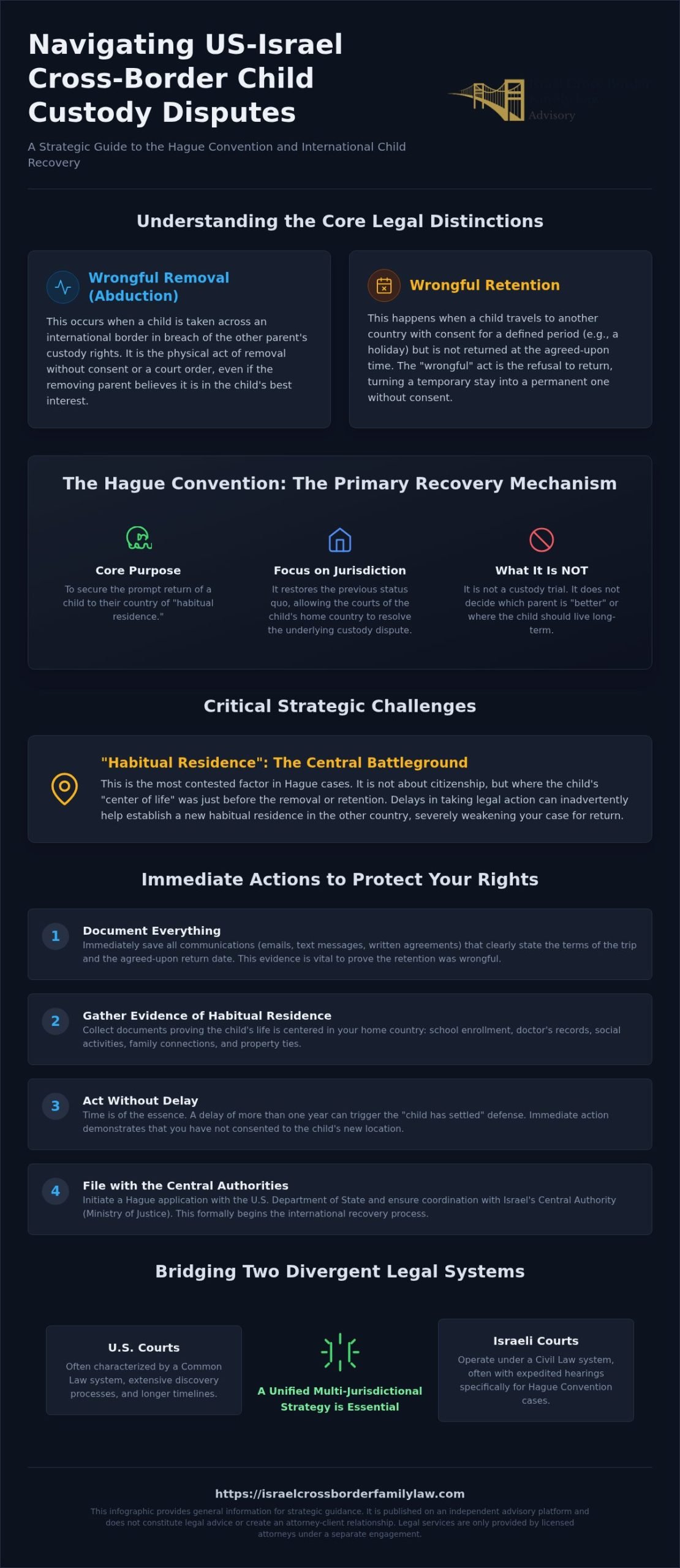
In the specialized field of cross-border family law, the terminology used to describe a child’s unauthorized stay abroad carries significant weight. Legal frameworks distinguish between “wrongful removal,” often referred to as abduction, and “wrongful retention.” While the former involves the physical act of taking a child across an international border without consent, the latter occurs when a child travels with permission but is not returned at the agreed-upon time. Both actions interfere with the rights of the left-behind parent and trigger complex recovery mechanisms. It’s essential to understand that shared parental responsibility generally prohibits unilateral decisions regarding a child’s residence. Even if one parent believes they are acting in the child’s best interests, moving a child without formal consent or a court order is legally problematic.
The Hague Convention serves as the primary international treaty designed to resolve these disputes. When a parent begins the process of recovering a child from another country, the focus remains on restoring the status quo rather than debating long-term custody. Israel Cross Border Law Firm provides strategic guidance to help families understand these distinctions before they enter into high-stakes litigation. Decisions made in the first few days of a non-return scenario often dictate the jurisdictional outcome of the entire case. As an independent advisory platform, we focus on strategy and decision-making guidance rather than an attorney-client relationship.
To better understand these concepts and the legal landscape in Israel, you can view the educational resources provided on our channel:
https://www.youtube.com/@IsraelFamilyLaw
The Legal Definition of Wrongful Removal
A removal is considered wrongful when it breaches the “rights of custody” attributed to a parent under the law of the child’s home country. Many parents mistakenly believe that having physical custody grants them the right to relocate. However, legal rights of access and the “right of consent” for travel are distinct. In both Israel and the U.S., courts look at whether the left-behind parent was actually exercising their rights at the time of the move. If a parent relocates a child to Israel without explicit permission, they may be found in violation of these international standards, regardless of their motives.
When a Holiday Becomes a Legal Dispute
The “summer holiday” scenario is one of the most frequent catalysts for legal conflict. A parent might agree to a three-week visit to family in Israel, only to be told at the end of the trip that the child will not be returning to the U.S. This often stems from “trial” stays where a parent attempts to test the waters of a new life abroad. Intent alone is insufficient; the law focuses on the expiration of consent and the breach of the original travel agreement. Wrongful retention is the refusal to return a child after a period of agreed-upon travel. For more information on these specific challenges, you can read about Hague Convention child abduction strategies.
The Hague Convention: The Primary Mechanism for Child Recovery
The 1980 Hague Convention on the Civil Aspects of International Child Abduction serves as the primary legal instrument for recovering a child from another country. This international treaty is built on a specific premise: a child’s interests are best served by returning them to their “habitual residence” so local courts there can resolve underlying custody disputes. It’s vital to understand that a Hague proceeding is not a custody trial. The court doesn’t decide which parent is “better,” but rather whether the child was taken or kept in violation of existing custody rights. Israel Cross Border Law Firm is an independent advisory platform, not a law firm, and this information is provided for strategic guidance rather than legal representation. To initiate this process, the child must be under 16 years of age, and the left-behind parent must demonstrate they were actually exercising their rights of custody at the time of the removal or retention.
Administrative support for these cases is provided by the Central Authority in each country. In Israel, this is the Ministry of Justice, while the U.S. Department of State manages cases in America. These offices help parents navigate the initial paperwork and coordinate with foreign counterparts, acting as a critical bridge between two different legal systems. If you’re currently assessing the feasibility of a petition, you can view our advisory options to better understand the strategic landscape and how these authorities interact. If you’re seeking strategic clarity, consider reaching out to discuss your specific circumstances.
How the Hague Process Works in Israel
Israeli Family Courts are required to handle Hague cases on an expedited basis, reflecting the treaty’s goal of a prompt return. These matters are frequently heard by specialized judges in Jerusalem or Tel Aviv who are familiar with the nuances of international family law and the specific needs of the Anglo-Israeli community. During the hearing, the court’s focus is narrow and technical, primarily examining evidence regarding the child’s life in their home country and the circumstances of their arrival in Israel. The goal is to reach a resolution quickly to minimize the time the child spends in a state of legal uncertainty.
US-Israel Treaty Relations
Both Israel and the United States are long-standing treaty partners, which ensures a high level of cooperation between their respective judicial systems. When recovering a child from another country, the legal action must be initiated in the country where the child is currently located. In the U.S., the International Child Abduction Remedies Act (ICARA) governs how the treaty is applied, allowing cases to be heard in either state or federal courts. This multi-jurisdictional complexity requires a unified strategy that accounts for how a decision in one country might influence future proceedings in the other. For more on the strategic risks involved, you may find our section on Hague Convention child abduction useful.
Strategic Challenges: Habitual Residence and the Grave Risk Exception
While the legal framework for recovering a child from another country is designed to be straightforward, the actual litigation often involves a deeply fact-sensitive inquiry. The most frequent battlefield in these cases isn’t the parent’s behavior, but the child’s “habitual residence.” This concept determines which country’s court system has the authority to make long-term custody decisions. It’s a strategic pivot point because once a child is considered “settled” in a new environment, the mandatory return provisions of the Hague Convention become much harder to enforce. As an independent advisory platform, Israel Cross Border Family Law helps parents understand these jurisdictional risks before they commit to a specific legal path.
Timing is everything in these disputes. The moment a child is wrongfully removed or retained, a legal clock begins to tick. If a parent delays filing a petition for more than one year, the taking parent can argue that the child is now well-settled in their new home. This isn’t just about the passage of time; it’s about the child’s integration into their new community. You should seek strategic clarity early to prevent an inadvertent shift in jurisdiction that could permanently change the outcome of your case. For more on the strategic risks involved, you may find our section on Hague Convention child abduction useful.
The Habitual Residence Trap
The “Habitual Residence Trap” occurs when a child’s daily life in Israel begins to outweigh their previous connections to the U.S. Israeli courts examine concrete evidence of integration, such as enrollment in a local school, registration with a health fund (Kupat Cholim), or participation in extracurricular activities like the Tzofim. These factors create a new “center of life” that can override a parent’s intent for the stay to be temporary. Habitual residence is determined by the child’s center of life, not just their nationality. If the child’s world has effectively shifted to Israel, recovering a child from another country becomes significantly more complex because the legal “status quo” has changed.
Defenses Against a Return Order
The Hague Convention includes specific exceptions that allow a court to refuse a return order, but the threshold for these defenses is exceptionally high. The most common is the “Grave Risk” exception under Article 13b, which requires evidence that returning the child would expose them to physical or psychological harm. It’s vital to distinguish between a standard custody dispute and a Hague recovery case; the court isn’t looking for the “better” home, but rather an “intolerable situation.” Additionally, for older children who have reached a sufficient age and degree of maturity, the court may consider the child’s own objection to being returned. Understanding these defenses is a core part of building a successful strategy for international custody and relocation issues.
Immediate Actions When a Child Is Not Returned from Abroad
When the agreed-upon date for a child’s return passes without their arrival, the window for effective action is narrow. Recovering a child from another country requires a methodical approach that prioritizes legal standing over emotional negotiation. Your first priority is to preserve all evidence. Save every text message, email, and travel itinerary that confirms the original agreement. This documentation serves as the foundation for proving that the retention is indeed wrongful. Simultaneously, you must verify the child’s current location and safety status, as this information is required for any formal petition.
Once safety is confirmed, you should immediately contact the relevant Central Authority. For those in the U.S., this is the Department of State; for those in Israel, it’s the Ministry of Justice. These bodies facilitate the initial Hague application and coordinate with their international counterparts. However, administrative filing is only one part of a successful strategy. Engaging a cross-border advisor is essential to coordinate efforts between legal teams in both jurisdictions. This ensures that a move made in one court doesn’t undermine your position in the other, providing a unified front in a complex multi-jurisdictional environment.
Securing Your Legal Standing Immediately
It’s a common mistake to “wait and see” if the other parent relents. This delay can be interpreted as acquiescence or consent to the new living arrangement, which can be legally damaging. You must issue a formal demand for the child’s return. This document establishes the exact date the wrongful retention began, which is a critical data point for counteracting the “settled” defense discussed in previous sections. For more on managing these transitions, review our guidance on International Custody and Relocation. If you need assistance establishing this timeline, request a confidential case review to gain strategic clarity.
Coordinating with Consular Services
If the child is in Israel, the U.S. Embassy in Jerusalem or the Branch Office in Tel Aviv can provide limited but important assistance. While consular officers cannot provide legal representation or intervene in court proceedings, they can perform welfare checks to ensure the child is safe and well-treated. You should also report the situation to the Office of Children’s Issues at the Department of State. They monitor abduction cases globally and provide resources for parents navigating the Hague process. If the child is currently in Israel, seeking a “Preventative Order” or Stay of Exit (Tzav Ikub Yetziah min HaAretz) is a crucial step. This prevents the child from being moved to a third country while the legal process for recovering a child from another country is underway.
Navigating the US-Israel Legal Bridge for Successful Recovery
Successfully recovering a child from another country requires more than just filing paperwork; it demands a synchronized approach that bridges the gap between two very different legal systems. While the U.S. and Israel are treaty partners, their family courts operate with distinct cultural and procedural nuances. U.S. proceedings often focus on strict adherence to constitutional due process and specific state statutes. In contrast, Israeli family courts are specialized environments where judges often take a more active, holistic role in the proceedings. Attempting to manage these cases as separate, isolated events often leads to strategic contradictions that can undermine your standing in both jurisdictions.
Israel Cross Border Family Law serves as an independent advisory platform, providing the strategic clarity needed to navigate this multi-jurisdictional complexity. We are not a law firm, and our role is to offer decision-making guidance and strategy rather than formal legal representation or an attorney-client relationship. By focusing on the broader strategy, we help international families understand the weight of their early decisions. Before committing to high-stakes litigation, it’s vital to recognize that a victory in one court is only effective if it’s recognized and enforceable in the country where the child is currently located.
Managing Multi-Jurisdictional Litigation
One of the most significant risks in these cases is the potential for conflicting orders from different countries. A U.S. court may order the immediate return of a child, but if that order isn’t structured correctly, it might not be recognized by an Israeli judge. Ensuring that your U.S. court orders are enforceable in Israel requires a deep understanding of how the Hague Convention and Child Abduction protocols are interpreted locally. Without a unified strategy, parents often find themselves trapped in a cycle of litigation where one country’s ruling is ignored by the other, leading to years of legal uncertainty and mounting costs.
The Advisory Approach to Recovery
The path to recovering a child from another country is fraught with long-term consequences that extend far beyond the initial return. Our advisory approach focuses on identifying these risks early, allowing you to make informed decisions about jurisdiction and settlement before the “habitual residence” clock shifts against you. Early strategy often prevents the need for years of exhausting litigation by establishing a clear, legally sound roadmap from the start. We emphasize the importance of local engagement in both Israel and the U.S. to ensure your rights are protected on both sides of the bridge. The most important advice we can offer is simple: get clarity before you commit. Request a confidential consultation to understand your options before taking irreversible legal steps.
Establishing Strategic Clarity for Your Family’s Future
Successfully recovering a child from another country requires more than just legal action; it demands an early, unified strategy that bridges the gap between the U.S. and Israeli legal systems. We’ve examined how the Hague Convention focuses on returning to the status quo and why delaying your response can inadvertently change a child’s habitual residence. These early decisions carry immense weight and often dictate the jurisdictional outcome of the entire case. It’s vital to act with precision and establish a clear timeline from the very beginning.
Our independent advisory platform provides specialized strategic guidance tailored for the US-Israel Anglo community. We help international families navigate multi-jurisdictional complexity with an authoritative and established perspective, focusing on risk assessment and clear decision-making. Please note that Israel Cross Border Family Law is an independent advisory platform and not a law firm; our role is to provide strategy and guidance rather than legal representation. Get clarity before you commit. Request a confidential consultation to discuss your unique situation. You can move forward with confidence when you have a clear roadmap in place.
Frequently Asked Questions
What is the first thing I should do if my child is taken to Israel without my consent?
The first step is to establish a formal record of the wrongful removal and verify the child’s location immediately. You should document all communication and issue a formal demand for the child’s return to establish the exact date of retention. Contacting the U.S. Department of State or the Israeli Ministry of Justice is essential to initiate the administrative process. Seeking strategic clarity early helps you understand the weight of these initial decisions before committing to litigation.
How long does a Hague Convention return process typically take in Israel?
While the Hague Convention aims for a resolution within six weeks, the actual duration in Israeli Family Courts depends on the case’s complexity. These matters are heard by specialized judges in Jerusalem or Tel Aviv who prioritize expedited proceedings. However, appeals and the fact-heavy inquiry into habitual residence can extend the timeline. Recovering a child from another country requires patience and a unified strategy to manage the multi-jurisdictional procedural differences between the U.S. and Israeli systems.
Can I recover my child if the other parent claims I was abusive?
A claim of abuse triggers the Grave Risk exception under Article 13b, but the legal threshold for this defense is exceptionally high. The court must be convinced that returning the child would expose them to physical or psychological harm or an otherwise intolerable situation. It’s important to distinguish this from a standard custody dispute. The court’s primary focus remains on the child’s immediate safety and the restoration of the status quo in their home country.
What happens if the country my child is in does not follow the Hague Convention?
If a country is not a party to the treaty, the return process relies on local laws and the principle of international comity. In these situations, recovering a child from another country becomes significantly more complex as there’s no standardized framework to follow. You may need to initiate a new custody case in that specific jurisdiction. Working with an advisor who understands cross-border complexity is vital to navigate these non-treaty environments and coordinate effectively with consular services.
Does a US custody order automatically work in Israel?
No, a U.S. custody order is not automatically enforceable in Israel without a formal process of recognition. Israeli courts may recognize a foreign order based on comity, but the Hague Convention remains the more direct mechanism for return in abduction cases. Relying solely on a U.S. order without understanding Israeli procedural law can lead to conflicting mandates. You should ensure your strategy accounts for how Israeli judges view foreign decrees to avoid potential jurisdictional traps.
Can my child decide they want to stay in the other country?
Older children with a sufficient degree of maturity may have their objections considered by the court under the Child’s Objection defense. However, the child’s preference is not an absolute veto. The judge will evaluate whether the objection is truly independent or influenced by the taking parent. This fact-sensitive inquiry requires careful management, as the court must balance the child’s views with the treaty’s mandate for a prompt return to their habitual residence.
How much does it cost to file a Hague Convention application?
There are generally no government application fees for filing through the Central Authorities in the U.S. or Israel. However, you’ll likely encounter significant costs related to legal representation, document translation, and individual court fees. These expenses vary based on the duration of the litigation and the complexity of the evidence required. Understanding the financial landscape early allows you to plan your resources effectively while seeking clarity on your strategic options and long-term goals.
Is it possible to recover a child without going to court?
Yes, a voluntary return can be achieved through mediation or direct negotiation before a court issues a final order. The Hague Convention actually encourages voluntary settlements to minimize the trauma for the child. However, any agreement should be formalized to ensure it’s legally binding in both jurisdictions. Seeking advisory guidance before entering these negotiations helps protect your rights and ensures that a temporary stay doesn’t inadvertently become a permanent relocation through a lack of clarity.

Article by
Gabriel Lior
A Personal Journey That Became a Mission
The advisory was founded by an American father Gabriel Lior, LLB, MBA , global entrepreneur, and cross-border advisor who spent more than a decade navigating the Israeli family court system firsthand and now lives in Singapore with his son.
As a divorced parent in a cross-border family, Gabriel faced nearly every legal challenge a foreign parent can encounter in Israel — including child custody disputes, child support proceedings, property matters in Israel and abroad, false accusations, and complex immigration and relocation proceedings.
Over the years, he learned the hard way how difficult it is for non-Israeli parents to understand the system, identify the right legal strategy, and choose the right legal representation — especially when language, culture, and jurisdictional differences are involved. He also witnessed how foreign parents and new immigrants are often disadvantaged or taken advantage of by service providers and institutions simply because they lack local knowledge or fluency.
From Client to Advisor
To truly understand — and survive — the system, Gabriel pursued formal legal education in Israel, completing two Israeli law degrees, alongside a BA and MBA earned in the United States. This was never about becoming a practicing attorney, but about gaining a deep, structural understanding of how the system works — and where it breaks down for foreign parents.
This rare combination of:
Firsthand client experience
Israeli legal and US business education
International business and negotiation training
Decades of commercial execution
created a unique perspective – one that understands both sides of the table.
After years of litigation, persistence, and at times self-representation, he ultimately succeeded in securing custody of his son and relocating abroad through a rare legal victory in the Israeli Supreme Court — becoming one of the first fathers in Israel to do so under these circumstances.
Disclaimer
Important Disclaimer:
The information provided on this website and in its content is for general informational and educational purposes only and does not constitute legal advice, legal opinion, or legal representation.
Gabriel Lior is not licensed to practice law in Israel (nor is he interested in doing so) and does not provide legal services, despite having completed 2 Law Degrees. The services offered are advisory in nature and are intended to provide general guidance, strategic insight, and information regarding cross-border family law considerations.
No attorney-client relationship is formed by accessing this website, reading its content, or communicating with us.
Any decisions made based on this information are at your own discretion and risk. For legal advice specific to your situation, you should consult a licensed attorney in the relevant jurisdiction.
Where appropriate, we may refer clients to independent, licensed attorneys or professionals. Such referrals do not constitute legal representation and no liability is assumed for services provided by third parties.