For individuals facing threats that span continents, the fear that a protective order issued in the United States holds no authority at the Israeli border is a significant and valid concern. This apprehension-that legal safeguards simply dissolve during international travel-can leave one feeling vulnerable and uncertain of where to turn. Navigating the enforcement of a temporary restraining order across borders presents a sophisticated, multi-jurisdictional challenge, demanding a deep and nuanced understanding of two distinct legal systems.
This comprehensive guide is engineered to demystify this intricate process. We provide an authoritative framework for understanding the critical steps required to recognize and enforce U.S. protective orders within Israel’s legal structure. By proceeding, you will gain the clarity and strategic insight needed to ensure your safety is upheld, prevent a threatening individual from causing harm, and secure your children from the profound risk of international abduction, transforming legal complexity into actionable protection.
Understanding the Challenge: Why a Standard TRO Fails at the Border
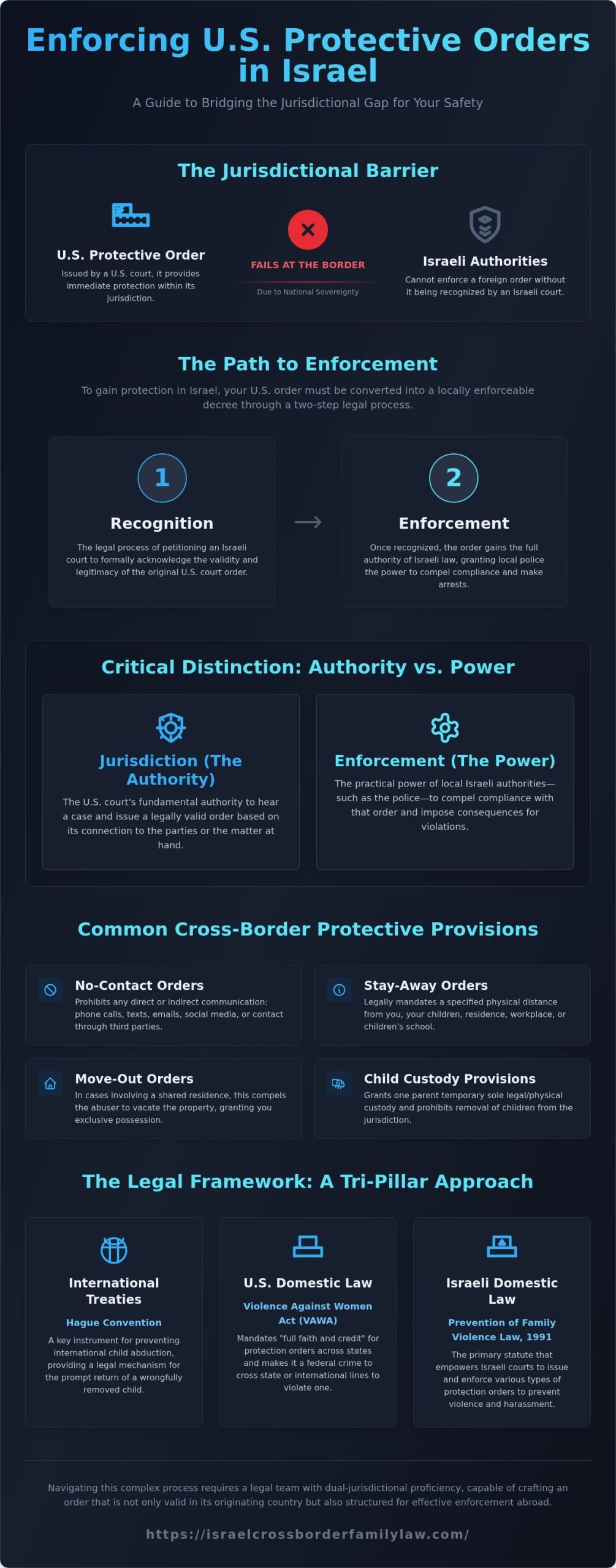
A Temporary Restraining Order (TRO) is a critical legal instrument issued by a court to provide immediate protection from harassment, abuse, or threats, often in the context of complex family law disputes. For a foundational overview, this guide to Understanding Restraining Orders provides valuable context. However, when parties reside in different countries, such as the United States and Israel, the protective power of a standard TRO encounters the formidable barrier of national sovereignty. The core challenge lies in the principle of legal jurisdiction: a court order issued in one sovereign nation is not automatically binding or enforceable within another.
Simply presenting a U.S.-issued TRO to Israeli police will not compel them to act, and the same holds true for an Israeli order presented to authorities in America. To bridge this jurisdictional gap, the legal process requires navigating the doctrines of ‘recognition’ and ‘enforcement’ of foreign judgments. The strategic objective is to convert the foreign protective order into a locally recognized and enforceable decree, granting it the full authority of the domestic legal system. This multi-jurisdictional process is essential for securing a meaningful and effective temporary restraining order across borders.
Types of Protective Orders in International Cases
Securing cross-border protection involves petitioning for specific provisions tailored to the threat. These often include a combination of the following, which must be correctly domesticated in the target jurisdiction:
- No-Contact Orders: Prohibiting any form of direct or indirect communication, including phone calls, text messages, emails, social media engagement, or contact through third parties.
- Stay-Away Orders: Legally mandating that the individual maintain a specified physical distance from you, your children, your residence, your place of work, or your children’s school.
- Move-Out Orders: In cases involving a shared residence, this provision can compel the abuser to vacate the property, granting you exclusive possession on a temporary basis.
- Child Custody Provisions: Granting one parent temporary sole legal and physical custody and explicitly prohibiting the other from removing the children from the jurisdiction.
The Critical Difference: Jurisdiction vs. Enforcement
Successfully navigating the complexities of a temporary restraining order across borders requires a sophisticated understanding of two distinct legal concepts. Jurisdiction is the court’s fundamental authority to hear a case and issue a legally valid order based on its connection to the parties or the matter at hand. Enforcement, conversely, is the practical power of local authorities-such as the police-to compel compliance with that order. A U.S. court may have jurisdiction to protect its citizen, but only Israeli authorities have the power of enforcement in Israel. Therefore, any effective legal strategy must be dual-focused, designed not only to obtain the initial order but also to ensure its subsequent recognition and enforcement abroad for true, tangible protection.
The Legal Framework: Treaties and Laws Governing Cross-Border Protection
Navigating the enforcement of a temporary restraining order across borders requires a sophisticated understanding of a complex, multi-layered legal landscape. While international law and treaties provide a foundational framework, the ultimate enforceability of a protective order hinges upon the specific domestic laws of the jurisdictions involved. The principle of judicial ‘comity’-the practice by which courts in one jurisdiction will generally recognize and enforce the legal decisions of another-is central to this process. However, this deference is not automatic; it is facilitated by bilateral agreements and a deep, practical knowledge of the relevant national statutes in both the United States and Israel.
The Role of the Hague Conventions
While no single international treaty is dedicated exclusively to the enforcement of temporary restraining orders, related conventions are of critical importance. The Hague Convention on the Civil Aspects of International Child Abduction, for instance, is a paramount concern in many cross-border family law disputes. A strategically drafted TRO can serve as a vital preventative measure, legally barring a parent from wrongfully removing a child from their country of habitual residence. Our firm is adept at leveraging these instruments to protect our clients’ most vital interests. Learn more about our experience with Hague Convention Child Abduction cases.
Relevant Domestic Legislation: US and Israel
A successful cross-border protection strategy must be built upon the specific domestic laws of each nation. Our attorneys possess comprehensive expertise in advising clients on the interplay between these distinct legal systems.
- In the United States: The Violence Against Women Act (VAWA) contains crucial provisions that give “full faith and credit” to qualifying protection orders issued in other jurisdictions. Furthermore, federal law makes it a serious criminal offense to cross state or international lines to violate such an order. The U.S. Department of Justice provides detailed guidance on prosecutions for an Interstate Violation of a Protective Order, underscoring the gravity with which U.S. authorities treat these matters.
- In Israel: The primary governing statute is the Prevention of Family Violence Law, 1991. This law empowers Israeli courts to issue various types of protection orders to prevent violence and harassment. Understanding its specific definitions, procedures, and evidentiary requirements is essential when seeking to have a U.S. order recognized or to obtain a new order within Israel.
Successfully protecting your rights requires a legal team capable of crafting an order that is not only valid in its originating country but also structured for effective enforcement in the other. This dual-jurisdictional proficiency is the cornerstone of our practice.
Practical Steps: How to Obtain a Protective Order with International Effect
Securing a temporary restraining order across borders is a sophisticated legal endeavor that extends far beyond the initial court hearing. The process demands meticulous planning and strategic foresight, as the initial filing and drafting of the order are paramount to its eventual enforcement abroad. Navigating this multi-jurisdictional landscape requires specialized legal counsel adept in the complexities of both domestic and foreign legal systems to ensure your protection is not confined by national boundaries.
Step 1: Determining the Correct Jurisdiction
The initial and most critical decision is selecting the proper jurisdiction for filing the protective order. This strategic choice-whether to file in the jurisdiction where you reside or where the adverse party is located-carries significant consequences for the case’s trajectory. Our analysis considers crucial factors such as the location of key evidence, the imminence of the threat, and the comparative legal standards of each jurisdiction to determine the most advantageous venue for securing immediate and enforceable relief.
Step 2: Drafting the Order for International Recognition
For a domestic order to be recognized internationally, it must be drafted with a foreign court in mind. A successful temporary restraining order across borders requires precise, unambiguous language that transcends local legal vernacular. The order should include detailed findings of fact and a clear legal basis that a foreign judge can readily comprehend and validate. Adherence to international legal frameworks, such as those established by the Hague Conference on Private International Law, is essential for facilitating this cross-border recognition and ensuring the document is robust enough for foreign enforcement.
Step 3: Initiating the Foreign Recognition Process
Once a meticulously drafted order is obtained, the next phase involves petitioning a court in the foreign country for its formal recognition and enforcement. This is not an automatic process; the foreign court will conduct a thorough review to confirm that the order complies with its local public policy and legal standards. This step often presents complex procedural hurdles, a common challenge in sensitive matters like international divorce and separation for international families, where ensuring seamless legal protection is critical.
The Enforcement Process: Making Your Foreign Order Legally Binding in Israel or the US
Securing a protective order is a significant first step, but a foreign court document holds no immediate power for local law enforcement in either Israel or the United States. To transform your order into an actionable legal instrument, it must undergo a formal process of recognition, often referred to as “domestication.” This is the critical legal procedure that grants your foreign order the full weight and authority of a domestic court order, thereby compelling local police to enforce its terms.
Successfully navigating the multi-jurisdictional complexities of domesticating a temporary restraining order across borders is a sophisticated undertaking. It demands precise adherence to procedural rules and a deep understanding of local family law. This process is not a clerical task; it is a formal legal action that unequivocally requires skilled, on-the-ground legal representation in the country where enforcement is sought.
Serving the Order Internationally
Before a court will recognize a foreign order, it must be satisfied that the respondent has received proper legal notice. International service of process is governed by complex treaties, most notably the Hague Service Convention. This formal, state-to-state mechanism ensures that service is conducted in a manner recognized by both jurisdictions. Failure to adhere to these strict protocols can invalidate the entire enforcement effort, rendering your order powerless.
Working with Local Law Enforcement
Once your order is successfully domesticated, it becomes a local command. You must provide law enforcement officials-whether the Israel Police or a U.S. sheriff’s department-with a certified copy of the newly recognized order, often accompanied by a certified translation. It is crucial to clearly communicate the specific prohibitions, such as stay-away distances and no-contact provisions. Proactively understanding the local procedures for reporting a violation is a key strategic step.
Responding to Violations
If the respondent violates the terms of the domesticated temporary restraining order across borders, you must report it to local police immediately. This action can trigger swift consequences, including contempt of court proceedings within the enforcing country’s legal system. A violation is a serious offense that can lead to severe penalties, including immediate arrest, fines, and criminal charges. In these high-stakes situations, decisive action is paramount. We strongly advise you to request a Confidential Case Review to ensure your rights are protected without delay.
Special Considerations in US-Israel Cross-Border Cases
In the complex landscape of US-Israel family law, a protective order is rarely an isolated legal action. More often, it represents a critical and strategic first step within a broader, multi-jurisdictional dispute involving divorce, child custody, or significant financial disagreements. Obtaining a temporary restraining order across borders is not merely a defensive measure; it is a proactive tool to establish control, protect vulnerable parties, and set the stage for subsequent legal proceedings.
These orders can be instrumental in preventing an opposing party from taking irreversible actions that could jeopardize the outcome of a case, particularly concerning children and marital assets. Understanding their strategic application is paramount for clients navigating the intricate legal systems of both the United States and Israel.
Preventing International Child Abduction
For parents in a contentious cross-border custody dispute, the fear of international child abduction is a significant concern. A TRO can be precisely drafted to mitigate this risk by explicitly forbidding the removal of a child from either the US or Israel. Critically, it can compel the surrender of a child’s passports to the court or a neutral third party, providing a powerful, proactive barrier against unilateral relocation and a potential crisis before it begins.
Protecting International Assets
High-conflict international divorces often involve attempts to conceal or dissipate marital assets. A strategically deployed TRO can freeze bank accounts, investment portfolios, and other valuable property in another country, preventing financial abuse. Securing these assets early, whether they are held in Tel Aviv or New York, is essential to ensure a fair and equitable division of the marital estate and to maintain financial stability for our clients during litigation.
Addressing Digital Harassment and Stalking
When parties are separated by thousands of miles, harassment frequently moves online. Modern protective orders must address this reality. Our firm ensures that restraining orders contain specific provisions to combat digital abuse, including prohibitions against:
- Unwanted contact via social media, email, or messaging apps
- Posting defamatory statements or private images online
- Using technology to track or monitor the other party
This is an essential component of the comprehensive protection we provide, with services designed for the unique needs of expats and foreign nationals.
Effectively managing a temporary restraining order across borders requires a sophisticated legal strategy that anticipates these interconnected issues. If you are facing a complex US-Israel family law matter, contact our firm to discuss how we can protect your rights and interests.
Secure Your Protection: A Strategic Approach to Cross-Border Enforcement
Navigating the legal intricacies between the United States and Israel is a formidable challenge, particularly when personal safety is paramount. As we have detailed, a standard domestic protective order is insufficient for international security; successfully enforcing a temporary restraining order across borders demands a nuanced understanding of international treaties and the specific procedural requirements of each nation’s judiciary. The path to making a foreign order legally binding requires meticulous preparation and strategic legal action, grounded in the principles of conventions like the Hague Convention.
The complexities of these multi-jurisdictional family law matters necessitate expert guidance. Our firm provides a strategic approach to international enforcement, built on deep expertise in both US and Israeli family law and proven experience with Hague Convention cases. To protect your rights and ensure your safety, we invite you to Schedule a Confidential Case Review to Discuss Your Protection. Take the decisive step toward securing your peace of mind, no matter the distance.
Frequently Asked Questions
Can a US court order someone in Israel to stay away from me?
While a US court can issue an order against an individual residing in Israel, Israeli authorities will not enforce it directly. For the order to be effective, it must be domesticated or formally recognized by an Israeli court. This multi-jurisdictional procedure requires experienced legal counsel to navigate Israeli civil procedure and family law, securing a parallel Israeli protective order that grants it local legal authority and ensures compliance within Israel’s borders.
How long does it take to enforce a foreign restraining order?
The timeline for enforcing a foreign protective order varies significantly based on case complexity, judicial cooperation, and the efficiency of international service of process. In Israel, an expedited petition can sometimes yield a temporary order within days. However, achieving full recognition and permanent enforcement is a more comprehensive legal undertaking that can span several weeks to months, requiring meticulous preparation of legal filings and strategic navigation of the Israeli judicial system.
What happens if I don’t know the person’s exact address in the other country?
Lacking a precise address complicates but does not prevent legal action. Effective service of process is a critical component of enforcing any court order. In such cases, our firm can engage licensed private investigators in Israel to locate the individual. Furthermore, Israeli law provides for alternative methods of service, such as service by publication, which are sophisticated legal mechanisms designed to satisfy due process requirements and allow the cross-border legal action to proceed effectively.
Is an Israeli protective order automatically valid in the United States?
No, an Israeli protective order is not automatically enforceable in the United States. Similar to a US order in Israel, it must be recognized by a competent US court. This process, governed by state-specific laws under the legal principle of comity, involves petitioning the court to domesticate the foreign order. Successfully guiding this petition requires counsel with deep expertise in both Israeli and US family law to ensure the order is properly validated by the American judicial system.
What kind of evidence is needed to obtain a cross-border protective order?
Obtaining a cross-border protective order requires substantial and well-documented evidence of harassment, threats, or violence. This typically includes documented communications like emails and text messages, sworn affidavits from witnesses, police reports from either jurisdiction, and any available photographic or video evidence. When petitioning for a temporary restraining order across borders, this evidence must be meticulously organized to satisfy the stringent standards of the foreign court, a task best handled by experienced international litigation counsel.
How much does it cost to enforce a restraining order internationally?
The costs associated with international enforcement are variable and contingent on the complexity of the matter. Expenses include legal fees in both jurisdictions, court filing fees, process server costs, and potential translation services. A relatively straightforward case may involve legal fees starting from ₪15,000-₪25,000. However, highly contested or complex cases can escalate significantly. We provide a detailed cost projection following an initial consultation to ensure full transparency regarding the required financial investment.
Can a temporary restraining order affect my immigration status?
Yes, a protective order can have serious immigration consequences. For the subject of the order, a finding of domestic violence or stalking can render them inadmissible to countries like the United States or trigger deportation proceedings. For the petitioner, pursuing a temporary restraining order across borders may, in some cases, provide protections and pathways to legal status under specific immigration laws. Navigating the complex intersection of family and immigration law requires highly specialized legal counsel.

Article by
Gabriel Lior
A Personal Journey That Became a Mission
The advisory was founded by an American father Gabriel Lior, LLB, MBA , global entrepreneur, and cross-border advisor who spent more than a decade navigating the Israeli family court system firsthand and now lives in Singapore with his son.
As a divorced parent in a cross-border family, Gabriel faced nearly every legal challenge a foreign parent can encounter in Israel — including child custody disputes, child support proceedings, property matters in Israel and abroad, false accusations, and complex immigration and relocation proceedings.
Over the years, he learned the hard way how difficult it is for non-Israeli parents to understand the system, identify the right legal strategy, and choose the right legal representation — especially when language, culture, and jurisdictional differences are involved. He also witnessed how foreign parents and new immigrants are often disadvantaged or taken advantage of by service providers and institutions simply because they lack local knowledge or fluency.
From Client to Advisor
To truly understand — and survive — the system, Gabriel pursued formal legal education in Israel, completing two Israeli law degrees, alongside a BA and MBA earned in the United States. This was never about becoming a practicing attorney, but about gaining a deep, structural understanding of how the system works — and where it breaks down for foreign parents.
This rare combination of:
Firsthand client experience
Israeli legal and US business education
International business and negotiation training
Decades of commercial execution
created a unique perspective – one that understands both sides of the table.
After years of litigation, persistence, and at times self-representation, he ultimately succeeded in securing custody of his son and relocating abroad through a rare legal victory in the Israeli Supreme Court — becoming one of the first fathers in Israel to do so under these circumstances.
Disclaimer
Important Disclaimer:
The information provided on this website and in its content is for general informational and educational purposes only and does not constitute legal advice, legal opinion, or legal representation.
Gabriel Lior is not licensed to practice law in Israel (nor is he interested in doing so) and does not provide legal services, despite having completed 2 Law Degrees. The services offered are advisory in nature and are intended to provide general guidance, strategic insight, and information regarding cross-border family law considerations.
No attorney-client relationship is formed by accessing this website, reading its content, or communicating with us.
Any decisions made based on this information are at your own discretion and risk. For legal advice specific to your situation, you should consult a licensed attorney in the relevant jurisdiction.
Where appropriate, we may refer clients to independent, licensed attorneys or professionals. Such referrals do not constitute legal representation and no liability is assumed for services provided by third parties.