Where you file for divorce may matter more than why you’re filing. In a divorce between citizens of different countries, the choice of jurisdiction isn’t a procedural detail — it’s the decision that shapes everything that follows: how your assets are divided, where your children will live, and which country’s courts will have the final word.
If you’re facing this situation, you already know it’s complicated. Two passports, two legal systems, and sometimes two completely different ideas about what a fair outcome looks like. That feeling of not knowing where to start — or worse, worrying that your spouse might file first in a court that favors them — is entirely reasonable. This is genuinely complex territory.
This guide is here to help you think clearly before you act. You’ll learn how international jurisdiction works, why the “race to the courthouse” is a real and serious risk, how conflicting civil and religious laws can affect your case, and what steps you can take now to protect your rights and your children. Understanding your options early is the most important move you can make.
Key Takeaways
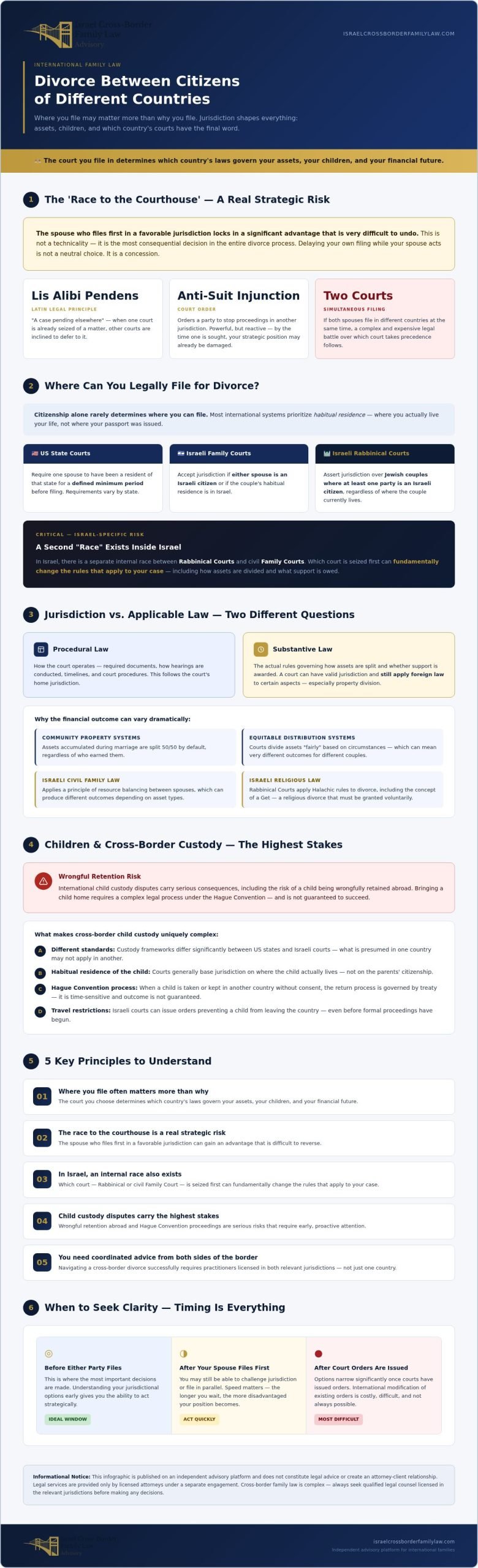
- In a divorce between citizens of different countries, where you file often matters more than why — the court you choose determines which country’s laws govern your assets, your children, and your financial future.
- The “race to the courthouse” is a real strategic risk: the spouse who files first in a favorable jurisdiction can gain a significant legal advantage that is difficult to reverse.
- In Israel, a separate internal race exists between Rabbinical Courts and civil Family Courts — and the outcome of that race can fundamentally change the rules that apply to your case.
- International child custody disputes carry serious consequences, including the risk of wrongful retention abroad and the complex legal process required to bring a child home under the Hague Convention.
- Navigating a cross-border divorce successfully requires coordinated legal advice from practitioners licensed in both relevant jurisdictions — not just one side of the border.
Understanding Jurisdiction and the ‘Race to the Courthouse’
Jurisdiction is the legal authority of a court to hear your case and issue orders that are binding on both parties. In a domestic divorce, this question is usually straightforward. In a divorce between citizens of different countries, it’s often the most consequential decision in the entire process, and it needs to be made before anything else.
The court you file in doesn’t just process your divorce. It decides which country’s laws apply to your assets, your support arrangements, and your children’s future. Two courts in two different countries can reach completely different outcomes on the same set of facts. That gap isn’t a technicality. It can translate into hundreds of thousands of dollars, or custody arrangements that would never have been ordered elsewhere.
Where Can You Legally File for Divorce?
Citizenship alone rarely determines where you can file. Most international family law systems, including those in the EU, Israel, and many US states, prioritize habitual residence: where you and your spouse actually live your lives, not where your passport was issued. If you’ve been living in Israel for several years, an Israeli court will likely assert jurisdiction regardless of your nationality.
Dual citizenship adds another layer of complexity. Holding two passports doesn’t automatically give you access to two court systems. Each jurisdiction has its own threshold requirements:
- US state courts typically require one spouse to have been a resident of that state for a defined minimum period before filing, with requirements varying by state.
- Israeli Family Courts will generally accept jurisdiction if either spouse is an Israeli citizen or if the couple’s habitual residence is in Israel.
- Israeli Rabbinical Courts assert jurisdiction over Jewish couples where at least one party is an Israeli citizen, regardless of where the couple currently lives.
Understanding which courts are actually open to you, and on what grounds, is the essential first step before any strategic decision can be made.
The Consequences of Conflicting Jurisdictions
Here’s the core strategic risk: the spouse who files first in a favorable jurisdiction can lock in a significant advantage that’s very difficult to undo. This is known in international law as lis alibi pendens, a Latin term meaning “a case pending elsewhere.” When one court is already seized of a matter, other courts are often required, or at least strongly inclined, to defer to it.
If both spouses file simultaneously in different countries, a complex and expensive legal battle over which court takes precedence follows. Courts may issue anti-suit injunctions, orders that prohibit a party from continuing proceedings in another jurisdiction. These are powerful tools, but they’re reactive. By the time one is sought, the damage to your strategic position may already be done.
Delaying your own filing while your spouse acts isn’t a neutral choice. It’s a concession. If the foreign court they’ve chosen applies laws less favorable to your financial position or parenting rights, you’ll be fighting from behind in a system you didn’t choose and may not fully understand.
Getting clarity on your jurisdictional options early, before either party has filed, is where the most important decisions in your case are actually made.
Choosing the Applicable Law: Why Forum Selection Matters
Jurisdiction determines which court hears your case. But there’s a second, equally important question that often gets overlooked: which country’s laws will that court actually apply? In a divorce between citizens of different countries, these two questions don’t always have the same answer. A court can have valid jurisdiction over your case and still apply foreign law to certain aspects of it, particularly property division.
Understanding this distinction, between procedural law (how the court operates, what documents it requires, how hearings are conducted) and substantive law (the actual rules governing how your assets are split and whether support is awarded), is essential before you file anywhere.
Substantive Differences in Asset Division
The financial outcome of your divorce can vary dramatically depending on which legal framework applies. These aren’t minor variations. They represent fundamentally different philosophies about what marriage means economically.
- Community property states (California, Texas, and others): Assets and debts acquired during the marriage are generally split 50/50, regardless of who earned more or whose name is on the title.
- Equitable distribution states (most other US states): Courts divide marital property “fairly,” which doesn’t necessarily mean equally. Factors like the length of the marriage, each spouse’s earning capacity, and contributions to the household all come into play.
- Israeli law (balancing of resources): Israel applies a system of resource balancing under the Spouses (Property Relations) Law, which generally equalizes the net value of assets accumulated during the marriage, but with significant nuances around how pre-marital and inherited assets are treated.
How separate property is handled also varies. In some US jurisdictions, assets you owned before the marriage remain yours entirely. In others, if those assets became intermingled with marital funds, they may lose their protected status. Israeli courts apply their own tests for tracing and separation. There’s no universal rule.
Forum shopping, the deliberate selection of the jurisdiction most favorable to your legal position, is a recognized and legitimate strategic tool in international family law, not a loophole.
Alimony and Spousal Maintenance Variations
Few areas of family law diverge as sharply across borders as spousal support. Some jurisdictions treat long-term maintenance as a standard remedy in marriages of significant duration. Others grant it rarely, preferring shorter “rehabilitative” awards designed to help a lower-earning spouse become financially independent within a defined period.
The difference matters enormously. A spouse who would receive substantial, ongoing support under one country’s law might receive a modest, time-limited payment under another’s. The choice of forum, made at the very beginning of the process, can define one party’s financial standing for years or even decades afterward.
Prenuptial agreements are the most reliable way to bring predictability to these questions before a marriage crosses borders. A well-drafted, properly executed agreement can specify which country’s law governs property division and support, removing those questions from judicial discretion entirely. Without one, the outcome depends on where you file and what that court decides is fair.
If you’re weighing your options and want to understand how different jurisdictions would treat your specific situation, request a confidential case review to get a clearer picture before making any commitments.
The Intersection of US and Israeli Family Law
Most guides on international divorce focus on European frameworks, particularly the EU’s Rome III regulation on applicable law. That’s useful for some cases, but it leaves a significant gap for anyone navigating a divorce between citizens of different countries where one jurisdiction is Israel. The US-Israel dynamic operates under a completely different logic, one shaped by a dual-court system that has no real equivalent in the Western legal world.
US citizens living in Israel, whether recent Olim or long-term expats, often discover this the hard way. Specific guidance for expats and foreign nationals is essential here, because the assumptions you bring from the American legal system don’t map cleanly onto what you’ll find in Israeli courts.
Civil Courts vs. Rabbinical Courts
Israel operates two parallel family law tracks for Jewish couples: the civil Family Court and the Rabbinical Court. Both can assert jurisdiction over divorce-related matters, and the race between them is a real strategic variable, separate from any international filing considerations.
The Rabbinical Court system is governed by Jewish religious law (Halacha). It has exclusive authority over the granting of a Get, the religious bill of divorce that Jewish law requires for a marriage to be formally dissolved. Without a Get, a Jewish woman cannot remarry under religious law, regardless of what any civil court orders. This creates one of the most serious risks in cross-border religious divorce: the Agunah problem.
An Agunah is a woman whose husband refuses to grant a Get, leaving her legally “chained” to the marriage in a religious sense even after a civil divorce is finalized. In a cross-border context, this risk is compounded. If a husband leaves Israel for a country where Israeli Rabbinical Court orders carry no enforcement weight, compelling him to deliver a Get becomes extraordinarily difficult.
The choice between filing first in Family Court or Rabbinical Court also affects outcomes on custody and property. Israeli civil Family Courts apply the principles of the child’s best interests and the resource-balancing framework discussed earlier. Rabbinical Courts apply Halachic principles, which can produce different outcomes on both questions. Filing first in one court can limit the other court’s authority to intervene, so the sequencing decision carries real consequences.
Enforceability of Foreign Judgments
A US divorce decree doesn’t automatically carry legal weight in Israel. For the Israeli Ministry of Interior to update civil status records based on a foreign divorce, the decree must meet specific recognition requirements. Generally, the marriage must have been validly dissolved under the law of the country where the divorce was granted, and the foreign court must have had proper jurisdiction by Israeli standards.
On the financial side, enforcing a US money judgment or alimony order in Israel requires a formal application under the Israeli Foreign Judgments Enforcement Law of 1958, which provides that a final monetary judgment issued by a competent foreign court may be declared enforceable by an Israeli court, provided the foreign court had proper jurisdiction, the judgment is no longer appealable, its enforcement would not contravene Israeli public policy, and it was not obtained by fraud.
The principle underlying cross-border recognition is comity: the idea that courts in one country will respect the valid orders of courts in another, as a matter of mutual professional courtesy and international cooperation. But comity is a principle, not a guarantee. Israeli courts retain discretion to decline recognition if any of the statutory conditions aren’t met. US courts apply similar discretion when asked to enforce Israeli orders, particularly those originating from the Rabbinical Court system, which US judges may view as insufficiently secular to meet due process standards.
The gap between holding a court order and being able to enforce it across borders is one of the most underappreciated risks in international family law. Understanding it before you file, not after, is where sound strategy begins.
Critical Considerations for Children and Support
When children are involved in a divorce between citizens of different countries, the stakes rise considerably. Custody disputes that cross international borders aren’t just legally complex; they can move quickly in directions that are very difficult to reverse. Understanding the frameworks that govern these situations, before a crisis develops, is essential.
Nearly every legal system applies some version of the “best interests of the child” standard. In principle, this sounds universal. In practice, courts in different countries interpret it through very different cultural and legal lenses. What an Israeli Family Court considers a stable primary residence arrangement may look quite different from what a US state court would order on the same facts. The forum you’re in shapes the outcome, just as it does with financial matters.
For a detailed look at how relocation requests and custody arrangements are handled across borders, navigating international custody and relocation is a useful starting point.
The Hague Convention on International Child Abduction
“Wrongful removal” under the Hague Convention on the Civil Aspects of International Child Abduction doesn’t require a stranger. It applies when one parent takes a child across an international border, or simply refuses to return them after a visit, in breach of the other parent’s custody rights. Both the US and Israel are signatories, which means a parent in this situation can petition for the child’s return to their country of habitual residence.
The process, however, isn’t automatic. Defenses exist, and courts take them seriously. The most significant is the “grave risk of harm” exception, which allows a court to refuse return if sending the child back would expose them to physical danger or psychological harm. This defense is sometimes raised strategically, so understanding how courts evaluate it in practice matters enormously.
Timing is critical. Hague applications are most effective when filed promptly; delays can complicate the legal picture significantly. For a thorough explanation of how the process works in the US-Israel context, see understanding the Hague Convention process.
Cross-Border Child Support Enforcement
Securing a child support order is one challenge. Collecting it when the paying parent lives in another country is another matter entirely.
Within the United States, the Uniform Interstate Family Support Act (UIFSA) coordinates enforcement across state lines. Internationally, the US participates in reciprocal enforcement arrangements with a number of countries, including Israel, though the mechanics of collection vary depending on the specific agreement in place and the assets available in each jurisdiction.
Currency adds a practical layer of complexity. When one parent earns in US dollars and the other in Israeli shekels, calculating a fair support amount requires accounting for exchange rate fluctuations over time. An order set at a fixed shekel amount may lose real value if the currency weakens, or create an unexpected burden if it strengthens. These variables need to be addressed explicitly when the support order is drafted, not after the fact.
For practical guidance on collecting support when parents live in different countries, enforcing child support across borders covers the key mechanisms and their limitations.
If your situation involves children and you’re uncertain about your rights or exposure, getting clear on your position early matters. Request a confidential case review to understand your options before any decisions are made for you.
Strategic Planning for a Cross-Border Divorce
By the time most people seek legal help in a divorce between citizens of different countries, several decisions have already been made for them. A spouse has filed. A jurisdiction has been established. Children have been in one country long enough to establish habitual residence. The window for strategic choice has closed. Planning ahead isn’t a luxury in cross-border divorce; it’s the only way to preserve meaningful options.
Steps to Take Before You File
The period before any filing is your most valuable window. Use it deliberately.
- Secure your financial records across all countries. Bank statements, tax returns, pension documents, property valuations, and business ownership records should be gathered and stored somewhere accessible to you alone. Discovery across international borders is genuinely difficult. Foreign courts have limited power to compel disclosure from parties residing abroad, and assets held in another country can be difficult to locate once the process begins. What you can document now, you won’t have to chase later.
- Assess where your children habitually reside. Courts don’t ask where your children were born or what passports they hold. They ask where the children actually live their lives. The answer to that question determines which court will likely have custody jurisdiction, and it shapes the entire parenting dispute before a single document is filed.
- Run a jurisdictional comparison with a cross-border specialist. This means mapping out every court that could plausibly assert jurisdiction over your case, then comparing how each would likely treat your assets, support claims, and parenting arrangements. It’s a structured analysis, not guesswork, and it’s the foundation of any sound filing strategy.
The Case for Dual-Track Legal Advice
A lawyer licensed only in the US can tell you what an American court would do. A lawyer licensed only in Israel can tell you what an Israeli court would do. Neither can tell you which forum is better for your specific situation, or how a decision in one jurisdiction will ripple into the other. That gap is where cross-border cases go wrong.
Coordinated advice from practitioners licensed in both relevant jurisdictions isn’t a premium add-on. It’s a structural requirement. Legal systems don’t just differ in their rules; they differ in their culture. US proceedings tend to be adversarial, with parties presenting competing evidence and arguments. Israeli courts, particularly in family matters, often take a more inquisitorial approach, with judges playing a more active role in gathering information. Preparing for one while appearing in the other requires practitioners who understand both registers.
For a clearer picture of how this advisory process works in practice, see how the cross-border advisory process is structured.
The Importance of Getting Clarity Early
Early decisions carry disproportionate weight in cross-border divorce. Where you live, how long you’ve lived there, and where your children go to school can all affect which courts will hear your case. These aren’t facts you choose at filing; they’re facts that already exist. What you can choose is how to act on them, and when.
Framing this process as a strategic transition, rather than simply a legal ending, changes how you approach every decision. The goal isn’t just to dissolve a marriage. It’s to reach the other side with your financial position protected, your parenting rights intact, and your future in a jurisdiction you’ve chosen rather than one chosen for you.
Don’t take irreversible legal steps before you have a clear map of the terrain. Get clarity before you commit. Request a confidential case review to understand your options before the window closes.
Disclaimer: This content is published on an independent advisory platform and is intended for informational purposes only. It does not constitute legal advice and does not create an attorney-client relationship. Legal services are provided exclusively by licensed attorneys under a separate engagement.
Your Next Step in a Complex Legal Landscape
A divorce between citizens of different countries doesn’t follow a single rulebook. Where you file, which laws apply, and how quickly you act can each shape the outcome in ways that are difficult to undo. The decisions made early in this process carry the most weight, and the window to make them strategically is often shorter than people expect.
The US-Israel legal dynamic is particularly nuanced. Civil and religious courts operate in parallel, foreign judgments require formal recognition, and cross-border custody disputes can move faster than most people anticipate. Getting clear on your position before any filing happens is the most protective step you can take.
This platform is published independently and is not a law firm. Legal services are provided exclusively by licensed attorneys under a separate engagement. What’s offered here is clarity: coordinated guidance from practitioners licensed in both Israel and the United States, specialized in the cross-border family dynamics that make these cases genuinely different from domestic divorce.
Get clarity before you commit. Request a confidential consultation and take the first step toward understanding your options on your own terms.
Frequently Asked Questions
Can I get a divorce in a country where I am not a citizen?
Yes, in most cases. Citizenship is rarely the deciding factor. What courts actually look at is habitual residence: where you genuinely live your life on a day-to-day basis. If you’ve been living in Israel for several years, Israeli courts will likely accept jurisdiction over your divorce even if you hold only a US passport. Each country sets its own residency threshold, so the specific requirements depend on which jurisdiction you’re considering.
Which country has jurisdiction if we live in different countries?
When spouses live in separate countries, multiple courts may each have a legitimate claim to jurisdiction, which is precisely what makes a divorce between citizens of different countries so legally complex. Courts typically look at factors like where each spouse is habitually resident, where the children live, and where the marriage was registered. Because more than one court can qualify, the sequencing of who files first, and where, becomes a genuinely consequential strategic decision.
What happens if my spouse files for divorce in another country before I do?
It creates a serious disadvantage that’s difficult to reverse. Once a court is actively seized of a case, other courts are generally inclined to defer to it under the principle of lis alibi pendens. You may be able to challenge the foreign court’s jurisdiction, but that process is expensive and uncertain. The most effective protection is acting before your spouse does, which requires knowing your jurisdictional options in advance, not after the fact.
Is a US divorce decree recognized and enforceable in Israel?
Not automatically. A US divorce decree requires formal recognition in Israel before it carries legal weight there. For civil status purposes, the decree must meet Israeli recognition standards, including confirmation that the issuing court had proper jurisdiction. For financial orders, enforcement requires a separate application under Israel’s Foreign Judgments Enforcement Law of 1958, and Israeli courts retain discretion to decline if the order conflicts with Israeli public policy or was obtained without proper jurisdiction. Getting advice on both sides of this process is essential.
Can I prevent my spouse from taking our children to their home country during a divorce?
Potentially yes, but the tools available depend on how quickly you act. In Israel, you can apply for a travel restriction order through the Family Court, which prevents a child from leaving the country while proceedings are active. In the US, courts can issue similar orders. The critical point is that these protections need to be in place before a departure occurs, not after. Once a child is abroad and not returned, the situation shifts into Hague Convention territory, which is a far more complex and stressful process.
How is child support calculated when parents live in two different countries with different costs of living?
There’s no single international formula. Each jurisdiction applies its own calculation method, typically based on the child’s needs, each parent’s income, and the standard of living in the child’s primary country of residence. When parents earn in different currencies, support orders need to address exchange rate fluctuations explicitly, either by pegging the amount to a stable benchmark or building in a review mechanism. An order that seems fair at the time of drafting can become unbalanced as currency values shift, so the drafting details matter considerably.
Do I need a lawyer in both countries for an international divorce?
In practical terms, yes. A lawyer licensed only in the US can advise you on American law, and a lawyer licensed only in Israel can advise you on Israeli law, but neither can tell you how a decision in one system will affect your position in the other. That gap is where cross-border cases tend to go wrong. Coordinated advice from practitioners who understand both legal systems isn’t an optional upgrade; it’s the structural foundation of a sound strategy in any genuinely international family law matter.
What is the Hague Convention, and how does it protect my parental rights?
The Hague Convention on the Civil Aspects of International Child Abduction is an international treaty that provides a legal pathway to return a child who has been wrongfully removed from, or not returned to, their country of habitual residence. Both the US and Israel are signatories. If a parent takes a child across a border without consent or in breach of a custody order, the other parent can file a Hague application seeking the child’s return. The process isn’t automatic, and certain defenses can delay or block return, so timing and legal preparation matter significantly.

Article by
Gabriel Lior
A Personal Journey That Became a Mission
The advisory was founded by an American father Gabriel Lior, LLB, MBA , global entrepreneur, and cross-border advisor who spent more than a decade navigating the Israeli family court system firsthand and now lives in Singapore with his son.
As a divorced parent in a cross-border family, Gabriel faced nearly every legal challenge a foreign parent can encounter in Israel — including child custody disputes, child support proceedings, property matters in Israel and abroad, false accusations, and complex immigration and relocation proceedings.
Over the years, he learned the hard way how difficult it is for non-Israeli parents to understand the system, identify the right legal strategy, and choose the right legal representation — especially when language, culture, and jurisdictional differences are involved. He also witnessed how foreign parents and new immigrants are often disadvantaged or taken advantage of by service providers and institutions simply because they lack local knowledge or fluency.
From Client to Advisor
To truly understand — and survive — the system, Gabriel pursued formal legal education in Israel, completing two Israeli law degrees, alongside a BA and MBA earned in the United States. This was never about becoming a practicing attorney, but about gaining a deep, structural understanding of how the system works — and where it breaks down for foreign parents.
This rare combination of:
Firsthand client experience
Israeli legal and US business education
International business and negotiation training
Decades of commercial execution
created a unique perspective – one that understands both sides of the table.
After years of litigation, persistence, and at times self-representation, he ultimately succeeded in securing custody of his son and relocating abroad through a rare legal victory in the Israeli Supreme Court — becoming one of the first fathers in Israel to do so under these circumstances.
Disclaimer
Important Disclaimer:
The information provided on this website and in its content is for general informational and educational purposes only and does not constitute legal advice, legal opinion, or legal representation.
Gabriel Lior is not licensed to practice law in Israel (nor is he interested in doing so) and does not provide legal services, despite having completed 2 Law Degrees. The services offered are advisory in nature and are intended to provide general guidance, strategic insight, and information regarding cross-border family law considerations.
No attorney-client relationship is formed by accessing this website, reading its content, or communicating with us.
Any decisions made based on this information are at your own discretion and risk. For legal advice specific to your situation, you should consult a licensed attorney in the relevant jurisdiction.
Where appropriate, we may refer clients to independent, licensed attorneys or professionals. Such referrals do not constitute legal representation and no liability is assumed for services provided by third parties.