Navigating a cross-border divorce between the United States and Israel presents a host of sophisticated legal and financial challenges, none more critical than the division of marital retirement assets. For individuals with substantial savings in both US 401(k)s or IRAs and Israeli pension funds (Kupot Gemel), the uncertainty can be overwhelming. Questions surrounding jurisdiction, the enforceability of foreign court orders, and potential tax liabilities create significant anxiety. Understanding precisely how are retirement accounts divided in international divorce is not merely a financial question; it is the cornerstone of securing your long-term financial future. This comprehensive guide is designed to demystify this complex, multi-jurisdictional process. We will provide a strategic framework for addressing the division of both American and Israeli retirement plans, from determining which country’s laws will govern the distribution to the practical steps of executing a US Qualified Domestic Relations Order (QDRO) in Israel. Our objective is to equip you with the critical knowledge needed to protect your assets, avoid costly legal and fiscal errors, and achieve a fair and legally sound division of your marital estate, ensuring your financial stability for the years to come.
The Critical First Step: Determining Jurisdiction in a US-Israel Divorce
In any multi-jurisdictional marital dissolution, the foundational question is not how assets will be divided, but where they will be divided. The determination of jurisdiction-the legal authority of a court to hear a case-is the single most critical factor in a US-Israel divorce. This initial decision dictates which country’s legal framework will govern the entire process, profoundly influencing the final allocation of marital property, including sophisticated financial instruments like retirement accounts. For a foundational understanding of how US-based retirement accounts are typically handled in a divorce, the following video offers valuable insights:
Because the laws in the United States and Israel differ significantly regarding asset division, the choice of venue can lead to vastly different financial outcomes. This reality gives rise to the strategic consideration of “forum shopping,” where one party may seek to file for divorce in the jurisdiction whose laws are more favorable to their position. Understanding which court has authority is therefore the first step in resolving how are retirement accounts divided in international divorce proceedings.
When US Courts Have Jurisdiction
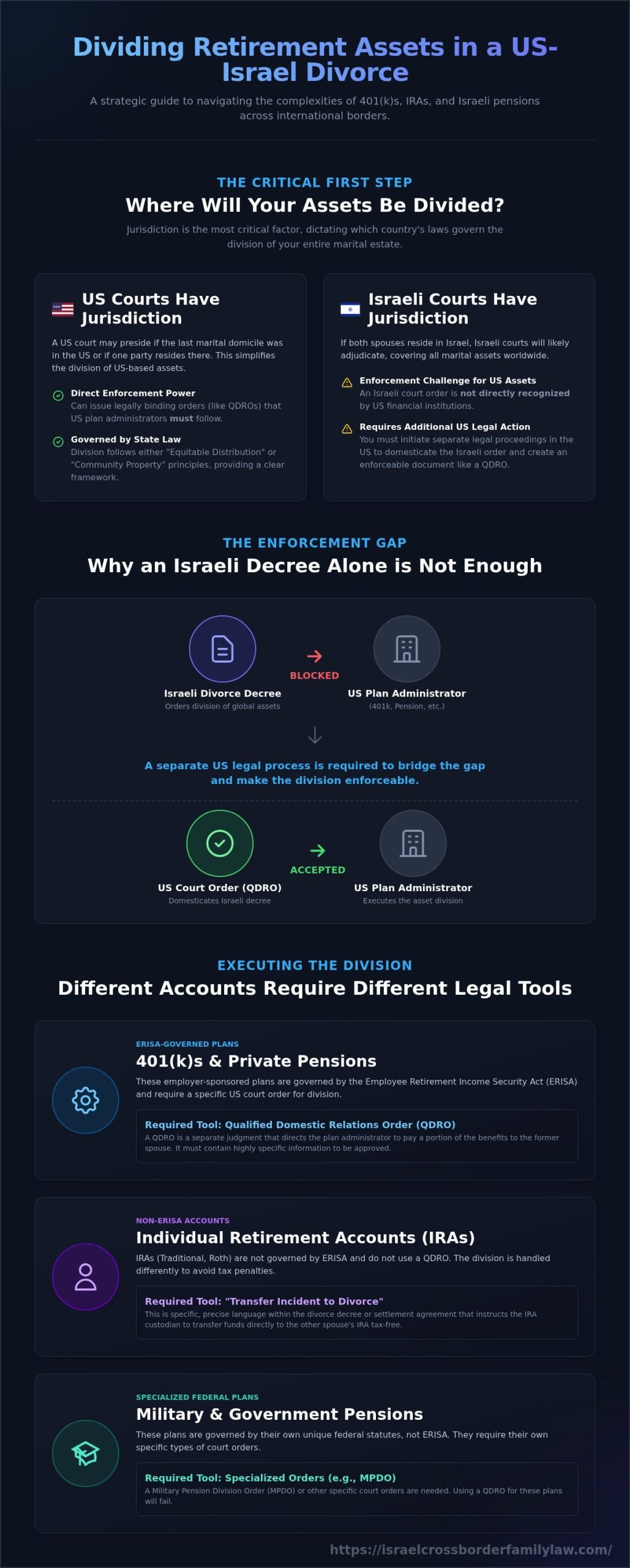
A US court may assert jurisdiction based on several factors, primarily the last marital domicile (the last place the couple lived together as spouses) and the current residency of one or both parties. If a US court presides, the division of assets will be governed by state-specific laws. These laws typically fall into two categories: equitable distribution or Community property. This framework simplifies the division of US-based retirement accounts, such as 401(k)s and IRAs, as American courts can issue legally binding orders, like QDROs, that plan administrators must follow.
When Israeli Courts Have Jurisdiction
Conversely, if both spouses have established residency in Israel, it is highly probable that Israeli courts will have jurisdiction. Under Israeli law, the family court has the authority to adjudicate the division of all marital assets, irrespective of where those assets are located globally. While comprehensive, this can introduce significant complexities when dividing US-based retirement plans. An Israeli court order may not be directly recognized or enforceable by a US financial institution, requiring additional legal proceedings in the US to effectuate the division-a common challenge in cases involving divorce for international families.
Dividing US Retirement Accounts: 401(k)s, IRAs, and Pensions
Navigating the division of United States-based retirement assets is a critical and technically complex component of any cross-border divorce. Understanding how are retirement accounts divided in international divorce proceedings requires a firm grasp of the specific legal instruments required by US law, as these often supersede the general terms of a foreign divorce decree. US retirement vehicles are broadly categorized into two types: defined contribution plans, such as 401(k)s, where the value is the account balance, and defined benefit plans, like traditional pensions, which promise a future stream of income. For high-net-worth individuals with assets spanning multiple jurisdictions, a simple divorce decree issued by an Israeli court is insufficient to compel a US plan administrator to divide these sophisticated financial products. This procedural gap highlights one of the core challenges for Americans divorcing overseas, necessitating separate, specific US legal orders to execute the asset division without incurring severe tax penalties.
The Role of the Qualified Domestic Relations Order (QDRO)
A Qualified Domestic Relations Order (QDRO) is a US court order, separate from the divorce judgment, that directs a retirement plan administrator to pay a portion of a plan participant’s benefit to their former spouse. QDROs are exclusively used for plans governed by the Employee Retirement Income Security Act (ERISA), which includes most 401(k)s and private pensions. A properly drafted QDRO must contain highly specific information, including the precise names and addresses of the parties, the exact amount or percentage to be paid, and the timing of payments. The plan administrator meticulously reviews the order to ensure it complies with both federal law and the plan’s own rules before approving and executing the division.
Handling Individual Retirement Accounts (IRAs)
Individual Retirement Accounts (IRAs), including Traditional and Roth IRAs, are not governed by ERISA and therefore are not divided by a QDRO. Instead, these accounts are typically divided via a “transfer incident to divorce,” which is authorized directly by the language within the divorce decree or settlement agreement. It is imperative that this language be precise, clearly instructing the IRA custodian to transfer a specific sum or percentage from one spouse’s IRA directly to an IRA established in the other spouse’s name. This precise execution ensures the transfer is treated as a non-taxable event.
Military and Government Pensions
The division of United States military and federal government pensions presents another layer of complexity, as these are governed by their own distinct federal statutes. A QDRO is not the appropriate instrument. For military retirement pay, a Military Pension Division Order (MPDO) is often required. Similarly, federal employee pensions have their own specific court order requirements. Navigating these multi-jurisdictional rules demands specialized expertise in US federal benefits law to ensure compliance and properly secure a non-employee spouse’s entitlements.
Addressing Israeli Retirement Assets: Pensions and Provident Funds (Kupot Gemel)
When navigating a cross-border divorce involving assets in Israel, understanding the local legal framework is paramount. Israeli retirement savings vehicles, primarily consisting of various pension schemes and provident funds (Kupot Gemel), are significant marital assets. Under Israel’s Spouses’ Property Relations Law, all assets accumulated during the marriage are subject to an “equal balancing of resources” upon divorce, regardless of whose name they are registered in. This principle forms the foundation for how these complex, long-term financial instruments are divided. The core question of how are retirement accounts divided in an international divorce involving Israel is answered through a structured, court-supervised process. Israeli courts treat these future financial rights with meticulous detail, ensuring an equitable distribution of the wealth built during the marital partnership.
How Israeli Law Divides Pensions and Provident Funds
Israeli family courts focus exclusively on the value of the “accrued rights” that were accumulated from the date of marriage to the date of separation. To determine this value, the court appoints a professional actuary. This expert performs a sophisticated calculation to ascertain the present-day value of the portion of the pension or provident fund that constitutes marital property. The court then typically orders one of two division methods:
- Lump-Sum Buyout: One spouse pays the other a present-value cash equivalent of their share, allowing the employee spouse to retain full ownership of the future benefits.
- Future Payment Rights: The court issues an order instructing the pension fund to pay the non-employee spouse their designated share directly when the benefits mature and become payable.
Enforcing a US Divorce Decree on Israeli Assets
A significant challenge arises when a US court issues a divorce decree intending to divide Israeli retirement assets. A standard US court order, such as a Qualified Domestic Relations Order (QDRO), is not recognized by Israeli financial institutions. Attempting to present such a document to a pension fund in Israel will result in non-compliance. To be effective, the US judgment must be formally “domesticated” through a legal proceeding in an Israeli family court. This process requires converting the foreign decree into an enforceable Israeli order that meets all local regulatory requirements. This is a critical and often complex issue for expats and foreign nationals. Without sophisticated legal guidance to draft and implement orders that are valid in both jurisdictions, parties risk having their asset division rights become unenforceable, highlighting the need for counsel with deep cross-border expertise.
Key Challenges and Strategic Solutions in Cross-Border Cases
Dividing retirement assets in a cross-border divorce between jurisdictions like Israel and the United States is a sophisticated process fraught with potential pitfalls. A coordinated legal and financial strategy is not merely advisable; it is essential for protecting long-term financial security. The most common and costly errors often stem from a failure to address the complex interplay of international tax laws, currency risks, and multi-jurisdictional regulatory requirements.
Tax Implications and Treaties
A critical component of determining how are retirement accounts divided in international divorce involves navigating a complex tax landscape. Asset transfers may trigger unforeseen tax obligations in both the US and Israel. While the US-Israel Tax Treaty is designed to prevent double taxation, its specific application to retirement asset division requires expert analysis. A common misstep is a premature withdrawal from a US 401(k) or an Israeli Keren Hishtalmut, which can lead to severe early distribution penalties and income tax liabilities that significantly diminish the asset’s value.
Valuation, Currency, and Growth/Loss
Accurately valuing and dividing assets held in different currencies, such as US Dollars and Israeli Shekels (₪), presents a significant challenge. The period between the asset valuation date and the final division can see substantial shifts due to currency fluctuations and market performance. A meticulously drafted settlement agreement is crucial and must explicitly define:
- The exact valuation date for all accounts.
- The methodology for determining the currency exchange rate.
- Which party assumes the risk of market gains or losses post-valuation.
Dealing with a Non-Resident Alien Spouse
The complexity escalates when one spouse is a non-resident alien (NRA) from the perspective of the country where the retirement account is held. For instance, transferring a portion of a US-based 401(k) to an Israeli spouse (an NRA in the US) can be restricted. Standard legal instruments like a Qualified Domestic Relations Order (QDRO) may not apply seamlessly, and any distributions could be subject to a mandatory 30% US withholding tax, drastically reducing the amount received. These challenges underscore that a cohesive strategy is imperative. Effectively addressing questions of tax, valuation, and residency status is central to any successful outcome. Navigating these sophisticated cross-border financial instruments requires counsel with deep, demonstrated experience in both US and Israeli legal frameworks. For guidance on structuring a settlement that protects your assets, it is vital to consult with a specialized legal team.
Why You Need a Specialized Cross-Border Divorce Attorney
Navigating the division of retirement assets in a standard divorce is challenging; introducing international borders elevates the complexity exponentially. The process involves a sophisticated interplay of competing legal frameworks, multi-jurisdictional tax laws, and fluctuating currency valuations. Answering the fundamental question of how are retirement accounts divided in international divorce requires far more than a domestic lawyer’s expertise; it demands a legal team fluent in the financial and legal systems of both the United States and Israel. A local family lawyer, while proficient in Israeli law, may not possess the critical understanding of U.S. regulations like ERISA or the intricacies of a 401(k). Conversely, a U.S. attorney is unlikely to be familiar with the unique structures of Israeli pension funds (*Kupot Gemel*) or advanced training funds (*Keren Hishtalmut*). A cross-border specialist serves as the essential bridge, possessing the bicultural and bilingual qualifications to protect your interests in both jurisdictions simultaneously.
The Dangers of Inadequate Legal Counsel
Relying on an attorney without specialized international experience exposes your financial future to significant and often irreversible risks. These costly errors can include:
- Unenforceable Orders: A U.S. QDRO may be unrecognized by an Israeli court, or an Israeli judgment may be unenforceable against a U.S. plan administrator, leading to years of costly post-divorce litigation.
- Accidental Tax Liabilities: An improper transfer of retirement funds can trigger severe tax penalties and early withdrawal fees in either country, potentially costing you hundreds of thousands of shekels.
- Incomplete Asset Discovery: A failure to properly identify, locate, and value all international retirement assets can result in an inequitable division, leaving a substantial portion of your marital wealth off the table.
Developing a Cohesive International Strategy
A premier cross-border family law firm provides more than just legal advice; we deliver a comprehensive, international strategy designed to secure your financial stability. Our team collaborates seamlessly with a network of vetted financial experts, including actuaries and tax accountants in both the U.S. and Israel, to create a unified plan. We specialize in drafting sophisticated, dual-jurisdiction legal documents that are valid and enforceable in both countries, providing you with clarity and peace of mind. This meticulous process ensures that every detail-from valuation dates to tax implications-is managed proactively. Understanding how are retirement accounts divided in international divorce is the first step; implementing a robust legal strategy is the key to protecting them. Get expert help by requesting a confidential case review to begin securing your future today.
Secure Your Retirement Assets with Expert Cross-Border Guidance
Navigating the division of retirement assets in a US-Israel divorce is an inherently complex undertaking. The critical first step is establishing jurisdiction, which dictates the legal framework for the entire process. Successfully addressing the question of how are retirement accounts divided in international divorce requires a sophisticated understanding of both US mechanisms like QDROs for 401(k)s and Israeli regulations governing pensions and Kupot Gemel. Without meticulous, expert planning, you risk significant financial loss and unforeseen tax consequences. Protecting the assets you have worked a lifetime to build demands specialized legal counsel. Our firm provides a strategic approach to these multi-jurisdictional challenges, grounded in a deep understanding of both the US and Israeli legal systems. We are dedicated to safeguarding your financial security through this intricate process. To ensure your retirement funds are protected with precision and foresight, we invite you to Schedule a Confidential Case Review. Take the decisive step toward securing your financial future today.
Frequently Asked Questions About International Divorce and Retirement Accounts
What is a QDRO and is it automatically enforceable in Israel?
A Qualified Domestic Relations Order (QDRO) is a judicial order specific to United States law, used to divide retirement plan assets pursuant to a divorce. This US legal instrument is not automatically recognized or enforceable by Israeli courts or financial institutions. Enforcing a division of assets in Israel requires a separate order under Israeli family law, a complex process that may involve domesticating the foreign judgment through a distinct local legal proceeding to ensure compliance.
Will I lose my entire 401(k) or IRA if I get divorced while living in Israel?
It is highly unlikely you would lose your entire US-based retirement account. Both US and Israeli legal systems generally treat retirement assets accumulated during the marriage as marital property subject to equitable division. The precise allocation depends on the governing law of the jurisdiction hearing the case and specific marital circumstances. A central issue is how are retirement accounts divided in international divorce, which requires a sophisticated analysis of which court has jurisdiction over the assets.
How are Israeli pension funds (Kupat Gemel) treated in a US divorce proceeding?
In a US divorce proceeding, an Israeli pension fund such as a Kupat Gemel is typically characterized as a marital asset subject to division if the contributions occurred during the marriage. While a US court can order its division, enforcing that order against an Israeli financial entity necessitates a sophisticated cross-border legal strategy. This often involves a parallel action in Israel to ensure the local institution recognizes and executes the division mandated by the US court.
What are the tax consequences of transferring retirement funds to a non-US citizen spouse?
Transferring US retirement funds to a non-US citizen spouse, particularly one residing abroad, presents complex tax implications. Without a properly structured QDRO or equivalent court order, the transfer could be classified as an early, taxable distribution, incurring substantial US income tax and potential penalties. Navigating the intersection of US tax law and international treaties is critical to structuring a transfer that minimizes adverse tax consequences for both parties involved in the dissolution.
Can a US court order the division of my spouse’s retirement accounts located in Israel?
Yes, a US court possesses the authority to order the division of marital property globally, including retirement accounts situated in Israel. However, the practical enforcement of such an order is a significant challenge. The effective legal pathway typically involves securing the US judgment and then leveraging Israeli legal processes to have it recognized and enforced locally. This multi-jurisdictional approach is essential for compelling Israeli financial institutions to act upon a foreign court’s decree.
My spouse is not disclosing their foreign retirement assets. What can I do?
The non-disclosure of foreign assets represents a serious challenge in cross-border divorce litigation. Our firm can utilize advanced international discovery mechanisms, such as letters rogatory or formal requests through Hague Convention protocols, to compel disclosure from foreign financial institutions. Engaging experienced forensic accountants and leveraging our global legal network are critical strategies for uncovering concealed retirement assets and ensuring a complete and equitable distribution of the marital estate.

Article by
Gabriel Lior
A Personal Journey That Became a Mission The advisory was founded by an American father Gabriel Lior, LLB, MBA , global entrepreneur, and cross-border advisor who spent more than a decade navigating the Israeli family court system firsthand and now lives in Singapore with his son.
As a divorced parent in a cross-border family, Gabriel faced nearly every legal challenge a foreign parent can encounter in Israel — including child custody disputes, child support proceedings, property matters in Israel and abroad, false accusations, and complex immigration and relocation proceedings. Over the years, he learned the hard way how difficult it is for non-Israeli parents to understand the system, identify the right legal strategy, and choose the right legal representation — especially when language, culture, and jurisdictional differences are involved. He also witnessed how foreign parents and new immigrants are often disadvantaged or taken advantage of by service providers and institutions simply because they lack local knowledge or fluency. From Client to Advisor To truly understand — and survive — the system, Gabriel pursued formal legal education in Israel, completing two Israeli law degrees, alongside a BA and MBA earned in the United States. This was never about becoming a practicing attorney, but about gaining a deep, structural understanding of how the system works — and where it breaks down for foreign parents. This rare combination of: Firsthand client experience Israeli legal and US business education International business and negotiation training Decades of commercial execution created a unique perspective – one that understands both sides of the table. After years of litigation, persistence, and at times self-representation, he ultimately succeeded in securing custody of his son and relocating abroad through a rare legal victory in the Israeli Supreme Court — becoming one of the first fathers in Israel to do so under these circumstances.
Disclaimer
Important Disclaimer: The information provided on this website and in its content is for general informational and educational purposes only and does not constitute legal advice, legal opinion, or legal representation. Gabriel Lior is not licensed to practice law in Israel (nor is he interested in doing so) and does not provide legal services, despite having completed 2 Law Degrees. The services offered are advisory in nature and are intended to provide general guidance, strategic insight, and information regarding cross-border family law considerations. No attorney-client relationship is formed by accessing this website, reading its content, or communicating with us. Any decisions made based on this information are at your own discretion and risk. For legal advice specific to your situation, you should consult a licensed attorney in the relevant jurisdiction. Where appropriate, we may refer clients to independent, licensed attorneys or professionals. Such referrals do not constitute legal representation and no liability is assumed for services provided by third parties.