Disclaimer: This content is published on an independent advisory platform and does not constitute formal legal advice. Legal services are only provided by licensed attorneys under a separate engagement.
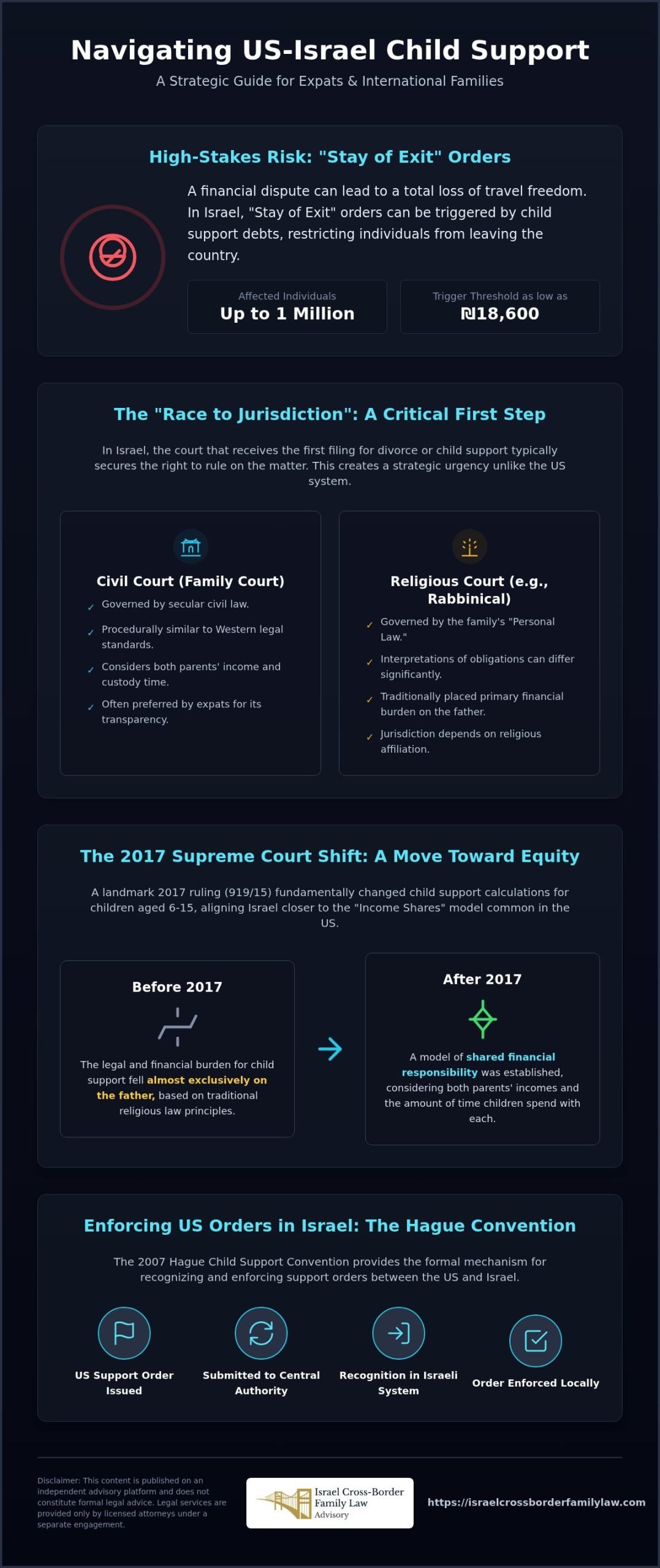
Did you know that up to one million people in Israel are currently restricted from leaving the country due to “stay of exit” orders, often triggered by child support debts as low as ₪18,600? For many expats and international families, the realization that a financial dispute can lead to a total loss of travel freedom is startling. It’s understandable to feel a sense of unease when you’re caught between the familiar regulations of the United States and the dual-court system of Israel. Understanding the multi-jurisdictional complexity of international child support laws US Israel is essential, as the stakes are high when your career or family life depends on international mobility.
This guide provides the strategic clarity you need to protect your financial interests and maintain your freedom of movement. We’ll examine the critical “jurisdictional race” between civil and religious courts, the lasting financial impact of the landmark 2017 Supreme Court ruling on shared responsibility, and the practical roadmap for enforcing or modifying orders across borders in 2026. By bridging the gap between these two distinct legal cultures, you can approach your situation with confidence instead of fear.
Key Takeaways
- Understand the critical “race to jurisdiction” between Israeli civil and religious courts and why your first filing location determines the legal framework of your case.
- Gain clarity on how international child support laws US Israel have evolved since 2017 to emphasize shared financial responsibility based on income and custody time.
- Learn how the Hague Convention provides a formal mechanism for enforcing US support orders within the Israeli system through the Central Authority.
- Identify the high-stakes risks of “stay of exit” orders, which can prevent travel if child support arrears exceed specific financial thresholds.
- Discover strategic ways to draft cross-border agreements that protect your mobility and provide financial predictability in both jurisdictions.
The Jurisdictional Split: Civil vs. Religious Courts in Israel
Israel operates under a unique legal framework where matters of personal status, including divorce and child maintenance, are governed by a person’s religious affiliation. This concept, known as “Personal Law,” creates a dual court system. You can find your case being heard in either a religious court, such as the Rabbinical Court for Jewish citizens, or the secular Family Court. Understanding Child support laws in Israel is the first step for any expat trying to manage a cross-border dispute.
The “Race to Jurisdiction” is a critical concept for families with ties to both countries. In Israel, the court that receives the first filing typically secures the right to rule on the matter. This creates a strategic urgency that doesn’t exist in most US states. If one parent prefers the religious court and the other prefers the civil system, the person who files first often sets the tone for the entire legal process. For families dealing with child support cross-border enforcement, choosing the right forum is the most impactful decision you’ll make.
To better understand how these systems interact, watch this helpful video:
The Role of Personal Law for US Expats
For US citizens living in Israel, religious law applies if they’re recognized as members of a specific religious community. The Family Law Amendment (Child Support) 5719–1959 dictates that if personal law doesn’t apply; for instance, if the parents are of different faiths or have no religious affiliation; civil law becomes the default. This distinction is vital because religious courts may interpret obligations differently than secular judges. Traditionally, religious law placed the primary financial burden on the father, but the civil courts have moved toward a more balanced approach based on income and custody time.
Navigating the Family Court System
The Israeli Family Court offers a procedural atmosphere that many US expats find more familiar, yet it has distinct requirements. Before any litigation can begin, parties must usually undergo a mandatory “Settlement of Dispute” period. This involves meetings with a social worker to explore mediation and reduce conflict. US citizens often prefer the civil track because it tends to follow more predictable, transparent rules that align closer to Western legal standards. Strategy is key here; once a case is rooted in one system, it’s very difficult to move it to the other. Seeking clarity early on helps you understand how international child support laws US Israel will apply to your specific family structure.
The 2017 Supreme Court Shift and Age-Based Obligations
The landscape of child maintenance in Israel underwent a seismic change with the 2017 Supreme Court ruling (919/15). This decision fundamentally altered how judges calculate payments for children between the ages of 6 and 15. Before this shift, the legal burden fell almost exclusively on the father. Today, the system has transitioned toward a more egalitarian model that considers the economic reality of both parents. This evolution is a critical factor for anyone navigating international child support laws US Israel, as it brings the Israeli system closer to the “Income Shares” models frequently used in US states like New York or California.
The framework for these cross-border obligations is often managed through the 2007 Hague Child Support Convention, which provides the legal machinery to recognize and enforce support orders between the two nations. While the US and Israel now share similar goals of proportional responsibility, the Israeli system remains unique because it segments obligations based on the child’s age.
Support for Children Ages 0-6
For children in this youngest bracket, the father’s obligation remains absolute under Hebrew Law. This means the father is responsible for the child’s “Essential Needs” regardless of the mother’s income or the time-sharing arrangement. Essential needs typically include food, basic clothing, and a proportional share of housing and utilities. Educational expenses or extracurricular activities are often categorized separately as “Extra Needs,” which may be split between parents. Under current 2026 standards, the Israeli Enforcement and Collection Authority maintains strict oversight, where arrears exceeding ₪18,600 can trigger severe administrative sanctions.
Shared Responsibility for Ages 6-15
Once a child reaches age six, the 2017 ruling applies a gender-neutral formula. The court evaluates the “relative ability” of each parent by looking at their actual income and earning potential. If parents have joint physical custody and similar incomes, the resulting support order may be significantly lower than under the old system. This shift requires families to provide detailed financial disclosures and clear evidence of their time-sharing schedule. Support obligations don’t necessarily end at 18; they often continue at a reduced rate (usually one-third) until the child completes mandatory military or national service. If you are managing a case involving children in multiple countries, requesting a strategic review can help clarify your specific obligations under this complex age-based system.
Enforcing US Child Support Orders in Israel
A child support order issued by a US state court doesn’t automatically carry legal weight once a parent or child moves to Israel. To bridge this gap, both nations rely on the 2007 Hague Convention on the International Recovery of Child Support. This treaty provides a formal framework for the recognition and enforcement of foreign maintenance decisions. Without this process, a parent in the US cannot easily collect funds from a parent residing in Israel. Understanding the mechanics of child support cross-border enforcement is vital for maintaining financial stability across two different legal systems.
The Israeli Ministry of Justice acts as the “Central Authority” under the Convention. They coordinate with US state agencies to ensure that documents are transmitted correctly. For an Israeli court to recognize a US order, the judgment must be final and non-appealable. Additionally, the parent who was ordered to pay must have received proper notice of the original US proceedings. Israeli courts will generally enforce these orders unless they conflict with local public policy or if a conflicting judgment already exists in Israel. This process ensures that international child support laws US Israel are respected while protecting the due process rights of both parties.
The Step-by-Step Enforcement Process
Navigating the path from a US court to an Israeli bank account involves several distinct stages. It’s a bureaucratic process that requires patience and precise documentation, including notarized Hebrew translations of all relevant court orders.
- Step 1: Application: The process begins at your local US State Child Support Agency, which prepares the formal request under the Hague Convention rules.
- Step 2: Transmission: The US agency sends the files to the Israeli Ministry of Justice for initial administrative processing.
- Step 3: Judicial Review: An Israeli Family Court conducts an “Exequatur” proceeding. This is a legal step where the judge officially adopts the US order as a domestic Israeli judgment.
- Step 4: Direct Enforcement: Once recognized, the order is sent to the Enforcement and Collection Authority (Hotsa’a LaPoal). They have the power to garnish wages, freeze bank accounts, or seize assets to satisfy the debt.
Modification of Foreign Orders
Can an Israeli court change the amount set by a US judge? Generally, the principle of legal “comity” means courts respect existing orders. However, if there’s a substantial change in circumstances; such as a major salary shift or a change in the child’s primary residence; a modification might be possible. This often creates jurisdictional friction. If one parent still lives in the original US state, that state might retain “exclusive continuing jurisdiction” under US law. If both parents have left the US, the Israeli court may have more leeway to adjust the support amounts to reflect local economic realities. Strategic planning is necessary before requesting a change, as it may open the door for the other parent to challenge other aspects of the divorce settlement.
High-Stakes Risks: Arrears and Stay of Exit Orders
One of the most significant differences between the US and Israeli legal systems is the use of the “Stay of Exit” order, known in Hebrew as Tzav Ikur Yetziah min HaAretz. While US enforcement typically relies on driver’s license suspension or credit reporting, Israel uses physical travel restrictions as a primary tool to ensure compliance. For dual citizens or expats, this can lead to a sudden and distressing realization at the border. Understanding how international child support laws US Israel manage these arrears is essential before planning any travel to the country.
The Enforcement and Collection Authority has the power to issue these orders automatically if debts exceed ₪18,600. This threshold is relatively low for cross-border families, where currency fluctuations or missed payments can quickly reach the limit. Once an order is in place, it often remains active until the child reaches age 18, unless the debt is fully settled or a specific legal arrangement is made. Human rights activists estimate that between 500,000 and 1 million people are currently affected by these orders, which highlights the scale of this enforcement mechanism.
Understanding the Stay of Exit Order
Israel utilizes travel bans because they are highly effective at preventing parents from evading their financial duties by moving abroad. If you are a dual US-Israeli citizen, your US passport will not protect you from this domestic order. It’s a high-stakes risk that can trap a parent in Israel, preventing them from returning to their job or family in the United States. Before visiting, it’s a standard precaution to check your status with the Enforcement and Collection Authority to see if any restrictions exist. If an order is active, you may need to provide significant financial guarantees or find “guarantors” who are Israeli residents willing to be liable for the debt to have the ban temporarily lifted for travel.
Dealing with Bituach Leumi
The National Insurance Institute, or Bituach Leumi, plays a unique role in the collection process. In many cases, if a custodial parent in Israel isn’t receiving support, the state pays them a monthly stipend and then steps into their shoes as the creditor. This changes the dynamic from a private dispute to a state-led collection action. Bituach Leumi is often more aggressive than an individual parent. They have broad powers to garnish wages and seize assets across the country. If you live outside of Israel but have arrears with the state, these debts continue to accrue interest and can lead to immediate travel bans upon entry. If you suspect you have outstanding obligations, you should consult with an advisor to develop a strategy for resolving the debt before it impacts your mobility.
Strategic Guidance for Cross-Border Families
Navigating the intersection of two legal systems requires more than just following rules; it demands a proactive strategy. When families have ties to both the United States and Israel, the choice of where to finalize a support order can have lifelong financial consequences. Determining the most favorable jurisdiction involves a careful analysis of income levels, the child’s age, and the specific custody arrangement. While the US system is often more predictable, the Israeli system’s 2017 shift toward shared responsibility offers a different set of opportunities and risks. Understanding how international child support laws US Israel apply to your specific household is the first step toward a sustainable future.
For many international families, standard support calculations don’t account for “Anglo” specific expenses. These often include the high cost of international flights for visitation, tuition for private English-speaking schools, and the maintenance of health insurance across borders. Codifying these expenses early prevents future litigation and ensures that the child’s lifestyle remains consistent despite the distance. It’s often more effective to address these costs in a comprehensive settlement rather than leaving them to the discretion of a judge who may not be familiar with the costs of an international lifestyle.
Drafting Agreements for Two Systems
A cross-border settlement must be resilient enough to satisfy both a US judge and an Israeli registrar. One of the most overlooked factors is currency fluctuation. Setting a support amount in a single currency without an adjustment mechanism can lead to significant financial imbalances as the exchange rate between the US Dollar and the Israeli Shekel shifts. Agreements should also clearly specify who bears the burden of international travel costs, including airfare, unaccompanied minor fees, and ground transportation. This level of detail provides the financial predictability that families need when managing lives in two different countries.
Clarity Before Commitment
It’s a common mistake to assume that a standard US “boilerplate” agreement will be accepted by an Israeli Rabbinical court. Religious courts operate under specific “Personal Law” principles that may conflict with secular US language. The psychological and financial weight of early decisions cannot be overstated. Once you’ve committed to a specific court or signed a poorly drafted document, reversing those choices is difficult and expensive. Obtaining specialized guidance allows you to anticipate these hurdles before they become crises. Learn more about our cross-border family law strategy to see how a structured approach can protect your interests.
Strategic Next Steps for Your International Family
Managing the intersection of international child support laws US Israel requires a proactive approach that balances legal requirements with your family’s long-term goals. We’ve explored how early decisions in the jurisdictional race between civil and religious courts can dictate your financial future, and why the 2017 shift toward shared responsibility is a critical factor for modern expats. Protecting your freedom of movement from stay of exit orders depends on precise, cross-border planning that accounts for the nuances of both systems.
Our advisory acts as a bridge between these two distinct legal cultures, providing the specialized US-Israel expertise you need to move forward. With practitioners licensed in multiple jurisdictions, we offer the strategic support required to navigate multi-jurisdictional complexity with confidence. It’s essential to remember that while the legal frameworks are different, they can be harmonized with a clear strategy and professional oversight. Decisions made today will impact your family for years; ensure they are based on clarity and established facts.
Get clarity before you commit. Request a confidential consultation.
By seeking guidance early, you can turn a complex legal challenge into a manageable roadmap for your family’s security and peace of mind.
Frequently Asked Questions
Can a US child support order be enforced in Israel?
Yes, a US child support order is enforceable in Israel through a formal legal process. Under the 2007 Hague Convention, the order must be recognized by an Israeli Family Court in cities like Tel Aviv or Jerusalem. This involves an “Exequatur” proceeding where a judge confirms the order is final and valid. Once recognized, the order has the same legal power as a domestic Israeli judgment, allowing for collection through local authorities.
What happens if I miss a child support payment while in Israel?
Missing a payment triggers aggressive collection efforts by the Enforcement and Collection Authority. Interest and linkage to the consumer price index typically apply to the debt. In cities like Herzliya or Ra’anana, local authorities can freeze bank accounts, garnish wages, or place liens on property. Most critically, arrears exceeding ₪18,600 often lead to a stay of exit order, which prevents you from leaving Israel until the debt is addressed or specific guarantees are provided.
Is child support in Israel higher or lower than in the US?
Child support levels vary significantly based on the child’s age and the specific court’s approach. While many US states use strict income-based formulas, Israeli courts focus on “essential needs” for children under six and proportional income for older children. Families in high-cost areas like Tel Aviv or Netanya may find that Israeli support amounts are comparable to or higher than those in the US, especially when including housing costs and international travel expenses.
How does the Hague Convention help with international child support?
The 2007 Hague Convention provides the primary legal machinery for the international recovery of maintenance. It establishes a standardized system where the US and Israel coordinate through their respective Central Authorities. This treaty simplifies the recognition of foreign orders and reduces the need for entirely new litigation in a foreign country. It ensures that international child support laws US Israel are respected, allowing for the efficient transfer of funds and documentation between jurisdictions.
Can I be stopped from leaving Israel due to child support?
Yes, a “stay of exit” order is a common enforcement tool in Israel. If you have outstanding child support arrears, the court or the Enforcement Authority can bar you from leaving the country. This travel ban applies to both Israeli citizens and foreign nationals. To lift the order, you generally must pay the debt in full or provide substantial financial guarantees, such as having two Israeli residents act as guarantors for your return.
Does child support in Israel continue during military service?
Support obligations in Israel typically extend beyond the age of 18 if the child is serving in the IDF or performing national service. During this period, the support amount is usually reduced to one-third of the original sum. This reflects the child’s continued financial dependence while their basic needs are partially met by the military. This extension is a significant difference from many US jurisdictions and should be clearly addressed in cross-border settlement agreements.
How is child support calculated if we have joint custody in Israel?
For children aged 6 to 15, joint custody significantly impacts the calculation under the 2017 Supreme Court ruling. The court examines the relative income of both parents and the actual time the child spends in each household. If incomes and time-sharing are equal, the support payment may be minimal or even zero. However, for children under six, the father often remains responsible for basic needs regardless of the joint custody arrangement in cities like Haifa or Modi’in.
What is the role of the Israeli National Insurance Institute in child support?
The National Insurance Institute, or Bituach Leumi, acts as a safety net for custodial parents who are not receiving court-ordered support. If the parent qualifies, the state pays the support amount directly to them and then becomes the creditor. Bituach Leumi then uses its broad powers to collect the debt from the paying parent. This state-led collection is often more aggressive and can include wage garnishment and travel restrictions for those residing in Jerusalem or Beit Shemesh.

Article by
Gabriel Lior
A Personal Journey That Became a Mission
The advisory was founded by an American father Gabriel Lior, LLB, MBA , global entrepreneur, and cross-border advisor who spent more than a decade navigating the Israeli family court system firsthand and now lives in Singapore with his son.
As a divorced parent in a cross-border family, Gabriel faced nearly every legal challenge a foreign parent can encounter in Israel — including child custody disputes, child support proceedings, property matters in Israel and abroad, false accusations, and complex immigration and relocation proceedings.
Over the years, he learned the hard way how difficult it is for non-Israeli parents to understand the system, identify the right legal strategy, and choose the right legal representation — especially when language, culture, and jurisdictional differences are involved. He also witnessed how foreign parents and new immigrants are often disadvantaged or taken advantage of by service providers and institutions simply because they lack local knowledge or fluency.
From Client to Advisor
To truly understand — and survive — the system, Gabriel pursued formal legal education in Israel, completing two Israeli law degrees, alongside a BA and MBA earned in the United States. This was never about becoming a practicing attorney, but about gaining a deep, structural understanding of how the system works — and where it breaks down for foreign parents.
This rare combination of:
Firsthand client experience
Israeli legal and US business education
International business and negotiation training
Decades of commercial execution
created a unique perspective – one that understands both sides of the table.
After years of litigation, persistence, and at times self-representation, he ultimately succeeded in securing custody of his son and relocating abroad through a rare legal victory in the Israeli Supreme Court — becoming one of the first fathers in Israel to do so under these circumstances.
Disclaimer
Important Disclaimer:
The information provided on this website and in its content is for general informational and educational purposes only and does not constitute legal advice, legal opinion, or legal representation.
Gabriel Lior is not licensed to practice law in Israel (nor is he interested in doing so) and does not provide legal services, despite having completed 2 Law Degrees. The services offered are advisory in nature and are intended to provide general guidance, strategic insight, and information regarding cross-border family law considerations.
No attorney-client relationship is formed by accessing this website, reading its content, or communicating with us.
Any decisions made based on this information are at your own discretion and risk. For legal advice specific to your situation, you should consult a licensed attorney in the relevant jurisdiction.
Where appropriate, we may refer clients to independent, licensed attorneys or professionals. Such referrals do not constitute legal representation and no liability is assumed for services provided by third parties.