For couples navigating the complex, cross-border legal landscape between the United States and Israel, the fundamental question, “is my US marriage valid in Israel?”, represents a significant and often stressful hurdle. The uncertainty surrounding this critical issue can cast a shadow over essential life plans, from securing spousal visas and establishing residency to ensuring the legal status of children and protecting spousal rights. Many fear becoming entangled in a web of bureaucratic complexity, unsure of where to even begin the process of having their union officially recognized by the state.
This comprehensive guide is designed to provide clarity and eliminate that ambiguity. We will deliver a definitive answer regarding the legal standing of your US marriage and, more importantly, provide a clear, step-by-step framework for navigating the registration process with the Israeli Ministry of Interior (Misrad HaPnim). By following this guide, you will gain the necessary knowledge to secure your family’s legal status, understand the full rights and benefits afforded by recognition, and achieve the peace of mind that your future in Israel is built on a solid legal foundation.
Key Takeaways
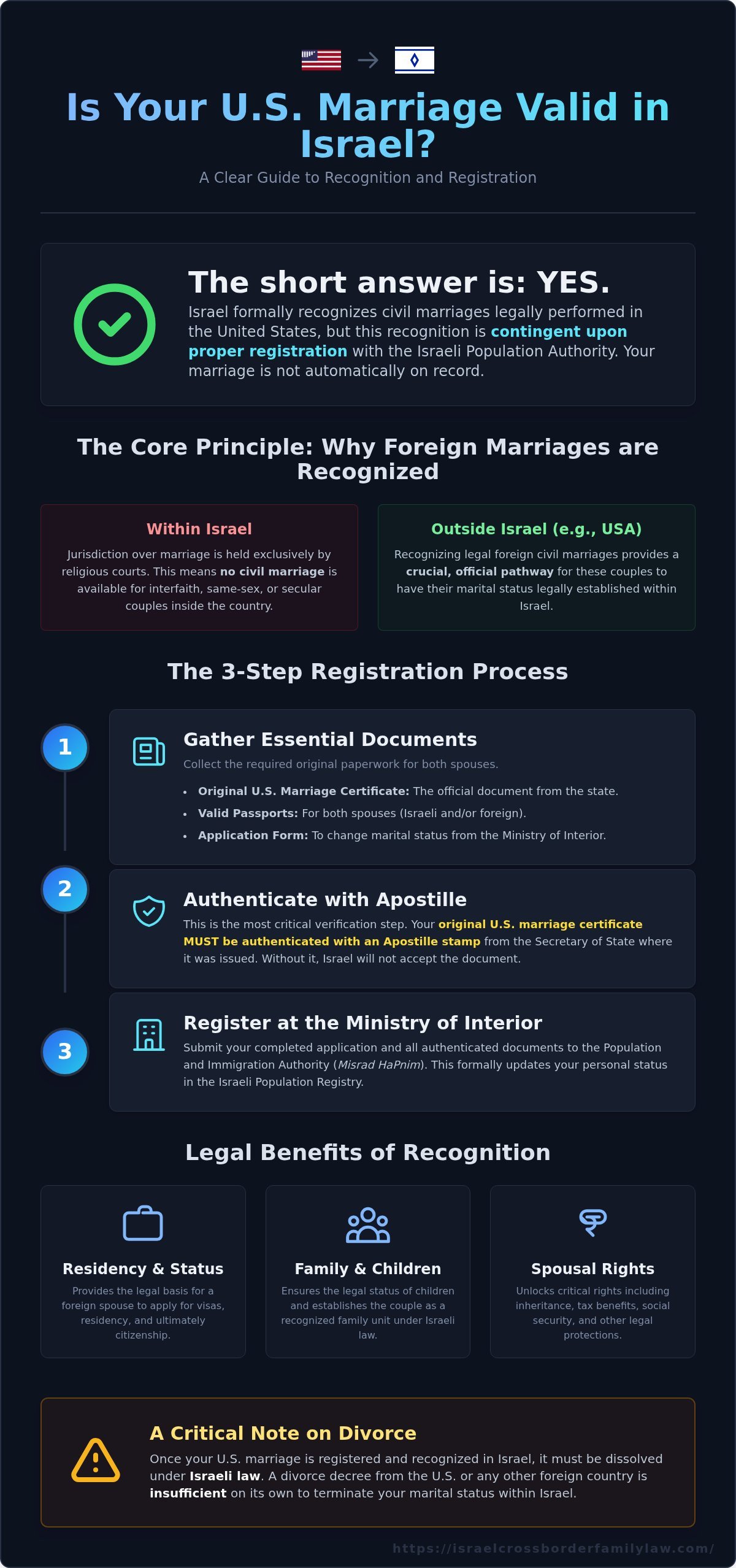
- Israel formally recognizes civil marriages legally performed in the United States, providing a critical pathway to legal status for couples where domestic marriage options are unavailable.
- The definitive answer to “is my us marriage valid in israel” is yes, contingent upon proper registration with the Israeli Population Authority, which officially updates your marital status.
- Registering your US marriage is a multi-step administrative procedure requiring specific, authenticated documentation to ensure your legal standing is updated correctly within Israel’s official systems.
- Successful recognition unlocks essential legal and social benefits, formally establishing your family unit and impacting critical matters from residency to inheritance rights.
- A US marriage recognized in Israel must be dissolved under Israeli law; a foreign divorce decree alone is insufficient to terminate the legal status within the state.
The Core Principle: Israel’s Recognition of Foreign Marriages
For individuals and couples navigating complex cross-border legal matters, understanding the foundational principles of Israeli law is paramount. The State of Israel, through its Ministry of the Interior’s Population and Immigration Authority, officially recognizes civil marriages that have been legally performed and registered in foreign jurisdictions. This long-standing policy provides a critical and reliable pathway for marital status recognition within Israel.
This means that if you were legally married in any US state, your marriage can be registered and recognized in Israel, provided you present the correct, authenticated documentation. This principle applies irrespective of the couple’s religious affiliation, or lack thereof, and is a cornerstone of Israeli family law.
For a detailed explanation of how this recognition impacts legal status for foreign spouses, the following overview provides valuable context.
Why Israel Recognizes Foreign Civil Marriages
The necessity for this framework stems from the domestic legal structure governing personal status in Israel. Jurisdiction over marriage and divorce is granted exclusively to the religious courts of recognized communities (Jewish, Muslim, Christian, etc.). This system precludes the possibility of civil marriage within Israel’s borders, creating significant challenges for interfaith couples, same-sex partners, and secular individuals. Recognizing foreign marriages serves as a crucial legal alternative, a practice upheld by decades of Israeli Supreme Court rulings and central to the core principle of recognizing foreign marriages in Israeli law.
The Legal Framework: What Makes Your US Marriage Valid?
The answer to the question, “is my us marriage valid in israel?”, hinges on one primary condition: the marriage must be fully and unequivocally legal in the jurisdiction where it was performed. For a marriage from the United States, this means it must comply with all the laws of the specific state (e.g., California, New York, Florida) in which the ceremony occurred.
The key piece of evidence required by the Israeli Ministry of the Interior is an original, official marriage certificate issued by a government authority. Crucially, this document must be properly authenticated with an Apostille stamp to be accepted. Israeli authorities do not re-evaluate the substantive validity of the union; their role is to verify the authenticity and legality of the foreign documentation presented. This process is applicable to valid marriages from all 50 U.S. states and territories.
The Registration Process: How to Formally Record Your US Marriage
While your U.S. marriage is legally recognized in Israel for most purposes, formalizing its status within the country is a critical administrative step. This is not a new marriage ceremony but a procedural registration designed to update your personal status in the Israeli Population Registry. Successfully navigating this process hinges on meticulous preparation of your documentation. For many couples asking, “is my us marriage valid in israel for official purposes like taxes or residency?”, this registration provides the definitive answer. A comprehensive understanding of how our advisory works can be instrumental in simplifying these complex cross-border requirements.
Step 1: Gathering the Essential Documents
The foundation of a successful registration is a complete and accurate set of documents. Before approaching the Ministry of Interior (Misrad HaPnim), you must have the following prepared:
- Your original marriage certificate issued in the United States.
- Valid passports for both spouses. This includes Israeli passports for citizens and foreign passports for non-Israeli spouses.
- A completed application form to change marital status, obtained from the Population and Immigration Authority.
- In certain circumstances, particularly for matters related to Aliyah or status, proof of Judaism may be requested.
Step 2: The Critical Role of the Apostille Stamp
This is arguably the most crucial and often overlooked requirement. Your original U.S. marriage certificate is not valid for registration in Israel without an Apostille stamp. An Apostille is an internationally recognized form of authentication under the 1961 Hague Convention, certifying the genuineness of the signature on the document. This certification must be obtained from the office of the Secretary of State in the U.S. state where the marriage license was issued. For a detailed guide from the U.S. government, you can review The Apostille Process for Your US Marriage Certificate. An application submitted without this specific authentication will be summarily rejected by the authorities.
Step 3: Submitting Your Application in Israel
Once your documents are authenticated and complete, the final step is to present them in person. You will need to schedule an appointment at your local branch of the Population and Immigration Authority. Both spouses are generally required to attend. At the appointment, an official will review all original documents, including any certified translations if required. Upon approval, your marital status will be updated in the registry, and you will be issued an updated appendix (sefach) for your Israeli ID card (Teudat Zehut) reflecting the change.
Legal Implications of Recognition: Rights, Benefits, and Status
Successfully registering a foreign marriage in Israel is not merely an administrative formality; it is the critical legal act that transforms a couple’s status from two separate individuals into a recognized family unit in the eyes of the state. This official recognition is the gateway to a comprehensive suite of legal, social, and financial benefits that are otherwise inaccessible. The question of is my US marriage valid in Israel extends far beyond a simple certificate-it directly governs your ability to build a life, secure your family’s future, and navigate the nation’s complex regulatory frameworks. Without this registration, a couple is legally unprotected, lacking the fundamental rights afforded to married spouses under Israeli law.
Immigration and Spousal Visas
For bi-national couples, the registration of their marriage is the foundational prerequisite for the non-Israeli spouse to commence the gradual process of obtaining legal status in Israel. This procedure, managed by the Ministry of Interior (Misrad HaPnim), opens the door to securing work visas, temporary residency, and ultimately, a pathway to permanent residency or Israeli citizenship. It is the legal mechanism that ensures a family can remain together in Israel without facing the constant threat of visa insecurity.
Financial and Inheritance Rights
Official recognition of your marriage provides immediate and significant financial advantages. A registered spouse gains access to a wide array of benefits and protections that impact long-term financial stability. Understanding these implications is a key part of determining how is my US marriage valid in Israel for all practical purposes. Key entitlements include:
- Social Security (Bituach Leumi): Eligibility for spousal and survivor’s benefits, disability allowances, and other social safety nets provided by the National Insurance Institute.
- Inheritance Law: Automatic status as a legal heir under Israel’s Succession Law, which grants a surviving spouse a significant portion of the deceased’s estate, even in the absence of a will.
- Mortgages and Taxes: Enhanced eligibility for joint mortgages (mashkanta) from Israeli banks and access to specific tax credits (nekudot zikui) that can lower a household’s overall income tax burden.
Parental and Family Rights
When a married couple’s union is registered with the state, the legal framework for establishing and protecting parental rights is significantly simplified. Registering the birth of a child is a more streamlined process, and legal parentage for both spouses is automatically established. This recognition is crucial for matters of custody, healthcare decisions, and education, ensuring both parents have equal legal standing and can access state-provided child-related benefits without administrative hurdles.
Common Pitfalls and Special Circumstances for US Citizens
Navigating the Israeli administrative system to register a foreign marriage can present unique and complex challenges. While the process is grounded in established legal precedent, certain personal circumstances require additional documentation and sophisticated legal guidance to ensure a successful outcome. Anticipating these potential issues is critical for preventing significant delays and the frustration that often accompanies bureaucratic hurdles. Understanding the nuances of how your specific situation impacts the answer to the question, is my us marriage valid in israel, is the first step toward a seamless registration.
Our firm provides dedicated legal services tailored for expats and foreign nationals who are managing these intricate cross-border family law matters, guiding them through each stage with precision and authority.
One Spouse is an Israeli Citizen
When a US citizen marries an Israeli citizen, the registration process is typically more direct. The primary step involves the Israeli spouse presenting the Apostille-certified US marriage certificate to the Ministry of the Interior (Misrad HaPnim). Following a review, the Israeli spouse’s marital status will be updated on their identity card (Teudat Zehut). This official update is a mandatory and foundational step before the foreign spouse can begin the gradual process of applying for legal status in Israel.
Same-Sex Marriages from the US
In accordance with landmark High Court of Justice rulings, the State of Israel recognizes same-sex marriages that have been legally performed and certified abroad. For couples married in the United States, the registration process and documentation requirements are identical to those for opposite-sex couples. This recognition is not merely administrative; it confers the same crucial rights regarding immigration, residency, social benefits, and inheritance, ensuring legal parity for the non-Israeli spouse.
Issues with Documentation or Prior Divorces
The most common delays stem from incomplete or improperly authenticated documentation. Meticulous preparation is essential. Key areas that demand attention include:
- Name Consistency: The full names of both spouses must match exactly across all submitted documents, including passports and the marriage certificate. Any discrepancies can lead to immediate rejection of the application.
- Proof of Prior Divorce: If either spouse was previously married, an original and final divorce decree must be provided. This is non-negotiable.
- Apostille Certification: Both the US marriage certificate and any divorce decrees must be authenticated with an Apostille seal. This international certification validates the document for use in Israel, and without it, the paperwork will be considered invalid.
Successfully addressing these potential pitfalls is key to confirming that your US marriage is valid in Israel without complication. For expert guidance on preparing your documentation, we invite you to contact our legal team.
When a Recognized US Marriage Ends: Divorce & Separation in Israel
Once the question of “is my us marriage valid in israel” is affirmatively answered, the subsequent legal complexities surrounding the dissolution of that marriage come into sharp focus. A civil marriage conducted in the United States and registered with the Israeli Ministry of Interior is legally binding. Consequently, it cannot be informally dissolved; it must be legally terminated under Israeli law. Simply obtaining a divorce decree in the US is insufficient to update your marital status in Israel or to remarry, creating significant legal and personal complications if not handled correctly. Navigating this cross-border legal landscape is vital for protecting your rights, assets, and future.
Jurisdiction for Divorce Proceedings
The determination of which court holds jurisdiction is a critical first step. If both spouses have established residency in Israel, Israeli courts will typically preside over the divorce proceedings. The specific judicial body depends on the religious affiliation of the couple:
- Jewish Couples: The Rabbinical Courts (Batei Din Rabbani’im) hold exclusive jurisdiction over the divorce itself, issuing a religious decree known as a Get.
- Other Couples: For interfaith, non-religious, or non-Jewish couples, the Family Courts have the authority to dissolve the marriage.
These jurisdictional rules underscore the necessity of strategic legal guidance from counsel experienced in Israeli family law.
The Process of Cross-Border Divorce
In many international families, one or both spouses may relocate, leading to divorce proceedings outside of Israel. A foreign divorce decree, such as one issued by a US court, is not automatically recognized. It must undergo a formal recognition process within the Israeli Family Court system. This is a distinct legal action, separate from the divorce itself, requiring the submission of authenticated documents and a petition to have the foreign judgment validated. These multi-jurisdictional cases demand sophisticated legal counsel to ensure compliance and finality. You can learn more about our dedicated approach to divorce for international families and how we manage these intricate matters.
Failing to properly dissolve or recognize the dissolution of a US marriage in Israel can have severe consequences, impacting inheritance rights, child custody arrangements, and financial settlements. Ensuring every legal requirement is met across both jurisdictions is not merely procedural-it is essential for securing your legal and financial future. For expert guidance on complex cross-border family law matters, contact our firm.
Navigating Your Cross-Border Marriage with Confidence
The legal landscape surrounding international unions can be intricate. This guide has established that the answer to the critical question, is my us marriage valid in israel, is generally affirmative, contingent upon the marriage’s legal standing in the United States and its correct registration with the Israeli Ministry of Interior. Recognizing your marriage unlocks vital rights and benefits, but it also means navigating Israeli law for complex matters like divorce and separation, which can present unique challenges for international families.
These multi-jurisdictional matters require sophisticated legal counsel. With a deep understanding of both US and Israeli legal systems and a proven track record of assisting international families, our firm is uniquely positioned to guide you through every step. We provide the strategic advice necessary to protect your rights and secure your family’s future in Israel. Do not navigate this complex process alone.
Facing a cross-border marriage issue? Schedule a Confidential Case Review.
With expert guidance, you can achieve the clarity and peace of mind essential for your international family’s legal status.
Frequently Asked Questions
Do we both have to be Jewish for Israel to recognize our US marriage?
No. Israel’s Ministry of Interior will register a valid foreign civil marriage irrespective of the couple’s religious affiliation. This civil recognition pathway exists because religious authorities in Israel control marriage ceremonies, which can be restrictive. Therefore, a legally performed US marriage between individuals of different faiths, or no faith, will be registered for civil purposes, such as population registry status, provided all documentation, including an apostilled marriage certificate, is correctly submitted to the Population and Immigration Authority.
How long does the marriage registration process take in Israel?
The timeline for registering a foreign marriage with the Population and Immigration Authority (Misrad HaPnim) can vary. Upon submission of a complete and correctly apostilled document package, the process can often be completed within several weeks. However, complexities such as document verification, backlogs at specific branches, or the need for additional evidence can extend this period. Engaging experienced counsel can help navigate these procedural hurdles and potentially streamline the registration timeline for a more predictable outcome.
What if my name on my passport is different from my marriage certificate?
A discrepancy between the name on your passport and your marriage certificate requires careful documentation to ensure a seamless registration. You will typically need to provide an official, apostilled document verifying the legal name change, such as a court order or an amended birth certificate. Israeli authorities require a clear and unambiguous paper trail to update your marital status and name in the population registry. Failure to provide this can result in significant delays or rejection of your application.
Can I register my US marriage at an Israeli consulate in the United States?
Registration of a foreign marriage must be conducted in person within Israel at a local branch of the Population and Immigration Authority. Israeli consulates in the United States and other international locations are not authorized to perform this specific function. The process necessitates presenting original, apostilled documentation directly to the relevant Israeli domestic authority. Therefore, one or both spouses must be physically present in Israel to complete this critical administrative and legal procedure.
What is the difference between registering a marriage and getting married in Israel?
The distinction is fundamental within Israeli law. Getting married in Israel is a religious act governed by the recognized religious courts (e.g., the Chief Rabbinate for Jews). Registering a foreign marriage, conversely, is a civil, administrative procedure. It involves the Ministry of Interior officially recognizing a legally valid marriage that occurred in another jurisdiction, like the U.S., for the purposes of the Israeli Population Registry, which affects rights and statuses within the state.
Do we need to hire a lawyer to register our foreign marriage in Israel?
While it is not a strict legal requirement to retain counsel, engaging a lawyer with cross-border expertise is highly advisable for navigating this complex process. An experienced attorney ensures all international documents are correctly authenticated with an apostille, manages communication with the Ministry of Interior, and preemptively addresses potential bureaucratic challenges. This strategic guidance can prevent costly errors and significant delays, providing certainty and efficiency in securing your legal status in Israel.
Will Israel recognize a common-law marriage from a US state that allows it?
The question of is my US marriage valid in Israel becomes more complex with common-law unions. While Israel has its own concept of “yeduim b’tzibur” (known in public as a couple), the direct registration of a US common-law marriage is not a straightforward administrative process like a formal civil marriage. Recognition typically requires a declaratory judgment from an Israeli court, a more involved legal proceeding. It is critical to seek specialized legal counsel to navigate this multi-jurisdictional challenge.

Article by
Gabriel Lior
A Personal Journey That Became a Mission
The advisory was founded by an American father Gabriel Lior, LLB, MBA , global entrepreneur, and cross-border advisor who spent more than a decade navigating the Israeli family court system firsthand and now lives in Singapore with his son.
As a divorced parent in a cross-border family, Gabriel faced nearly every legal challenge a foreign parent can encounter in Israel — including child custody disputes, child support proceedings, property matters in Israel and abroad, false accusations, and complex immigration and relocation proceedings.
Over the years, he learned the hard way how difficult it is for non-Israeli parents to understand the system, identify the right legal strategy, and choose the right legal representation — especially when language, culture, and jurisdictional differences are involved. He also witnessed how foreign parents and new immigrants are often disadvantaged or taken advantage of by service providers and institutions simply because they lack local knowledge or fluency.
From Client to Advisor
To truly understand — and survive — the system, Gabriel pursued formal legal education in Israel, completing two Israeli law degrees, alongside a BA and MBA earned in the United States. This was never about becoming a practicing attorney, but about gaining a deep, structural understanding of how the system works — and where it breaks down for foreign parents.
This rare combination of:
Firsthand client experience
Israeli legal and US business education
International business and negotiation training
Decades of commercial execution
created a unique perspective – one that understands both sides of the table.
After years of litigation, persistence, and at times self-representation, he ultimately succeeded in securing custody of his son and relocating abroad through a rare legal victory in the Israeli Supreme Court — becoming one of the first fathers in Israel to do so under these circumstances.
Disclaimer
Important Disclaimer:
The information provided on this website and in its content is for general informational and educational purposes only and does not constitute legal advice, legal opinion, or legal representation.
Gabriel Lior is not licensed to practice law in Israel (nor is he interested in doing so) and does not provide legal services, despite having completed 2 Law Degrees. The services offered are advisory in nature and are intended to provide general guidance, strategic insight, and information regarding cross-border family law considerations.
No attorney-client relationship is formed by accessing this website, reading its content, or communicating with us.
Any decisions made based on this information are at your own discretion and risk. For legal advice specific to your situation, you should consult a licensed attorney in the relevant jurisdiction.
Where appropriate, we may refer clients to independent, licensed attorneys or professionals. Such referrals do not constitute legal representation and no liability is assumed for services provided by third parties.