ICBFL provides independent advisory information and coordination. This article is general information, not legal advice. Legal advice and representation are provided by independent licensed attorneys under separate engagements.
Imagine discovering that your family’s legacy in Hod Hasharon is stalled because of a Hebrew document you cannot read and a tax rule you didn’t know existed. Many expats and international families find that the emotional weight of loss is compounded by the frustration of the Israeli probate system. It’s common to feel overwhelmed by the disconnect between the legal systems. Finding an english speaking inheritance lawyer Hod Hasharon can bridge this gap, providing the strategic clarity needed to manage local assets without losing your peace of mind.
You deserve a clear roadmap for managing cross-border estates that protects your assets from risks like the basis-carryover rule, which can trigger a 25% capital gains tax. This article outlines the essential steps of the Israeli probate process, the importance of separate wills, and how to manage the timeline of the Registrar of Inheritance Affairs. We’ll examine the strategic decisions you must make to ensure your assets remain secure across borders. Get clarity before you commit. Request a confidential consultation.
Key Takeaways
- Understand why families in the region often require an english speaking inheritance lawyer Hod Hasharon to manage the interplay between Israeli law and foreign estate requirements.
- Discover how specific tax treaty provisions and the Israeli continuity principle affect the long-term value of your inherited assets.
- Learn the essential criteria for selecting a professional who can provide strategic guidance across both Israeli and international jurisdictions.
- Establish a clear roadmap for the immediate steps required after a loss to prevent common delays in the Israeli probate system.
- Explore the bridge philosophy that aligns your home-country expectations with the practical realities of the Israeli legal landscape.
Navigating Inheritance in Hod Hasharon as an English Speaker
Hod Hasharon has evolved into a primary hub for English-speaking families, creating a unique legal landscape where local property ownership often intersects with foreign financial interests. While a local generalist might understand the basic mechanics of Israeli probate, they often lack the specialized background required to manage the principles of private international law that dictate how your home country’s rules interact with Israeli statutes. Choosing an english speaking inheritance lawyer Hod Hasharon provides a strategic advantage, ensuring that your family’s global asset structure is viewed through a lens that respects both legal systems.
To better understand how inheritance expectations can differ from reality, watch this helpful video:
The Language Barrier in the Israeli Inheritance Registrar
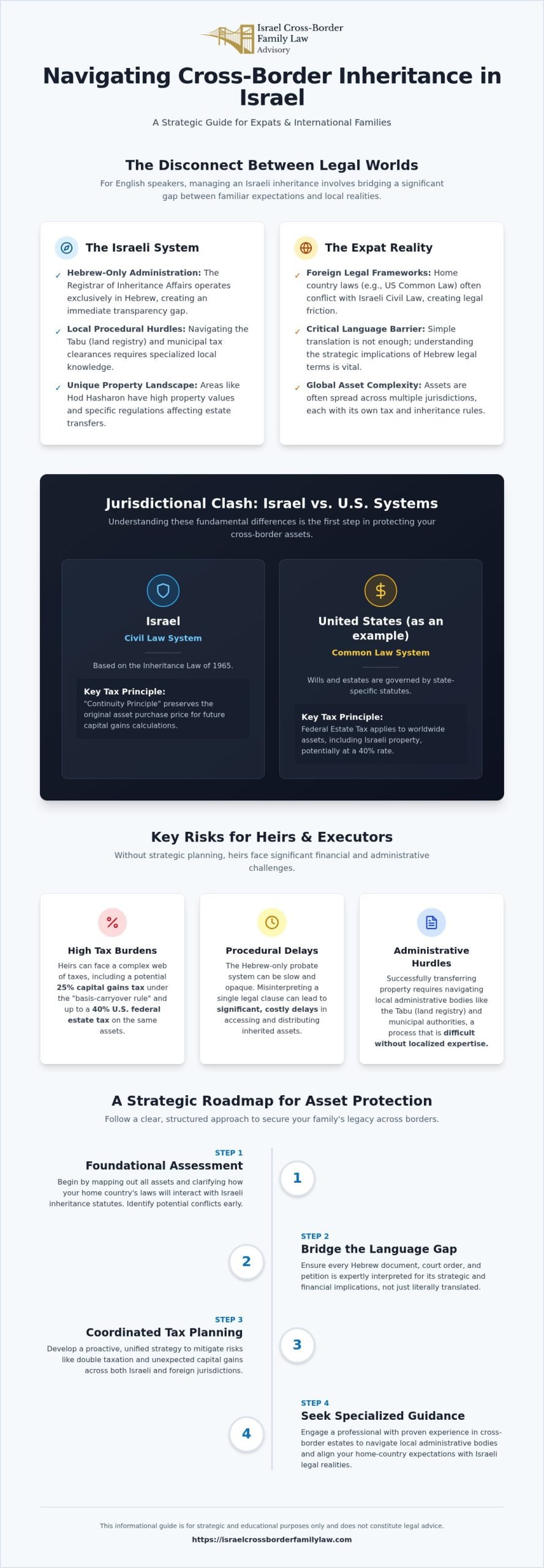
The Registrar of Inheritance Affairs operates entirely in Hebrew, which creates an immediate transparency gap for families who aren’t fluent. Relying on an english speaking inheritance lawyer Hod Hasharon ensures every petition, response, and court order is explained in plain English. This isn’t just about basic translation. It’s about interpreting the strategic implications of legal terms that don’t have direct equivalents in foreign systems. Misunderstanding a single clause in a Hebrew probate application can lead to significant delays or unintended tax consequences for heirs living abroad.
Why Hod Hasharon Heirs Face Unique Challenges
Hod Hasharon features high property values and specific municipal regulations that affect estate transfers. Heirs must navigate the local Tabu (land registry) and municipal tax clearances, which can be particularly slow without localized knowledge. For expats and foreign nationals, these local hurdles require a guide who understands the neighborhood’s administrative quirks. Strategic decisions, such as whether to sell or hold a property in the Sharon region, must account for the Israeli “continuity principle” of taxation, which preserves the original purchase price for future capital gains calculations.
The Complexity of Cross-Border Estates: Israel vs. US Jurisdictions
Managing an estate that spans the Atlantic requires more than just local knowledge; it demands a deep understanding of how two distinct legal frameworks collide. While Israel operates under a civil law system rooted in the Inheritance Law of 1965, the US relies on a common law approach. This difference often leads to friction when a US-based will is presented to the Israeli Registrar. US citizens are subject to federal estate tax on their worldwide assets, which includes property in Hod Hasharon. Without a coordinated strategy, families risk the 40% US federal tax rate on assets exceeding the $13.99 million threshold, while simultaneously navigating Israeli capital gains obligations. Consulting an english speaking inheritance lawyer Hod Hasharon helps identify these jurisdictional overlaps before they become costly liabilities.
The US-Israel tax treaty provides some relief, but it doesn’t eliminate the complexity of “basis” differences. In the US, heirs benefit from a “step-up in basis,” where the asset’s value is reset to its market value at the time of death. Israel, however, applies a “continuity principle,” meaning the heir inherits the deceased’s original purchase price. When you eventually sell that family home in Hod Hasharon, the 25% capital gains tax is calculated from that original, often much lower, price. You can examine your strategic options to mitigate these divergent tax treatments through early planning.
Understanding the Israeli Probate Order (Tzav Yerusha)
To access any asset in Israel, you must obtain a Tzav Yerusha (Succession Order) or a Tzav Kiyum Tzava’a (Probate Order). This process involves filing a digital petition with the Registrar of Inheritance Affairs, a step that is mandatory when represented by an attorney. While the standard timeline for an order is 40 to 50 days, foreign wills often face delays. The Registrar typically requires a “Foreign Law Expert Opinion” to validate the will’s standing under the laws of the deceased’s home state. These opinions can cost between ₪5,000 and ₪15,000, and failing to provide a precise document can stall the process for months.
US Reporting Requirements for Israeli Inheritance
Receiving an inheritance from Israel isn’t just a local matter for US taxpayers. The IRS requires strict reporting through Form 3520 if the value of the foreign gift or estate exceeds $100,000. Additionally, if the inheritance includes Israeli bank accounts, you must remain compliant with FBAR (Foreign Bank and Financial Accounts) and FATCA reporting. These aren’t tax-paying events, but the penalties for non-disclosure are severe. Your strategy in Hod Hasharon must be mirrored by precise reporting in the US to ensure full transparency across both jurisdictions.
Essential Criteria for Selecting an English-Speaking Lawyer in Hod Hasharon
Selecting an english speaking inheritance lawyer Hod Hasharon requires looking beyond basic linguistic fluency. You need a professional who understands the friction between Israeli probate requirements and your home country’s estate expectations. The most effective advisors hold multi-jurisdictional experience, allowing them to anticipate how an Israeli inheritance order might impact your US tax standing or foreign trust structures. They should be able to explain complex legal strategy in plain English, ensuring you understand the risks before any documents are filed with the Registrar.
A significant advantage of choosing a local professional in the Sharon region is their established network of auxiliary experts. Cross-border estates often involve high-value real estate that requires precise valuation from local appraisers who understand the Hod Hasharon market. Your advisor should coordinate seamlessly with these professionals, as well as with your existing tax accountants abroad, to ensure a unified strategy. Transparency is equally vital. Look for an “unbundled” service model where you pay for specific strategic milestones rather than open-ended hourly fees that can quickly deplete the estate’s value.
The ‘Anglo-Friendly’ Vetting Process
When vetting potential advisors, focus on their specific experience with US-Israel estates. Ask how many cases they have handled involving foreign-resident heirs and what their process is for coordinating with US tax professionals. A physical presence in the Sharon region is a practical necessity for property-heavy estates. It allows the lawyer to manage local municipal clearances and land registry filings efficiently, which are often the primary source of delays for heirs living overseas. During your initial consultation, pay attention to whether they use jargon or if they translate Israeli concepts into terms that align with your financial reality.
Strategy Over Filing: The Advisory Difference
There is a fundamental difference between a “paper pusher” who simply files forms and a strategic advisor who protects your long-term interests. In cross-border cases, the filing is often the easiest part; the real work lies in making early decisions that prevent future litigation or tax traps. For example, deciding whether to renounce an interest in an estate or how to structure a family agreement requires deep foresight. You can learn more about how the advisory works to prioritize clarity and informed choice at every stage of the process.
Strategic Decision-Making for Heirs and Executors
When a loss occurs in Israel, the immediate pressure to take action can lead to hasty decisions that complicate the estate for years. A strategic approach focuses on mapping the entire estate before filing any documents. This is particularly vital in Hod Hasharon, where property values are high and the administrative requirements are strict. An english speaking inheritance lawyer Hod Hasharon helps you prioritize immediate tasks, such as securing physical assets and notifying local institutions, while keeping the long-term cross-border implications in mind. Protecting the estate’s value starts with understanding the risks of inaction or incorrect filings.
One of the most significant decisions for international heirs involves the fate of Israeli real estate. Deciding whether to sell or hold a property in Hod Hasharon isn’t just about market timing; it’s about tax residency and future liabilities. If you choose to sell, you must account for the Israeli capital gains tax and the potential reporting requirements in your home country. Managing liquid assets and bank accounts also requires care. Israeli banks often freeze accounts immediately upon the death of an owner, and releasing those funds to foreign heirs involves navigating complex anti-money laundering regulations and US reporting rules.
Step 1: Asset Discovery and Protection
Locating assets in Israel from the US can be a daunting task. You need to search government databases and coordinate with local financial institutions to ensure no bank accounts, insurance policies, or pension funds are overlooked. Securing a property in Hod Hasharon is equally important. This may involve changing locks, ensuring insurance remains valid, and managing utility payments from abroad. Using a confidential case review allows you to create an initial map of the estate, identifying what needs immediate protection before the formal probate process begins.
Step 2: Choosing the Right Legal Path
The path you take depends on whether the deceased left a valid will. If a will exists, you apply for a Probate Order (Tzav Kiyum Tzava’a). If there is no will, you must apply for a Succession Order (Tzav Yerusha). Each path has different requirements for documentation and notification. In cases where heirs are minors or cannot be located, the Israeli Administrator General may intervene to protect their interests. This oversight can add months to the timeline, making it essential for expats and foreign nationals to choose the most efficient legal route from the start.
How Our Advisory Simplifies Your Cross-Border Inheritance Journey
Managing a multi-jurisdictional estate requires more than just local filings; it demands a bridge between divergent legal cultures and financial expectations. Our advisory serves as this bridge, connecting your home-country financial goals with the practical realities of the Israeli system. We recognize that families in Hod Hasharon often hold assets that are part of a larger, global portfolio. Finding an english speaking inheritance lawyer Hod Hasharon who understands these nuances is the first step toward a unified strategy that prevents your assets from being eroded by administrative friction or avoidable tax liabilities.
Our approach is built on transparency and coordination. We provide an unbundled pricing model, ensuring you understand the cost of each strategic milestone before work begins. This eliminates the uncertainty often associated with open-ended hourly billing in complex probate cases. By acting as a central hub, we coordinate with your existing US-based accountants and local Israeli professionals to ensure every decision, from property valuations to bank account releases, is made with a complete view of your cross-border obligations.
Clarity Before Commitment
We believe that education is the foundation of any successful estate transition. Before taking any formal action with the Registrar of Inheritance Affairs, we prioritize providing you with a comprehensive understanding of the risks and opportunities unique to your case. A confidential consultation allows for a high-level mapping of your family’s assets, identifying potential conflicts between US and Israeli law early in the process. This proactive strategy reduces the likelihood of future litigation among heirs and ensures that the transition of wealth is as seamless as possible. Get clarity before you commit. Request a confidential consultation.
Expertise in Complex US-Israel Matters
Our advisory has successfully guided families through intricate scenarios, including the resolution of inherited real estate disputes where heirs were spread across multiple continents. For those inheriting family businesses or complex corporate interests, navigating US-Israel M&A provides additional context on how business-related transitions are managed within this cross-border framework. You can also access a wealth of informational resources and strategic guides on the Israel Family Law Channel. These resources are designed to help you make informed choices while maintaining full compliance with both Israeli statutes and US reporting requirements.
Securing Your Family’s Global Legacy in Hod Hasharon
Managing the transition of cross-border assets requires a proactive approach that respects both Israeli probate timelines and foreign tax reporting duties. By prioritizing strategy early in the process, families can avoid common pitfalls like the 40% US federal estate tax or the Israeli basis-carryover rules. Whether you’re managing high-value real estate or complex financial holdings, the right guidance ensures your family’s interests remain protected across borders. An english speaking inheritance lawyer Hod Hasharon serves as a vital bridge, translating intricate Hebrew documentation into a clear, actionable roadmap.
Our specialized focus on US-Israel estates provides the strategic clarity needed to navigate multi-jurisdictional complexity with confidence. We emphasize a collaborative model that works alongside your existing professional team to achieve a unified outcome. This advisory approach replaces confusion with informed choice and steady direction, ensuring that every decision serves your long-term objectives.
Taking the first step toward strategic planning today ensures your family’s legacy remains secure for the future.
Frequently Asked Questions
Do I need a lawyer in Hod Hasharon if the deceased lived in the US?
Yes, you generally require a local order if the deceased owned assets in Israel, as US probate courts lack jurisdiction over Israeli property. An english speaking inheritance lawyer Hod Hasharon facilitates this by obtaining a probate or succession order from the Israeli Registrar. This professional serves as a link between the two systems, ensuring that local administrative steps align with the broader goals of a US-based estate plan while managing Hebrew-only documentation.
How long does the Israeli probate process take for foreign residents?
The timeline for foreign residents is often extended due to additional evidentiary requirements. While a standard inheritance order might be issued within 50 days, foreign wills usually require an Expert Opinion on Foreign Law and notarized translations. These steps, along with the mandatory 14-day objection period after publication, mean that international cases often take several months to conclude. Strategic preparation of documents from abroad is the most effective way to prevent unnecessary delays.
Can an English-speaking lawyer in Israel help with US estate taxes?
A strategic advisor in Israel coordinates with your US tax professionals to ensure a unified approach to global assets. While they focus on Israeli inheritance law, they understand how local decisions affect US reporting obligations like Form 3520 or FBAR. This collaboration is vital for US citizens to identify potential tax credits under the US-Israel treaty and to manage the differences between the US step-up in basis and the Israeli continuity principle.
What are the costs associated with inheritance in Hod Hasharon?
Inheritance costs include government filing fees for the Registrar and mandatory newspaper publication charges. For foreign residents, you must also budget for notarized Hebrew translations and a Foreign Law Expert Opinion, which is a standard requirement for validating non-Israeli wills. Professional fees for an english speaking inheritance lawyer Hod Hasharon are typically unbundled and based on specific milestones. We prioritize transparency, ensuring you have a clear understanding of all administrative and strategic costs before the probate process begins.
Is it possible to manage an Israeli inheritance entirely from the US?
It’s entirely possible to manage the process from abroad by granting a power of attorney to a local advisor. This allows all filings with the Registrar of Inheritance Affairs, bank communications, and land registry updates to be handled without you traveling to Israel. Since digital submission is now mandatory for lawyers representing petitioners, the system is well-equipped to handle the needs of international heirs and executors living in the US.
What happens if there is no will for assets located in Israel?
When no will exists, the estate is distributed according to the Israeli Inheritance Law of 1965. This legal framework defines the specific proportions given to the surviving spouse, children, or other relatives. For international families, these default rules may not align with their home country’s laws or personal wishes. Understanding these statutory distributions early is essential for heirs to make informed decisions about family agreements or renouncing interests before the formal succession order is issued.
How do I transfer an apartment in Hod Hasharon to my name after probate?
Transferring an apartment requires registering the inheritance order with the Land Registry, known as the Tabu. You must provide the original probate order along with municipal tax clearances confirming that all local levies and debts have been settled. In Hod Hasharon, this involves coordinating with the local municipality to obtain the necessary certifications. Correct registration is a prerequisite for any future sale or management of the property, making it a critical final step.
Does the Israeli government take inheritance tax from US beneficiaries?
The Israeli government doesn’t currently levy an inheritance or estate tax, as this was abolished in 1981. US beneficiaries receive their inheritance without an Israeli tax bite at the moment of transfer. However, US citizens must still account for US federal estate taxes on their worldwide assets if the estate exceeds the exemption threshold. Additionally, future sales of inherited Israeli real estate will trigger capital gains tax based on the deceased’s original purchase price.

Article by
Gabriel Lior
A Personal Journey That Became a Mission
The advisory was founded by an American father Gabriel Lior, LLB, MBA , global entrepreneur, and cross-border advisor who spent more than a decade navigating the Israeli family court system firsthand and now lives in Singapore with his son.
As a divorced parent in a cross-border family, Gabriel faced nearly every legal challenge a foreign parent can encounter in Israel — including child custody disputes, child support proceedings, property matters in Israel and abroad, false accusations, and complex immigration and relocation proceedings.
Over the years, he learned the hard way how difficult it is for non-Israeli parents to understand the system, identify the right legal strategy, and choose the right legal representation — especially when language, culture, and jurisdictional differences are involved. He also witnessed how foreign parents and new immigrants are often disadvantaged or taken advantage of by service providers and institutions simply because they lack local knowledge or fluency.
From Client to Advisor
To truly understand — and survive — the system, Gabriel pursued formal legal education in Israel, completing two Israeli law degrees, alongside a BA and MBA earned in the United States. This was never about becoming a practicing attorney, but about gaining a deep, structural understanding of how the system works — and where it breaks down for foreign parents.
This rare combination of:
Firsthand client experience
Israeli legal and US business education
International business and negotiation training
Decades of commercial execution
created a unique perspective – one that understands both sides of the table.
After years of litigation, persistence, and at times self-representation, he ultimately succeeded in securing custody of his son and relocating abroad through a rare legal victory in the Israeli Supreme Court — becoming one of the first fathers in Israel to do so under these circumstances.
Disclaimer
Important Disclaimer:
The information provided on this website and in its content is for general informational and educational purposes only and does not constitute legal advice, legal opinion, or legal representation.
Gabriel Lior is not licensed to practice law in Israel (nor is he interested in doing so) and does not provide legal services, despite having completed 2 Law Degrees. The services offered are advisory in nature and are intended to provide general guidance, strategic insight, and information regarding cross-border family law considerations.
No attorney-client relationship is formed by accessing this website, reading its content, or communicating with us.
Any decisions made based on this information are at your own discretion and risk. For legal advice specific to your situation, you should consult a licensed attorney in the relevant jurisdiction.
Where appropriate, we may refer clients to independent, licensed attorneys or professionals. Such referrals do not constitute legal representation and no liability is assumed for services provided by third parties.