Navigating the process of divorce is an inherently complex undertaking, made all the more challenging by concerns over your future relationship with your children and the intricacies of the Israeli family court system. For many parents, the concept of joint custody in Israel represents an ideal outcome-a framework for maintaining a meaningful and active role in their children’s lives. Yet, the path to establishing such an arrangement is often obscured by questions regarding legal standards, financial obligations, and the practical realities of successful co-parenting. This comprehensive guide is designed to provide clarity and confidence. We will navigate the sophisticated legal framework governing shared physical custody, demystify the calculation of child support (mezanot) in these scenarios, and offer strategic guidance on creating a durable and fair parenting plan. Our objective is to equip you with a deep understanding of your rights and responsibilities, empowering you to make informed decisions and advocate effectively for an arrangement that serves the best interests of your children.
Key Takeaways
- Understand that joint custody (משמורת משותפת) in Israel is a comprehensive legal framework encompassing both shared physical custody and joint authority in major decision-making for your children.
- Evaluate key factors, including parental communication and co-location, to determine if a joint custody arrangement is a viable and beneficial option for your family’s specific circumstances.
- Navigating the financial implications is critical, as the framework for joint custody Israel has fundamentally altered traditional child support calculations, impacting parental obligations.
- A detailed and legally enforceable Joint Parenting Plan is an essential tool for mitigating future conflict and providing a clear roadmap for all co-parenting responsibilities.
Understanding Joint Custody (משמורת משותפת) in the Israeli Legal System
In the context of Israeli family law, joint custody (משמורת משותפת) represents a modern legal framework centered on shared parental responsibility. This arrangement dictates that both parents actively participate in the child’s life, sharing not only physical time with the child but also the legal authority to make significant decisions regarding their education, health, and general welfare. It stands in contrast to sole custody, where one parent is designated as the primary physical custodian, while the other typically holds visitation rights. To better understand this complex legal arrangement, the following video provides a clear overview of what joint custody entails in practice:
The Legal Foundation for Joint Custody in Israel
The primary statute governing all matters of child custody is the Capacity and Guardianship Law, 1962. Historically, Israeli courts often defaulted to the ‘Tender Years Doctrine,’ which presumed that maternal custody was in the best interest of young children. However, judicial precedent has evolved significantly, and Israeli Family Courts now increasingly recognize the benefits of shared parenting. While not an automatic default, the model for joint custody in Israel is now a strongly considered option, provided it aligns with the child’s welfare.
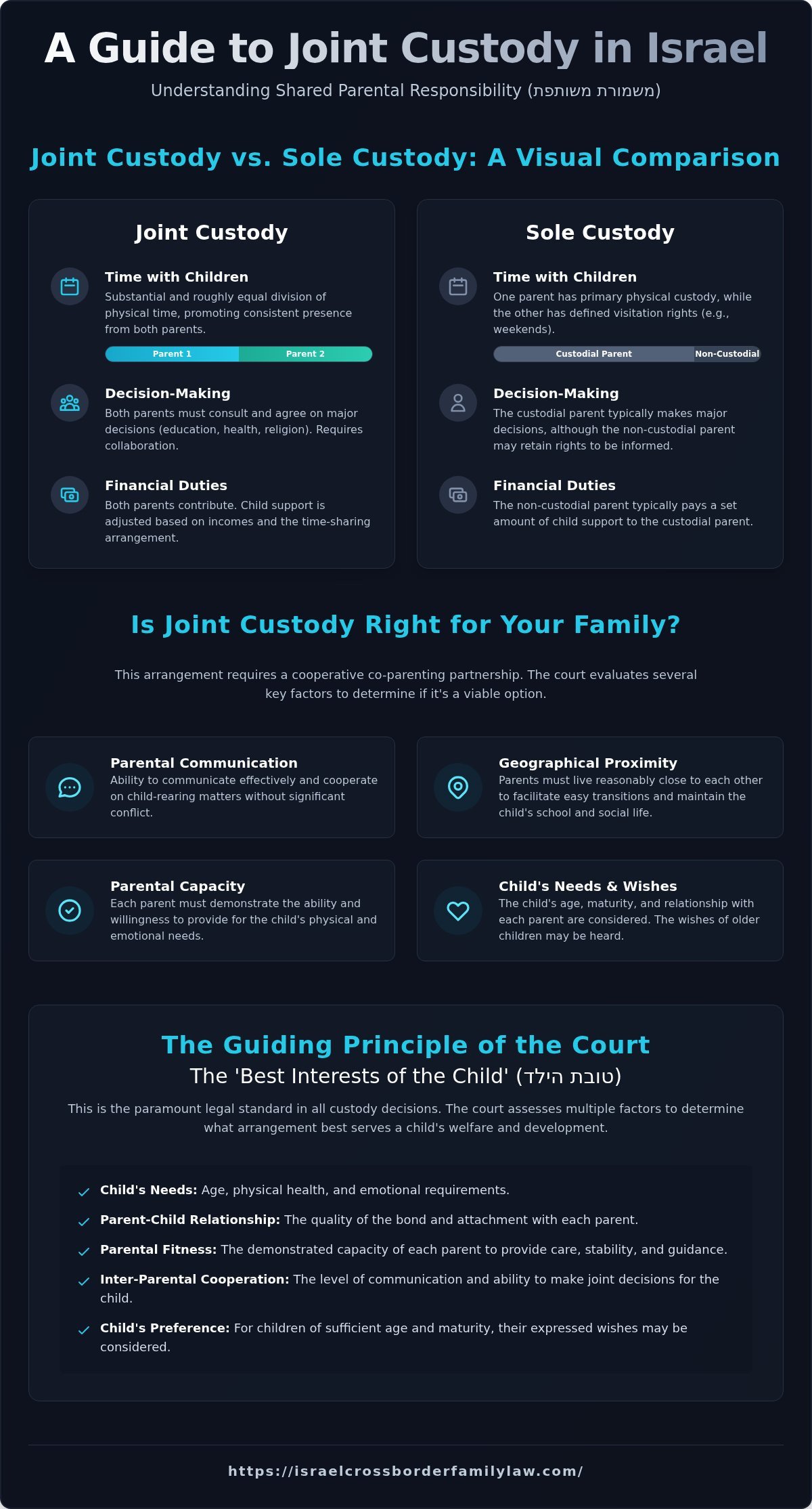
Joint Custody vs. Sole Custody: A Practical Comparison
Navigating the differences between custody arrangements requires a clear understanding of their practical implications. The primary distinctions lie in the division of time, decision-making authority, and financial obligations.
| Feature | Joint Custody | Sole Custody |
|---|---|---|
| Time with Children | Substantial and roughly equal division of physical time, often structured around weekly or bi-weekly schedules. | One parent has primary physical custody; the other has defined visitation rights (הסדרי ראייה), such as weekends and holidays. |
| Decision-Making | Both parents must consult and agree on major decisions (education, medical, religious upbringing). | The custodial parent makes most day-to-day and major decisions, though the non-custodial parent may have rights to be informed. |
| Financial Duties | Both parents contribute financially. Child support may be adjusted based on income levels and the time-sharing arrangement, governed by complex Child support laws in Israel. | The non-custodial parent typically pays a set amount of child support to the custodial parent. |
A successful joint custody arrangement can offer significant psychological benefits, fostering a strong and continuous relationship with both parents and reducing feelings of loss or abandonment for the child.
The ‘Best Interests of the Child’ as the Guiding Principle
Ultimately, all custody decisions made by the Israeli Family Court are dictated by one paramount consideration: the ‘best interests of the child’ (טובת הילד). This is not a vague concept but a legal standard assessed through several key factors, including:
- The child’s age, physical health, and emotional needs.
- The quality of the child’s relationship with each parent.
- The demonstrated capacity of each parent to provide for the child’s needs.
- The level of communication and cooperation between the parents.
- For children of sufficient age and maturity, their own expressed wishes may be taken into account by the court.
Is Joint Custody Right for Your Family? Key Requirements & Considerations
While increasingly favored by Israeli courts, joint custody is not a universal solution suitable for every family. This arrangement demands a profound shift in mindset from a marital relationship to a cooperative co-parenting partnership. It is not a legal battle to be won, but rather a sophisticated framework designed exclusively for the child’s well-being. High-conflict situations, poor communication, or an inability to set aside personal grievances are significant impediments to a successful joint custody outcome. Before pursuing a joint custody israel arrangement, parents should undertake a candid self-assessment. Consider the following foundational questions:
- Can we communicate respectfully and effectively regarding our child’s needs?
- Are we both willing to prioritize our child’s stability over our own convenience or disputes?
- Do we live in sufficient proximity to make shared physical custody practical and non-disruptive for our child?
- Are we both genuinely committed to being actively involved in the day-to-day responsibilities of parenting?
Essential Parental Cooperation and Communication
A successful joint custody agreement is built on a foundation of consistent, high-level communication. This extends beyond major decisions to the daily logistics of a child’s life, including coordinating school projects, medical appointments, extracurricular activities, and social events. To facilitate this, many parents utilize tools like shared digital calendars or specialized co-parenting applications. It is critical to note that a history of domestic violence or severe, unmanaged conflict typically precludes this model, as it fundamentally undermines the safety and trust necessary for cooperative parenting.
Geographic Proximity of Parents’ Homes (The ‘Nearness’ Factor)
The practical viability of joint physical custody often hinges on the geographic proximity of the parents’ residences. Living in the same city, and ideally within the same school district, is crucial for maintaining the child’s stability, routine, and social connections. Frequent and lengthy travel between homes can be disruptive and stressful for a child. This factor becomes particularly complex and requires expert guidance in cases involving international custody and relocation, where significant distance can render a joint physical custody arrangement impractical.
Assessing Each Parent’s Ability and Willingness to Parent
Israeli family courts conduct a thorough evaluation of each parent’s capacity and commitment to active parenting. This assessment goes beyond mere desire; it scrutinizes a parent’s historical involvement, their ability to maintain a flexible work schedule, and their genuine willingness to share the responsibilities of raising a child. The Israeli family courts, whose jurisdiction in these matters is a complex interplay of civil and religious law as noted by the U.S. State Department on Israeli family law, will also consider how new partners might impact the family dynamic, ensuring any new relationship supports, rather than detracts from, the child’s best interests.
The Financial Impact: How Joint Custody Affects Child Support
The financial framework surrounding child support represents one of the most significant and evolving areas of Israeli family law, particularly in cases of joint physical custody. Historically, the father bore the absolute responsibility for child support, irrespective of the time the children spent with him. The modern legal landscape, however, has shifted towards a more equitable model. It is a critical misconception that joint custody automatically eliminates child support obligations; rather, the objective is a fair and proportional distribution of the child’s costs, reflective of each parent’s financial capacity and the time-sharing arrangement.
The Landmark Supreme Court Ruling (BA 919/15)
A pivotal 2017 Supreme Court ruling, known as BA 919/15, fundamentally altered the child support paradigm for children aged 6 to 15. This landmark decision established a new core principle for joint custody israel: both parents are financially responsible for the child’s essential needs. The court mandated that these basic costs be shared between the parents in direct proportion to their respective incomes, moving away from the previous gender-based model and creating a more balanced approach.
Calculating Child Support with Joint Custody
The calculation under this new framework is a sophisticated analysis considering two primary factors:
- The ratio of the parents’ respective disposable incomes.
- The division of physical custody time between the parents.
For example, if Parent A earns ₪20,000 monthly (66.7% of total income) and Parent B earns ₪10,000 (33.3%), and the child’s essential needs are ₪3,600, Parent A is responsible for ₪2,400 and Parent B for ₪1,200. In a 50/50 time split, the higher-earning parent (Parent A) would typically pay a balancing amount of ₪600 to the lower-earning parent to equalize the financial burden.
Dividing Extraordinary and Other Child-Related Expenses
Beyond essential needs, parents must account for ‘extraordinary expenses,’ which include costs such as private education, orthodontic treatment, significant medical care, or specialized therapy. These are typically divided in proportion to parental income, but this requires explicit agreement. A comprehensive parenting plan is essential to delineate responsibility for these costs, preventing future disputes. The complexity of these arrangements is significantly amplified in international cases, where navigating cross-border child support enforcement presents unique jurisdictional and logistical challenges. Properly structuring these financial agreements is crucial for long-term stability. For expert guidance in navigating the sophisticated financial aspects of family law, especially in multi-jurisdictional matters, contact our firm for a confidential consultation.
Creating a Practical and Enforceable Joint Parenting Plan
A successful joint custody arrangement is built upon a comprehensive and meticulously detailed joint parenting plan. This document serves as the essential roadmap for your co-parenting relationship, providing clear guidelines and protocols that significantly reduce the potential for future conflict and litigation. Whether negotiated collaboratively through mediation or determined by the Israeli Family Court, the plan must be submitted to the court to be ratified as a binding legal order. This step transforms an agreement into an enforceable judgment, providing security and clarity for both parents and, most importantly, for the children.
Structuring the Physical Custody Schedule
The core of any plan is the physical custody schedule, which dictates the children’s residential arrangements. A well-defined schedule provides stability and predictability. Common structures include:
- Week-On/Week-Off: Children spend one full week with each parent consecutively.
- 2-2-3 Schedule: Children are with Parent A for two days, Parent B for two days, and then Parent A for a three-day weekend, with the rotation reversing the following week.
The plan must also explicitly outline arrangements for holidays (both religious and national), school vacations, and birthdays. Including provisions for flexibility, allowing for temporary changes by mutual written agreement, is a practical measure for managing unforeseen events.
Making Decisions on Major Issues: Health, Education, and Religion
For a framework of joint custody in Israel to be effective, the plan must specify which significant decisions require mutual consent. These typically involve the child’s education, non-emergency medical or psychological treatment, and religious upbringing. It is crucial to outline a clear process for resolving disagreements, such as engaging a parenting coordinator or mediator, before escalating the matter to court. Furthermore, the agreement should include a clause guaranteeing both parents unimpeded access to all school and medical records.
Communication Protocols and Dispute Resolution
Maintaining respectful and business-like communication is paramount. The parenting plan should establish clear protocols, such as using a dedicated co-parenting app or email for all non-urgent correspondence. To prevent minor disagreements from becoming major legal battles, incorporating a mandatory mediation clause is highly advisable. This requires parents to attempt mediation before filing any court action. The plan should also define a process for periodic review and modification as children age and their needs change. This is a key part of the process for international families facing separation, who must navigate complex multi-jurisdictional issues. Drafting a robust and legally sound parenting plan is a complex undertaking. To ensure your agreement is comprehensive and protects your parental rights, we recommend seeking experienced legal counsel. Contact our firm to navigate this critical process with confidence.
Navigating Your Path Forward with Joint Custody in Israel
Navigating the complexities of joint custody in Israel requires a strategic understanding of its legal, financial, and practical dimensions. As we have explored, a successful arrangement hinges not only on meeting the court’s requirements centered on the child’s best interest but also on a meticulously crafted and enforceable parenting plan. Furthermore, a clear comprehension of the financial implications, particularly how child support is calculated under this model, is critical for long-term stability for your family. For families managing multi-jurisdictional dynamics, these matters become exponentially more complex. Achieving a stable and beneficial joint custody Israel agreement demands sophisticated, bicultural guidance. Our firm brings decades of dedicated experience navigating the Israeli Family Court system. With specialized expertise in US-Israel cross-border family law, our bilingual legal team provides clear, strategic counsel in both English and Hebrew, ensuring you understand every step of this critical process. To protect your parental rights and secure your child’s future, we invite you to Schedule a Confidential Case Review to Discuss Your Custody Options. Taking this decisive step can provide the clarity and confidence needed to move forward.
Frequently Asked Questions About Child Custody in Israel
Is joint custody the default arrangement ordered by Israeli courts?
While there is no statutory default for joint custody in Israel, family courts are increasingly viewing it as a viable and often preferred arrangement. The paramount principle guiding judicial decisions is the “best interest of the child” (טובת הילד). Courts conduct a comprehensive assessment of various factors, including each parent’s capacity, the child’s wishes (depending on age), and the level of parental cooperation. A joint physical custody arrangement is ordered only when it is demonstrably beneficial for the child’s welfare.
What happens if one parent fails to follow the joint custody agreement?
Non-compliance with a court-sanctioned joint custody agreement is a significant legal matter. The aggrieved parent may petition the Family Court for enforcement, which can result in various sanctions against the non-compliant party. These measures can range from financial penalties to compensatory parenting time for the compliant parent. In cases of persistent or severe violation, the court may even reconsider and modify the existing custody order, deeming the arrangement no longer in the child’s best interest.
Can a joint custody arrangement be modified if a parent’s circumstances change?
Yes, a joint custody order can be modified, but it requires a petitioner to demonstrate a “material change in circumstances” to the court. Such changes could include a parent’s relocation (especially internationally), a significant alteration in their work schedule rendering them unable to fulfill their duties, or a change in the child’s needs. The court will only approve a modification if it is convinced that the new arrangement is essential for serving the child’s best interests.
Does the ‘Tender Years Doctrine’ (presuming custody for mothers of young children) still apply in Israel?
The ‘Tender Years Doctrine’ (חזקת הגיל הרך), which created a legal presumption in favor of maternal custody for children under six, has been largely set aside by case law in favor of a gender-neutral assessment. However, the child’s age and developmental needs remain a critical consideration. For very young children, the court will still heavily weigh the role of the primary caregiver and the importance of stability when determining the most beneficial arrangement, without an automatic legal presumption for the mother.
How do the Rabbinical Courts in Israel view joint custody arrangements?
The Rabbinical Courts are empowered to adjudicate on child custody, particularly when tied to a divorce proceeding for Jewish couples. While these courts can and do approve joint custody israel agreements, especially when reached by mutual consent, their perspective is fundamentally guided by Halakha (Jewish Law). In contentious cases, their approach may differ from the secular Family Courts. If jurisdiction is contested, the Family Court often becomes the primary forum for determining custody based on the child’s best interests.
What role does a social worker or psychologist’s report play in a joint custody case?
A professional report (תסקיר סעד) authored by a court-appointed expert plays a highly influential role in custody determinations. This assessment provides the court with an impartial analysis of the family dynamic, parental capabilities, and the child’s specific needs. While the court is not legally bound by the report’s recommendations, its findings on matters such as parental fitness and the viability of a joint custody israel arrangement carry substantial weight and frequently guide the final judicial decision.

Article by
Gabriel Lior
A Personal Journey That Became a Mission The advisory was founded by an American father Gabriel Lior, LLB, MBA , global entrepreneur, and cross-border advisor who spent more than a decade navigating the Israeli family court system firsthand and now lives in Singapore with his son.
As a divorced parent in a cross-border family, Gabriel faced nearly every legal challenge a foreign parent can encounter in Israel — including child custody disputes, child support proceedings, property matters in Israel and abroad, false accusations, and complex immigration and relocation proceedings. Over the years, he learned the hard way how difficult it is for non-Israeli parents to understand the system, identify the right legal strategy, and choose the right legal representation — especially when language, culture, and jurisdictional differences are involved. He also witnessed how foreign parents and new immigrants are often disadvantaged or taken advantage of by service providers and institutions simply because they lack local knowledge or fluency. From Client to Advisor To truly understand — and survive — the system, Gabriel pursued formal legal education in Israel, completing two Israeli law degrees, alongside a BA and MBA earned in the United States. This was never about becoming a practicing attorney, but about gaining a deep, structural understanding of how the system works — and where it breaks down for foreign parents. This rare combination of: Firsthand client experience Israeli legal and US business education International business and negotiation training Decades of commercial execution created a unique perspective – one that understands both sides of the table. After years of litigation, persistence, and at times self-representation, he ultimately succeeded in securing custody of his son and relocating abroad through a rare legal victory in the Israeli Supreme Court — becoming one of the first fathers in Israel to do so under these circumstances.
Disclaimer
Important Disclaimer: The information provided on this website and in its content is for general informational and educational purposes only and does not constitute legal advice, legal opinion, or legal representation. Gabriel Lior is not licensed to practice law in Israel (nor is he interested in doing so) and does not provide legal services, despite having completed 2 Law Degrees. The services offered are advisory in nature and are intended to provide general guidance, strategic insight, and information regarding cross-border family law considerations. No attorney-client relationship is formed by accessing this website, reading its content, or communicating with us. Any decisions made based on this information are at your own discretion and risk. For legal advice specific to your situation, you should consult a licensed attorney in the relevant jurisdiction. Where appropriate, we may refer clients to independent, licensed attorneys or professionals. Such referrals do not constitute legal representation and no liability is assumed for services provided by third parties.