This article is published on an independent advisory platform and does not constitute a law firm or an attorney-client relationship. Legal services are provided only by licensed attorneys under a separate engagement.
What if the biggest obstacle to settling an Israeli estate isn’t the law itself, but the thousands of miles between your home and a Hebrew-speaking courtroom? If you’re managing assets from abroad, you already know that distance creates a unique set of pressures, especially when Israeli bank accounts are frozen and legal documents are written in a language you don’t speak. It’s natural to feel concerned about whether a foreign will is even valid in Israel or how long the process will actually take. Finding an experienced probate lawyer for foreign residents israel is often the first step toward gaining control over a complex cross-border situation.
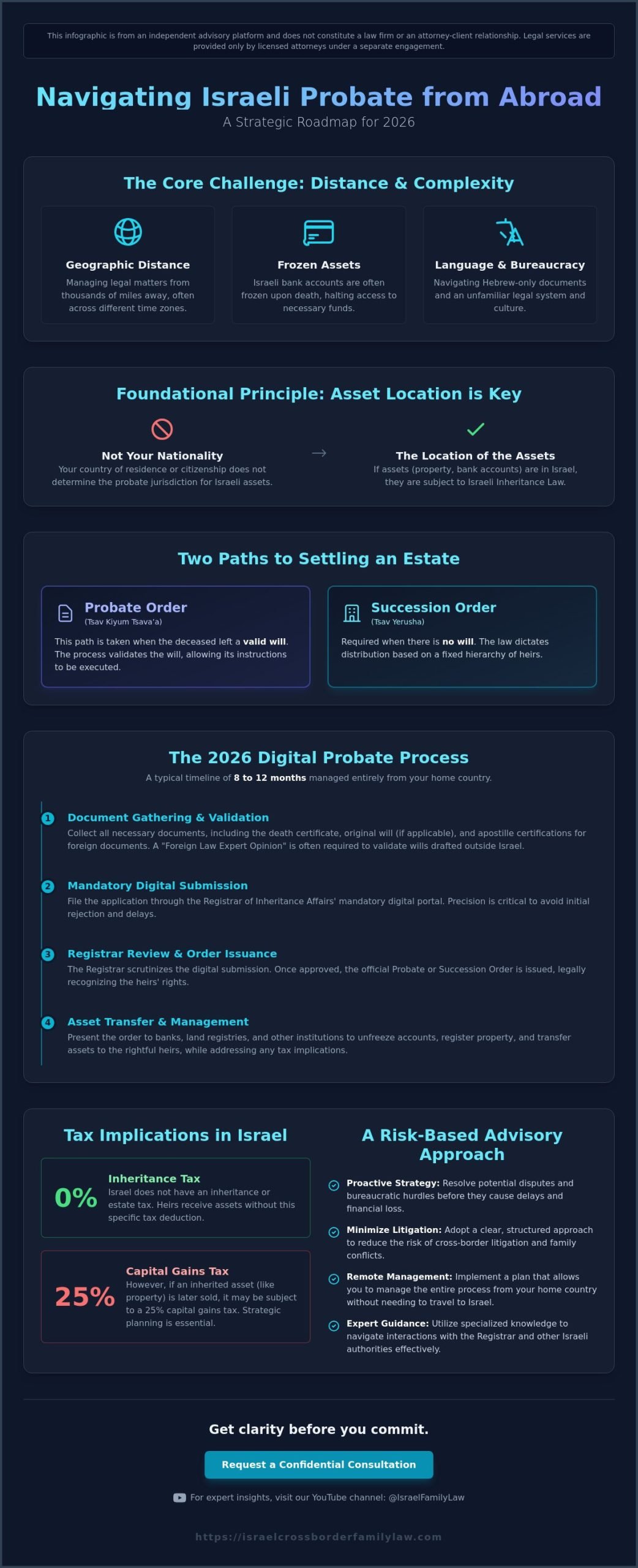
This guide provides a strategic, risk-based roadmap for 2026 to help you navigate the Israeli inheritance system with confidence. You’ll learn about the mandatory digital submission portals, the typical eight to twelve month probate timeline, and how to protect the estate from common pitfalls like the 25% capital gains tax on inherited assets. We’ll show you how to manage the estate entirely from your home country while avoiding the risks of litigation, incorporating expert insights from our specialized resources at https://www.youtube.com/@IsraelFamilyLaw. Get clarity before you commit. Request a confidential consultation.
Key Takeaways
- Distinguish between nationality and asset location to understand why Israeli probate is necessary even for those living abroad.
- Identify the specific documents, such as apostilles and expert opinions, required to validate a foreign will under the 2026 digital filing mandates.
- Explore strategies for a probate lawyer for foreign residents israel to resolve common logistical hurdles like frozen bank accounts and property registration.
- Learn how to adopt a risk-based advisory approach to minimize the potential for cross-border litigation and family disputes.
- Gain clarity on the expected 2026 timelines and the financial impact of capital gains tax versus the absence of inheritance tax in Israel.
This article is published on an independent advisory platform and does not constitute a law firm or an attorney-client relationship. Legal services are provided only by licensed attorneys under a separate engagement.
Understanding Probate in Israel for Foreign Residents
In the Israeli legal context, probate refers to the formal process of validating a deceased person’s estate so that assets can be legally transferred to heirs. While many international families assume their nationality dictates the process, the reality is that the location of the assets is the primary factor. If a person owned property, bank accounts, or investments in Israel, the estate must pass through the local system regardless of where the owner lived or died. This is why engaging a probate lawyer for foreign residents israel is a common step for those managing cross-border successions.
The governing framework for these matters is the Inheritance Law of 1965. This law applies to all assets located within the country’s borders. For foreign residents, the process often feels opaque due to Hebrew-only documentation and the nuances of local bureaucracy. Managing these requirements from thousands of miles away adds a layer of logistical friction that requires a strategic approach rather than a purely clerical one.
To understand how these legal frameworks intersect with financial planning for those connected to Israel, watch this helpful video:
Succession Order vs. Probate Order
There are two primary paths to settling an estate in Israel. A Succession Order (Tsav Yerusha) is required if the deceased died without a valid will. In this case, Israeli law determines the distribution based on a fixed hierarchy of heirs. Conversely, a Probate Order (Tsav Kiyum Tsava’a) is used to validate an existing will. Choosing the wrong application path or failing to account for Israeli land and property laws can delay access to assets by several months. Early clarity on which order you need is essential for a smooth transition.
The Role of the Registrar of Inheritance Affairs
The Registrar of Inheritance Affairs is the government body that oversees all estate filings. In 2026, the Registrar has fully transitioned to a mandatory digital portal for all applications involving foreign residents. This shift aims to streamline the process, but it requires precise digital documentation and specific legal affidavits. The Registrar scrutinizes foreign applications closely, often requiring a “Foreign Law Expert Opinion” to confirm the validity of a will drafted outside of Israel.
Managing these interactions with the Registrar requires a deep understanding of how local authorities view international documents. For many expats and international families, the goal is to resolve these matters remotely without needing to travel. Using a structured strategy helps ensure that the digital submission is accepted the first time, preventing costly back-and-forth with the authorities. You can learn more about how we support expats and foreign nationals through this process. Get clarity before you commit. Request a confidential consultation.
This article is published on an independent advisory platform and does not constitute a law firm or an attorney-client relationship. Legal services are provided only by licensed attorneys under a separate engagement.
The Israeli Probate Process for Foreigners: A Step-by-Step Guide
Executing an estate in Israel requires a sequence of specific procedural actions. In 2026, the Registrar of Inheritance Affairs mandates a digital-first approach for all filings involving international residents. This structured process ensures that the transition of assets is recorded accurately and that all potential heirs are identified. Because the system is entirely in Hebrew, many families choose to coordinate with a probate lawyer for foreign residents israel to manage the remote logistics and ensure compliance with the mandatory digital portal.
- Step 1: Document Collection. You must gather original death certificates and any existing wills. These documents require an Apostille to be recognized by Israeli authorities.
- Step 2: Digital Submission. The application is filed through the Registrar’s portal. This includes the payment of relevant fees and the submission of translated documents.
- Step 3: Public Notification. Every application requires a mandatory public notice in a daily newspaper. As of May 2026, the fee for this publication is 215 NIS.
- Step 4: State Review. The Administrator General’s office reviews the file to ensure there are no conflicting claims or state interests in the estate.
- Step 5: Issuance of the Order. Once the review is complete, the Registrar issues a digital Probate or Succession Order, which allows for the distribution of assets.
Understanding how it works from a strategic perspective can help you avoid the common mistakes that lead to administrative rejection.
Documentation Requirements for Non-Residents
Foreign government documents are not automatically accepted in Israel. You must obtain an Apostille from the issuing country to verify the document’s authenticity. Additionally, any document not in Hebrew must be translated and notarized by an Israeli notary. If the deceased lived abroad, the court requires a “Foreign Law Expert Opinion.” This is a legal affidavit from a practitioner qualified in that jurisdiction, typically costing between 3,000 and 7,000 ILS, confirming the validity of the will under local laws.
Estimated Timelines and Potential Delays
For most foreign residents, the probate process typically takes between 8 and 12 months to reach completion. Simple, uncontested cases may conclude within 3 to 6 months, while complex estates involving multiple jurisdictions can extend beyond a year. Bottlenecks often occur if the digital submission is incomplete or if the Registrar transfers the case to a family court for further deliberation. Monitoring the progress of your case through a dedicated advisory platform helps maintain momentum without the need for international travel. For a more detailed look at your specific situation, you may want to request a confidential case review. Get clarity before you commit. Request a confidential consultation.
This article is published on an independent advisory platform and does not constitute a law firm or an attorney-client relationship. Legal services are provided only by licensed attorneys under a separate engagement.
Foreign Wills in Israel: Validity and Conflict of Laws
When an estate includes assets in multiple countries, the legal principle of Lex Loci Rei Sitae becomes the primary concern. This rule dictates that the law of the place where property is situated governs its distribution. Consequently, even if a deceased person was a resident of New York or London, Israeli law remains the ultimate authority over any real estate located within its borders. While Israeli courts generally respect the intentions of a foreign testator, they require formal proof that the foreign document meets specific legal standards. This procedural bridge is where a probate lawyer for foreign residents israel becomes essential to ensure the will is recognized by the Registrar of Inheritance Affairs.
To gain recognition, the estate must provide a “Legal Opinion on Foreign Law.” This is a mandatory affidavit from an attorney qualified in the jurisdiction where the will was drafted. As of May 2026, this expert opinion typically costs between 3,000 and 7,000 ILS. Without this document, the Israeli Registrar cannot verify that the will is valid under the laws of the foreign state, which effectively stalls the probate process. Relying solely on a foreign will without understanding these local requirements often leads to significant delays and increased administrative costs.
Common Conflicts in Dual-Country Estate Planning
Discrepancies between legal systems often create friction during the probate process. For example, the common law concept of an “Executor” used in the US or UK doesn’t have an exact equivalent in Israel. Instead, the court may need to appoint an “Estate Manager” (Manhel Izavon) to handle local assets. Additionally, while Israel provides broad testamentary freedom, it’s important to understand how the US-Israel Tax Treaty interacts with your planning. Although Israel abolished inheritance tax in 1981, foreign heirs may still face tax obligations in their home countries. You can find detailed discussions on these cross-border nuances at https://www.youtube.com/@IsraelFamilyLaw.
When to Consider a Specific Israeli Will
Many international families opt for a “Silo” approach by maintaining a separate Israeli will specifically for their local assets. This strategy simplifies the process for heirs by removing the need for translated documents and expensive foreign law opinions. It also ensures that the language used doesn’t inadvertently contradict Israeli public policy, which could lead to a will being contested. For those managing complex international lives, creating a localized plan is a strategic decision that provides long-term clarity. You can learn more about divorce and separation for international families to see how life changes impact these plans. Get clarity before you commit. Request a confidential consultation.
This article is published on an independent advisory platform and does not constitute a law firm or an attorney-client relationship. Legal services are provided only by licensed attorneys under a separate engagement.
Logistical Hurdles: Bank Accounts, Real Estate, and Taxes
The immediate logistical aftermath of a death in Israel often takes international families by surprise. Local financial institutions act with significant speed to protect assets, which usually results in the immediate freezing of all bank accounts held by the deceased. This includes joint accounts unless specific legal provisions were established beforehand. For heirs living abroad, this creates an urgent need to manage ongoing costs, such as property maintenance and utility bills, while being unable to access the funds intended for those purposes. Coordinating with a probate lawyer for foreign residents israel is frequently the only way to manage these local institutional requirements without being physically present.
Unfreezing Israeli Bank Accounts
Israeli banks are known for their strict compliance departments, especially regarding anti-money laundering regulations for foreign beneficiaries. A digital Probate Order is the primary key to unfreezing these funds. The process involves more than just presenting the order; you must also satisfy the bank’s internal “know your customer” protocols. This often requires identifying all accounts, including those that may have been forgotten over time. Successfully moving funds out of the country requires a clear strategy to meet both Israeli and international banking standards. You can learn more about our support for expats and foreign nationals dealing with these complexities.
Inherited Real Estate Management
Once a Probate Order is issued, inherited property must be formally registered with the Israeli Land Registry, commonly referred to as the Tabu. This transfer is a mandatory step before any sale or lease can occur. If the heirs decide to sell the property, they must navigate the 25% capital gains tax, known as Mas Shevach. Unlike some other systems, Israel does not offer a “step-up in basis.” The tax is calculated from the original purchase price paid by the deceased, which can lead to a significant tax bill if the property was held for decades. Additionally, heirs should check for any “Betterment Tax” (Heitel Hashbacha) owed to the local municipality for improvements or zoning changes. Speak with our team about your estate management needs to understand these risks before you commit to a sale. Get clarity before you commit. Request a confidential consultation.
This article is published on an independent advisory platform and does not constitute a law firm or an attorney-client relationship. Legal services are provided only by licensed attorneys under a separate engagement.
The Advisory Approach: Strategy Before Representation
Managing an international estate requires a shift in perspective. Most traditional law firms focus on the technical execution of a filing, but for families living abroad, the primary challenge is often the lack of clarity regarding cross-border risks. An advisory approach prioritizes strategy over immediate litigation or clerical action. By identifying potential conflicts between legal systems before they reach a courtroom, you can save significant time and resources. This distinction is critical; while a probate lawyer for foreign residents israel provides the necessary legal representation, an advisory platform serves as a strategic bridge to help you understand the full scope of your situation.
Decisions made in the first few weeks after a death can have long-term consequences for the estate’s value and the harmony of the family. Rushing into a probate application without a clear roadmap often leads to administrative deadlocks or unforeseen tax liabilities. Taking the time to evaluate the landscape allows you to move forward with a plan that accounts for both Israeli bureaucracy and your home country’s requirements. This strategic foundation is what allows for the remote management of assets without the stress of constant uncertainty.
Strategic Risk Assessment
A thorough risk assessment involves evaluating the likelihood of a will contest and performing a cost-benefit analysis of different settlement methods. In some cases, the traditional probate process may not be the most efficient path, especially if assets are held in complex structures. Understanding how the advisory process works helps heirs determine the most stable route for asset distribution. This early clarity prevents the common pitfall of hiring a litigator for a process that could have been resolved through careful strategic planning. It’s about making informed choices based on data and local procedural knowledge rather than reacting to events as they unfold.
Resources for Expats and Foreign Nationals
International families often face a steep learning curve when dealing with the Israeli legal system. To bridge this gap, we provide a variety of educational resources designed to simplify complex concepts. You can explore detailed discussions on international estates through the Israel Family Law YouTube channel. These resources are specifically tailored for those who need to manage their affairs from a distance.
For more specific information on your rights and obligations, we offer dedicated guidance for expats and foreign nationals. This information helps you identify the right legal team for your specific jurisdictional needs. Navigating the 2026 digital requirements and banking compliance is easier when you have a clear understanding of the milestones ahead. Get clarity before you commit. Request a confidential consultation.
This article is published on an independent advisory platform and does not constitute a law firm or an attorney-client relationship. Legal services are provided only by licensed attorneys under a separate engagement.
Securing Your Israeli Estate with Strategic Clarity
Navigating the intersection of two different legal systems requires more than just filling out forms. You’ve seen how the 2026 digital mandates and banking compliance rules create a high bar for documentation and timing. Success in these matters depends on resolving the initial friction of distance and language before it leads to administrative delays. By prioritizing a strategy-first advisory model, you can ensure that foreign wills are recognized and that assets like real estate or frozen bank accounts are managed with precision. The right strategy works.
Choosing an experienced probate lawyer for foreign residents israel is a vital step for international families and expats who need a bridge between US and Israeli jurisdictions. Our focus remains on providing the educational clarity you need to make informed choices without the stress of the unknown. Get clarity before you commit. Request a confidential consultation. You don’t have to face these complexities alone; a structured approach makes all the difference in protecting your family’s legacy.
This article is published on an independent advisory platform and does not constitute a law firm or an attorney-client relationship. Legal services are provided only by licensed attorneys under a separate engagement.
Frequently Asked Questions
Do I need to travel to Israel to handle the probate process?
No, you don’t need to travel to the country to manage the estate. The entire process can be handled remotely by granting a power of attorney to a local representative. Since the Registrar of Inheritance Affairs transitioned to a mandatory digital portal in 2026, documents are submitted electronically. This allows international families to resolve legal matters from their home country without the expense of international travel.
How long does it typically take to get a probate order in Israel?
The timeline for foreign residents typically ranges between 8 and 12 months. If the case is straightforward and uncontested, it might be resolved in 3 to 6 months. However, complex estates involving multiple jurisdictions or disputes can take over a year. Early coordination with a probate lawyer for foreign residents israel helps minimize administrative delays by ensuring all digital filings are complete and accurate from the start.
Is my US will valid for my property in Tel Aviv or Jerusalem?
Yes, an Israeli court can recognize a US will, but it must meet specific procedural requirements. You’ll need to provide an original copy with an Apostille and a “Foreign Law Expert Opinion.” This mandatory affidavit, which usually costs between 3,000 and 7,000 ILS, confirms the will’s validity under the laws of the state where it was drafted. Without these steps, the Registrar cannot validate the document for local assets.
What happens if a relative dies in Israel without a will?
If there’s no will, the estate is distributed according to the Inheritance Law of 1965. Heirs must apply for a Succession Order (Tsav Yerusha) rather than a Probate Order. The law follows a specific hierarchy, usually dividing assets between the surviving spouse and children. Because this process follows a rigid legal formula, it’s important to identify all legal heirs according to Israeli standards early in the process.
Are there inheritance taxes in Israel for foreign residents?
Israel does not have an inheritance or estate tax as of May 2026. This tax was abolished in 1981, and there are currently no plans to reintroduce it. While this is a significant benefit for heirs, you must still consider the tax laws in your home country. US citizens, for example, may still have federal estate tax obligations on their global holdings regardless of where the assets are located.
How can I unfreeze a bank account in Israel from abroad?
A bank account can only be unfrozen once you present a final Probate or Succession Order to the bank’s compliance department. Israeli banks freeze accounts immediately upon notification of death to protect the estate. Accessing these funds requires satisfying strict “know your customer” protocols and anti-money laundering regulations. This process is managed remotely by providing the bank with the validated digital order and required identification documents.
What is an ‘Apostille’ and why do I need one for Israeli probate?
An Apostille is a specialized certificate that verifies the authenticity of a document for international use. You need an Apostille for any foreign government document, such as a death certificate or a notarized will, to be accepted by the Israeli Registrar. It proves to the local authorities that the document is legitimate. Without this certification, the Israeli bureaucracy won’t recognize your foreign paperwork, causing the entire application to be rejected.
Can I sell an inherited apartment in Israel before probate is finished?
No, you cannot formally sell or transfer ownership of an apartment until the probate process is complete. The heirs’ rights must first be registered in the Land Registry, known as the Tabu. This registration requires a final legal order from the Registrar. While you can enter into preliminary negotiations with potential buyers, the legal title cannot move until the estate is settled. Get clarity before you commit. Request a confidential consultation.

Article by
Gabriel Lior
A Personal Journey That Became a Mission
The advisory was founded by an American father Gabriel Lior, LLB, MBA , global entrepreneur, and cross-border advisor who spent more than a decade navigating the Israeli family court system firsthand and now lives in Singapore with his son.
As a divorced parent in a cross-border family, Gabriel faced nearly every legal challenge a foreign parent can encounter in Israel — including child custody disputes, child support proceedings, property matters in Israel and abroad, false accusations, and complex immigration and relocation proceedings.
Over the years, he learned the hard way how difficult it is for non-Israeli parents to understand the system, identify the right legal strategy, and choose the right legal representation — especially when language, culture, and jurisdictional differences are involved. He also witnessed how foreign parents and new immigrants are often disadvantaged or taken advantage of by service providers and institutions simply because they lack local knowledge or fluency.
From Client to Advisor
To truly understand — and survive — the system, Gabriel pursued formal legal education in Israel, completing two Israeli law degrees, alongside a BA and MBA earned in the United States. This was never about becoming a practicing attorney, but about gaining a deep, structural understanding of how the system works — and where it breaks down for foreign parents.
This rare combination of:
Firsthand client experience
Israeli legal and US business education
International business and negotiation training
Decades of commercial execution
created a unique perspective – one that understands both sides of the table.
After years of litigation, persistence, and at times self-representation, he ultimately succeeded in securing custody of his son and relocating abroad through a rare legal victory in the Israeli Supreme Court — becoming one of the first fathers in Israel to do so under these circumstances.
Disclaimer
Important Disclaimer:
The information provided on this website and in its content is for general informational and educational purposes only and does not constitute legal advice, legal opinion, or legal representation.
Gabriel Lior is not licensed to practice law in Israel (nor is he interested in doing so) and does not provide legal services, despite having completed 2 Law Degrees. The services offered are advisory in nature and are intended to provide general guidance, strategic insight, and information regarding cross-border family law considerations.
No attorney-client relationship is formed by accessing this website, reading its content, or communicating with us.
Any decisions made based on this information are at your own discretion and risk. For legal advice specific to your situation, you should consult a licensed attorney in the relevant jurisdiction.
Where appropriate, we may refer clients to independent, licensed attorneys or professionals. Such referrals do not constitute legal representation and no liability is assumed for services provided by third parties.