Navigating a divorce is an inherently complex undertaking, but when it involves cross-border jurisdictions and the unique legal landscape of Israel, the challenges can feel insurmountable. For foreign nationals, the prospect of contending with a dual court system-both Rabbinical and civil Family Courts-while facing uncertainty over child custody, international travel, and the division of global assets can be a source of significant anxiety. Understanding the intricate process of a divorce in Israel for foreigners is the first critical step toward protecting your interests and securing a stable future. This comprehensive guide is engineered to provide that clarity, delivering an authoritative roadmap for foreign nationals seeking to dissolve their marriage within the Israeli legal framework. We will guide you through the complete legal process, from establishing jurisdiction and navigating the unique court systems to implementing sophisticated strategies for protecting your children and financial assets. By the end of this article, you will have a clear understanding of your legal rights and the confidence to make informed decisions, including when to engage an expert cross-border lawyer to represent your interests.
Key Takeaways
- The initial determination of jurisdiction is the most critical strategic step, dictating the entire course of your cross-border divorce proceedings in Israel.
- Gain a clear understanding of Israel’s unique dual court system-Rabbinical vs. Family Courts-to select the forum best suited for your specific circumstances.
- Successfully navigate the key stages of the divorce in Israel for foreigners by understanding the procedural requirements and the advantages of reaching a negotiated settlement.
- Prepare for the most complex aspects of an international divorce, including multi-jurisdictional asset division, child custody arrangements, and cross-border support obligations.
First Step: Determining Jurisdiction for Your International Divorce
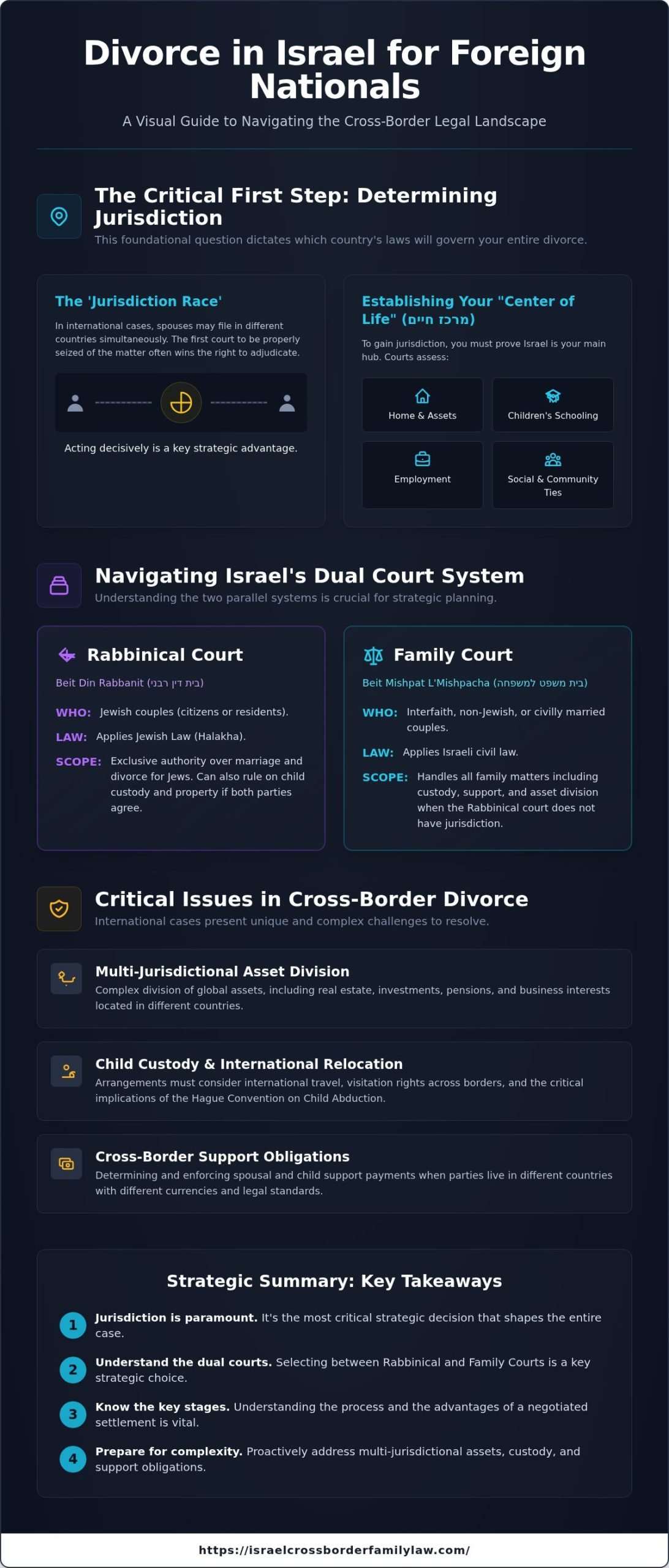
For any international couple, the single most critical preliminary step in the dissolution of a marriage is determining jurisdiction-the legal authority of a court to hear and decide a case. This foundational question dictates which country’s laws will govern matters of property division, child custody, and support. Successfully navigating a divorce in israel for foreigners begins with a clear understanding of where the case can, and should, be heard. Generally, Israeli courts possess jurisdiction if the couple’s last common marital home was in Israel, even if one or both spouses have since relocated. However, the situation becomes substantially more complex when spouses hold different nationalities or reside in separate countries, creating multi-jurisdictional challenges. This complex analysis is a core component of our practice, where we specialize in guiding expats and foreign nationals through these intricate legal matters. To better understand the nuances of this process, our founding partner provides key insights in the video below:
Residency and Connection Requirements
Establishing jurisdiction in Israel requires more than just a physical presence; it necessitates demonstrating that Israel is your “center of life” (merkaz ha’chaim). The family court will assess various factors to determine this connection, including the location of your home and assets, your children’s schooling, your place of employment, and your social and community ties. This applies whether both spouses are foreign nationals living in Israel or if one spouse is an Israeli citizen and the other is not. Proving this connection is a pivotal legal threshold.
The ‘Jurisdiction Race’: Why Filing First Matters
In international divorce cases, it is common for spouses to initiate parallel proceedings in two different countries simultaneously. This creates a “jurisdiction race,” where the first court to be properly seized of the matter often retains the authority to adjudicate the case. The outcome of this race can have profound consequences on the final divorce settlement. Acting decisively and securing timely legal advice is therefore of paramount strategic importance to ensure your case is heard in the most favorable jurisdiction.
When to File in Israel vs. Your Home Country
The decision of where to file is a strategic one that demands sophisticated legal analysis. Key factors that influence this choice include significant differences in international laws regarding:
- Division of marital assets and property
- Child custody, relocation (Hague Convention implications), and support
- Spousal support (alimony) duration and amounts
- The speed and efficiency of the court system
Understanding the nuances of Marriage and divorce laws in Israel is paramount, as they often blend civil and religious legal principles, a significant departure from the common law systems in countries like the United States or the United Kingdom. Choosing the correct forum is not merely a procedural step; it is a critical decision that will shape the outcome of your divorce in israel for foreigners.
Navigating Israel’s Dual Court System: Rabbinical vs. Family Courts
One of the most complex and often confusing aspects of initiating a divorce in Israel for foreigners is the country’s unique dual legal system for family law. Unlike many Western nations with a single civil court structure, Israel maintains two parallel court systems: the religious Rabbinical Courts and the civil Family Courts. The determination of which court holds jurisdiction over your case is not a matter of choice but is dictated by the religious affiliation of the spouses. This initial jurisdictional determination is a critical strategic step, as it profoundly impacts every subsequent aspect of the divorce, from the legal principles applied to property division and child custody.
The Rabbinical Court: For Jewish Couples
The Rabbinical Court (Beit Din Rabbanit) holds exclusive authority over all matters of marriage and divorce for Jewish citizens and residents in Israel, irrespective of their level of religious observance or where they were married. This court operates under ancient Jewish law (Halakha), a legal framework that can be unfamiliar and intimidating for expats. This authority is so comprehensive that the U.S. State Department travel advisory on Israeli divorce courts specifically warns American citizens that these religious courts hold jurisdiction over them in matters of personal status. Even if you are a foreign national who had a civil ceremony abroad, if both you and your spouse are recognized as Jewish, the Rabbinical Court is the sole venue for dissolving your marriage.
The Family Court: For Civil and Interfaith Marriages
The Family Court (Beit Mishpat Le’Inyanei Mishpacha) is the civil judicial body with jurisdiction over family law matters for non-Jewish couples, interfaith couples, or those with no recognized religious affiliation. For couples married in civil ceremonies where at least one spouse is not Jewish, the Family Court handles the process known as “dissolution of marriage.” This court operates under Israeli civil law, which is generally more aligned with Western legal principles regarding equitable distribution of assets, child welfare, and spousal support, making the proceedings often feel more familiar to international clients.
Which Court is Right for Your International Marriage?
Determining the correct forum is the foundational step in your divorce proceedings. The decision generally follows a clear jurisdictional line:
- Both Spouses are Jewish: The Rabbinical Court has exclusive jurisdiction to grant the divorce (get).
- Interfaith or Both Spouses Non-Jewish: The Family Court has jurisdiction to dissolve the marriage.
A critical strategic consideration is the “race for jurisdiction.” While the Rabbinical Court’s authority is limited to the divorce itself, a spouse who files there first can link ancillary matters-such as child custody and asset division-to the divorce claim. This concept, known as binding authority (kricha), can force all related issues to be adjudicated under the principles of the religious court. Given the significant implications of this choice, securing sophisticated legal counsel to navigate this crucial decision is essential for any divorce in Israel for foreigners.
The Divorce Process: Key Stages for an International Family
Navigating a divorce in Israel for foreigners involves a structured legal process designed to address all facets of the family’s dissolution. While every case is unique, the lifecycle follows a predictable path. The Israeli legal system strongly encourages amicable resolution, recognizing that a mutually crafted agreement is invariably superior to a court-imposed decision. A negotiated settlement can often be reached within several months, whereas contentious litigation can extend for over a year. Skilled legal counsel is paramount in guiding clients toward efficient, out-of-court resolutions that protect their interests. For a more granular look at the legal framework, we offer a detailed guide on divorce for international families.
Filing the Initial Claim & Mandatory Mediation
The process formally begins when one spouse files a divorce claim and opens a file with the appropriate judicial body-either the Family Court or, for Jewish couples, the Rabbinical Court. Before any substantive legal arguments can be heard, Israeli law mandates that the couple attend a series of ‘Dispute Resolution’ meetings. This is a form of compulsory mediation intended to provide a forum for de-escalation and encourage the parties to reach a comprehensive settlement before embarking on costly and adversarial litigation.
Crafting a Comprehensive Divorce Agreement
The ultimate goal of negotiation or mediation is a comprehensive divorce agreement (Heskem Gerushin). This legally binding document, once approved by the court, governs all aspects of the separation. For international families, it is critical that this agreement explicitly addresses cross-border complexities. Key components include:
- Child Custody and Relocation: Clear terms for physical custody, visitation rights, and specific protocols for international travel or potential relocation.
- Financial Support: Precise calculations for child support (Mezonot Isha) and spousal support, including mechanisms for cross-border enforcement.
- Division of Assets: A meticulous division of all marital property and debts, including real estate, pensions, and investments located in Israel and abroad.
Litigation vs. Settlement
Should mediation fail, the case proceeds to litigation. This path is significantly more time-consuming, expensive, and emotionally taxing, involving court hearings, witness testimonies, and judicial rulings that leave the final outcome in the hands of a judge. A settlement, by contrast, allows the parties to retain control, maintain privacy, and craft a bespoke agreement tailored to their family’s specific needs. Our role is to provide robust advocacy in either scenario, whether through strategic negotiation to achieve a favorable settlement or through vigorous representation in court.
Finalizing the Divorce: The ‘Get’ or Court Judgment
For Jewish couples, the final step is obtaining a ‘Get’ (a Jewish bill of divorce) through a formal ceremony at the Rabbinical Court. Concurrently, the Family Court issues a final judgment that formally dissolves the civil marriage and gives the divorce agreement the force of a court order. A critical final consideration in a divorce in Israel for foreigners is ensuring the decree is recognized in their home country and any other relevant jurisdictions. The requirements for this vary, as detailed in resources like the International Comparative Legal Guide to Family Law in Israel, making expert legal guidance essential for a seamless cross-border conclusion.
Critical Issues in Cross-Border Divorce Cases
While obtaining the decree of divorce is a primary objective, the most contentious and complex aspects of a divorce in Israel for foreigners often involve ancillary matters. These multi-jurisdictional issues-namely child custody, financial support, and division of global assets-frequently require more sophisticated legal strategy than the dissolution of the marriage itself. Israeli law contains specific provisions for these international family law matters, and navigating them successfully is where an experienced cross-border lawyer provides indispensable value.
International Child Custody and Relocation
In all matters concerning children, Israeli family courts are governed by the paramount principle of the “child’s best interest.” This standard becomes particularly complex when one parent wishes to relocate with a child outside of Israel post-divorce. Such a move requires explicit court permission, which is a significant legal hurdle. Furthermore, as a signatory to the Hague Convention on the Civil Aspects of International Child Abduction, Israel is committed to preventing the wrongful removal of children across borders. We provide dedicated guidance on these sensitive matters of international custody and relocation.
Cross-Border Child and Spousal Support
The determination of child support (alimony) in Israel is based on the child’s needs and the parents’ respective financial capacities. A critical challenge in international cases is the enforcement of these financial orders across different legal jurisdictions. Israel is a party to several international treaties, including the Convention on the Recognition and Enforcement of Foreign Arbitral Awards (the “New York Convention”), which provides a framework for enforcing Israeli support orders abroad and recognizing foreign orders within Israel, ensuring financial obligations are met regardless of where a parent resides.
Dividing International Property and Assets
Israel’s Spouses’ Property Relations Law mandates the equitable division of all marital property under the “Balancing of Resources” arrangement. Crucially, this principle applies to the couple’s entire global asset portfolio, including real estate, bank accounts, pensions, and business investments held in foreign countries. Properly managing the division of a multi-jurisdictional estate demands a sophisticated approach, often requiring international discovery processes and the engagement of forensic accountants and financial experts to accurately trace, value, and divide assets located worldwide. Successfully resolving these intricate cross-border disputes is fundamental to securing your future. For expert guidance on the complexities of an international divorce in Israel for foreigners, contact our firm for a confidential consultation.
Strategic Guidance for Your Cross-Border Divorce in Israel
Successfully navigating a divorce in Israel for foreigners requires a sophisticated understanding of foundational legal principles. From establishing the correct jurisdiction at the outset to strategically selecting between the distinct Rabbinical and Family Court systems, each decision carries significant weight. The complexities are magnified when addressing critical issues like multi-jurisdictional asset division and international child custody arrangements, where the legal and financial stakes are exceptionally high and demand meticulous planning. Protecting your interests in such a complex legal landscape demands experienced counsel. With decades of focused experience in complex US-Israel cross-border family law, our firm provides the strategic guidance necessary to protect your rights. We possess deep, nuanced expertise in navigating both the Rabbinical and Family Court systems, ensuring a comprehensive and robust approach to international asset division and child custody matters. To gain clarity and develop a strategic path forward, we invite you to Schedule a Confidential Case Review and discuss your specific situation with our team. While the path forward may seem daunting, with a dedicated legal partner, you can confidently navigate this process and move toward a secure future.
Frequently Asked Questions
What if we had a civil marriage abroad? Can we still divorce in Israel?
Yes, Israeli courts possess the jurisdiction to dissolve civil marriages conducted abroad. While the State of Israel recognizes foreign civil marriages for registration purposes, the dissolution process is a complex, multi-jurisdictional matter. Cases involving couples of different or no religious affiliation are typically adjudicated in the Family Court rather than the religious courts. Navigating this requires sophisticated legal guidance to determine the applicable law and ensure a valid decree is issued.
How long does a divorce for foreigners typically take in Israel?
The timeline for a divorce in Israel for foreigners is highly variable and depends on the complexity of the case. An amicable divorce with a pre-negotiated settlement agreement can often be concluded within several months. However, contested proceedings involving significant cross-border assets, child custody disputes, or jurisdictional challenges can extend for a year or more. A strategic legal approach is essential to managing the process efficiently and mitigating potential delays.
Will a divorce granted in Israel be automatically recognized in my home country?
Recognition is not automatic and is contingent upon the laws of your home country and existing international treaties with Israel. To facilitate recognition, the Israeli divorce decree must typically be authenticated with an Apostille. However, your home jurisdiction may still require a separate legal process to formally register and validate the Israeli judgment. We advise clients on the necessary steps to ensure the global finality of their divorce across all relevant jurisdictions.
Do I have to be physically present in Israel for the entire divorce process?
While your initial presence may be required to establish jurisdiction or for critical hearings, it is not mandatory to remain in Israel for the entire duration of the proceedings. Experienced international counsel can effectively represent your interests through a legally executed power of attorney for many procedural appearances and negotiations. This allows our global clients to manage their professional and personal obligations abroad while their case progresses efficiently within the Israeli legal system.
What are the official grounds for divorce in Israel’s religious and civil courts?
The grounds for divorce depend on the adjudicating court. In the Rabbinical Courts, which have exclusive jurisdiction over Jewish couples, grounds are based on Jewish Law (Halakha) and can include proven infidelity or irreconcilable differences leading to a mutual agreement. For matters in the Family Court, which handles divorces for non-Jewish or mixed-faith couples, the primary ground is the irretrievable breakdown of the marriage, though the specific foreign law applied can influence the requirements.
How are legal fees for an international divorce structured?
Legal fees for complex, cross-border divorces are typically structured based on an hourly rate commensurate with the expertise of the advising attorneys. A comprehensive retainer agreement will be established at the outset, detailing the hourly rates for partners, associates, and paralegals, all denominated in Israeli Shekel (ILS). For certain well-defined stages, a fixed fee arrangement may be possible. All potential costs and disbursements are outlined with full transparency to ensure clients understand the investment required.

Article by
Gabriel Lior
A Personal Journey That Became a Mission The advisory was founded by an American father Gabriel Lior, LLB, MBA , global entrepreneur, and cross-border advisor who spent more than a decade navigating the Israeli family court system firsthand and now lives in Singapore with his son.
As a divorced parent in a cross-border family, Gabriel faced nearly every legal challenge a foreign parent can encounter in Israel — including child custody disputes, child support proceedings, property matters in Israel and abroad, false accusations, and complex immigration and relocation proceedings. Over the years, he learned the hard way how difficult it is for non-Israeli parents to understand the system, identify the right legal strategy, and choose the right legal representation — especially when language, culture, and jurisdictional differences are involved. He also witnessed how foreign parents and new immigrants are often disadvantaged or taken advantage of by service providers and institutions simply because they lack local knowledge or fluency. From Client to Advisor To truly understand — and survive — the system, Gabriel pursued formal legal education in Israel, completing two Israeli law degrees, alongside a BA and MBA earned in the United States. This was never about becoming a practicing attorney, but about gaining a deep, structural understanding of how the system works — and where it breaks down for foreign parents. This rare combination of: Firsthand client experience Israeli legal and US business education International business and negotiation training Decades of commercial execution created a unique perspective – one that understands both sides of the table. After years of litigation, persistence, and at times self-representation, he ultimately succeeded in securing custody of his son and relocating abroad through a rare legal victory in the Israeli Supreme Court — becoming one of the first fathers in Israel to do so under these circumstances.
Disclaimer
Important Disclaimer: The information provided on this website and in its content is for general informational and educational purposes only and does not constitute legal advice, legal opinion, or legal representation. Gabriel Lior is not licensed to practice law in Israel (nor is he interested in doing so) and does not provide legal services, despite having completed 2 Law Degrees. The services offered are advisory in nature and are intended to provide general guidance, strategic insight, and information regarding cross-border family law considerations. No attorney-client relationship is formed by accessing this website, reading its content, or communicating with us. Any decisions made based on this information are at your own discretion and risk. For legal advice specific to your situation, you should consult a licensed attorney in the relevant jurisdiction. Where appropriate, we may refer clients to independent, licensed attorneys or professionals. Such referrals do not constitute legal representation and no liability is assumed for services provided by third parties.