This article is published on an independent advisory platform (not a law firm). It focuses on strategy, risks, and decision-making guidance. For personalized assistance, feel free to reach out via WhatsApp.
What if the document you shredded and discarded in 2021 is still the legally binding blueprint for your entire estate? Many expats believe that signing a new US will automatically cancels their previous arrangements in Israel. However, without a formal israeli will inheritance revocation, an old document can resurface and trigger costly litigation for your heirs. You’ve likely spent years building assets in two countries, and you deserve the certainty that your current wishes will be honored without a legal battle.
You’ll learn the specific legal requirements for revoking a will under the Israeli Succession Law of 1965 and the strategic risks of mutual wills that often restrict surviving spouses. This guide provides a clear strategy for managing assets across borders so your Israeli and international plans work in harmony. For more visual guides on cross-border estate planning, visit our YouTube channel at https://www.youtube.com/@IsraelFamilyLaw. We’ll help you understand how to navigate these complexities before they become a crisis.
Get clarity before you commit. Request a confidential consultation.
Key Takeaways
Understand the formal legal standards set by the Israeli Succession Law to ensure any cancellation of your testamentary documents is recognized by the authorities in IL.
Identify the three primary methods for israeli will inheritance revocation, including why executing a new will is the most secure way to update your instructions.
Avoid the "Expat Trap" where a general revocation clause in a foreign will can inadvertently trigger complex legal disputes over your Israeli assets.
Learn about the unique "lock-in" nature of Israeli mutual wills and the specific restrictions that apply to changing them while both spouses are still alive.
Establish a proactive strategy for auditing your cross-border estate plan every few years to ensure your international documents remain synchronized and protected.
Table of Contents
Understanding Revocation under the Israeli Succession Law
In the Israeli legal system, revoking a will is a deliberate act that requires more than a casual conversation or a handwritten note. The Succession Law, 5725-1965, serves as the primary governing statute in IL for all matters concerning estates and israeli will inheritance revocation. It defines revocation as the formal legal act of nullifying a previous testamentary document. While people often look at global inheritance laws for general guidance, the Israeli system is very specific about the procedural requirements for nullification. You must execute a revocation using the same formal rigors as the original will’s creation. Mere intent is legally insufficient if it isn’t backed by one of the methods recognized by the state.
To better understand how inheritance works in the absence of a clear, updated plan, watch this helpful video:
The 1965 law recognizes two main paths: express revocation or revocation by implication. Express revocation occurs when you create a new document that explicitly states it cancels all previous ones. Revocation by implication happens when a new will contains provisions that are inconsistent with the old one. In such cases, the newer instructions prevail. There’s also the option of partial revocation, often handled through a codicil. This allows you to update a specific section, such as changing an executor or a specific cash gift, without throwing out the entire document. However, if the changes are extensive, a total annulment and the drafting of a fresh document is usually the safer route to avoid ambiguity during probate.
The Legal Threshold for a Valid Revocation
For an israeli will inheritance revocation to hold up in court, the testator must meet specific capacity requirements. You must be of sound mind and acting of your own free will at the moment of revocation. If there’s any suspicion of undue influence from a beneficiary, the court may disregard the new document. Israeli jurisprudence is built on the "Freedom to Testate" principle, which ensures your right to change your mind until your final day. Because of this, IL courts prioritize the most recent validly executed document. It’s a protection of your autonomy, but it requires that you follow the statutory forms precisely. If a revocation is found to be technically flawed, the court may revert to the previous version by default.
Why "Set It and Forget It" Fails Expats
Expats and international families often assume that relocation or significant life changes automatically update their legal status. In Israel, a divorce or a move to another country doesn’t automatically revoke an existing will. This leads to the appearance of "zombie wills" during the probate process. These are old documents that beneficiaries find in safe deposit boxes or digital files after a death. If a revocation wasn’t formally registered or clearly executed, the court is obligated to follow the last valid document it has. This is why clarity matters before commitment to any estate plan. Relying on common sense instead of the 1965 statute often leads to expensive, multi-year legal battles that deplete the estate’s value. This content is for informational and advisory purposes only and does not constitute legal representation or legal advice. Legal services are provided separately by licensed attorneys.
Get clarity before you commit. Request a confidential consultation.
This article is published on an independent advisory platform (not a law firm). Do NOT use language that implies attorney-client relationship, legal representation, or giving legal advice. Focus on strategy, risks, and decision-making guidance. Soft CTA to advisory call / WhatsApp.
The Three Primary Methods of Revoking a Will in IL
The Israeli Succession Law of 1965 establishes the legal framework for how a person can undo or modify their testamentary decisions. In Israel, a testator retains the absolute right to change their mind at any time before death. This flexibility is vital for international families whose financial or personal circumstances change frequently. There are three primary pathways to achieve a valid israeli will inheritance revocation, and choosing the wrong one can lead to probate delays or family disputes.
Method 1: Drafting a New Will
Executing a new document is widely considered the "gold standard" for revoking a prior will. To be effective, the new document must meet all formal requirements set out in the 1965 Law, such as being signed in front of two witnesses or being written entirely in the testator’s hand. It’s standard practice to include an explicit revocation clause. This clause should state that the new document cancels all previous wills and codicils. Without this specific language, the law applies the principle of implicit revocation. This means the new will only cancels parts of the old one that directly contradict it. For a family owning a ₪5,000,000 property in Jerusalem and assets in the UK, failing to be explicit can create a "patchwork" of conflicting instructions that confuses the court.
Method 2: The Formal Declaration of Cancellation
You don’t always need a new will to cancel an old one. A testator can issue a standalone written declaration of revocation. This document doesn’t need to name new heirs; it simply states that the previous will is null and void. For maximum security, this declaration should be filed with the Registrar of Inheritance (Rasham HaYerusha). Filing with the Registrar creates a public record that prevents the old will from being accidentally probated. This is a strategic move for individuals who know their current will is outdated but aren’t yet ready to finalize a complex new cross-border estate plan. It ensures that if they pass away before the new will is signed, their estate will be distributed according to the default rules of the Succession Law rather than an obsolete document.
Method 3: Destruction and the Burden of Proof
Physical destruction, such as tearing, burning, or shredding the original document, is a recognized method of revocation in Israel. However, this method is fraught with risk, especially for expats. If the original will is missing, the court may operate under a "presumed revocation" theory. Problems arise when copies of the destroyed will still exist in a lawyer’s office or a digital file. Heirs who stand to benefit from the old will can challenge the revocation by claiming the document was simply lost or destroyed by accident. In these cases, the burden of proof is high. The court will require evidence of the testator’s specific intent to revoke the will through that physical act. This often leads to expensive litigation that can cost the estate tens of thousands of shekels in legal fees.
Managing assets across different jurisdictions requires a coordinated approach to ensure your Israeli documents don’t conflict with your foreign ones. You can explore strategic planning options to align your global interests before you finalize any changes.
Get clarity before you commit. Request a confidential consultation.
This article is published on an independent advisory platform (not a law firm). Do NOT use language that implies attorney-client relationship, legal representation, or giving legal advice. Focus on strategy, risks, and decision-making guidance. Soft CTA to advisory call / WhatsApp.
The Expat Trap: Cross-Border Conflicts in Will Revocation
Many expats mistakenly believe a standard "revoke all prior wills" clause in a US document automatically handles their global estate. It doesn’t work that way. In Israel, the Israeli Guardian General and Director of Inheritance Affairs oversees the legal framework for succession, and they require strict adherence to local statutes. If a US will revokes an Israeli one without clearly replacing the provisions for Israeli assets, the estate often enters a legal vacuum. This common pitfall in israeli will inheritance revocation can lead to unintended intestacy, where the state decides who inherits your property.
Israeli courts sometimes apply the Doctrine of Dependent Relative Revocation to fix these errors. This principle suggests that if a testator revokes a will based on the mistaken belief that a new will is valid, the court may ignore the revocation. If your new US will fails to meet Israeli formal requirements, the court might "revive" your old Israeli will to ensure your assets aren’t distributed by default law. It’s a complex, multi-jurisdictional safety net that requires sophisticated legal analysis to trigger correctly.
The Conflict of Laws (Private International Law)
Israeli courts evaluate foreign testamentary acts through the lens of the Succession Law of 1965. While Israel generally respects the "law of the domicile" for movable property like bank accounts, real estate follows the rule of "Situs." Israeli real estate is almost always governed by Israeli law regardless of foreign wills. If you revoke an Israeli will using a foreign document that doesn’t comply with local "Situs" regulations, your Tel Aviv apartment or Jerusalem home could be tied up in probate for years.
Coordinating US and Israeli Estate Plans
The most effective way to manage a global portfolio is through "limited" or "situs" wills. Instead of one global document, you maintain separate wills for each jurisdiction. A limited Israeli will should specifically state it only covers assets in Israel and does not revoke your US estate plan. This prevents the "accidental revocation" of your primary plan by a generic template. Given the high stakes, seeking specialized advisory for foreign nationals is a critical step for anyone with assets in both countries.
Avoid generic templates: US-based "boilerplate" language often lacks the specific terminology required by the Israeli Registrar of Inheritance.
Coordinate dates: Ensure your Israeli and foreign wills are signed in a sequence that doesn’t create israeli will inheritance revocation conflicts.
Local storage: A revoked will should be physically retrieved or formally cancelled with the Israeli Registrar to avoid confusion during probate.
Strategic coordination saves your heirs from the ₪30,000 to ₪60,000 in additional legal fees often required to untangle cross-border inheritance disputes. Professional guidance ensures that your intent in New York or London translates perfectly to the authorities in Jerusalem. Don’t leave your Israeli legacy to the mercy of jurisdictional friction.
Get clarity before you commit. Request a confidential consultation.
This article is published on an independent advisory platform (not a law firm). Do NOT use language that implies attorney-client relationship, legal representation, or giving legal advice. Focus on strategy, risks, and decision-making guidance. Soft CTA to advisory call / WhatsApp.
Special Considerations for Mutual Wills and Divorce
Mutual wills, known in Israel as Zavaot Hedadiyot, create a unique legal framework that significantly complicates the israeli will inheritance revocation process. Unlike a standard individual will that you can change at any time, a mutual will is a reciprocal agreement between spouses. Since August 1, 2005, the Israeli Succession Law includes specific provisions that restrict how and when these documents can be cancelled. This amendment was designed to protect the "reliance interest" of the other spouse, ensuring that one partner doesn’t secretly change their mind after the other has already committed to a joint distribution plan.
The "lock-in" nature of these wills means that unilateral changes are generally prohibited unless specific procedural steps are followed. If both spouses are alive, the party wishing to revoke must provide a written notice to the other spouse. This notice effectively "unlocks" the mutual arrangement, allowing both parties to draft new, independent wills. However, once one spouse passes away, the surviving spouse faces much steeper hurdles. To revoke a mutual will after the first death, the survivor must usually renounce any inheritance they received from the deceased spouse under that will. If the estate has already been distributed, the survivor might be required to return assets or their equivalent value in Israeli Shekels (₪) to the estate before they can legally execute a new testamentary document.
Revoking a Mutual Will: Procedural Hurdles
The requirement for written notice is a strict legal mandate. Attempting a secret revocation often leads to protected litigation in the Family Court, where judges frequently invalidate the "new" will if the proper notice wasn’t served. Some mutual wills also include specific financial penalties or "return of assets" clauses. These clauses dictate that if a survivor changes the will, they lose their right to the deceased’s share of the family home or investment portfolios. You should review the specific language of your 2005-era or later mutual will to understand the exact financial exposure involved in a revocation.
Divorce and the Presumption of Revocation
A common misconception among expats is that divorce automatically cancels an existing will. In many US jurisdictions, "revocation upon divorce" statutes exist, but Israeli law operates differently. In Israel, a divorce decree does not void a previously executed will. If you fail to update your documents, your ex-spouse could still inherit your entire Israeli estate based on a will written a decade ago. This creates a dangerous "limbo" period for international families. If you are going through divorce or separation for international families, you must take immediate steps to draft a new document or formally revoke the old one to reflect your new reality.
The complexity of israeli will inheritance revocation in the context of cross-border lives requires a strategic approach. Waiting until a divorce is finalized or until a spouse passes away can result in irreversible legal consequences. You can learn more about cross-border estate strategy to ensure your assets remain protected under Israeli regulations. Early decisions regarding these "lock-in" clauses are essential for maintaining control over your legacy.
Get clarity before you commit. Request a confidential consultation.
This article is published on an independent advisory platform (not a law firm). This content does not constitute legal advice or an attorney-client relationship. We focus on strategy, risks, and decision-making guidance. For personalized assistance, reach out for an advisory call via WhatsApp.
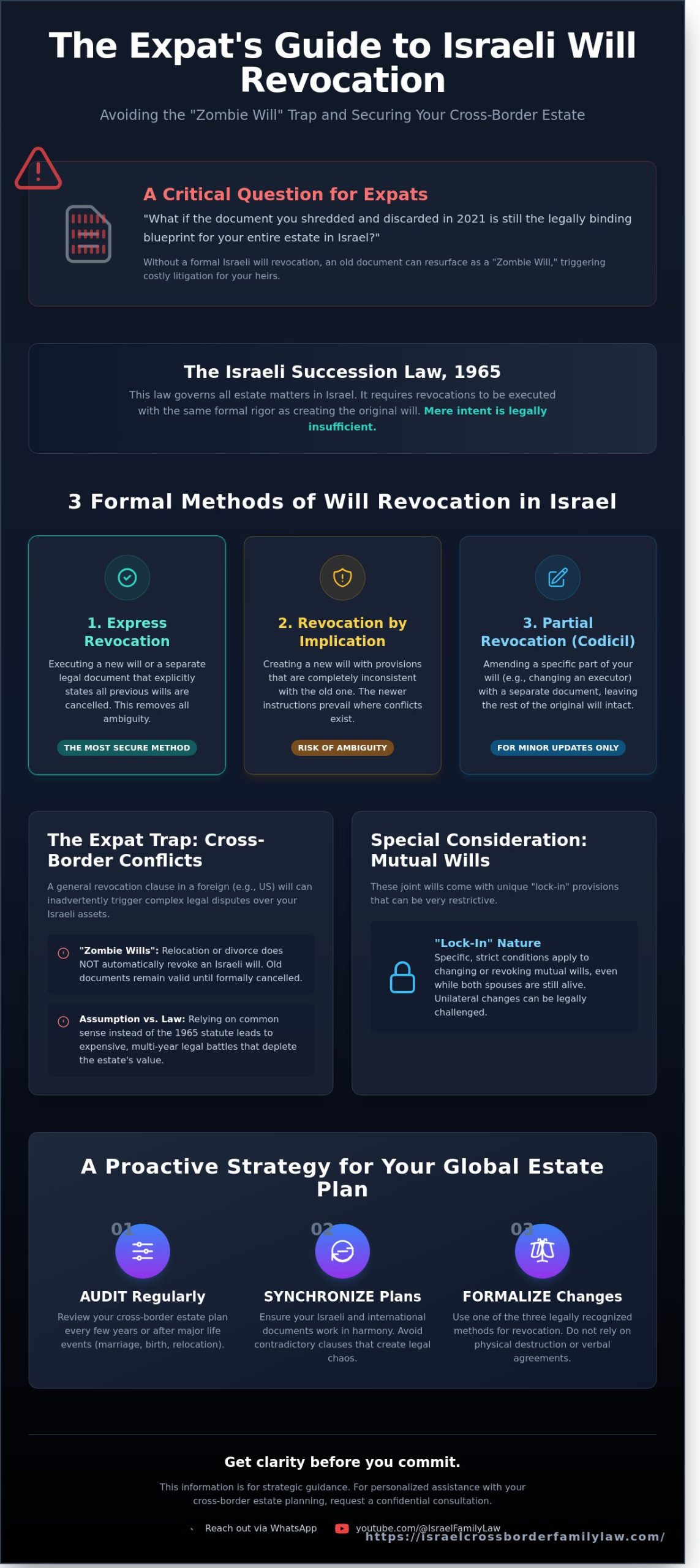
Strategy for Updating Your Global Estate Plan
Managing assets across borders requires more than a "set it and forget it" mindset. An outdated document is often more dangerous than having no document at all. You should conduct a formal "Will Audit" every 3 to 5 years. This timeline ensures your plan accounts for shifts in Israeli tax regulations or changes in your family structure. If you’ve recently purchased property in Tel Aviv or Jerusalem, your current israeli will inheritance revocation strategy needs immediate review.
Secure storage is the bridge between your intent and the law. If the Registrar of Inheritance cannot locate a physical revocation or a new will, they’ll likely proceed with the last known version. This mistake frequently costs families upwards of 40,000 ₪ in unnecessary legal fees. Store documents in a fireproof safe and ensure your executors know the exact location. Digital copies are helpful for reference, but the Israeli court system still prioritizes original physical documents with wet-ink signatures.
A cross-border advisor acts as the essential link between your US and IL legal teams. US attorneys often don’t understand the specific requirements of the Israeli Inheritance Law of 1965. Without this coordination, a US codicil might accidentally revoke your entire IL estate plan. Properly executing an israeli will inheritance revocation requires a bilingual understanding of how these two distinct systems overlap.
Use a clear decision-making framework for changes. Revoke the document entirely if the legal structure is obsolete. Replace it if you’re changing primary beneficiaries or adding significant new assets. Amend the document via a codicil for minor adjustments, such as adding a specific legacy of 75,000 ₪ to a grandchild or charity. Each path has different evidentiary requirements under IL law.
The Importance of Informed Choice
DIY revocation is a high-risk gamble that often fails during probate. The Registrar of Inheritance frequently rejects applications because a homemade revocation didn’t meet strict formalities. Beyond the paperwork, communication is your best defense against future litigation. Explaining your decisions to heirs now reduces the chance of a "will contest" after you’re gone. For complex estates involving multiple properties or business interests, confidential case reviews provide the necessary depth to identify hidden risks before they become public disputes.
Next Steps and Advisory Guidance
Start by educating yourself on the process. The YouTube channel @IsraelFamilyLaw offers visual guides that break down the nuances of inheritance and probate in IL. Before meeting an advisor, prepare a comprehensive list of all global assets, including bank accounts, real estate, and pension funds. Clarity today prevents litigation tomorrow. It’s better to spend 3,500 ₪ on a professional review now than to leave your heirs facing a 120,000 ₪ court battle. Gather your documents, review your beneficiaries, and ensure your global plan is a unified front.
Get clarity before you commit. Request a confidential consultation.
Securing Your Legacy Across Borders
Managing an israeli will inheritance revocation isn’t just about drafting a new document. It’s about ensuring your global intentions are legally recognized in IL. Under the 1965 Succession Law, failing to follow specific procedural steps can lead to costly litigation for your heirs. Expats often face a trap where a US revocation doesn’t meet Israeli standards. This oversight can leave assets worth ₪100,000s at risk of improper distribution.
Your strategy should prioritize clarity across both jurisdictions. Whether you’re navigating the complexities of a mutual will or adjusting your plan after a divorce, professional guidance ensures your documents work together instead of in conflict. We specialize in US-Israel cross-border family law, providing international families with advisory support and clear, transparent pricing models. Don’t leave your legacy to chance or outdated paperwork.
Get clarity before you commit. Request a confidential consultation.
Taking this step today provides the peace of mind that your estate plan remains robust and enforceable regardless of where you live.
This article is published on an independent advisory platform (not a law firm). Do NOT use language that implies attorney-client relationship, legal representation, or giving legal advice. Focus on strategy, risks, and decision-making guidance. Soft CTA to advisory call / WhatsApp.
Frequently Asked Questions
Does getting a divorce in Israel automatically revoke my old will?
No, a divorce decree doesn’t automatically cancel an existing will in IL. Under the Israeli Succession Law of 1965, a will remains valid until the testator takes proactive steps to revoke it or replaces it with a new document. If you don’t formally update your estate plan, your ex-spouse might still legally inherit your assets despite the dissolution of your marriage.
Strategic planning is vital during a separation. You should consider revoking your old will as soon as the divorce process begins to ensure your ₪5,000,000 apartment or Israeli bank accounts don’t end up with an unintended beneficiary. Relying on the court to interpret your "intent" after a divorce is a high-risk strategy that often leads to years of litigation.
Can I revoke my Israeli will by simply telling my family my new wishes?
Oral instructions to family members aren’t legally sufficient to revoke a written will in the Israeli system. Section 36 of the Succession Law is very specific about the methods of revocation, requiring either a formal document or the physical destruction of the original will. Verbal statements are generally inadmissible in the Inheritance Registrar’s office unless they meet the extremely narrow criteria for a "deathbed will" involving two witnesses.
To avoid confusion, you should always document your changes in writing. Relying on conversations creates a vacuum where family members may fight over conflicting memories of your wishes. For more guidance on documenting your intentions, you can view our strategy videos at https://www.youtube.com/@IsraelFamilyLaw.
Will my new US will automatically cancel my previous will in Israel?
A US will only cancels an Israeli will if it contains an explicit revocation clause that covers all prior wills in all jurisdictions. If the US document is silent on foreign assets, you might create a "dual will" scenario where both documents are considered valid. This is a frequent complication in israeli will inheritance revocation cases involving North American expats with assets in both Tel Aviv and New York.
The Israeli Family Court may have to decide which document takes precedence if the instructions conflict. To prevent this, your cross-border strategy should include a clear statement in your newest will that specifically revokes any documents previously signed in IL. This ensures a seamless transition and prevents your executors from facing ₪50,000 in unnecessary legal fees.
What is the risk of revoking a will by physical destruction?
The primary risk of physical destruction is the lack of a paper trail to prove your intent. While tearing up a will is a legal form of revocation under Section 36, it’s difficult to prove that you were the one who destroyed it or that you did so with the intent to cancel it. In 2021, several Israeli cases involved disputes where a "lost" will was presumed destroyed, but the court eventually probated a photocopy found in a lawyer’s archive.
If you choose to destroy a document, you should do so in front of witnesses or send a formal notification to your legal advisor. A better approach is to sign a short, formal "Notice of Revocation" and have it witnessed. This creates an undeniable record and protects your estate from being distributed based on an old, discarded draft.
How do I revoke a mutual will if my spouse refuses to cooperate?
You can revoke a mutual will unilaterally by providing written notice to your spouse while you’re both still alive. Following the 2005 amendment to the Succession Law, if one spouse cancels their part of a mutual will, the entire mutual agreement is typically nullified for both parties. You don’t need your spouse’s consent, but the law requires you to follow a specific notification protocol to make the revocation effective.
If one spouse has already passed away, the surviving spouse faces much stricter rules. In that case, you may have to renounce your entire share of the inheritance from the deceased spouse before you can change your own will. This is a complex maneuver that requires careful timing to avoid losing your ₪3,000,000 share of a family home.
Can I revoke only part of my Israeli will without canceling the whole thing?
Yes, you can revoke specific clauses by creating a "codicil," which is an amendment to your existing will. This document must follow the same formal requirements as the original will, meaning it must be signed in front of two witnesses or a notary. It’s a practical way to change a single beneficiary or update the distribution of a specific ₪500,000 investment portfolio without drafting a 20-page document from scratch.
Ensure the codicil clearly identifies which paragraphs of the original will are being replaced. If the codicil is vague, it can create "latent ambiguities" that force your heirs into the Israeli court system. For a breakdown of how these amendments work in practice, check our educational channel at https://www.youtube.com/@IsraelFamilyLaw.
Is a handwritten note sufficient to revoke a formal typewritten will in IL?
A handwritten note can be legally valid for revocation if it meets the requirements of a "holographic will" under Section 19 of the Succession Law. The entire note must be in your handwriting, dated, and signed by you. However, using a handwritten note to revoke a professional, typewritten document is risky because it’s easier for disgruntled heirs to claim the note is a forgery or was written under duress.
While the law allows it, the "gold standard" for israeli will inheritance revocation is a document signed before two witnesses or a notary. This higher level of formality makes it much harder for anyone to challenge your decision in the future. It’s a small step that provides significant security for your heirs.
What happens if I revoke my will but die before signing a new one?
If you die without a valid will in place, your estate is distributed according to the Israeli Law of Intestacy. This is a rigid formula where the state determines who gets what: typically 50% goes to your spouse and 50% is divided equally among your children. If you have a ₪4,000,000 estate and no will, your preferences for specific charities or friends will be completely ignored.
Intestacy can be particularly problematic for international families or those in second marriages. The state’s default "one-size-fits-all" plan rarely aligns with the complex needs of modern families. It’s always better to have a temporary "bridge" will in place rather than leaving your assets to the default legal formulas provided by the government.
Get clarity before you commit. Request a confidential consultation.

Article by
Gabriel Lior
A Personal Journey That Became a Mission
The advisory was founded by an American father Gabriel Lior, LLB, MBA , global entrepreneur, and cross-border advisor who spent more than a decade navigating the Israeli family court system firsthand and now lives in Singapore with his son.
As a divorced parent in a cross-border family, Gabriel faced nearly every legal challenge a foreign parent can encounter in Israel — including child custody disputes, child support proceedings, property matters in Israel and abroad, false accusations, and complex immigration and relocation proceedings.
Over the years, he learned the hard way how difficult it is for non-Israeli parents to understand the system, identify the right legal strategy, and choose the right legal representation — especially when language, culture, and jurisdictional differences are involved. He also witnessed how foreign parents and new immigrants are often disadvantaged or taken advantage of by service providers and institutions simply because they lack local knowledge or fluency.
From Client to Advisor
To truly understand — and survive — the system, Gabriel pursued formal legal education in Israel, completing two Israeli law degrees, alongside a BA and MBA earned in the United States. This was never about becoming a practicing attorney, but about gaining a deep, structural understanding of how the system works — and where it breaks down for foreign parents.
This rare combination of:
Firsthand client experience
Israeli legal and US business education
International business and negotiation training
Decades of commercial execution
created a unique perspective – one that understands both sides of the table.
After years of litigation, persistence, and at times self-representation, he ultimately succeeded in securing custody of his son and relocating abroad through a rare legal victory in the Israeli Supreme Court — becoming one of the first fathers in Israel to do so under these circumstances.
Disclaimer
Important Disclaimer:
The information provided on this website and in its content is for general informational and educational purposes only and does not constitute legal advice, legal opinion, or legal representation.
Gabriel Lior is not licensed to practice law in Israel (nor is he interested in doing so) and does not provide legal services, despite having completed 2 Law Degrees. The services offered are advisory in nature and are intended to provide general guidance, strategic insight, and information regarding cross-border family law considerations.
No attorney-client relationship is formed by accessing this website, reading its content, or communicating with us.
Any decisions made based on this information are at your own discretion and risk. For legal advice specific to your situation, you should consult a licensed attorney in the relevant jurisdiction.
Where appropriate, we may refer clients to independent, licensed attorneys or professionals. Such referrals do not constitute legal representation and no liability is assumed for services provided by third parties.