The prospect of a holiday abroad with your child should be one of excitement, yet for divorced parents in Israel, it is often overshadowed by significant legal anxiety. The fear of a misunderstanding at Ben Gurion Airport, a challenge from an uncooperative ex-spouse, or even the grave accusation of parental kidnapping can turn a dream vacation into a complex legal ordeal. Navigating the requirements for international travel with child after divorce involves a sophisticated understanding of both domestic Israeli family law and the entry protocols of your destination country, a cross-border challenge where meticulous preparation is paramount. This comprehensive guide is engineered to remove that uncertainty and empower you with strategic legal clarity. We will provide an authoritative checklist of all essential documentation, from notarized consent forms to court orders, ensuring you are fully prepared for border control. Furthermore, we will delve into the precise legal pathways for securing travel permission, offering guidance on how to proceed when your divorce decree is silent on the matter or when facing a lack of consent. Our objective is to guide you through these multi-jurisdictional complexities, ensuring your journey is not only memorable but also fully compliant with all legal mandates for a seamless and stress-free experience.
Key Takeaways
- Understand precisely how your Israeli divorce decree and custody order govern your legal authority to travel abroad with your child, as these documents are the foundation of any travel plan.
- Securing clear, written, and often notarized consent from the other parent is the most critical step; failure to do so can lead to significant legal challenges and denied travel.
- A comprehensive documentation strategy, including valid passports for the child and specific consent forms, is essential for navigating the complexities of international travel with child after divorce.
- Learn how international agreements like The Hague Convention serve as a safeguard against parental abduction and why strict compliance is paramount, especially for cross-border travel between Israel and the U.S.
The Legal Framework: Why International Travel Requires Special Permission
Navigating international travel with a child after a divorce involves more than simply booking flights and packing bags; it requires a comprehensive understanding of a complex legal landscape. Your divorce decree and custody order are not merely domestic agreements but are the foundational documents that define the scope of your parental rights and responsibilities. When you cross an international border, you enter a new jurisdiction with its own laws, and the primary legal concern for global authorities is the prevention of international parental child abduction. This is why strict protocols are in place, regardless of your specific custody arrangement. For a detailed overview of the key legal considerations, the following video provides valuable insights:
Understanding Your Custody Order
Your custody order is a legally binding document that dictates the terms of your co-parenting relationship. It is imperative to review the specific language concerning travel. Pay close attention to any clauses that explicitly require written consent from the other parent for out-of-country travel. It is also critical to distinguish between sole legal custody (the right to make major decisions) and sole physical custody (where the child primarily resides). Even with sole physical custody, the non-custodial parent typically retains legal rights that include consenting to international travel. Ignoring these provisions can lead to severe legal repercussions.
Parental Rights and International Law
The requirement for consent is reinforced by international law and border control procedures worldwide. Most nations, including Israel, recognize the rights of both parents and have implemented stringent measures to prevent wrongful removal. The international framework governing these matters is largely defined by The Hague Convention on the Civil Aspects of International Child Abduction, an agreement designed to secure the prompt return of children wrongfully removed to or retained in any contracting state. Consequently, airline staff and immigration officials are trained to scrutinize documentation for a traveling minor with only one parent. Properly preparing for international travel with your child after divorce by securing the necessary permissions is not just a formality-it is a critical step to protect yourself, your child, and the other parent from legal challenges and to ensure a smooth journey.
Essential Documentation: A Pre-Travel Checklist
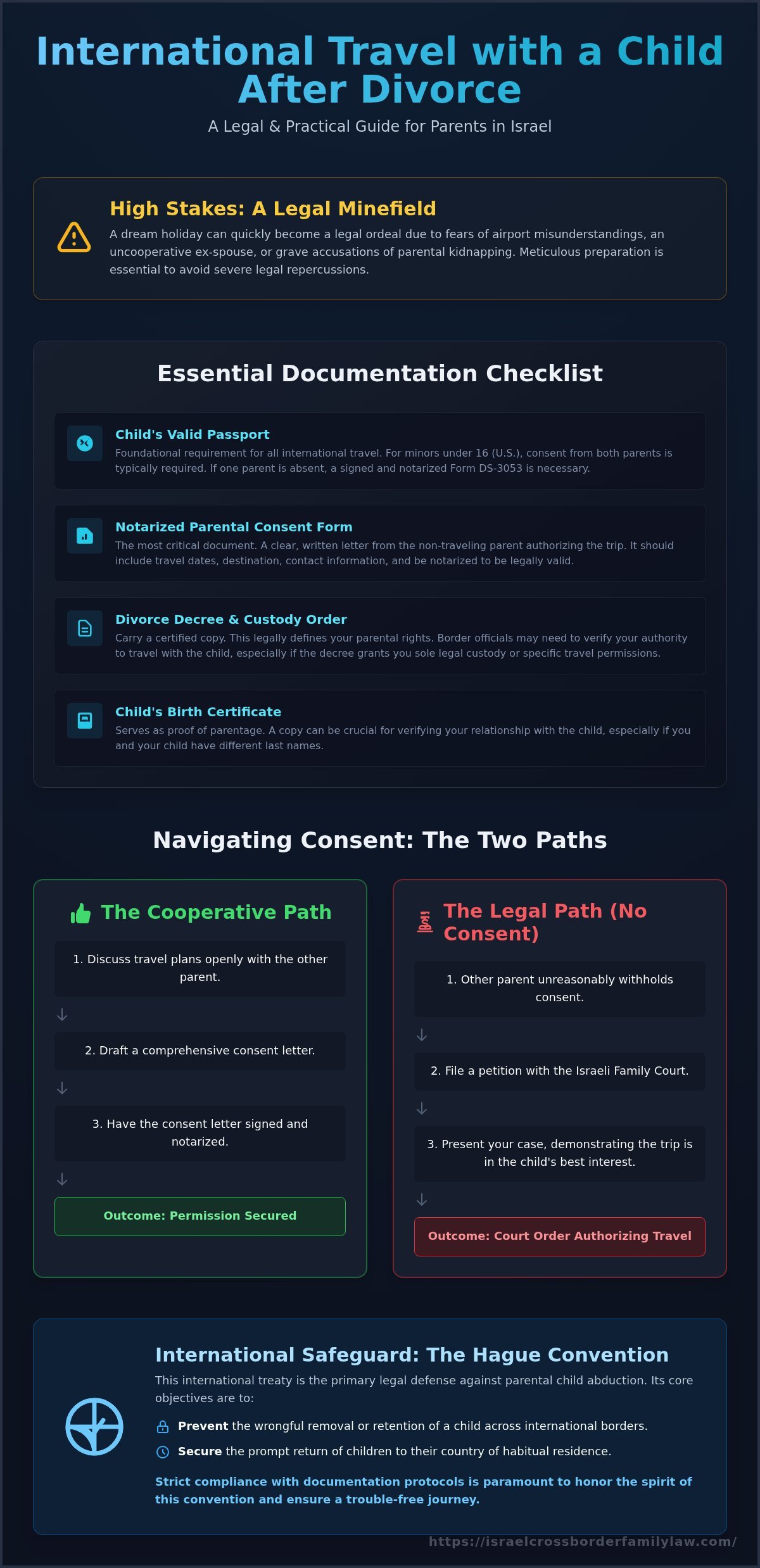
Navigating the complexities of international travel with child after divorce requires meticulous preparation and an unwavering attention to detail. Border officials in Israel, the United States, and worldwide are trained to scrutinize family travel situations to prevent parental child abduction. Assembling a comprehensive portfolio of documents well in advance is not merely recommended; it is a critical step to ensure seamless transit and avoid potentially distressing delays or denial of entry. We advise clients to maintain both secure digital copies and organized physical copies of every document for the duration of their travel.
Obtaining a U.S. Passport for a Minor
A valid passport is the foundational requirement for all international travel, and U.S. federal law mandates that all children, including infants, possess their own. For a minor under the age of 16, consent from both parents is typically required. If one parent cannot appear in person at the U.S. Embassy or Consulate, they must provide a signed and notarized consent form, DS-3053. In cases where you possess sole legal authority, you must present the complete, certified court order as evidence. This process can be lengthy, so initiating the application months before your departure date is essential.
Drafting a Comprehensive Parental Consent Letter
Beyond official government documents, a parental consent letter is your most crucial piece of evidence. This letter demonstrates that the non-traveling parent has granted explicit permission for the specific trip, mitigating any suspicion of wrongful removal. This letter is a primary defense against allegations of wrongdoing, a serious concern you can learn more about through the U.S. Department of State’s International Parental Child Abduction information. A robust letter must be signed, dated, notarized, and include:
- The child’s full name, date of birth, and passport information.
- Specific travel dates and detailed itinerary, including destinations and flight numbers.
- The full name and contact information of the non-traveling parent.
- The full name of the traveling parent or accompanying adult.
Additional Supporting Documents
To present a complete and unimpeachable case for your travel authorization, we strongly advise carrying certified copies of all relevant legal documents. This file should be readily accessible and include, at a minimum, the child’s birth certificate listing both parents, a complete copy of the divorce and custody decree, and any applicable proof of name changes for either the parent or the child. Furthermore, it is your responsibility to verify and secure any necessary visas for your child for the destination country, as these requirements are separate from passport and custody matters.
Navigating Consent: From Cooperation to Court Orders
For any parent planning international travel with a child after divorce, securing the other parent’s consent is a fundamental legal prerequisite. This critical step can range from a simple, cooperative discussion to a complex legal proceeding. Navigating this landscape requires a strategic approach grounded in clear communication, thorough documentation, and, when necessary, decisive legal action. A parent’s refusal to consent can halt travel plans, but an unreasonable objection is not the final word.
When the Other Parent is Cooperative
The most efficient path to obtaining consent is through transparent and proactive communication. By treating the other parent as a partner in the child’s well-being, you can build trust and facilitate a smooth process. We advise clients to provide a comprehensive packet of information, including:
- A detailed travel itinerary with flight numbers, accommodation addresses, and local contact information.
- A clear explanation of the trip’s purpose, whether for family visitation, education, or vacation.
- A proposed time to meet and sign any required passport applications or notarized consent letters.
- Reassurances regarding the child’s safety, return date, and plans for regular communication during the trip.
Addressing an Uncooperative Parent’s Refusal
A refusal to consent demands a careful analysis of the underlying reasons. If the objection is based on a legitimate and specific risk to the child’s safety, it must be addressed. However, a vague fear or a desire to control the situation is not a valid legal basis to deny a child a beneficial travel experience. Legitimate concerns about parental abduction are taken with the utmost seriousness, and understanding official protocols like the U.S. Department of State prevention guidelines can help address these fears constructively. Mediation is often a valuable first step, providing a neutral forum to resolve disputes before resorting to more adversarial measures.
Seeking Court Intervention to Permit Travel
If direct negotiation and mediation fail to yield a resolution, the traveling parent may file a motion with the Israeli Family Court to request permission to travel. The court’s decision will be predicated entirely on the “best interests of the child” doctrine. To succeed, you must present compelling evidence that the proposed trip is beneficial, such as strengthening family ties, providing educational opportunities, or offering a valuable life experience. Successfully representing your case requires sophisticated legal guidance. An experienced family law attorney can navigate the court’s procedures and strategically present your position to secure the necessary travel order.
Preventing Abduction: The Hague Convention and International Safeguards
While most international travel with a child after a divorce proceeds without incident, the risk of parental abduction is a severe and complex concern that demands proactive legal strategy. Navigating the multi-jurisdictional landscape of international family law requires a deep understanding of the treaties and safeguards in place. The primary international instrument designed to address these crises is the Hague Convention on the Civil Aspects of International Child Abduction. Understanding these legal frameworks is not merely a precaution; it is a critical component of managing custody across borders. Proper legal guidance ensures that your rights and your child’s security are protected, transforming a potentially volatile situation into a well-managed plan for international travel with a child after a divorce. This is particularly critical in complex international custody and relocation cases where the stakes are highest.
What is the Hague Convention on Child Abduction?
The Hague Convention is a multi-lateral treaty that establishes a legal framework for the prompt return of a child wrongfully removed from their country of habitual residence. Both the United States and Israel are signatories, providing a crucial, though not guaranteed, pathway for legal recourse. The Convention does not adjudicate custody rights but instead seeks to restore the status quo by returning the child, allowing the proper jurisdiction’s courts to resolve the dispute. For a detailed analysis, you can learn more about the Hague Convention on Child Abduction.
Red Flags for Parental Kidnapping
Vigilance is your first line of defense. Certain behaviors can indicate an elevated risk of parental kidnapping and should prompt immediate consultation with experienced legal counsel. Be aware if the other parent:
- Explicitly threatens to take the child and not return from a trip.
- Has strong family, financial, or personal ties to a country that is not a signatory to the Hague Convention.
- Begins liquidating assets, quitting their job, or selling a primary residence without a clear reason.
- Seeks to obtain a passport for the child without your knowledge or consent.
Proactive Measures to Protect Your Child
Implementing legal safeguards before travel occurs is essential. Our firm advises clients on a range of protective measures tailored to their unique circumstances:
- Enroll in CPIAP: For children with U.S. citizenship, enroll them in the Children’s Passport Issuance Alert Program (CPIAP) to be notified of any U.S. passport applications.
- Strengthen Custody Orders: Ensure your custody agreement or court order contains specific, unambiguous, and enforceable clauses regarding international travel, passport control, and required consent.
- Secure Documentation: Maintain certified copies of your child’s birth certificate, your custody order, and the other parent’s written travel consent. Keep digital and physical copies separate and secure.
If you have concerns about an upcoming trip or recognize any potential red flags, it is imperative to act decisively. We invite you to request a confidential case review to assess your situation and implement the necessary legal protections.
Special Considerations for US-Israel Cross-Border Travel
The complexities of international travel with child after divorce are significantly magnified when navigating the distinct legal landscapes of the United States and Israel. While both nations are signatories to the Hague Convention on the Civil Aspects of International Child Abduction, this shared framework does not eliminate the sophisticated challenges that arise from dual citizenship, differing judicial procedures, and unique domestic regulations. Navigating these multi-jurisdictional issues requires specialized legal counsel with deep experience in both systems.
Israeli Entry and Exit Requirements
Successfully crossing Israeli borders with a minor requires meticulous preparation. Israeli authorities are exceptionally vigilant in preventing parental kidnapping, and a parent traveling alone with a child should expect scrutiny. Before traveling, it is imperative to verify the most current regulations with the nearest Israeli embassy or consulate. To facilitate a smooth process, we strongly recommend preparing a comprehensive travel packet that includes:
- A Notarized Consent Letter: A detailed letter of consent from the non-traveling parent, written in both English and Hebrew, is highly advisable.
- Israeli Passport: Under Israeli law, a minor holding Israeli citizenship is required to enter and exit Israel using an Israeli passport.
- Supporting Documents: Carry original or certified copies of the child’s birth certificate and your divorce decree and custody order.
Harmonizing US and Israeli Court Orders
A US-issued custody order, no matter how detailed, may not be immediately recognized or enforceable by Israeli authorities. To prevent potential disputes or travel interruptions, the order must be clear, unambiguous, and explicitly grant you the authority for international travel. For maximum legal protection, we often advise clients to have their US custody order formally recognized, or “domesticated,” within the Israeli legal system. This crucial step translates your parental rights into a framework that is enforceable in Israel, providing a powerful safeguard should a conflict arise while you are abroad. Our firm possesses extensive experience in this highly specialized area, offering sophisticated legal guidance on the divorce for international families. We are adept at ensuring your legal standing is secure in both jurisdictions, allowing you to focus on your family. If you are planning international travel with a child after divorce, contact our legal team to ensure your rights are protected across borders.
Secure Your Family’s Future in Cross-Border Travel
Navigating the legal framework of post-divorce international travel demands meticulous preparation, from securing unequivocal legal consent and compiling essential documentation to understanding the critical protections of international treaties like the Hague Convention. Successfully managing international travel with child after divorce is not merely a logistical challenge but a significant legal undertaking, particularly within the complex US-Israel corridor where multi-jurisdictional laws intersect. These sophisticated matters require specialized legal counsel to safeguard parental rights and ensure full compliance. Our firm possesses deep expertise in US-Israel family law, with attorneys licensed in both jurisdictions who provide a seamless understanding of cross-border enforcement. For strategic guidance tailored to your unique situation, we invite you to Schedule a Confidential Case Review with our Cross-Border Family Law Experts. With precise legal support, you can protect your child’s best interests and move forward with clarity and peace of mind.
Frequently Asked Questions: Navigating Cross-Border Travel with a Minor Post-Divorce
What happens if I travel internationally with my child without the other parent’s consent?
Undertaking international travel with your child without the explicit, documented consent of the other parent, or a court order permitting such travel, can have severe legal ramifications. This action may be construed as parental kidnapping under Israeli law and international treaties like the Hague Convention on the Civil Aspects of International Child Abduction. You could face immediate legal action upon your return, including criminal charges, significant fines in shekels, and adverse modifications to your existing custody orders.
Does a notarized consent letter expire or is it good for any trip?
A notarized travel consent letter is not a blanket authorization for indefinite travel. For maximum legal validity and acceptance by border control authorities, each letter should be trip-specific. It is standard practice to execute a new letter for every international journey, clearly stipulating the precise travel dates, destinations including all countries to be visited, flight information, and accommodation details. Vague or open-ended letters are frequently challenged and may be deemed insufficient, risking travel disruption.
Can my ex-spouse legally prevent my child from getting a passport?
Yes, an ex-spouse can legally obstruct the issuance of a child’s passport. In Israel, as in many jurisdictions, the passport application for a minor typically requires the signature of both parents. If one parent withholds their consent, the other parent cannot unilaterally procure the passport. In such a deadlock, the parent wishing to travel must petition the Israeli Family Court for an order compelling the non-cooperative parent’s signature or authorizing the passport issuance without it.
Are the rules different if we were never married but have a custody order?
The legal framework governing international travel with a child after divorce is predicated on the formal custody order, not the marital status of the parents. If a court has issued an order establishing paternity, custody, and visitation rights, its stipulations are legally binding. Unmarried parents with a shared custody arrangement are subject to the same requirements for travel consent as divorced parents. The critical document is the court order that outlines each parent’s legal rights and responsibilities.
What if the other parent’s location is unknown?
If the other parent’s whereabouts are genuinely unknown, you cannot simply proceed with travel. You must first demonstrate to the Family Court that you have performed exhaustive and diligent efforts to locate them. This may include searches through public records, last known employers, and mutual contacts. Only after you have provided sufficient evidence of your good-faith search can you petition the court for an order granting you sole authority to apply for the child’s passport and permission for international travel.
Do I need a consent letter for a cruise or a short trip to Canada?
Yes, a consent letter is highly recommended for any form of cross-border travel, irrespective of the duration or destination. A cruise that enters international waters or docks in foreign ports constitutes international travel. Similarly, land border crossings to neighboring countries require proper documentation. Border officials possess broad discretion, and failing to present a consent letter can result in being denied entry or facing significant delays, even for trips that seem routine or brief.

Article by
Gabriel Lior
A Personal Journey That Became a Mission The advisory was founded by an American father Gabriel Lior, LLB, MBA , global entrepreneur, and cross-border advisor who spent more than a decade navigating the Israeli family court system firsthand and now lives in Singapore with his son.
As a divorced parent in a cross-border family, Gabriel faced nearly every legal challenge a foreign parent can encounter in Israel — including child custody disputes, child support proceedings, property matters in Israel and abroad, false accusations, and complex immigration and relocation proceedings. Over the years, he learned the hard way how difficult it is for non-Israeli parents to understand the system, identify the right legal strategy, and choose the right legal representation — especially when language, culture, and jurisdictional differences are involved. He also witnessed how foreign parents and new immigrants are often disadvantaged or taken advantage of by service providers and institutions simply because they lack local knowledge or fluency. From Client to Advisor To truly understand — and survive — the system, Gabriel pursued formal legal education in Israel, completing two Israeli law degrees, alongside a BA and MBA earned in the United States. This was never about becoming a practicing attorney, but about gaining a deep, structural understanding of how the system works — and where it breaks down for foreign parents. This rare combination of: Firsthand client experience Israeli legal and US business education International business and negotiation training Decades of commercial execution created a unique perspective – one that understands both sides of the table. After years of litigation, persistence, and at times self-representation, he ultimately succeeded in securing custody of his son and relocating abroad through a rare legal victory in the Israeli Supreme Court — becoming one of the first fathers in Israel to do so under these circumstances.
Disclaimer
Important Disclaimer: The information provided on this website and in its content is for general informational and educational purposes only and does not constitute legal advice, legal opinion, or legal representation. Gabriel Lior is not licensed to practice law in Israel (nor is he interested in doing so) and does not provide legal services, despite having completed 2 Law Degrees. The services offered are advisory in nature and are intended to provide general guidance, strategic insight, and information regarding cross-border family law considerations. No attorney-client relationship is formed by accessing this website, reading its content, or communicating with us. Any decisions made based on this information are at your own discretion and risk. For legal advice specific to your situation, you should consult a licensed attorney in the relevant jurisdiction. Where appropriate, we may refer clients to independent, licensed attorneys or professionals. Such referrals do not constitute legal representation and no liability is assumed for services provided by third parties.