This content is published on an independent advisory platform and is intended for informational purposes; it does not constitute legal representation or formal legal advice. If you are facing the financial strain of spousal support, you might wonder if a fresh start in a new country could offer a clean slate. It’s a common misconception that individuals can successfully avoid alimony by moving overseas, assuming that international borders will shield them from domestic court orders. While the distance may feel like a barrier, the legal reality is much more interconnected than most people realize.
We understand the confusion that arises when you’re trying to navigate two different legal systems, such as those in the United States and Israel. It’s stressful to worry about legal repercussions while you’re already managing the costs of an international relocation. This article provides clarity on how support orders are enforced across borders and the specific risks you face if you attempt to evade these obligations. You’ll learn about the treaties that allow courts to cooperate and the strategic ways you can seek to modify your payments if your financial circumstances change after moving. Understanding these mechanisms is the first step toward making informed decisions for your future.
Key Takeaways
- This informational content, provided by an independent advisory platform, explains why relocating doesn’t grant immunity from existing support orders.
- Learn about the international frameworks that facilitate the enforcement of spousal maintenance between the US and Israel.
- Understand the severe consequences of trying to avoid alimony by moving overseas, including potential passport issues and domestic asset seizure.
- Explore the legitimate legal path to modify support payments when your financial circumstances or cost of living change significantly.
- Gain a strategic perspective on managing cross-border family law issues without the risks of non-compliance.
This content is published on an independent advisory platform and is intended for informational purposes; it does not constitute legal representation or formal legal advice.
The Myth of Jurisdictional Immunity: Can You Avoid Alimony by Moving?
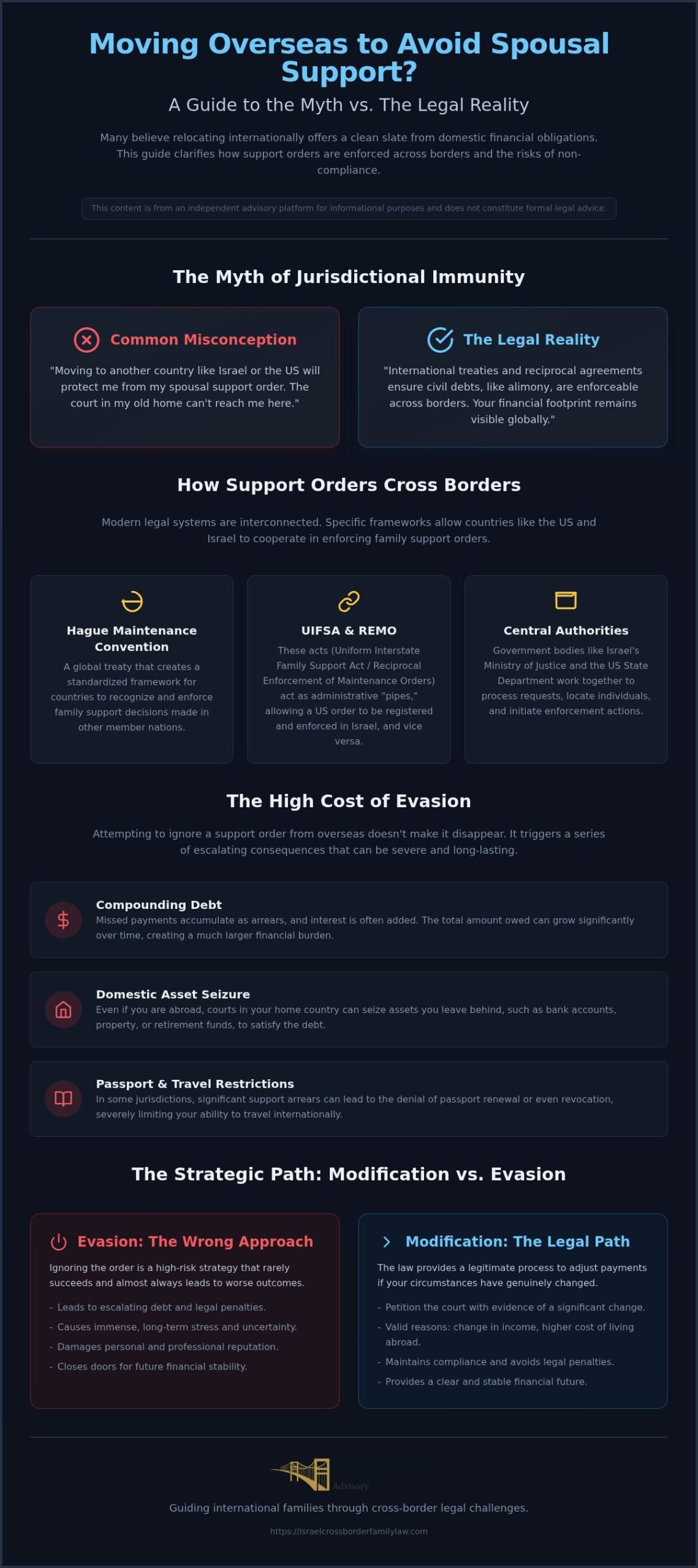
Many people believe that crossing an international border provides a legal shield against domestic obligations. The idea that you can successfully avoid alimony by moving overseas is a persistent myth, often fueled by online discussions suggesting that relocation to a country without an extradition treaty makes you unreachable. However, this perspective overlooks the fundamental distinction between criminal law and civil enforcement. Alimony is a civil debt, and the legal mechanisms used to collect it operate through different channels than those used for criminal prosecution.
In our experience, “disappearing” is no longer a viable strategy for professionals in the modern world. Global banking regulations, inter-governmental data sharing, and sophisticated asset-tracing tools mean that your financial footprint remains visible. Attempting to ignore a support order doesn’t make it go away; instead, it often leads to a compounding financial burden that becomes much harder to manage over time as arrears and interest accumulate.
Civil Debt vs. Criminal Evasion
In the context of international law, extradition is a process reserved for criminal suspects. Since spousal support is a civil matter, a lack of an extradition treaty between two nations is largely irrelevant to the enforcement of a support order. Instead, nations rely on civil treaties and reciprocal agreements to ensure that obligations are met. For example, the Hague Maintenance Convention provides a framework for countries to recognize and enforce support decisions across borders. Debts are now recorded and tracked through international financial systems, meaning that a judgment issued in a US state or an Israeli court can eventually be recognized in your new jurisdiction through administrative cooperation.
The Long Arm of the Law
Courts in the US and Israel typically retain power over individuals who relocate, provided the court had proper jurisdiction when the original order was issued. This is often referred to as “long-arm jurisdiction.” If you lived in a specific jurisdiction and were served legal papers there, that court’s authority doesn’t vanish simply because you’ve moved to Tel Aviv or New York. Legal standing is maintained through “minimum contacts,” which include previous residency or the fact that the family unit was established in that location. Jurisdictional continuity for support orders means that the issuing court maintains the exclusive right to modify or enforce the order until it is legally transferred or terminated. Understanding how cross-border enforcement functions is essential for anyone planning a move between these two legal cultures.
International Enforcement Mechanisms: UIFSA and REMO
The belief that a person can successfully avoid alimony by moving overseas ignores the sophisticated legal frameworks that link the United States and Israel. Modern international law relies on structured cooperation to ensure that support obligations remain enforceable regardless of where the payer resides. Two primary mechanisms, the Uniform Interstate Family Support Act (UIFSA) and the Reciprocal Enforcement of Maintenance Orders (REMO), bridge the gap between these two distinct legal systems. These acts provide the administrative “pipes” through which support orders flow from one country to another.
Israel and the United States maintain a robust reciprocal relationship regarding family support. The Israeli Ministry of Justice, specifically the Department of International Affairs, serves as the Central Authority for processing incoming foreign support requests. This government body works directly with the US State Department and individual state child support agencies to locate payers and initiate enforcement actions within Israeli borders.
How UIFSA Works Across Borders
While UIFSA is a US law, it contains specific provisions for international “responding jurisdictions.” When a US court order is sent to Israel, the process begins with formal registration in the Israeli family court system. This isn’t a new trial; instead, it’s a procedural step that gives the foreign order the same legal weight as a local Israeli judgment. Once registered, the order allows for the same enforcement tools used in domestic cases, such as wage garnishments or bank account liens. Modern electronic document transmission between central authorities has significantly increased the speed of this process. It’s no longer a matter of years to recognize a debt; digital cooperation ensures that files are transferred and processed with high efficiency.
US-Israel Reciprocity in Support Enforcement
Israel is a signatory to several international conventions that prioritize the welfare of families and the fulfillment of financial duties. This commitment means that Israeli authorities are proactive in assisting US agencies. The cooperation between the US State Department and the Israeli Central Authority creates a transparent environment where it’s difficult for a payer to remain anonymous. If you’re managing a move or an existing order, it’s helpful to learn about cross-border enforcement strategies to understand how these treaties might affect your specific situation. These frameworks ensure that the “move and forget” approach is a high-risk strategy that rarely succeeds in the long term. If you have questions about how these treaties apply to your circumstances, you can request a strategy review to gain clarity.
This content is published on an independent advisory platform and is intended for informational purposes; it does not constitute legal representation or formal legal advice.
The Severe Consequences of Non-Payment from Overseas
The assumption that one can successfully avoid alimony by moving overseas often fails to account for the administrative power of the issuing country. While you may be physically located in Israel, your home country maintains significant leverage through its control over your identity documents and domestic assets. These penalties are often automated and triggered by administrative systems rather than individual court hearings, making them difficult to halt once the process begins. For the Anglo expat community, these consequences can disrupt the very foundation of their international lifestyle.
Ignoring a support order doesn’t just lead to a mounting debt; it creates a series of legal tripwires that can catch you during routine life events, such as renewing a professional license or traveling across borders. The risks are not limited to legal fees; they extend to your freedom of movement and your long-term financial reputation in both the US and Israel.
Administrative Penalties and Travel Restrictions
One of the most potent tools used by the US government is the Passport Revocation Program. If your support arrears exceed $2,500, the Department of Health and Human Services (HHS) certifies your debt to the State Department. This results in the automatic denial of passport renewals or even the revocation of your current passport. For expats and foreign nationals living in Israel, losing a valid US passport can be catastrophic. It can prevent you from renewing your Israeli visa, hinder your ability to travel for work, or leave you stranded if you need to return to the US for an emergency. Active warrants for non-payment can also lead to detention or being served with legal papers by border agents immediately upon re-entry into your home country.
Global Asset Seizure and Financial Tracking
Even if you’ve moved your primary residence, your domestic assets remain within the reach of the law. US and Israeli authorities have the power to seize various forms of property and income, including:
- Bank Accounts: Funds in domestic accounts can be frozen or garnished through administrative liens.
- Real Estate: Liens can be placed on property you still own in your home country, preventing a sale or refinancing.
- Federal Payments: The government can intercept tax refunds or social security payments to satisfy outstanding support debts.
- Professional Licenses: Many jurisdictions will suspend medical, legal, or even driver’s licenses due to significant arrears.
Modern financial tracking has become increasingly integrated. International banks often cooperate with court-ordered garnishments, and cooperation between the IRS and the Israeli Tax Authority makes it easier to identify offshore income. It’s a reality that domestic tax refunds or social security payments are frequently intercepted before they ever reach an overseas bank account. Attempting to avoid alimony by moving overseas without a legal modification strategy often results in a loss of control over your own financial assets.
Modification vs. Evasion: The Legal Path to Support Relief
Relocating to a new country is a significant life event that fundamentally alters your financial profile. While some individuals mistakenly believe they can successfully avoid alimony by moving overseas through non-payment, this approach creates long-term legal vulnerabilities. A more secure and strategic path involves a formal petition for modification. By engaging with the legal system rather than evading it, you can seek a support adjustment that reflects your new economic reality while maintaining your standing in both the US and Israeli legal systems.
Courts generally require proof of a “substantial change in circumstances” to adjust an existing support order. Moving between the US and Israel often meets this threshold, but the burden of proof lies with the person seeking the change. It’s essential to act proactively; in most jurisdictions, a court cannot retroactively reduce alimony that has already accrued as a debt. Filing a petition before you miss a payment is the only way to protect yourself from the administrative penalties discussed in previous sections.
Relocation as a Material Change in Circumstances
The economic landscape in Israel differs significantly from most US states. High housing costs in central Israel, unique tax structures, and the initial challenges of finding comparable employment can all serve as grounds for a support review. Beyond these factors, the “real” value of support payments is often dictated by currency exchange rates. If your income is in Israeli Shekels (ILS) but your obligation is in US Dollars, a shift in the exchange rate can effectively increase your payment burden without any change in your actual earnings. We provide specialized guidance for expats and foreign nationals to help document these complex financial shifts for court review.
The Process of International Modification
Determining which court has the power to modify your order is a critical first step. Typically, the original court that issued the decree retains “exclusive continuing jurisdiction” as long as one party still resides there. However, modern legal practices have made international litigation much more accessible. Virtual hearings allow you to testify from Israel without the expense of transatlantic travel. Strategic timing is everything; you must initiate the process while you’re still in compliance with your current order to demonstrate good faith to the judge. If you’re concerned about how your move will affect your obligations, you should request a consultation to discuss a modification strategy before your relocation begins.
This content is published on an independent advisory platform and is intended for informational purposes; it does not constitute legal representation or formal legal advice.
Navigating Cross-Border Disputes with Expert Advisory
The strategy to avoid alimony by moving overseas is built on a legal fallacy that underestimates the power of modern international cooperation. As we’ve explored throughout this article, enforcement mechanisms ensure that borders are no longer the barriers they once were. For professionals moving between the US and Israel, the “move and forget” approach doesn’t just fail; it often results in compounded financial and administrative crises that could have been prevented with a proactive strategy. A successful transition requires a plan that respects the laws of both nations while prioritizing your long-term stability.
Our advisory acts as a bridge between the distinct legal cultures of the United States and Israel. We help you understand how a decision made in a US family court might echo through the Israeli system years later. Protecting your assets requires more than just relocation. It demands a nuanced understanding of how multi-jurisdictional treaties function and how to present your financial reality to courts that may be thousands of miles away. We focus on providing a calm, educational environment where you can evaluate your options without the pressure of immediate litigation.
Building a Multi-Jurisdictional Strategy
Early decisions often carry the most weight in cross-border cases. Choosing to ignore an order rather than seeking a modification can lock you into a path of mounting arrears and revoked travel privileges. Seeking clarity before you make international commitments is the most effective way to manage these risks. To help you understand the specific nuances of these two systems, you can watch our detailed videos on US-Israel family law at the Israel Family Law YouTube Channel. This resource offers a deeper look at the strategy behind successful cross-border management and the common pitfalls to avoid during a move.
Getting Professional Clarity
Every international relocation presents unique challenges based on your specific financial profile and existing legal orders. Evaluating these risks requires an objective look at your domestic assets, your income in Israel, and the treaties currently in effect between your home state and the Ministry of Justice. You can review the advisory pricing and services to see how we help clients map out their legal landscape. We believe that informed decisions are the best defense against the uncertainty of international family law. It’s better to address these complexities now than to face the severe consequences of non-payment later.
Get clarity before you commit. Request a confidential consultation.
This content is published on an independent advisory platform and is intended for informational purposes; it does not constitute legal representation or formal legal advice.
Securing Your Financial Future Across Borders
Relocating between the United States and Israel involves more than just a change of address; it requires a sophisticated understanding of how two distinct legal systems interact. The attempt to avoid alimony by moving overseas is a high-risk strategy that often leads to severe administrative penalties, including the loss of travel privileges and the seizure of domestic assets. Modern international enforcement mechanisms ensure that “disappearing” is no longer a viable option for professionals in a connected global economy.
Instead of evasion, focus on a proactive legal strategy. Petitioning for a formal modification based on your new economic circumstances in Israel offers a sustainable path that protects your reputation and your assets. With decades of strategic experience in international litigation, our advisory helps you manage these multi-jurisdictional complexities with confidence. We provide the clarity you need to move forward without the weight of unresolved legal obligations.
Get clarity before you commit. Request a confidential consultation to discuss your strategy.
Frequently Asked Questions
Can my US passport be revoked if I live in Israel and owe alimony?
Yes, your US passport can be denied or revoked if you have child or spousal support arrears exceeding $2,500. The Department of Health and Human Services certifies these debts to the State Department through the Passport Denial Program. For expats living in cities like Tel Aviv or Jerusalem, this creates significant travel restrictions and may complicate the renewal of Israeli residency permits. It’s a critical risk for anyone attempting to avoid alimony by moving overseas.
How does the Israeli court enforce a spousal support order from a US state?
Israeli family courts enforce US support orders through a formal registration process under reciprocal agreements. Once a foreign judgment is recognized by the court, it gains the same legal standing as a domestic Israeli order. This allows authorities to use local enforcement tools, including wage garnishments or bank liens. The Israeli Ministry of Justice handles these requests through its Department of International Affairs to ensure compliance with international treaties and domestic regulations.
Will moving to Israel stop my ex-spouse from collecting support from my US bank account?
No, moving to Israel doesn’t protect assets located within the United States from collection actions. US courts maintain jurisdiction over your domestic bank accounts, real estate, and other investments. Your ex-spouse can obtain a writ of execution or a garnishment order to seize funds directly from your US financial institutions. Distance doesn’t shield these assets, making relocation an ineffective strategy for evading existing financial obligations that remain under the authority of the issuing court.
Can I lower my alimony payments if the cost of living in Israel is higher?
You can seek to lower your payments by filing a petition for modification in the court that issued the original order. Relocating to Israel is often considered a substantial change in circumstances due to differences in income, housing costs, or currency exchange rates. It’s vital to file this petition before you stop paying, as courts generally won’t retroactively reduce debts that have already accrued as arrears during your time abroad.
What happens if I ignore a foreign support order while living overseas?
Ignoring a foreign support order leads to severe administrative and legal consequences that follow you globally. Arrears will continue to accrue with interest, and your name may be added to international databases used for tracking debtors. You face the risk of having your passport revoked, your credit score damaged, and being detained or served with legal papers if you attempt to re-enter the US for family or business visits in the future.
Is there an international treaty between the US and Israel for alimony enforcement?
Yes, the United States and Israel cooperate under several frameworks, including the Hague Maintenance Convention. This treaty facilitates the recovery of family maintenance and ensures that support orders are recognized across international borders. Most US states have reciprocal arrangements with Israel, allowing for the administrative exchange of information to locate payers and enforce financial duties through the Israeli Central Authority at the Ministry of Justice located in Jerusalem.
Can my social security benefits be garnished to pay alimony if I live abroad?
Yes, your US social security benefits can be garnished to satisfy alimony or child support obligations even if you’re a resident of Israel. The US government has the authority to intercept federal payments at the source before the funds are transferred to your local bank. This includes tax refunds and other federal benefits. It’s another reason why trying to avoid alimony by moving overseas is technically and financially difficult for most professionals.
Do I need a lawyer in both the US and Israel to handle a support dispute?
Handling a cross-border support dispute usually requires legal expertise in both jurisdictions to ensure your rights are protected under two different legal systems. While you may need local representation in the US court that issued the order, you also benefit from a strategic advisory that understands Israeli family law procedures. This dual approach ensures that your relocation and financial changes are properly documented and presented in a way that both courts recognize.

Article by
Gabriel Lior
A Personal Journey That Became a Mission
The advisory was founded by an American father Gabriel Lior, LLB, MBA , global entrepreneur, and cross-border advisor who spent more than a decade navigating the Israeli family court system firsthand and now lives in Singapore with his son.
As a divorced parent in a cross-border family, Gabriel faced nearly every legal challenge a foreign parent can encounter in Israel — including child custody disputes, child support proceedings, property matters in Israel and abroad, false accusations, and complex immigration and relocation proceedings.
Over the years, he learned the hard way how difficult it is for non-Israeli parents to understand the system, identify the right legal strategy, and choose the right legal representation — especially when language, culture, and jurisdictional differences are involved. He also witnessed how foreign parents and new immigrants are often disadvantaged or taken advantage of by service providers and institutions simply because they lack local knowledge or fluency.
From Client to Advisor
To truly understand — and survive — the system, Gabriel pursued formal legal education in Israel, completing two Israeli law degrees, alongside a BA and MBA earned in the United States. This was never about becoming a practicing attorney, but about gaining a deep, structural understanding of how the system works — and where it breaks down for foreign parents.
This rare combination of:
Firsthand client experience
Israeli legal and US business education
International business and negotiation training
Decades of commercial execution
created a unique perspective – one that understands both sides of the table.
After years of litigation, persistence, and at times self-representation, he ultimately succeeded in securing custody of his son and relocating abroad through a rare legal victory in the Israeli Supreme Court — becoming one of the first fathers in Israel to do so under these circumstances.
Disclaimer
Important Disclaimer:
The information provided on this website and in its content is for general informational and educational purposes only and does not constitute legal advice, legal opinion, or legal representation.
Gabriel Lior is not licensed to practice law in Israel (nor is he interested in doing so) and does not provide legal services, despite having completed 2 Law Degrees. The services offered are advisory in nature and are intended to provide general guidance, strategic insight, and information regarding cross-border family law considerations.
No attorney-client relationship is formed by accessing this website, reading its content, or communicating with us.
Any decisions made based on this information are at your own discretion and risk. For legal advice specific to your situation, you should consult a licensed attorney in the relevant jurisdiction.
Where appropriate, we may refer clients to independent, licensed attorneys or professionals. Such referrals do not constitute legal representation and no liability is assumed for services provided by third parties.