Navigating the bureaucratic labyrinth of two distinct legal systems to secure travel documents for your child can be a formidable challenge. This is particularly true for the complex process of obtaining a passport for a child with dual citizenship between the United States and Israel. Families are often confronted with a cascade of critical questions: Which passport should be applied for first? How do the documentation requirements differ? And most importantly, how does one satisfy the stringent parental consent laws in both countries, especially in cases of separation or divorce? This comprehensive guide is engineered to demystify this multi-jurisdictional process, providing authoritative, step-by-step legal guidance. We will furnish you with a clear checklist and strategic timeline for both the U.S. and Israeli passport applications, ensuring you understand the legal thresholds for parental consent. Our objective is to empower you with the confidence and clarity needed to successfully secure your child’s travel documents, enabling unrestricted international mobility and peace of mind.
Key Takeaways
- Understand the critical first step for securing your child’s U.S. passport from within Israel, which begins with the Consular Report of Birth Abroad (CRBA) process.
- Learn the specific procedure for registering a child born abroad with Israeli authorities, a mandatory prerequisite before applying for their first Israeli passport.
- Successfully navigate the complex parental consent requirements for obtaining a passport for a child with dual citizenship, even in challenging scenarios involving separation or divorce.
- Master the international travel protocols for dual-citizen children, including the specific rules for entering and exiting both the United States and Israel to ensure seamless journeys.
Understanding the Foundation: Dual Citizenship for US-Israeli Children
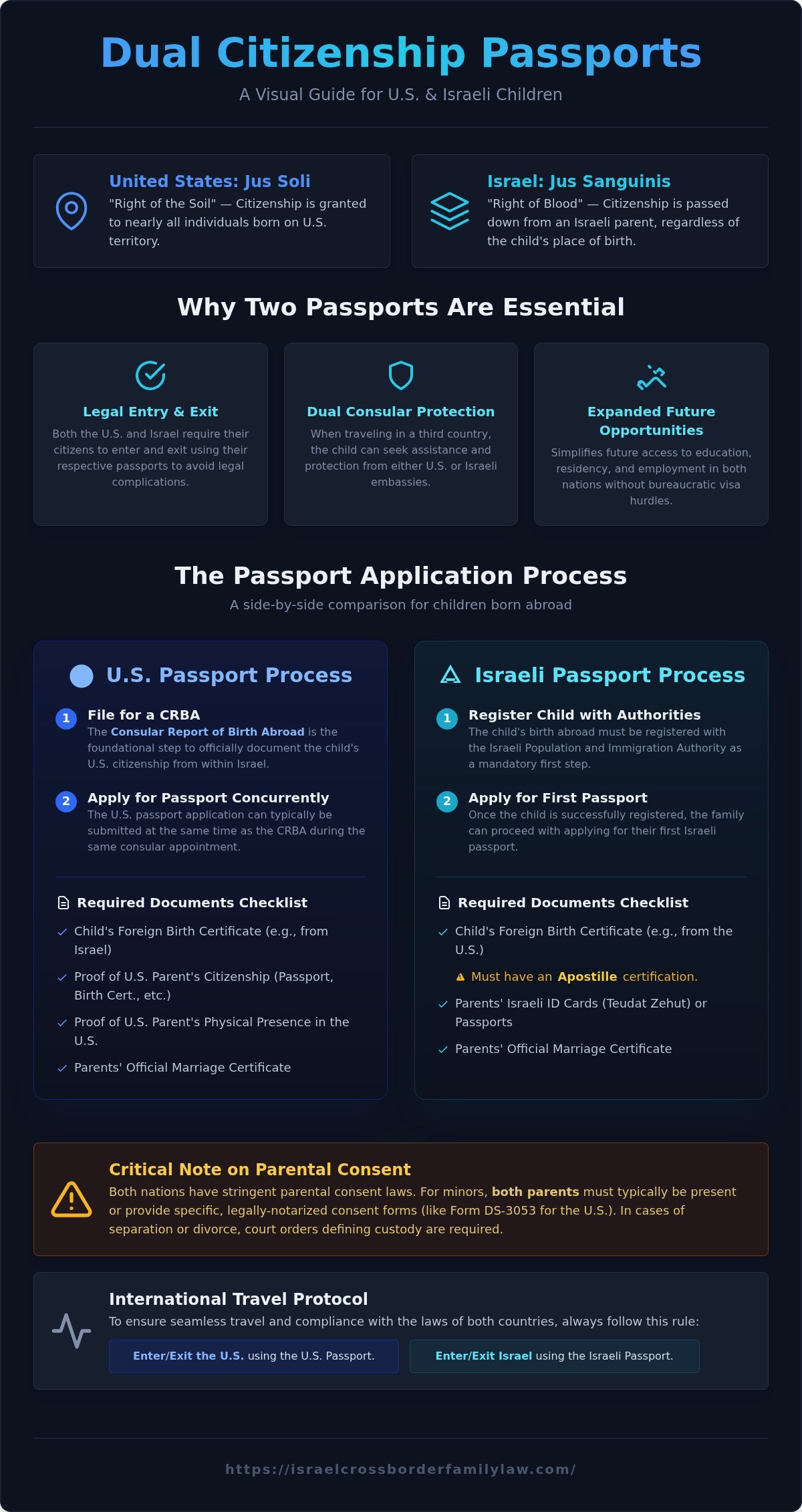
Navigating the legal framework for a child holding both United States and Israeli citizenship begins with understanding how this status is acquired. For many children, dual nationality is an automatic right conferred at birth, based on two distinct legal principles. The United States primarily follows jus soli (“right of the soil”), granting citizenship to nearly all individuals born on its territory. Conversely, Israel primarily adheres to jus sanguinis (“right of blood”), where citizenship is passed down from an Israeli parent, regardless of the child’s place of birth. A comprehensive Understanding Dual Citizenship is the critical first step in this multi-jurisdictional process. Fortunately, both nations recognize and permit dual nationality, which provides a clear legal path for families. For a detailed overview of the U.S. passport application process for minors, the following guide provides essential, practical information:
Holding dual nationality confers significant rights, including the freedom to live, work, and study in both countries without complex visa requirements. However, it also comes with distinct obligations. These can include U.S. tax filing responsibilities and, for Israel, potential mandatory military service, which is subject to specific regulations and potential exemptions for citizens living abroad. Properly managing these dual obligations is a key component of successfully obtaining a passport for a child with dual citizenship.
Why Two Passports Are Essential
Securing both a U.S. and an Israeli passport is not merely a convenience; it is a legal and practical necessity for navigating international travel and residency. The benefits are substantial and facilitate seamless cross-border life.
- Legal Entry and Exit Requirements: Both the United States and Israel mandate that their citizens enter and exit the country using their respective passports. Attempting to use a foreign passport can lead to significant delays and legal complications at border control.
- Access to Consular Services: When traveling in a third country, a dual citizen child can seek assistance and protection from either the U.S. or Israeli embassy or consulate, providing a dual layer of diplomatic support.
- Future Opportunities: Holding both passports simplifies future access to education, residency, and employment in both nations, providing the child with a broader set of life opportunities without bureaucratic hurdles.
Key Documents to Establish Citizenship
The process of obtaining a passport for a child with dual citizenship hinges on presenting precise documentation to each government to prove the child’s claim to nationality. Meticulous preparation is paramount.
- For United States Citizenship: The primary documents include the child’s foreign birth certificate (e.g., from Israel), along with robust proof of the parent’s U.S. citizenship, such as a U.S. passport, birth certificate, or Certificate of Naturalization. The U.S. citizen parent must also demonstrate they meet physical presence requirements in the U.S. prior to the child’s birth.
- For Israeli Citizenship: Key evidence includes the child’s birth certificate, which, if issued abroad (e.g., in the U.S.), must have an apostille certification to be legally recognized in Israel. Parents must also provide their Israeli identity cards (Teudat Zehut) or passports.
- Supporting Documentation: Parents’ official marriage certificate is often a crucial supporting document. Depending on the specific circumstances, other documents may be required to establish a clear and indisputable lineage.
The U.S. Passport Process for a Minor Abroad: A Step-by-Step Guide
For United States citizens born in Israel, the foundational step toward securing a U.S. passport is formally establishing their claim to citizenship through a Consular Report of Birth Abroad (CRBA). The U.S. Department of State has streamlined this complex, cross-border procedure, enabling parents to apply for the CRBA and the child’s first passport concurrently during a single, consolidated consular appointment. This integrated approach represents the most efficient pathway for obtaining a passport for a child with dual citizenship.
Preparing Your Application Package (CRBA & Passport)
Meticulous preparation of your application dossier is critical to navigating the process successfully. A complete package must contain comprehensive documentation proving the child’s identity, parentage, and the transmission of U.S. citizenship. You will be required to present original documents.
- Child’s Original Israeli Birth Certificate: Must be accompanied by a certified English translation if the original is in Hebrew.
- Parents’ Identification: Valid government-issued photo identification for both parents, such as U.S. or Israeli passports.
- Parents’ Marriage Certificate: The original document is required if the parents are married.
- Proof of U.S. Citizen Parent’s Physical Presence: Substantial evidence of time spent in the U.S. prior to the child’s birth. This may include academic transcripts, employment records (W-2s), or official government records.
- Passport Photographs: One 2×2 inch (5×5 cm) color photograph of the child, taken against a plain white background, meeting all U.S. passport photo requirements.
- Application Forms: A completed, but unsigned, Form DS-11 (U.S. Passport Application) and Form DS-2029 (Application for CRBA).
The Two-Parent Consent Rule
United States law mandates that for all minors under the age of 16, both legal parents or guardians must provide explicit consent. The standard procedure requires both parents to attend the consular appointment in person with the child. In circumstances where one parent cannot attend, they must provide a signed and notarized Form DS-3053, Statement of Consent. This document must be notarized in English by a U.S. notary or a local Israeli notary public whose commission is recognized by the U.S. Embassy.
The Embassy Appointment: What to Expect
All CRBA and passport services require a pre-scheduled appointment, which must be made online via the official website for the U.S. Embassy in Jerusalem or the Branch Office in Tel Aviv. During the appointment, a consular officer will review all documentation, administer an oath, and collect the required fees. Upon approval, the processing of the CRBA and passport typically takes several weeks. The completed documents are returned via a designated courier service, for which the delivery fee must be paid in Israeli Shekel (₪).
The Israeli Passport Process: Registering and Applying
For a child born outside of Israel to at least one Israeli parent, Israeli law generally confers citizenship at birth. However, this status must be officially documented before a passport can be issued. The foundational step is to formally register the child with the State of Israel through the appropriate consulate. This procedure is not merely administrative; it is a legal prerequisite for securing travel documents and is a critical component in the multi-jurisdictional challenge of obtaining a passport for a child with dual citizenship.
Registering Your Child with the Israeli Consulate
The initial and most crucial action is to submit a “Notification of the Birth of an Israeli Citizen Abroad” at the Israeli consulate or embassy with jurisdiction over the child’s place of birth. This process formally adds your child to the Israeli Population Registry. At least one of the Israeli parents must appear in person to submit the application. Navigating the documentary requirements demands meticulous preparation.
- Original Birth Certificate: The child’s official, original birth certificate must be presented. Crucially, it must be authenticated with an Apostille stamp, which is an international certification verifying the document’s authenticity.
- Parental Identification: Both parents must provide their valid passports. The Israeli parent must present their Israeli passport.
- Proof of Relationship: If the parents are married, their original marriage certificate is typically required.
Applying for the First Israeli Passport
Once the registration is processed and the child is assigned an Israeli ID number (Mispar Zehut), you may proceed with the passport application. This can often be done during the same consular visit. The consent of both parents is a strict requirement. If both parents cannot be present, the non-attending parent must typically provide a notarized written consent form. You will generally have the option between two types of travel documents, with applicable fees payable in ILS. The standard choice is a biometric passport, which for minors is issued with a validity of five years. In certain circumstances, the consulate may instead issue a temporary travel document (Teudat Ma’avar), which has a shorter validity period and may have different visa-free travel implications. We advise confirming the current procedural nuances and fee schedule directly with the relevant Israeli mission.
Navigating Complex Scenarios: Parental Consent and Disputes
For international families, particularly those with U.S. and Israeli ties, the legal complexities surrounding parental consent represent a significant challenge. The process of obtaining a passport for a child with dual citizenship is intentionally rigorous to protect parental rights and prevent wrongful removal. When parents are separated, divorcing, or in disagreement, navigating these multi-jurisdictional requirements demands sophisticated legal strategy and a deep understanding of both U.S. and Israeli family law.
When One Parent is Uncooperative or Absent
U.S. law mandates that both legal parents consent to a minor’s passport application. While the DS-11 form includes a “special circumstances” section for situations where one parent’s consent cannot be obtained, relying on this is often insufficient and leads to significant delays. The most definitive solution is to secure a U.S. court order granting the applying parent sole legal authority to obtain the child’s passport. Similarly, Israeli family courts can address these disputes, but the interplay between the two legal systems necessitates expert guidance to ensure enforceability.
Divorce Decrees and Custody Agreements
A proactive approach during divorce or separation proceedings is paramount. A meticulously drafted custody agreement or divorce decree that explicitly grants one parent sole authority-or outlines a clear process for joint authority-to apply for passports can prevent future conflicts. It is critical that such orders are structured to be recognized in both jurisdictions. Our firm provides expert counsel for families navigating the complexities of international custody and relocation, ensuring legal agreements are robust and enforceable across borders.
Preventing International Child Abduction
The stringent two-parent consent rules are a primary safeguard against international child abduction. For parents with legitimate concerns, the U.S. Department of State offers the Children’s Passport Issuance Alert Program (CPIAP). Enrolling a child in this program ensures you are notified if a U.S. passport application is submitted on their behalf. Should you fear your child is at risk of being taken abroad without consent, immediate legal action is critical. Our firm possesses deep experience in cases governed by the Hague Convention on Child Abduction, providing decisive representation to protect your child and your parental rights. If you are facing challenges in obtaining a passport for a child with dual citizenship due to parental disputes, contact our legal team to discuss your case.
Practical Considerations for Dual-Citizen Children
Beyond the initial process of obtaining a passport for a child with dual citizenship, parents must navigate a landscape of ongoing practical and legal responsibilities. Managing international travel, understanding future obligations, and adhering to strict renewal timelines are critical for ensuring seamless cross-border mobility for your child. A foundational rule for international travel is to use the passport corresponding to the country you are entering or exiting. U.S. law mandates that American citizens must use a U.S. passport to enter and leave the United States. Similarly, Israel requires its citizens to present an Israeli passport for entry and exit. When traveling to a third country, the choice of passport may depend on visa agreements between that nation and either the U.S. or Israel. Furthermore, parents must remain cognizant of future obligations tied to Israeli citizenship, most notably the mandatory military service requirement, which becomes relevant as the child approaches adulthood.
Passport Renewal Timelines and Procedures
Proactive management of travel documents is essential. U.S. passports issued to minors under 16 are valid for only five years and cannot be renewed by mail, necessitating a new in-person application. Israeli passports for minors also have shorter, variable validity periods. Planning these renewals well in advance is a crucial step to prevent the logistical and legal complications that arise from an expired travel document, particularly when urgent international travel is required.
When to Seek Professional Legal Advice
While many families navigate this process smoothly, certain complex, multi-jurisdictional family dynamics require sophisticated legal counsel. The challenges inherent in obtaining a passport for a child with dual citizenship are significantly magnified in situations involving:
- High-conflict divorce or separation proceedings.
- An uncooperative co-parent or a parent whose location is unknown.
- Discrepancies in names, dates, or other critical information across official documents.
These circumstances can create substantial legal hurdles that demand expert intervention. For a thorough evaluation of your unique situation and to ensure your child’s rights and mobility are protected, we recommend you request a confidential case review with our experienced cross-border family law team.
Expert Guidance for Your Child’s Dual-Nationality Journey
The process of obtaining a passport for a child with dual citizenship is a significant undertaking, demanding meticulous adherence to the distinct legal frameworks of both the United States and Israel. Successfully navigating this multi-jurisdictional path requires a clear understanding of documentation requirements for both nations and proactive management of potential complexities, particularly those concerning parental consent. While this guide provides a comprehensive roadmap, unique family circumstances often necessitate specialized legal counsel. Our firm provides specialized expertise in US-Israel cross-border family law, offering dedicated guidance for expats and foreign nationals. With extensive experience navigating the intricacies of both the U.S. and Israeli legal systems, we are uniquely positioned to manage your case with precision. For complex cross-border family matters, we invite you to schedule a confidential consultation with our legal experts. By taking these proactive steps, you can confidently secure the travel documents that affirm your child’s rich heritage and global future.
Frequently Asked Questions
Which passport should we apply for first, the U.S. or the Israeli one?
It is imperative to secure the U.S. passport first. United States federal law mandates that all U.S. citizens, including dual nationals, must use a valid U.S. passport to enter and exit the United States. Furthermore, Israeli authorities often require proof of the child’s other citizenship when processing their first Israeli passport. Initiating the U.S. passport application at the Embassy is the correct and most efficient protocol to ensure compliance with multi-jurisdictional travel regulations.
How long does it take to get a passport for a dual-citizen child?
The timeline for obtaining a passport for a child with dual citizenship is a multi-stage process. The U.S. passport, applied for at the U.S. Embassy in Israel, typically requires 5-7 weeks for routine processing after your appointment. Expedited services may be available for an additional fee of $60 USD, which can reduce this timeframe. The subsequent application for the Israeli passport is a separate process with its own timeline managed by the Israeli Ministry of Interior.
What is an apostille and why do I need it for the birth certificate?
An apostille is a specialized certificate of authenticity recognized internationally under the terms of the 1961 Hague Convention. When submitting a U.S. birth certificate to Israeli authorities for processes such as citizenship registration, the apostille is required. It is issued by the Secretary of State in the U.S. state where the child was born, and it verifies that the signatures and seals on the document are genuine, making it a valid legal instrument in Israel.
Can my child travel to Europe on their Israeli passport if their U.S. one is expired?
While your child can utilize their valid Israeli passport for direct travel between Israel and European nations, it is crucial to address the expired U.S. passport. U.S. law strictly requires that American citizens enter and exit the United States on a valid U.S. passport. Attempting to return to the U.S. with an expired document can result in significant travel delays and serious complications with U.S. Customs and Border Protection. We strongly advise maintaining the validity of both passports.
What happens if a parent’s name on the birth certificate is different from their passport?
A name discrepancy between a parent’s current passport and the child’s birth certificate must be formally explained with supporting legal documentation. This is a common occurrence due to marriage or other legal name changes. You must present an original or certified copy of the relevant document, such as a marriage certificate or an official name change decree, to create a clear legal link between the two names. Failure to provide this evidence will result in application processing delays.
Do we need to translate documents for the applications?
Yes, translation requirements are determined by the agency receiving the documents. For all U.S. passport and Consular Report of Birth Abroad applications, any document not in English must be submitted with a complete and certified English translation. Conversely, when presenting U.S. documents to the Israeli Ministry of Interior (Misrad HaPnim), a notarized translation into Hebrew is generally required. Ensuring proper translations are prepared is a critical step for regulatory compliance in both jurisdictions.

Article by
Gabriel Lior
A Personal Journey That Became a Mission The advisory was founded by an American father Gabriel Lior, LLB, MBA , global entrepreneur, and cross-border advisor who spent more than a decade navigating the Israeli family court system firsthand and now lives in Singapore with his son.
As a divorced parent in a cross-border family, Gabriel faced nearly every legal challenge a foreign parent can encounter in Israel — including child custody disputes, child support proceedings, property matters in Israel and abroad, false accusations, and complex immigration and relocation proceedings. Over the years, he learned the hard way how difficult it is for non-Israeli parents to understand the system, identify the right legal strategy, and choose the right legal representation — especially when language, culture, and jurisdictional differences are involved. He also witnessed how foreign parents and new immigrants are often disadvantaged or taken advantage of by service providers and institutions simply because they lack local knowledge or fluency. From Client to Advisor To truly understand — and survive — the system, Gabriel pursued formal legal education in Israel, completing two Israeli law degrees, alongside a BA and MBA earned in the United States. This was never about becoming a practicing attorney, but about gaining a deep, structural understanding of how the system works — and where it breaks down for foreign parents. This rare combination of: Firsthand client experience Israeli legal and US business education International business and negotiation training Decades of commercial execution created a unique perspective – one that understands both sides of the table. After years of litigation, persistence, and at times self-representation, he ultimately succeeded in securing custody of his son and relocating abroad through a rare legal victory in the Israeli Supreme Court — becoming one of the first fathers in Israel to do so under these circumstances.
Disclaimer
Important Disclaimer: The information provided on this website and in its content is for general informational and educational purposes only and does not constitute legal advice, legal opinion, or legal representation. Gabriel Lior is not licensed to practice law in Israel (nor is he interested in doing so) and does not provide legal services, despite having completed 2 Law Degrees. The services offered are advisory in nature and are intended to provide general guidance, strategic insight, and information regarding cross-border family law considerations. No attorney-client relationship is formed by accessing this website, reading its content, or communicating with us. Any decisions made based on this information are at your own discretion and risk. For legal advice specific to your situation, you should consult a licensed attorney in the relevant jurisdiction. Where appropriate, we may refer clients to independent, licensed attorneys or professionals. Such referrals do not constitute legal representation and no liability is assumed for services provided by third parties.