This article is published on an independent advisory platform and provides strategic guidance for informational purposes. It does not constitute legal advice or formal legal representation.
What if the decision to move your child to a new country rested entirely on a judge’s interpretation of a single, subjective phrase? For expats and international families in Israel, the choice to relocate is rarely just about a new job or a return to family. It is a high-stakes legal process where the state intervenes in your most private decisions. Understanding How Courts Decide International Relocation Requests is essential to protecting your parental rights and avoiding the devastating consequences of being accused of international child abduction under the Hague Convention.
It’s natural to feel anxious about how a move might impact your child’s relationship with the other parent or which country’s laws will ultimately apply. This guide will help you understand the “Best Interests of the Child” standard and the legal weight of the 1962 Legal Capacity and Guardianship Law. We will preview the specific criteria judges use to evaluate relocation petitions, the current status of the “Tender Years Doctrine,” and the critical importance of obtaining formal permission before you commit to a move.
Key Takeaways
- Learn why Israeli courts define international relocation as a change in a child’s “habitual residence” and how this classification triggers specific legal protections.
- Gain clarity on How Courts Decide International Relocation Requests by prioritizing the child’s long-term stability over a parent’s professional or personal desires.
- Understand the strategic importance of jurisdiction, including the procedural differences between Family and Rabbinical courts and the complexities of enforcing US-Israel custody orders.
- Discover the key evidence judges evaluate, such as the true motivation behind the move and the practical feasibility of proposed international visitation schedules.
- Identify why early strategic planning and mediation are essential tools for building a sustainable cross-border parenting plan before committing to any formal legal action.
This section is published on an independent advisory platform and provides strategic guidance for informational purposes. It does not constitute legal advice or formal legal representation.
Defining International Relocation and the Court’s Role
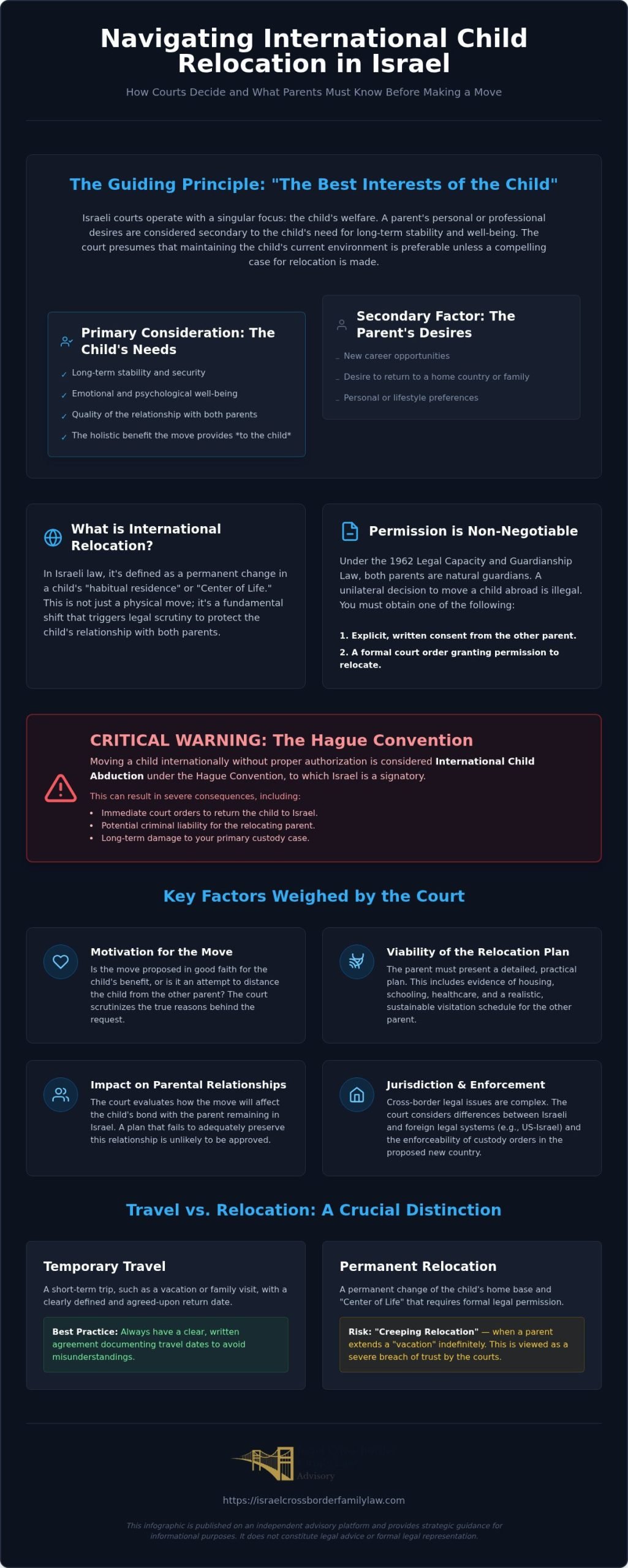
In the Israeli legal system, international relocation is defined as a permanent change in a child’s “habitual residence.” This isn’t just a simple physical move. It’s a fundamental shift in the child’s “Center of Life” that requires careful legal scrutiny. While moving between cities in Israel is often straightforward, crossing international borders introduces complexities regarding distance, cultural identity, and differing legal frameworks. This is why understanding How Courts Decide International Relocation Requests is essential for any parent considering a move abroad.
The court acts as a protective gatekeeper in these scenarios. Its role is to ensure that any move doesn’t unfairly sever the child’s bond with the parent staying behind. Under the 1962 Legal Capacity and Guardianship Law, both parents are natural guardians. This means neither parent can unilaterally decide to move the child to another country. You must obtain either the other parent’s written consent or a formal order from an Israeli court before you make any final commitments.
To better understand the strategic considerations involved, watch this helpful video from our advisory channel:
Why Court Approval is Non-Negotiable
Moving without permission can have devastating consequences. Israel is a committed signatory to the Hague Convention on the Civil Aspects of International Child Abduction. This treaty is designed to return children to their home country if they’re removed without consent. If you move without a court order, you risk being accused of international child abduction. This can lead to immediate return orders and potential criminal liability. Even if you have an existing custody order, it doesn’t automatically grant you the right to relocate. The court must specifically evaluate How Courts Decide International Relocation Requests in the context of your unique family dynamics and the child’s specific needs.
The Distinction Between Travel and Relocation
It’s important to understand the difference between temporary travel and permanent relocation. A vacation to visit family in the US is a temporary event with a clear return date. Relocation is a permanent change of the child’s home base. Judges are very sensitive to “creeping relocation,” which occurs when a parent takes a child on a vacation but then refuses to return. This is viewed as a breach of trust and a violation of the other parent’s rights. To protect yourself, always ensure international travel is documented with clear, written agreements. If your intention is a permanent move, you should seek a formal international custody relocation strategy before you depart.
This section is published on an independent advisory platform and provides strategic guidance for informational purposes. It does not constitute legal advice or formal legal representation.
The ‘Best Interests of the Child’ as the Primary Decision Standard
Israeli judges approach relocation petitions with a singular focus: the welfare of the child. While a parent may have a compelling career opportunity or a deep desire to return to their home country, the court views these as secondary factors. The judicial system operates on a presumption of stability. This means it usually favors keeping the child in their current environment unless the moving parent proves that the relocation offers a significant, holistic benefit. This high standard is part of the broader Israeli implementation of the Hague Convention and domestic guardianship laws.
When examining How Courts Decide International Relocation Requests, judges look at the holistic best interests of the child. This includes the emotional health of the primary caregiver. If a parent is the child’s main source of stability but is struggling due to isolation or lack of support in Israel, the court may consider how that parent’s well-being directly impacts the child. However, this is always balanced against the potential damage caused by reducing the child’s contact with the other parent. The court’s goal is to ensure the child’s development isn’t compromised by the move.
Core Factors Evaluated by Judges
The evaluation process is granular and evidence-based. Judges consider the child’s age and developmental stage. The “Tender Years Doctrine” still carries weight in 2026 for children under age six, though it’s increasingly balanced against the father’s right to an active relationship. They also scrutinize the quality of education and healthcare in the proposed new country. If the destination offers specialized medical care or unique educational support that the child requires, it can strengthen the case for moving. The court also looks at the existing bond and frequency of contact the child has with both parents to gauge the potential impact of physical distance.
The Role of Expert Appointed Evaluators
Courts rarely make these life-altering decisions in a vacuum. They rely heavily on court-appointed social workers or child psychologists to conduct a formal Relocation Assessment. These professionals interview both parents, observe the child, and provide a detailed report to the court. For older children with sufficient maturity, the court may also allow the child to express their own preferences. These reports carry immense weight in the final ruling. Because these assessments involve complex psychological evaluations, it’s wise to seek professional guidance early to understand how to present your family’s situation accurately. This preparation is a key part of managing an international custody relocation process effectively.
This section is published on an independent advisory platform and provides strategic guidance for informational purposes. It does not constitute legal advice or formal legal representation.
US-Israel Cross-Border Considerations: Jurisdiction and Enforcement
Navigating the legal corridor between Israel and the United States introduces a layer of multi-jurisdictional complexity that domestic cases simply don’t face. A central conflict in these cases is often the determination of a child’s “Center of Life.” While a US court might look at where a child has spent the last six months to determine jurisdiction, an Israeli court examines deeper cultural, familial, and social ties. This divergence is why How Courts Decide International Relocation Requests often depends on which legal system takes the lead first.
In Israel, a unique “race for jurisdiction” exists between the civil Family Courts and the religious Rabbinical Courts. The court that is first to receive a valid filing generally gains the authority to decide the case. Each system has its own procedural nuances and historical leanings, which can significantly influence the outcome of a relocation petition. This environment creates a risk of “forum shopping,” where one parent attempts to file in the jurisdiction they perceive as more favorable to their specific goals. Preventing this requires a proactive, specialized strategy that considers both Israeli and US state laws from the very beginning.
The Hague Convention on International Child Abduction
The Hague Convention serves as the primary international safeguard against the unilateral move of a child. It focuses on preventing “wrongful removal,” which is taking a child without consent, and “wrongful retention,” which is failing to return a child after a permitted visit or vacation. If a parent moves a child to the US without Israeli court approval, the left-behind parent can petition for an immediate return under this treaty. It’s critical to understand these Understanding Hague Convention Risks before making any travel plans, as the legal consequences of a mistake are often irreversible.
Mirror Orders and Pre-emptive Agreements
Even when both parents agree to a move, enforcement across borders remains a challenge. A “Mirror Order” is a vital tool in these scenarios. This is a court order issued in the destination country, such as a US state court, that exactly replicates the terms of the Israeli relocation agreement. It ensures that the parenting plan is legally binding and enforceable in both jurisdictions. To further secure these arrangements, How Courts Decide International Relocation Requests frequently involves the requirement of financial bonds or guarantees. These funds are held in escrow and may be forfeited if a parent fails to return the child to Israel for scheduled visits, providing a tangible layer of security for the parent remaining behind.
This section is published on an independent advisory platform and provides strategic guidance for informational purposes. It does not constitute legal advice or formal legal representation.
Key Evidence and Factors Courts Evaluate in Relocation Cases
Israeli judges require more than just a good reason to move; they require a comprehensive evidentiary foundation. When analyzing How Courts Decide International Relocation Requests, the court places the entire burden of proof on the parent wishing to leave. This means you must present a concrete, well-documented case that proves the move is not only beneficial but also sustainable for the child’s relationship with both parents. The court doesn’t accept promises at face value; it demands a structured plan that addresses every logistical and emotional hurdle of a cross-border transition.
One of the most scrutinized factors is motivation. Judges look for “good faith” reasons, such as a verified job offer, a return to a robust family support network, or specific educational needs that cannot be met in Israel. If the court suspects the move is intended to frustrate the other parent’s access, the petition is likely to be denied. Conversely, the court also examines the non-relocating parent’s opposition. If their refusal to consent is based on a desire for control or a personal vendetta rather than the child’s actual needs, the judge will weigh that heavily in the final determination. Understanding How Courts Decide International Relocation Requests involves recognizing that both parents’ motivations are under the microscope.
Strengthening the Relocation Case
To build a strong case, you should present a detailed “Relocation Plan” or “Life Plan.” This document serves as a roadmap for the child’s future, covering specific schools, housing arrangements, and community involvement in the new country. You must also address the digital divide. Proposing a schedule that utilizes technology-based communication tools, such as dedicated video calling times or shared digital calendars, shows a commitment to maintaining the bond with the parent staying in Israel. Evidence of the child’s ability to adapt, such as prior visits to the location, existing friendships there, or proficiency in the local language, further reassures the court of a smooth transition.
Common Reasons for Denial
Petitions often fail when the reasoning is vague or speculative. Simply stating you want a “fresh start” or a “better lifestyle” without documented proof of how that translates to the child’s welfare is rarely sufficient. A major pitfall is failing to provide a realistic visitation plan. If the proposed schedule is too expensive, logistically impossible, or results in the total severance of the bond with the non-relocating parent, the court will likely intervene to keep the child in Israel. Because the weight of early decisions is so significant, it’s vital to request a confidential case review before filing any formal motions. This allows you to assess the strengths and risks of your specific evidentiary profile and prepare a plan that meets the court’s high standards.
This section is published on an independent advisory platform and provides strategic guidance for informational purposes. It does not constitute legal advice or formal legal representation.
Navigating the Legal Path to a Successful Resolution
The journey through a relocation dispute is often a long one. Success depends heavily on the initial steps you take. Understanding How Courts Decide International Relocation Requests requires more than just knowing the law; it requires a strategic vision that spans both the Israeli and US legal systems. One of the most significant risks in this process is the “status quo.” If a court issues a temporary order keeping a child in Israel while a case is pending, that order can remain in place for months or even years. These early decisions carry immense weight and can inadvertently set the final outcome before a full trial even begins.
Mediation offers a powerful alternative to a contested court battle. While a judge’s ruling is often binary, either you can move or you cannot, a mediated agreement allows for a customized international parenting plan. This might include creative solutions for summer visits, shared travel costs, or specific digital communication guarantees. A negotiated settlement provides the certainty that a court hearing cannot. It allows parents to maintain control over their family’s future rather than leaving it to a judicial officer who only knows your life through legal briefs.
Seeking Clarity in a Complex System
Cross-border cases involve jurisdictional rules that many general family lawyers rarely encounter. An advisory perspective is essential because it bridges the gap between different legal cultures. For example, the way an Israeli court views a mother’s role may differ from the expectations of a US state court. To see these concepts in action and gain more visual guidance, you can explore the Israel Family Law YouTube channel. Our approach to international relocation strategy focuses on identifying these cultural and legal friction points before they become obstacles.
Next Steps for Parents
If you’re considering a move or facing a relocation request from a co-parent, your first step should be documentation. Start recording the child’s current “Center of Life,” including school attendance, medical records, and the daily involvement of both parents. Assessing the risks of a contested hearing against the benefits of a negotiated settlement is a cold, necessary calculation. It’s about understanding your specific standing within the Israeli system. Get clarity before you commit. We invite you to request a confidential case review to discuss your strategy and decision-making options with an experienced advisor.
Get clarity before you commit. Request a confidential consultation.
Securing Your Child’s Future Across Borders
Deciding to move a child between countries is one of the most significant legal and personal choices a parent can make. As an independent advisory platform focused on the US-Israel legal corridor, we understand that the complexity of these cases often feels overwhelming. Gaining a deep understanding of How Courts Decide International Relocation Requests is the first step toward a successful resolution, whether you are seeking to move or opposing a relocation. By focusing on the “Best Interests” standard and preparing a robust, evidence-based life plan, you can protect your child’s stability and your parental rights.
Early strategic planning is essential to avoid the risks of “wrongful removal” or becoming trapped in a long-term “status quo” order. Our calm, authoritative guidance helps international families navigate these multi-jurisdictional challenges with confidence. We provide a bridge between legal cultures, ensuring you have the strategic insight needed to make informed decisions before filing any formal motions. Get clarity before you commit. Request a confidential consultation.
You don’t have to navigate this transition alone. With the right strategy and a focus on long-term stability, you can find a path forward that preserves your family’s most important bonds.
This section is published on an independent advisory platform and provides strategic guidance for informational purposes. It does not constitute legal advice or formal legal representation.
Frequently Asked Questions
Can I move my child to the US from Israel without the other parent’s consent?
No, you cannot move your child out of IL permanently without either the express written consent of the other parent or a formal order from the court. Attempting to move without these approvals is treated as international child abduction. Even if you have primary custody, the law requires you to resolve the relocation issue through the proper legal channels before departing.
How long does a relocation trial typically take in Israeli courts?
International relocation cases are complex and typically take between 6 to 18 months to reach a final judgment. The timeline is often extended by the need for court-appointed experts to conduct thorough evaluations and submit their reports. Understanding How Courts Decide International Relocation Requests involves preparing for a significant investment of time, as judges rarely fast-track these life-altering decisions.
What is the ‘Best Interests’ standard in international custody cases?
The “Best Interests” standard is the primary legal yardstick used to evaluate whether a child should be permitted to move. It is a holistic assessment that prioritizes the child’s emotional, physical, and developmental needs over the desires of the parents. The court examines which environment will best support the child’s growth and maintain their essential family bonds.
Will the court let me move if I have a better job offer in another country?
A superior career opportunity is considered a legitimate motivation, but it is rarely the sole reason a move is granted. The court will scrutinize how your increased income or professional satisfaction directly improves the child’s quality of life. You must demonstrate that the benefits of this opportunity outweigh the loss of frequent, in-person contact with the parent staying in Israel.
How does the court handle visitation when parents live in different countries?
Courts manage cross-border visitation by establishing a rigorous schedule that often includes extended stays during summer and winter breaks. These arrangements are frequently secured by a “Mirror Order” in the destination country and financial bonds. This ensures that the parent who relocates remains committed to returning the child for scheduled visits and maintaining the other parent’s rights.
What happens if I move with my child and the court later denies my request?
If you move prematurely and the court denies your petition, you will be required to return the child to Israel immediately. Failure to comply can result in enforcement actions under the Hague Convention and may lead to a loss of custody. Moving before a final ruling is a high-risk decision that can permanently damage your standing in the eyes of the court.
Can a child’s preference stop an international relocation?
A child’s preference is a significant factor, but it is not always the deciding one. Judges generally listen to children who are of sufficient age and maturity, typically over the age of 10 or 12, to understand their perspective. However, the court also investigates whether a child’s stated preference is genuine or the result of influence from one of the parents.
What are the risks of the Hague Convention in a relocation dispute?
The primary risk is that the Hague Convention focuses on the immediate return of the child to their “habitual residence” rather than the merits of who should have custody. If a child is moved without permission, the court in the new country is generally required to order their return to IL. This process is designed to ensure that How Courts Decide International Relocation Requests happens in the child’s home jurisdiction, not where the moving parent chooses.

Article by
Gabriel Lior
A Personal Journey That Became a Mission
The advisory was founded by an American father Gabriel Lior, LLB, MBA , global entrepreneur, and cross-border advisor who spent more than a decade navigating the Israeli family court system firsthand and now lives in Singapore with his son.
As a divorced parent in a cross-border family, Gabriel faced nearly every legal challenge a foreign parent can encounter in Israel — including child custody disputes, child support proceedings, property matters in Israel and abroad, false accusations, and complex immigration and relocation proceedings.
Over the years, he learned the hard way how difficult it is for non-Israeli parents to understand the system, identify the right legal strategy, and choose the right legal representation — especially when language, culture, and jurisdictional differences are involved. He also witnessed how foreign parents and new immigrants are often disadvantaged or taken advantage of by service providers and institutions simply because they lack local knowledge or fluency.
From Client to Advisor
To truly understand — and survive — the system, Gabriel pursued formal legal education in Israel, completing two Israeli law degrees, alongside a BA and MBA earned in the United States. This was never about becoming a practicing attorney, but about gaining a deep, structural understanding of how the system works — and where it breaks down for foreign parents.
This rare combination of:
Firsthand client experience
Israeli legal and US business education
International business and negotiation training
Decades of commercial execution
created a unique perspective – one that understands both sides of the table.
After years of litigation, persistence, and at times self-representation, he ultimately succeeded in securing custody of his son and relocating abroad through a rare legal victory in the Israeli Supreme Court — becoming one of the first fathers in Israel to do so under these circumstances.
Disclaimer
Important Disclaimer:
The information provided on this website and in its content is for general informational and educational purposes only and does not constitute legal advice, legal opinion, or legal representation.
Gabriel Lior is not licensed to practice law in Israel (nor is he interested in doing so) and does not provide legal services, despite having completed 2 Law Degrees. The services offered are advisory in nature and are intended to provide general guidance, strategic insight, and information regarding cross-border family law considerations.
No attorney-client relationship is formed by accessing this website, reading its content, or communicating with us.
Any decisions made based on this information are at your own discretion and risk. For legal advice specific to your situation, you should consult a licensed attorney in the relevant jurisdiction.
Where appropriate, we may refer clients to independent, licensed attorneys or professionals. Such referrals do not constitute legal representation and no liability is assumed for services provided by third parties.