Navigating the dissolution of a marriage is a formidable challenge, made exponentially more complex when it involves cross-border elements and Israel’s unique dual legal system. For international families, the uncertainty surrounding the specific grounds for divorce Israel recognizes can be a significant source of anxiety. Questions about jurisdiction-whether the Rabbinical Courts or the Family Courts will preside-and the validity of one’s reasons for separation in a fault-based system often create a barrier to taking necessary action.
This authoritative guide is designed to demystify this intricate process. We provide a clear explanation of the legally accepted grounds for divorce, clarifying the distinct roles and requirements of both the religious and civil court systems for Jewish and multi-national couples. Our objective is to equip you with the foundational knowledge regarding the types of evidence required to substantiate your case, thereby providing the clarity and confidence needed to engage with experienced legal counsel and move forward.
Key Takeaways
- The first step in any Israeli divorce is determining the correct legal venue; Jewish couples are subject to Rabbinical Courts, while mixed-faith couples fall under the Family Court’s jurisdiction.
- Unlike many Western nations, Israel does not operate a ‘no-fault’ system; establishing legally recognized grounds for divorce in Israel is a mandatory requirement, even in cases of mutual consent.
- For international or mixed-faith couples, the divorce process is managed by the Family Court through a distinct procedure known as the ‘Dissolution of Marriage’.
- Successfully navigating a divorce claim requires more than an allegation; you must be prepared to present specific, compelling evidence to substantiate your stated grounds before the court.
Understanding Israel’s Dual System: Rabbinical Courts vs. Family Courts
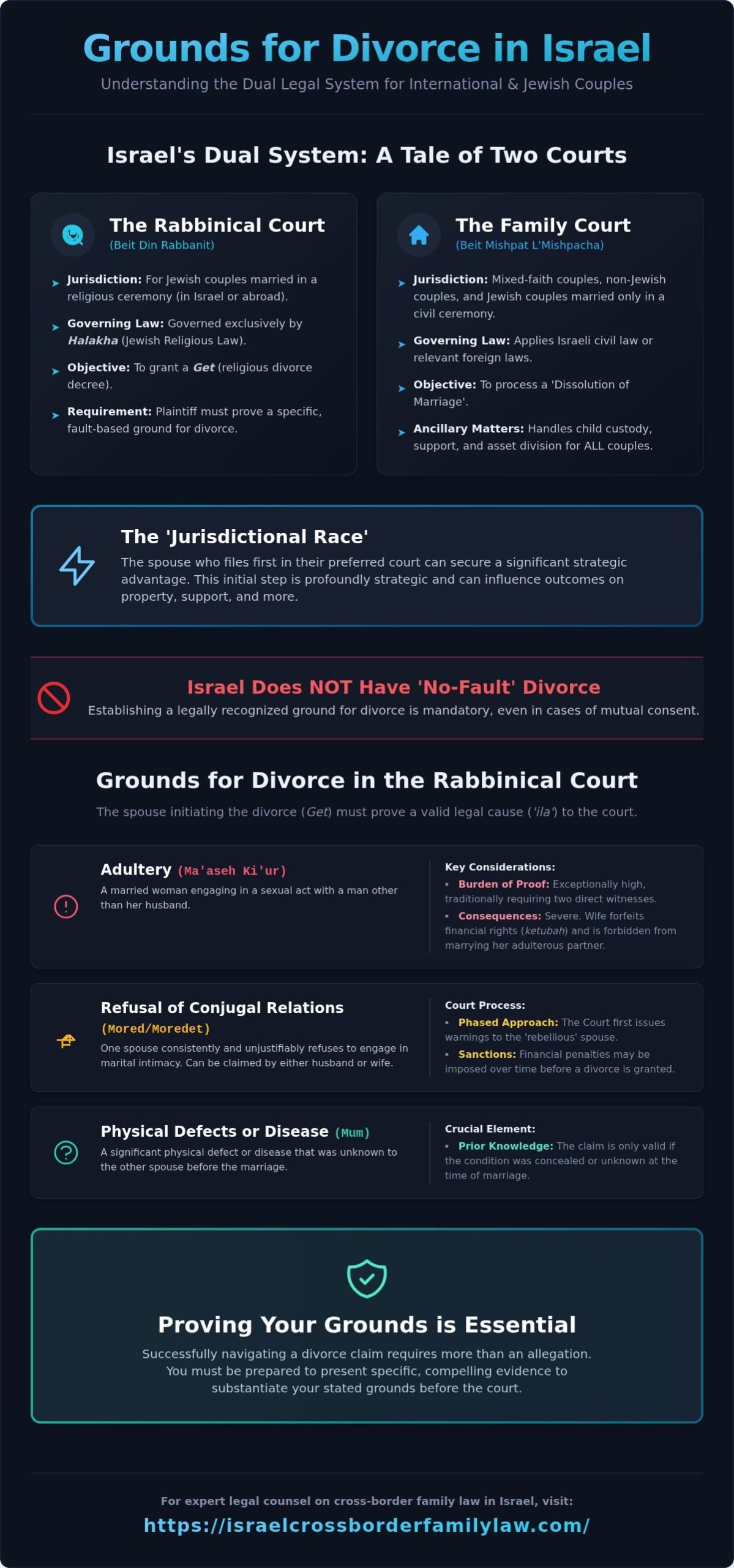
Navigating the process of divorce in Israel requires a foundational understanding of its unique dual-jurisdiction legal system. Unlike many Western countries, Israel does not have a uniform civil law for marriage and divorce. Instead, matters of personal status are delegated to the religious courts of the parties’ respective recognized communities. This complex statutory framework, detailed in the overarching Marriage and divorce laws in Israel, dictates that the first and most critical step in any dissolution proceeding is to determine which court holds the proper authority over your case.
This determination is not merely procedural; it is a profoundly strategic decision. The Rabbinical Courts and the civil Family Courts operate under different legal principles, which can lead to vastly different outcomes regarding property division, spousal support, and even the fundamental ability to divorce. This gives rise to a phenomenon known as the ‘jurisdictional race,’ where the spouse who files first in their preferred court can secure a significant strategic advantage. The intricate nature of this system underscores why expert legal guidance on divorce for international families is essential to protect your rights and achieve a favorable outcome.
The Role of the Rabbinical Court
For Jewish couples who were married in a Jewish ceremony (in Israel or abroad), the Rabbinical Court (Beit Din Rabbanit) holds exclusive jurisdiction over the divorce itself. Proceedings are governed by Halakha (Jewish religious law), not civil statutes. To be granted a divorce, known as a Get, one party must prove one of the specific, fault-based grounds for divorce israel recognized by Jewish law, such as infidelity or abuse. The court’s authority is absolute in granting or denying the Get.
The Role of the Family Court
The Family Court (Beit Mishpat L’Mishpacha) is the civil venue that handles divorces for couples not under the Rabbinical Court’s authority, including non-Jewish couples, mixed-faith couples, or Jewish couples married in a civil ceremony only. Depending on the specifics of the case, this court may apply Israeli civil law or relevant foreign laws. Crucially, the Family Court also has parallel jurisdiction over all ancillary matters, such as child custody, child support, and the division of marital assets, for all couples, including those divorcing in the Rabbinical Court.
Established Grounds for Divorce in the Rabbinical Court (For Jewish Couples)
For Jewish couples in Israel, divorce proceedings are governed exclusively by Jewish law (Halakha) and adjudicated within the Rabbinical Court system. This legal framework, confirmed as having jurisdiction over marriage and divorce for all citizens by sources like the U.S. State Department on Israeli court jurisdiction, does not recognize the concept of a “no-fault” divorce. Instead, the spouse initiating the claim must present a valid legal cause, or ‘ila’ (עילה), rooted in ancient religious principles. Successfully navigating these specific grounds for divorce israel requires a sophisticated understanding of both the law and the complex evidentiary process, as the burden of proof rests entirely on the plaintiff.
Adultery (Ma’aseh Ki’ur)
Under Jewish law, adultery is defined as a married woman engaging in a sexual act with a man who is not her husband. The standard of proof for this claim is exceptionally high, traditionally requiring the direct testimony of two valid witnesses. If this ground is proven, the consequences are severe: the wife forfeits her financial rights under the ketubah (marriage contract) and is legally forbidden from ever marrying her adulterous partner.
Refusal of Conjugal Relations (Mored/Moredet)
This ground, known as Mored (for a rebellious husband) or Moredet (for a rebellious wife), can be claimed by either spouse. It applies when one partner consistently and unjustifiably refuses to engage in marital intimacy. The Rabbinical Court will typically issue a series of warnings and may impose financial sanctions over time to compel the rebellious spouse to fulfill their marital obligations before granting a divorce on this basis.
Physical Defects or Disease (Mum)
A divorce may be granted if a spouse has a significant physical defect or disease (mum) that was unknown to the other party prior to the marriage. This includes conditions like impotence, infertility discovered post-nuptials, or a serious contagious disease that makes cohabitation untenable. The court evaluates the claim based on the severity of the condition and its direct and substantial impact on the viability of the marriage.
Other Recognized Grounds
Beyond these primary claims, the Rabbinical Court recognizes several other valid causes for divorce. These are adjudicated based on their severity and impact on the marital bond, and include:
- Apostasy: One spouse converting from Judaism to another religion.
- Intolerable Behavior: Documented patterns of physical violence or severe emotional abuse that make cohabitation impossible or dangerous.
- Failure to Provide: The husband’s inability or refusal to financially support his wife, which is a core obligation of the ketubah.
What About ‘No-Fault’ Divorce in Israel?
A common point of confusion for individuals familiar with Western legal frameworks is the concept of ‘no-fault’ divorce. It is imperative to understand that Israel does not possess a no-fault divorce system akin to those in the United States or the United Kingdom. Under the jurisdiction of the Rabbinical Courts, which oversee matters of marriage and divorce for Jewish citizens, a specific cause of action, or ‘ground’, must be established before a divorce (Get) can be granted. Even in cases of complete mutual agreement, the legal process requires the formal presentation of a valid reason for the dissolution of the marriage.
However, this does not mean every separation must involve a contentious and public dispute over fault. The Israeli legal system provides a robust mechanism for amicable separation through a comprehensive divorce agreement, which remains the most common and strategic path for couples seeking to part ways.
Divorce by Mutual Consent
The most efficient method for navigating the legal requirements is by negotiating and executing a comprehensive Divorce Agreement. This legally binding document is meticulously drafted to address all facets of the separation, thereby pre-empting future conflict. A well-structured agreement will definitively resolve critical matters including:
- The division of all marital property, assets, and debts.
- Child custody (mishmeret) and visitation schedules (hesderei re’iyah).
- The quantum of child support (mezonot yeladim).
- Any applicable spousal support (mezonot isha).
Once both parties have signed the agreement, it is submitted to the Rabbinical Court or Family Court for ratification. The court’s approval grants the agreement the full force and authority of a legal judgment, providing a clear and enforceable framework for the separation.
Prolonged Separation as a De Facto Ground
In circumstances where one party is uncooperative or an agreement cannot be reached, a long and continuous separation can serve as compelling evidence for the court. While not an enumerated ground itself, presenting proof of a prolonged separation demonstrates that the marriage has irretrievably broken down and there is no chance of reconciliation (shlom bayit). The complex framework of Israel divorce laws allows experienced counsel to use this factual reality to persuade the Rabbinical Court to facilitate the divorce process. This approach is one of several strategic options for managing the formal grounds for divorce Israel requires, even in the absence of a signed agreement.
Divorce for Mixed-Faith and Non-Jewish Couples
When a marriage in Israel involves spouses of different faiths, or spouses who are not recognized members of any religious community, the case falls outside the jurisdiction of the religious courts. These complex situations are managed through a distinct civil process known as the ‘Dissolution of Marriage’, which is adjudicated exclusively by the Family Court. This area of law presents unique challenges, particularly for expats and foreign nationals navigating a multi-jurisdictional legal landscape.
Jurisdiction of the Family Court
The Family Court’s authority is established under the Jurisdiction in Matters of Dissolution of Marriage (Special Cases) Law. Before assuming jurisdiction, the court must first ascertain that no single religious court has exclusive authority over the couple. This applies to mixed-faith couples (e.g., Jewish and Christian), non-Jewish couples from different religions (e.g., Christian and Muslim), or individuals with no religious affiliation. Once confirmed, the Family Court can proceed with the dissolution request, provided at least one spouse is an Israeli citizen or resides in Israel.
Application of Foreign Law
A critical aspect of these proceedings involves the court determining which country’s substantive law will govern the divorce. The Israeli court applies a set of ‘conflict of laws’ rules to make this determination, which can significantly impact the applicable grounds for divorce Israel will recognize for the specific couple. The court examines the following connections in a hierarchical order:
- The law of the couple’s joint domicile (place of residence).
- The law of the couple’s last joint domicile.
- The law of the country of the couple’s common citizenship.
- The law of the place where the marriage was contracted.
For instance, if two American citizens from New York married and lived there before moving to Israel, the Israeli Family Court may apply New York’s ‘no-fault’ divorce laws. This means the grounds for the divorce are dictated by foreign statutes, a complexity that requires sophisticated legal guidance. Successfully navigating these matters demands deep expertise in both Israeli and international family law. For a comprehensive assessment of your case, contact our firm for a consultation.
Proving Your Grounds: Evidence and Legal Procedure
Successfully obtaining a divorce (get) in Israel requires more than merely stating a claim; you must substantiate your allegations before the Rabbinical Court (Beit Din). The burden of proof rests entirely on the petitioner. A poorly constructed or inadequately supported case can be dismissed, even if the underlying reasons are valid. Therefore, understanding the procedural and evidentiary requirements is a critical component of navigating the complex process of establishing the grounds for divorce in Israel.
Types of Admissible Evidence
The evidence required is directly linked to the specific ground being argued. The Rabbinical Court has established standards for what it considers credible and admissible proof. Key forms of evidence include:
- Witness Testimony: This is a cornerstone of proceedings in the Beit Din. Credible witnesses who can provide first-hand accounts of a spouse’s infidelity, abusive behavior, or abandonment can be exceptionally persuasive. The court places significant weight on the character and reliability of the individuals testifying.
- Documentary Evidence: Tangible proof is essential for many claims. This can range from financial statements and bank records demonstrating financial malfeasance to digital communications, such as emails or text messages, that can corroborate claims of an affair or desertion.
- Private Investigator Reports: While a sensitive matter, evidence gathered by a licensed private investigator can be instrumental, particularly in cases of suspected adultery. Legally obtained photographs, videos, and surveillance logs can provide the decisive evidence needed to secure a divorce decree.
The Role of Your Attorney
Engaging experienced legal counsel is paramount to building a compelling case. An attorney’s role extends far beyond courtroom representation; they are your primary strategist in this sophisticated legal environment. A skilled family law attorney will:
- Formulate a comprehensive legal strategy, advising on the most viable grounds for divorce in Israel based on your unique circumstances and the available evidence.
- Guide you through the process of collecting evidence legally and ethically, ensuring that all documentation and testimony will be admissible and impactful.
- Represent your interests with authority before the court, expertly presenting the evidence, articulating legal arguments, and cross-examining opposing witnesses to fortify your position.
Successfully navigating the complexities of the Rabbinical Court demands a meticulously prepared case. If you are ready to discuss your situation and understand how to effectively prove your grounds for divorce, we invite you to take the next step. Request a Confidential Case Review to receive professional, strategic guidance.
Navigating the Complexities of Israeli Divorce Law
Understanding the intricacies of divorce in Israel begins with recognizing its unique dual-court system and how jurisdiction-whether Rabbinical or Family Court-profoundly impacts your case. For international families, the process is further complicated by cross-border considerations regarding child custody, asset division, and spousal support. Successfully establishing the necessary grounds for divorce israel requires a meticulous approach to evidence and a deep appreciation for the applicable religious or civil laws governing your circumstances.
The complexities of a multi-jurisdictional divorce demand sophisticated legal counsel. Our firm possesses a deep and nuanced understanding of both the Israeli and U.S. legal systems, providing a critical advantage in cross-border family law matters. We invite you to schedule a confidential consultation to discuss your case with an experienced cross-border attorney. During this strategic case evaluation, we can help you understand your legal standing and chart a clear path forward.
With the right guidance, you can navigate this challenging period with confidence and secure a stable future for your family.
Frequently Asked Questions About Divorce in Israel
What happens if my spouse refuses to grant a ‘Get’ (Jewish divorce)?
In cases where a spouse becomes a ‘recalcitrant spouse’ (sarvan/it get) and refuses to grant or accept a Get, the Rabbinical Court has the authority to impose severe sanctions. These measures are designed to compel compliance and can include the suspension of a driver’s license, freezing of bank accounts, issuance of a travel ban, and, in the most extreme cases, imprisonment. Navigating such a complex situation requires experienced legal counsel to petition the court for these powerful remedies.
Can we get divorced in Israel if we were married in a civil ceremony abroad?
Yes, but the process is subject to specific jurisdictional rules. For Jewish couples married civilly overseas, the divorce must still be processed through the Rabbinical Courts in Israel. For couples of different religions or those with no religious affiliation, the dissolution of the marriage is handled by the Family Court. The recognition of your foreign marriage for registration purposes does not alter the fact that Israeli religious or civil courts retain exclusive jurisdiction over the divorce itself.
How long does it take to get a divorce in Israel based on specific grounds?
The timeline for a divorce in Israel varies significantly. A divorce based on mutual consent, with a pre-negotiated agreement, can be concluded within a few months. However, a contested divorce can extend for several years, particularly when there are complex disputes over child custody, property division, or alimony. The specific grounds for divorce in Israel that are alleged, and the evidence required to substantiate them, are a primary factor influencing the duration of the legal proceedings.
Is it possible to get a divorce in Israel without appearing in court?
It is generally not possible to finalize a divorce without any court appearance. Even in amicable cases where both parties have signed a comprehensive divorce agreement, they are typically required to appear before the relevant judicial body-either the Rabbinical Court or the Family Court-to ratify the agreement. This appearance ensures the court verifies the parties’ identities, confirms their free will in signing the agreement, and gives the agreement the full force of a legal judgment.
What are the grounds for divorce for a Christian couple living in Israel?
For Christian citizens, divorce proceedings are governed by the canon law of their specific denomination and are adjudicated by that community’s Ecclesiastical Court. While grounds vary between denominations, they often include proven adultery, a serious threat to the life of a spouse, or abandonment. Should the relevant religious court lack jurisdiction or be unable to adjudicate, the Family Court may assume jurisdiction to dissolve the marriage under specific circumstances provided for in Israeli law.
Does it matter who files for divorce first in Israel?
Filing for divorce first can provide a significant strategic advantage in what is commonly known as the “race for jurisdiction.” In Israel’s parallel court system, the party who files first can often choose whether ancillary matters like property division and child support are heard in the Rabbinical Court or the Family Court. As each court system has different approaches and precedents, securing the preferred forum can have a profound impact on the ultimate outcome of the divorce settlement.

Article by
Gabriel Lior
A Personal Journey That Became a Mission
The advisory was founded by an American father Gabriel Lior, LLB, MBA , global entrepreneur, and cross-border advisor who spent more than a decade navigating the Israeli family court system firsthand and now lives in Singapore with his son.
As a divorced parent in a cross-border family, Gabriel faced nearly every legal challenge a foreign parent can encounter in Israel — including child custody disputes, child support proceedings, property matters in Israel and abroad, false accusations, and complex immigration and relocation proceedings.
Over the years, he learned the hard way how difficult it is for non-Israeli parents to understand the system, identify the right legal strategy, and choose the right legal representation — especially when language, culture, and jurisdictional differences are involved. He also witnessed how foreign parents and new immigrants are often disadvantaged or taken advantage of by service providers and institutions simply because they lack local knowledge or fluency.
From Client to Advisor
To truly understand — and survive — the system, Gabriel pursued formal legal education in Israel, completing two Israeli law degrees, alongside a BA and MBA earned in the United States. This was never about becoming a practicing attorney, but about gaining a deep, structural understanding of how the system works — and where it breaks down for foreign parents.
This rare combination of:
Firsthand client experience
Israeli legal and US business education
International business and negotiation training
Decades of commercial execution
created a unique perspective – one that understands both sides of the table.
After years of litigation, persistence, and at times self-representation, he ultimately succeeded in securing custody of his son and relocating abroad through a rare legal victory in the Israeli Supreme Court — becoming one of the first fathers in Israel to do so under these circumstances.
Disclaimer
Important Disclaimer:
The information provided on this website and in its content is for general informational and educational purposes only and does not constitute legal advice, legal opinion, or legal representation.
Gabriel Lior is not licensed to practice law in Israel (nor is he interested in doing so) and does not provide legal services, despite having completed 2 Law Degrees. The services offered are advisory in nature and are intended to provide general guidance, strategic insight, and information regarding cross-border family law considerations.
No attorney-client relationship is formed by accessing this website, reading its content, or communicating with us.
Any decisions made based on this information are at your own discretion and risk. For legal advice specific to your situation, you should consult a licensed attorney in the relevant jurisdiction.
Where appropriate, we may refer clients to independent, licensed attorneys or professionals. Such referrals do not constitute legal representation and no liability is assumed for services provided by third parties.