Is it truly possible for a family member to move wealth across the ocean and make it vanish? Many people fear that once funds reach a bank account in Tel Aviv or a property in Jerusalem, they are effectively untouchable by a US court order. This assumption can lead to a paralyzing sense of defeat during an already stressful family dispute. However, successful Cross-Border Asset Recovery is not a matter of luck. It is a calculated strategy that bridges the gap between two distinct judicial cultures.
You likely feel that managing a legal battle across two continents is both confusing and prohibitively expensive. It’s natural to worry about the risk of assets being spent or hidden while you wait for a resolution. This article, presented by the experts at Israel Cross Border Law Firm, provides the clarity you need to move forward. You’ll learn how to synchronize US discovery with Israeli enforcement to ensure that assets remain reachable. We will preview a roadmap for identifying hidden holdings, the process of validating a US judgment in Israeli courts, and strategic steps to protect your interests before costs rise into many thousands of shekels (₪). For more visual guidance, you can also explore our resources on the Israel Family Law YouTube channel.
Key Takeaways
- Understand the strategic interplay between US discovery and Israeli search and seize orders to identify hidden assets effectively.
- Learn the legal criteria for Cross-Border Asset Recovery, including how the Enforcement of Foreign Judgments Law (1958) applies to your specific case.
- Discover how “Caution Notes” and one-sided freeze motions can protect Israeli real estate and bank accounts from being sold or emptied during a dispute.
- Gain clarity on the requirement of reciprocity between US states and Israel, ensuring your foreign judgment is recognized in Tel Aviv or Jerusalem.
- Evaluate the financial benefits of an advisory-first approach to reduce the risk of costly, uncoordinated litigation across multiple jurisdictions.
Understanding Cross-Border Asset Recovery Between the US and Israel
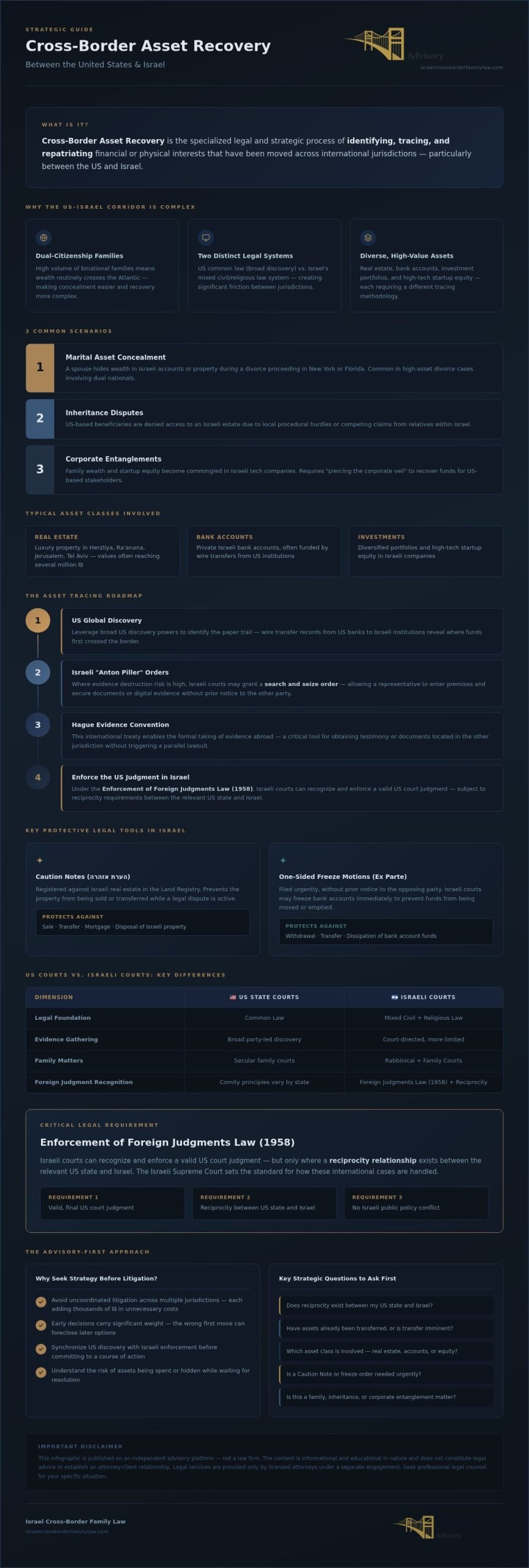
Cross-Border Asset Recovery is the specialized legal and strategic process of identifying, tracing, and repatriating financial or physical interests that have been moved across international jurisdictions. This process is rarely a straightforward administrative task. It requires a sophisticated understanding of how different legal systems interact when assets are transferred or concealed. In the US-Israel corridor, this need is particularly acute. The high volume of dual-citizenship families and transnational investments creates a unique environment where assets frequently cross the Atlantic. This article is published on an independent advisory platform, not a law firm, to provide objective strategic guidance on these complex matters. You can learn more about the advisory and our role in these disputes.
The types of assets involved are often high-value and diverse. Families frequently deal with luxury real estate in cities like Herzliya or Ra’anana, where property values can reach several million shekels (₪). Beyond physical property, recovery efforts often focus on private bank accounts, diversified investment portfolios, and high-tech equity in Israeli startups. Each asset class requires a different tracing methodology to ensure it is correctly identified and valued within the context of a legal dispute.
The Legal Framework: US State Courts vs. Israeli Family Courts
Success in these cases depends on bridging the gap between two distinct judicial philosophies. US state courts generally operate under a common law framework, emphasizing broad discovery and party-led evidence gathering. Israel, however, utilizes a mixed system that incorporates civil law principles and, in family matters, elements of religious law. The Israeli Supreme Court frequently sets the standard for how international cases are handled, particularly regarding the recognition of foreign orders. An independent advisor acts as a bridge, helping families navigate the friction between these systems before they commit to expensive litigation in a foreign language.
Common Scenarios for Asset Recovery
Most recovery efforts fall into three primary categories:
- Marital Asset Concealment: A spouse may attempt to hide wealth in Israeli accounts or property during a divorce proceeding in New York or Florida.
- Inheritance Disputes: US-based beneficiaries may find themselves denied access to an Israeli estate due to local procedural hurdles or competing claims.
- Corporate Entanglements: Disputes often arise involving Israeli startups where family wealth and corporate equity have become commingled; this requires a “piercing of the corporate veil” to recover funds for US-based stakeholders.
Understanding these scenarios early allows families to develop a proactive strategy rather than reacting to asset dissipation as it happens. Strategic clarity is the first step in ensuring that Cross-Border Asset Recovery remains a viable path rather than a theoretical possibility.
Strategies for Tracing Assets in Israel and the US
Successful Cross-Border Asset Recovery depends entirely on the quality of the initial tracing phase. Without a clear map of where funds have moved, legal orders remain theoretical. Tracing is a multi-step process that utilizes the strengths of both the US and Israeli legal systems to uncover hidden wealth. For those unfamiliar with these procedures, the Israel Family Law YouTube channel offers visual guides that break down these complex tracing methods into manageable steps.
- Step 1: US Global Discovery. The US legal system provides broad discovery powers. We often begin by identifying the “paper trail” within the US, such as wire transfer records from US banks to Israeli institutions.
- Step 2: Israeli “Anton Piller” Orders. In cases where there is a high risk of evidence destruction, Israeli courts may grant an Anton Piller order. This is a “search and seize” order that allows a designated representative to enter a premises to secure documents or digital evidence without prior warning to the other party.
- Step 3: The Hague Evidence Convention. This international treaty allows for the formal taking of evidence abroad. It’s a critical tool for obtaining testimony or documents located in Israel for use in US proceedings.
- Step 4: Analysis of Financial Inconsistencies. We look for discrepancies between reported income in tax filings and actual lifestyle expenditures. Identifying these gaps is often the first sign that assets have been diverted to offshore accounts or Israeli tech investments.
The Role of Forensic Accounting in Cross-Border Cases
Forensic experts are essential for identifying “lifestyle vs. income” discrepancies that suggest hidden wealth. In the modern economy, this often involves tracing crypto-assets or high-tech equity between Tel Aviv innovation hubs and US markets. These assets are often volatile and complex, requiring specialized knowledge to value and freeze. If you are an international resident dealing with these complexities, you can find more tailored information on our page for expats and foreign nationals.
Navigating Bank Secrecy and Privacy Laws
There is a common misconception that Israeli banking privacy is absolute. While it’s strong, it’s not an impenetrable shield against legitimate legal claims. Israeli courts will often compel disclosure if “Probable Cause” is established, showing that the account likely contains relevant assets. Additionally, US courts can sometimes compel disclosure from the US-based branches of major Israeli banks, bypassing the need for initial Israeli court intervention. Developing a clear strategy before approaching these institutions is vital. You might consider a confidential case review to assess the viability of your tracing efforts before committing significant resources.
Enforcing Foreign Judgments in the Israeli Legal System
Once you’ve identified assets through Cross-Border Asset Recovery strategies, the next hurdle is turning a US court order into an enforceable reality in Israel. This isn’t an automatic process. Israeli courts don’t simply “rubber stamp” foreign orders. Instead, the procedure is governed by the Enforcement of Foreign Judgments Law (1958). This statute provides a structured pathway for recognizing judgments from US state courts, provided they meet specific legal standards. Success requires more than just a valid decree; it demands a proactive strategy that anticipates local procedural requirements.
One of the most frequent questions families ask is whether a US divorce decree or financial settlement can be enforced in Tel Aviv or Haifa. The answer is generally yes, but it depends heavily on the principle of reciprocity. Israeli courts will typically enforce a judgment from a specific US state if that state would also recognize and enforce an Israeli judgment. For matters involving financial obligations like maintenance, you can review our guide on child support cross-border enforcement for detailed examples of how these principles apply in practice.
The Five Conditions for Enforcement in Israel
For an Israeli court to declare a foreign judgment enforceable, five statutory conditions must be satisfied. These are designed to ensure the judgment is legitimate and fair under Israeli standards:
- Finality: The judgment must be final and no longer subject to appeal in the original US jurisdiction.
- Authority: The US court must have had the legal jurisdiction to issue the judgment according to its own state laws.
- Public Policy: The judgment’s content must not contradict Israeli public policy or fundamental legal values.
- Enforceability: The order must be capable of being enforced in the country where it was originally granted.
- Reciprocity: As mentioned, there must be a mutual recognition between the US state and Israel, though courts have some discretion to waive this in specific circumstances.
Common Defenses Against Enforcement
Even if the five conditions are met, the opposing party may raise specific defenses to block the process. The most common defenses include:
- Lack of Proper Service: If the defendant wasn’t properly notified of the US proceedings according to legal requirements, the Israeli court may refuse enforcement.
- Procurement by Fraud: Evidence that the judgment was obtained through fraudulent means can invalidate the enforcement request.
- Contradiction with Prior Rulings: If an Israeli court has already issued a conflicting judgment on the same matter, the local ruling will generally take precedence.
By addressing these potential roadblocks during the strategy phase, families can significantly reduce the risk of a failed recovery effort. Getting clarity on these points early is essential before committing to a lengthy legal process.
Risk Mitigation: Preventing Asset Dissipation
In the context of Cross-Border Asset Recovery, identifying a hidden account or a property in Jerusalem is only the first step. The greater challenge is ensuring those assets remain in place until a final judgment is reached. When an opposing party realizes legal action is imminent, the risk of “asset dissipation”-the rapid liquidation or transfer of wealth-increases significantly. Preventing this requires a proactive strategy that utilizes specific protective measures within the Israeli legal system to “freeze” the status quo. If you are concerned about the immediate safety of family wealth, you may benefit from a confidential case review to assess your specific risks.
One of the most effective tools in Israel is the “Ex Parte” motion. These are one-sided requests made to the court without notifying the other party in advance. The goal is to obtain a temporary injunction or a freeze order before the individual has a chance to move funds. For real estate, we often look at the “Caution Note” (He’arat Azhara). This is a formal entry in the Israeli Land Registry (Tabu) that alerts any potential buyer or lender that the property is subject to a legal claim. It effectively prevents an unauthorized sale of a home in Ra’anana or an office in Tel Aviv, protecting interests worth millions of shekels (₪).
Flight risk is another critical factor. If there’s a credible threat that an individual might flee the jurisdiction with portable assets, Israeli courts can sometimes issue a “Stay of Exit” order. This prevents the person from leaving the country until they provide sufficient financial guarantees or comply with disclosure orders. While these measures are restrictive, they are often necessary to ensure the recovery process isn’t rendered moot by the physical disappearance of the debtor or the assets.
Temporary Restraining Orders (TROs) in a Global Context
A Temporary Restraining Order (TRO) issued by a US state court carries significant weight as evidence in an Israeli courtroom. While an Israeli bank is a purely local entity and won’t automatically freeze an account based on a California or New York order, the Israeli judge will view the US TRO as proof of a legitimate, ongoing dispute. These early decisions carry immense weight. If you fail to seek a freeze order early, Israeli courts may later question the urgency of your claim. Establishing a “bridge” between the US order and the Israeli filing is a core strategic priority.
Utilizing International Treaties and Conventions
International treaties provide the legal infrastructure for many recovery efforts. For instance, the Hague Convention on the Civil Aspects of International Child Abduction often overlaps with asset disputes, as the movement of children and wealth frequently happen simultaneously. When corporate structures are used to hide family wealth, families should also consider the strategies discussed in our guide on navigating US-Israel M&A. Additionally, the 1994 US-Israel Income Tax Treaty facilitates the exchange of information between tax authorities, which can be a vital tool for uncovering unreported income or offshore holdings. To begin securing your family’s future, contact us today for strategic guidance.
The Advisory Approach: Strategy Before Commitment
Success in international disputes isn’t achieved through aggressive litigation alone. It’s the result of a deliberate, well-structured strategy. This is where an independent advisory platform provides its greatest value. By offering an objective perspective, we help families avoid the emotional and financial drain of uncoordinated legal battles. Navigating Cross-Border Asset Recovery requires a guide who understands the nuances of both the US state court system and the unique procedural environment in Israel. This “Authoritative Reassurance” allows you to move forward with a clear vision of the risks and opportunities ahead. It’s important to remember that this content is published on an independent advisory platform, not a law firm; our focus is on strategy, risk assessment, and decision-making guidance.
Our model is built on collaboration. We don’t replace your existing local legal counsel in cities like Haifa, Be’er Sheva, or Jerusalem. Instead, we act as a strategic layer, ensuring that the actions taken in one jurisdiction don’t inadvertently harm your position in the other. It’s about synchronizing the efforts of multiple professionals to achieve a single, cohesive objective. This prevents the common pitfall of conflicting legal arguments being made in different countries, which can lead to judicial skepticism and increased costs reaching tens of thousands of shekels (₪).
The Importance of Cultural Nuance in Israeli Law
Israeli legal and business culture is often more informal and direct than the highly structured corporate environment of the United States. While US cases rely heavily on formal depositions and strict adherence to protocol, Israeli proceedings can be more dynamic. Having “boots on the ground” in Tel Aviv is essential for effective asset tracing; it allows for real-time monitoring of local registries and bank behaviors. Additionally, one must consider the influence of religious courts. In Israel, Rabbinical courts often have concurrent jurisdiction with civil family courts in specific matters, and their approach to asset distribution can differ significantly from Western expectations. Understanding these cultural shifts before you file a motion is critical to your success.
Taking the First Step Toward Recovery
The path to recovery begins with a thorough audit of all US-based documentation. Bank statements, wire transfer receipts, and tax filings are the building blocks of your case. It’s vital to avoid the common mistake of “self-help” methods. Attempting to access accounts via unauthorized digital means or illegal hacking can permanently damage your credibility in court and may lead to criminal liability. Professional tracing relies on legal, court-sanctioned discovery and forensic analysis. By organizing your evidence correctly from the start, you reduce the risk of asset dissipation and set the stage for a successful enforcement action.
Asset recovery is a marathon of strategy, not a sprint of litigation. It requires patience, precision, and a steady hand to navigate the complexities of two different legal worlds. Get clarity before you commit. Request a confidential consultation.
Securing Your Family’s Global Interests
Navigating the intersection of US and Israeli law requires more than just local representation. It demands a unified strategy that accounts for the nuances of both systems. Successful Cross-Border Asset Recovery is achievable when you prioritize early discovery and protective measures, such as Caution Notes on real estate, before assets can be moved or hidden. Understanding that Israeli courts require specific conditions for enforcing foreign judgments, including reciprocity and finality, allows you to prepare your case with professional clarity. This advisory platform serves as a bridge, helping Anglos and expats manage the inherent complexity of multi-jurisdictional disputes without the confusion of a language barrier.
Get clarity before you commit. Request a confidential consultation.
Taking the first step toward reclaiming what’s yours doesn’t have to be overwhelming. With the right roadmap and a focus on strategic decision-making, you can protect your family’s future across every border.
Frequently Asked Questions
Can I recover assets in Israel if I only have a US court order?
Yes, but the order must be declared enforceable by an Israeli court before you can seize property or funds. This involves a formal petition under the Enforcement of Foreign Judgments Law (1958). You must prove the US court had jurisdiction and that the judgment is final. While the process isn’t automatic, it provides a structured legal path for families to reclaim wealth that has been moved across borders.
How long does the cross-border asset recovery process typically take?
The timeline depends on the complexity of the assets and the level of cooperation from the opposing party. A standard enforcement of a foreign judgment often takes six to twelve months. If the case involves contested Cross-Border Asset Recovery with extensive forensic tracing of hidden accounts, it can take much longer. Strategic early decisions are the most significant factor in reducing delays and managing the overall duration of the case.
Are Israeli bank accounts protected from US discovery?
Israeli bank secrecy is strong, but it doesn’t offer total immunity from legal scrutiny. While an Israeli branch won’t respond to a US subpoena, US courts can often compel disclosure if the bank has a physical presence in the United States. In Israel, a judge can order disclosure if you show probable cause that the account holds relevant assets. This often requires a coordinated effort between US discovery and Israeli motions.
What happens if assets were moved to a third country from Israel?
Moving assets to a third country creates a complex multi-jurisdictional challenge for Cross-Border Asset Recovery. You would likely need to initiate new legal actions in that specific jurisdiction to continue the recovery effort. This highlights why early freeze orders in Israel are so critical. Once assets leave the US-Israel corridor, the cost and legal hurdles increase. Strategic planning ensures you’re prepared to follow the paper trail wherever it leads globally.
Do I need to travel to Israel to initiate an asset recovery case?
You don’t need to be physically present in Israel to start your case. Most initial steps, including strategy development and the filing of court petitions, are handled by your professional team remotely. Israeli courts have become increasingly comfortable with digital procedures and video testimony. This allows international families to manage their interests in Tel Aviv or Jerusalem while remaining in the US, provided they have a steady guide on the ground.
Can an Israeli trust be “pierced” in a US divorce case?
Piercing an Israeli trust is a high legal bar, but it can be done if the trust is shown to be a sham. If a spouse transferred marital funds into a trust to hide them, a US court might award you a larger share of other assets to compensate. If that isn’t possible, you may need to litigate in Israel to prove the trust’s invalidity. This is a complex area requiring specialized strategic guidance.
What are the costs associated with cross-border asset tracing?
Costs include professional fees for forensic accountants, investigators, and local legal counsel in cities like Haifa. A thorough investigation can easily cost tens of thousands of shekels (₪). It’s essential to perform a detailed financial assessment before committing to the process. You should weigh the potential recovery amount against these expenses to ensure that pursuing the assets makes commercial sense for your family’s specific situation.
Is it possible to freeze an Israeli apartment during a US legal dispute?
It’s possible to freeze an Israeli apartment by filing for a Caution Note in the Land Registry. While an Israeli registrar won’t accept a US order directly, a local court can use that order as a basis to grant a temporary injunction. This prevents the owner from selling a property in Herzliya or Ra’anana while your US case is pending. Speed is the most important factor here to prevent an unauthorized sale.

Article by
Gabriel Lior
A Personal Journey That Became a Mission
The advisory was founded by an American father Gabriel Lior, LLB, MBA , global entrepreneur, and cross-border advisor who spent more than a decade navigating the Israeli family court system firsthand and now lives in Singapore with his son.
As a divorced parent in a cross-border family, Gabriel faced nearly every legal challenge a foreign parent can encounter in Israel — including child custody disputes, child support proceedings, property matters in Israel and abroad, false accusations, and complex immigration and relocation proceedings.
Over the years, he learned the hard way how difficult it is for non-Israeli parents to understand the system, identify the right legal strategy, and choose the right legal representation — especially when language, culture, and jurisdictional differences are involved. He also witnessed how foreign parents and new immigrants are often disadvantaged or taken advantage of by service providers and institutions simply because they lack local knowledge or fluency.
From Client to Advisor
To truly understand — and survive — the system, Gabriel pursued formal legal education in Israel, completing two Israeli law degrees, alongside a BA and MBA earned in the United States. This was never about becoming a practicing attorney, but about gaining a deep, structural understanding of how the system works — and where it breaks down for foreign parents.
This rare combination of:
Firsthand client experience
Israeli legal and US business education
International business and negotiation training
Decades of commercial execution
created a unique perspective – one that understands both sides of the table.
After years of litigation, persistence, and at times self-representation, he ultimately succeeded in securing custody of his son and relocating abroad through a rare legal victory in the Israeli Supreme Court — becoming one of the first fathers in Israel to do so under these circumstances.
Disclaimer
Important Disclaimer:
The information provided on this website and in its content is for general informational and educational purposes only and does not constitute legal advice, legal opinion, or legal representation.
Gabriel Lior is not licensed to practice law in Israel (nor is he interested in doing so) and does not provide legal services, despite having completed 2 Law Degrees. The services offered are advisory in nature and are intended to provide general guidance, strategic insight, and information regarding cross-border family law considerations.
No attorney-client relationship is formed by accessing this website, reading its content, or communicating with us.
Any decisions made based on this information are at your own discretion and risk. For legal advice specific to your situation, you should consult a licensed attorney in the relevant jurisdiction.
Where appropriate, we may refer clients to independent, licensed attorneys or professionals. Such referrals do not constitute legal representation and no liability is assumed for services provided by third parties.