The prospect of an international child relocation between the United States and Israel is one of the most complex and emotionally charged challenges a parent can face. The legal process can feel overwhelming, and the fear of a negative outcome for your relationship with your child is profound. Success or failure often hinges on a single, critical factor: the strength, quality, and presentation of the evidence needed for international move-away case. Understanding precisely what a judge in either jurisdiction requires is not just beneficial-it is fundamental to protecting your parental rights and your child’s best interests. This comprehensive guide is designed to demystify this multi-jurisdictional process. We will provide a clear, strategic framework for the types of documentation and testimony courts prioritize, from demonstrating financial stability and a detailed parenting plan to substantiating the child’s potential for thriving in a new environment. By navigating the specific legal standards applied in both US and Israeli family courts, you will gain the confidence and clarity required to build a compelling case, whether you are proposing or opposing the relocation.
Key Takeaways
- The court’s decision centers exclusively on the “best interest of the child,” meaning all evidence must strategically prove how the relocation to Israel will benefit them.
- The core evidence needed for an international move-away case involves the moving parent presenting a comprehensive plan detailing financial stability, secured housing, and educational arrangements.
- A meticulously detailed visitation plan, with all associated travel and accommodation costs calculated in Israeli Shekels (₪), is a critical piece of the evidence needed for an international move-away case and can determine the outcome.
- For the non-moving parent, the focus of the evidence needed for an international move-away case shifts to demonstrating the potential harm of the move, highlighting the child’s strong ties to their current community and the detriments of separation.
The Legal Standard: Proving the ‘Best Interest of the Child’
In any child custody dispute, particularly a sophisticated cross-border relocation, the court’s primary and overriding mandate is to determine what serves the “best interest of the child.” Every piece of evidence submitted, every expert testimony provided, and every argument made must be meticulously framed to support this central thesis. The burden of proof rests squarely on the parent proposing the move, who must present a compelling and comprehensive case demonstrating that the relocation will enhance the child’s life, not detract from it. This is the foundational principle upon which all international move-away cases are adjudicated. To better understand the core concepts involved in presenting such a case, the following video provides a valuable overview:
The legal analysis shifts dramatically when a proposed move crosses international borders. Unlike a domestic relocation within Israel, an international move introduces profound complexities regarding jurisdiction, enforcement of custody orders, and the preservation of the child’s relationship with the non-moving parent. This multi-jurisdictional reality is governed by international treaties, most notably the Hague Convention on the Civil Aspects of International Child Abduction, which underscores the gravity of such decisions. While both US and Israeli family courts are guided by the “best interest” standard, Israeli courts often place a heightened emphasis on maintaining the child’s connection to their Israeli heritage and the non-moving parent, making the evidentiary threshold for the moving parent exceptionally high.
What ‘Best Interest’ Means in a Cross-Border Context
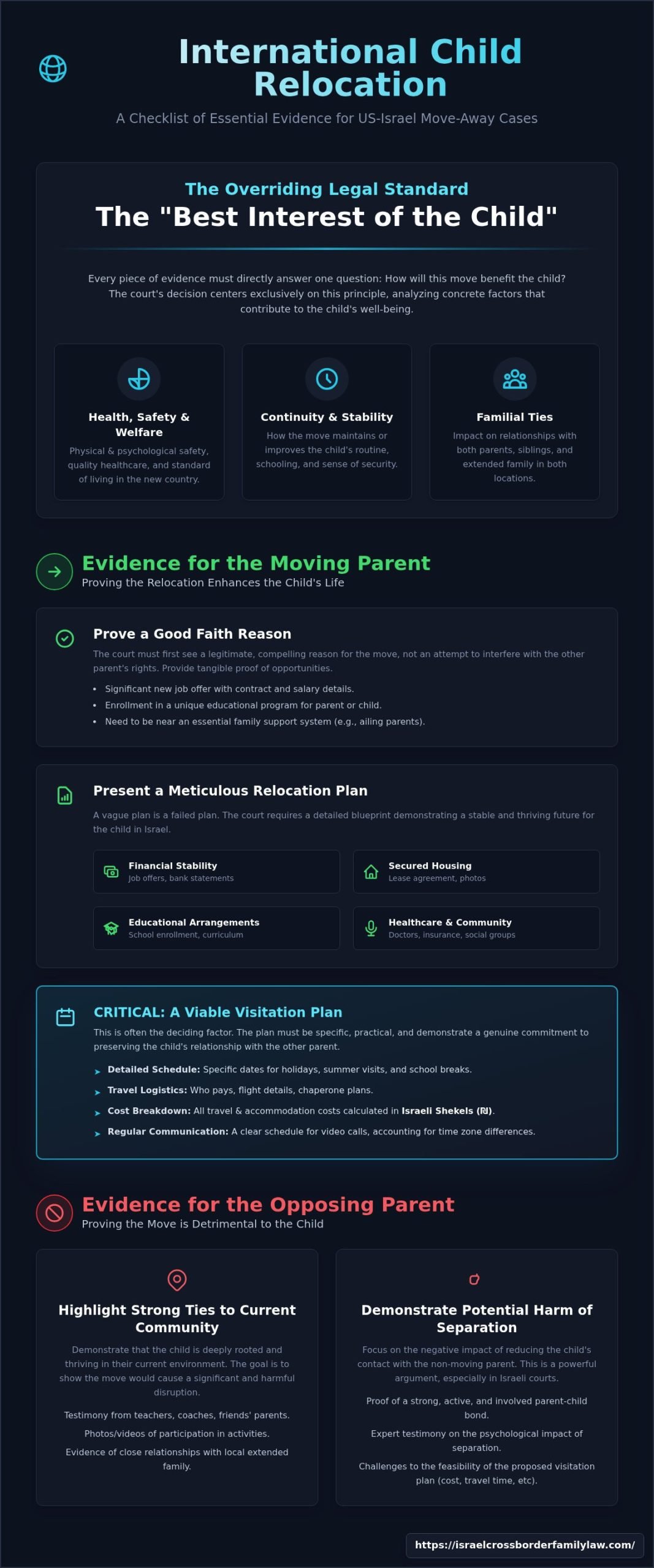
The concept of “best interest” is not abstract; it is defined by a series of concrete factors that courts meticulously evaluate. The specific evidence needed for an international move-away case must directly address these key areas:
- Health, Safety, and Welfare: This includes the physical and psychological safety of the child, access to quality healthcare, and the general standard of living in the proposed new country.
- Continuity and Stability: Courts favor stable environments. Evidence must show how the move will maintain or improve the child’s routine, schooling, and overall sense of security, rather than disrupt it.
- Familial Ties: The court will scrutinize the potential impact on the child’s relationship with each parent, siblings, and extended family members, including grandparents, in both locations.
The Moving Parent’s Initial Burden: A Good Faith Reason
Before a court will even begin a deep analysis of the child’s best interests, the moving parent must first satisfy a crucial threshold requirement: proving the relocation is sought in good faith and for a legitimate reason. The court must be convinced that the move is not a pretext designed to frustrate the other parent’s custody or visitation rights. Compelling evidence of good faith often includes tangible opportunities such as a significant new job offer, enrollment in a unique educational program for the parent or child, or the need to return to a home country to be near an essential family support system.
Core Evidence for the Moving Parent: Building a Case for Relocation
In any cross-border relocation dispute, the burden of proof rests squarely on the parent proposing the move. Courts approach these complex matters with extreme caution, as the implications of an international move are permanent and profound. A vague or aspirational plan is the most common reason for a court’s denial; the judiciary must be convinced that the relocation is not only well-intentioned but meticulously planned and in the child’s paramount best interest. The comprehensive evidence needed for an international move-away case serves to counteract any perception of flight risk or parental abduction, a serious concern outlined by authorities like the U.S. Department of State on International Parental Child Abduction. Your objective is to present an irrefutable, concrete vision of a stable and advantageous future for your child.
Evidence of the Opportunity and Financial Stability
The foundation of your case is demonstrating that the move is motivated by a significant opportunity that will enhance the family’s financial security and overall quality of life. This requires tangible proof, not just promises. Essential documentation includes:
- Formal Job Offer: A signed offer letter on company letterhead detailing the position, salary in Israeli Shekel (₪), comprehensive benefits package (e.g., Bituach Menahalim, Keren Hishtalmut), and start date.
- Business Plan: For entrepreneurs or self-employed individuals moving to Israel, a sophisticated business plan with financial projections, market analysis, and evidence of initial funding is critical.
- Financial Statements: Detailed personal budgets projecting income versus expenses in Israel, bank statements showing sufficient savings (denominated in ILS), and proof of financial solvency.
Evidence of a Detailed Logistical Plan
Beyond the financial impetus, you must present a clear and practical plan for the child’s daily life. This evidence shows the court you have moved beyond the idea of relocation and have executed the necessary preparations. Key logistical proof includes a signed rental agreement or property purchase contract for a specific residence, complete with photographs and information about the neighborhood, local parks, and amenities. Furthermore, provide documentation of school enrollment, such as acceptance letters or completed applications to specific Israeli schools, along with their curriculum and academic reports. Finally, detail your healthcare plan, including registration with a Kupat Holim (HMO) and identification of a local pediatrician and nearby medical facilities; to get a sense of what this entails in other jurisdictions, you can learn more about Insurance VISA, which offers plans for foreigners in Europe.
Evidence of Support Systems in the New Location
A court must be assured that the child will not be isolated from a supportive community. This evidence is crucial to demonstrate that the child will have a robust social and emotional network. Gather sworn affidavits or notarized letters from family members, such as grandparents residing in Israel, explicitly stating their commitment to providing regular support. Present detailed information on community groups, religious institutions (e.g., a local synagogue), or social networks you plan to join. To further illustrate a thriving environment for the child, provide proof of enrollment or detailed plans for extracurricular activities like sports teams, music lessons, or youth movements such as the Tzofim (Scouts).
Critical Evidence on Child’s Ties and Potential Impact
When adjudicating a complex international relocation petition, Israeli family courts conduct a meticulous analysis centered on the child’s best interests. The core judicial objective is to weigh the child’s established stability and network of relationships in Israel against the proposed benefits and inherent disruptions of the move. Consequently, a significant portion of the evidence needed for an international move-away case is dedicated to demonstrating the child’s current reality and the potential impact of its fundamental alteration. This evidence is equally critical for the parent proposing the relocation and the parent opposing it.
Documenting the Child’s Current Life
For both parties, providing a comprehensive, tangible record of the child’s life in Israel is non-negotiable. This evidence serves to create a detailed portrait of the child’s world, including their academic progress, emotional well-being, and social integration. Key documents include:
- School and Educational Records: Report cards, attendance records, letters from teachers or school counselors detailing the child’s academic performance and social adjustment.
- Medical and Therapeutic Documentation: Records from pediatricians, therapists, or other specialists, along with statements regarding ongoing treatment plans that would be disrupted by a move.
- Social and Extracurricular Involvement: Photographs, videos, and testimony illustrating the child’s deep connections to friends, sports teams, community groups, and hobbies.
The Relationship with the Non-Moving Parent
The nature and depth of the child’s relationship with the parent remaining in Israel is a central pillar of the court’s inquiry. The non-moving parent must present compelling evidence of their active and consistent involvement, moving beyond mere statements to demonstrable facts like participation in school pickups, coaching sports, attending medical appointments, and being an integral part of the child’s daily routine. This dynamic is central to many international custody and relocation disputes, as the court must assess whether the proposed move would irreparably harm this fundamental bond. The judiciary’s deep concern for maintaining parental ties is a cornerstone of Israeli family law, reflecting principles that also inform the state’s approach to severe parental disputes, as detailed in resources like the Israeli Ministry of Justice Guide to Child Abduction.
Child Custody Evaluations and Expert Testimony
In highly contested cases, Israeli courts frequently appoint a neutral, third-party expert, such as a forensic psychologist or custody evaluator, to conduct a comprehensive assessment. This expert evaluation, culminating in a detailed report and potential testimony, is often one of the most influential pieces of evidence submitted. The evaluator will meet with both parents and the child, review documents, and offer a professional opinion on the child’s best interests regarding the proposed relocation. While the child’s own preference may be considered, its weight is determined by their age, maturity, and the specific circumstances of the case.
The Visitation Plan: Proving Continued Contact is Viable
In a cross-border child relocation proceeding, the petition is frequently won or lost based on the strength and viability of the proposed visitation plan. The Israeli Family Court must be convinced that the move will not sever or substantially harm the child’s relationship with the non-moving parent. Vague promises of ‘frequent visits’ are insufficient; the court demands a detailed, realistic, and financially sound proposal. This plan is a critical piece of the evidence needed for an international move-away case, demonstrating a good-faith commitment to preserving the parental bond across borders.
A Detailed and Specific Visitation Schedule
A successful plan must be concrete. It should meticulously outline a proposed schedule for visitation during all major school holidays, including Passover, Sukkot, and the extended summer break. The proposal must explicitly state who will be responsible for travel arrangements and, crucially, who will bear the associated costs. For example, providing sample flight itineraries from Ben Gurion Airport (TLV) to the destination, with estimated costs (e.g., a summer flight to New York costing ₪4,000-₪6,000) and travel times, lends significant credibility to the plan.
A Robust Communication Plan
Beyond physical visits, the court requires a comprehensive strategy for maintaining regular and meaningful contact. This communication plan must be more than a suggestion; it should be a structured schedule. The most effective evidence needed for an international move-away case in this regard includes:
- A fixed schedule for video calls (e.g., via WhatsApp or Zoom) that explicitly accounts for time zone differences between Israel and the new country of residence.
- Provisions for daily communication through text messaging or email, allowing for spontaneous interaction.
- A commitment to provide the non-moving parent with shared, direct access to the child’s online school and medical portals, ensuring full transparency and involvement in the child’s daily life.
Presenting such a sophisticated and well-researched plan demonstrates to the court that the relocating parent is not only considering the logistical challenges but is strategically prepared to overcome them. Crafting a plan that satisfies judicial scrutiny in these complex matters requires experienced legal guidance. For assistance in navigating these challenges, contact our firm of cross-border family law specialists.
Evidence for the Opposing Parent: Proving the Move is Detrimental
When opposing an international relocation, the legal focus shifts from the moving parent’s aspirations to the potential detrimental impact on the child. The objective is to present a compelling, evidence-based argument that the proposed move is not in the child’s best interests. This requires a meticulous deconstruction of the relocation plan and a robust presentation of the instability and loss the child would face. The crucial evidence needed for an international move-away case from this perspective centers on demonstrating harm, challenging motives, and highlighting risks.
Challenging the ‘Good Faith’ Reason
A court must be convinced that the relocation is founded on a legitimate, good-faith purpose, not a desire to marginalize the other parent. Evidence to counter this can include a documented history of frustrated contact, such as emails or text messages showing a pattern of interference with visitation. Furthermore, the purported opportunity must be scrutinized. We can investigate whether a job offer is genuine and stable, or if a proposed salary, such as ₪20,000 per month, is truly sufficient for the destination’s cost of living. Proving the primary motive is alienation is a powerful counter-argument.
Highlighting Risks and Instability
A critical strategy involves presenting concrete evidence of instability or risk in the destination country. This can include official government travel advisories citing political unrest or safety concerns. We would also analyze the availability of essential services. For a child with specific medical needs or requiring a particular educational framework, demonstrating a lack of comparable resources can be a decisive factor. This argument extends to legal instability-the inherent risk that Israeli court orders for visitation will not be respected or easily enforced in a foreign jurisdiction.
The Hague Convention and International Law
While both Israel and the U.S. are signatories to the Hague Convention on Child Abduction, this treaty is a complex remedy for wrongful removal, not a preventative shield. A core legal argument is that the proposed relocation dramatically increases the risk of an international abduction scenario. Enforcing visitation rights across borders is notoriously difficult and costly, and the Convention does not guarantee a simple resolution. The most effective legal strategy is to prevent the move, thereby eliminating the potential for a multi-jurisdictional crisis before it begins. Successfully opposing an international move requires a sophisticated approach that challenges every facet of the proposal. If you are facing this complex cross-border challenge, our experienced team can provide the guidance needed to build the strongest possible case. Contact our firm to navigate these sophisticated legal matters.
Strategic Counsel for Your Complex International Relocation Case
Successfully navigating a US-Israel move-away case is a sophisticated legal endeavor that hinges on a meticulously prepared evidentiary strategy. The central pillars of any argument, whether for or against the relocation, are demonstrating the child’s best interests and presenting a robust, detailed visitation plan that proves continued, meaningful contact is viable. The sheer volume and specificity of the evidence needed for international move-away case-from financial stability and the child’s community ties to the new location’s benefits-demands unparalleled legal precision and a deep understanding of multi-jurisdictional law. These high-stakes, cross-border disputes require more than just legal representation; they require strategic guidance from a team intimately familiar with the nuances of both legal systems. With decades of experience in complex custody disputes and profound expertise in US-Israel treaties and The Hague Convention, our bilingual, bicultural legal team is uniquely positioned to protect your parental rights. We invite you to Schedule a Confidential Case Review to Discuss Your Move-Away Case to secure the authoritative counsel your family deserves.
Frequently Asked Questions
What happens if the other parent agrees to the international move?
While parental consent is a critical first step, it is imperative to formalize this agreement legally. A verbal understanding is insufficient for a multi-jurisdictional matter. You must obtain a comprehensive, written, and notarized consent agreement that details the new custody and visitation arrangements. This document should then be submitted to the Israeli Family Court for ratification into a binding court order. This formalizes the relocation and provides an enforceable legal framework, safeguarding against future disputes or challenges.
Do I need a formal child custody evaluation for my case?
In complex, contested international relocation cases, a formal child custody evaluation is highly advisable, though not always mandatory. This evaluation, conducted by a court-appointed psychologist or social worker, provides the court with an objective, expert assessment of the child’s best interests concerning the proposed move. The resulting report serves as critical evidence, analyzing factors such as parental fitness and the potential impact of the move on the child, thereby carrying substantial weight in the court’s final determination.
How much weight does the court give to my child’s opinion about moving?
The court’s consideration of a child’s preference is a nuanced aspect of relocation litigation, directly correlated with the child’s age, maturity, and ability to articulate a reasoned opinion. While the preference of an older adolescent is given significant weight, it is never the sole determinative factor. The court will carefully balance the child’s stated desires against all other evidence to ascertain whether the proposed international move truly serves the child’s overall best interests and long-term welfare.
Can I move with my child before I get a final court order?
Relocating internationally with your child without a final court order or the other parent’s explicit, notarized consent is strictly prohibited and carries severe legal consequences. Such an action can be construed as international parental child abduction under the Hague Convention, which could trigger immediate return proceedings. This would critically undermine your legal position, likely resulting in the denial of your relocation request and potentially impacting your existing custody rights. Formal legal authorization is an absolute prerequisite.
What makes a US-Israel move-away case different from other international cases?
US-Israel cross-border relocation cases present unique complexities and advantages. Both nations are signatories to the Hague Convention, providing a structured framework for resolving disputes. However, the deep cultural, familial, and economic ties between the two countries often introduce distinct evidentiary challenges and opportunities. A deep understanding of both legal systems is essential for navigating these nuances and presenting a compelling, culturally-attuned case to the Israeli Family Court on behalf of our clients.
How do courts handle the costs of international travel for visitation?
Courts meticulously address the financial logistics of maintaining the non-relocating parent’s relationship with the child. The allocation of travel costs is a key component of the final order. While costs may be divided, it is common for the relocating parent to bear a greater portion of the expense, which can range from ₪7,000 to ₪15,000 or more per round trip. The evidence needed for an international move-away case should include a proposed budget demonstrating your ability to facilitate this ongoing contact.

Article by
Gabriel Lior
A Personal Journey That Became a Mission The advisory was founded by an American father Gabriel Lior, LLB, MBA , global entrepreneur, and cross-border advisor who spent more than a decade navigating the Israeli family court system firsthand and now lives in Singapore with his son.
As a divorced parent in a cross-border family, Gabriel faced nearly every legal challenge a foreign parent can encounter in Israel — including child custody disputes, child support proceedings, property matters in Israel and abroad, false accusations, and complex immigration and relocation proceedings. Over the years, he learned the hard way how difficult it is for non-Israeli parents to understand the system, identify the right legal strategy, and choose the right legal representation — especially when language, culture, and jurisdictional differences are involved. He also witnessed how foreign parents and new immigrants are often disadvantaged or taken advantage of by service providers and institutions simply because they lack local knowledge or fluency. From Client to Advisor To truly understand — and survive — the system, Gabriel pursued formal legal education in Israel, completing two Israeli law degrees, alongside a BA and MBA earned in the United States. This was never about becoming a practicing attorney, but about gaining a deep, structural understanding of how the system works — and where it breaks down for foreign parents. This rare combination of: Firsthand client experience Israeli legal and US business education International business and negotiation training Decades of commercial execution created a unique perspective – one that understands both sides of the table. After years of litigation, persistence, and at times self-representation, he ultimately succeeded in securing custody of his son and relocating abroad through a rare legal victory in the Israeli Supreme Court — becoming one of the first fathers in Israel to do so under these circumstances.
Disclaimer
Important Disclaimer: The information provided on this website and in its content is for general informational and educational purposes only and does not constitute legal advice, legal opinion, or legal representation. Gabriel Lior is not licensed to practice law in Israel (nor is he interested in doing so) and does not provide legal services, despite having completed 2 Law Degrees. The services offered are advisory in nature and are intended to provide general guidance, strategic insight, and information regarding cross-border family law considerations. No attorney-client relationship is formed by accessing this website, reading its content, or communicating with us. Any decisions made based on this information are at your own discretion and risk. For legal advice specific to your situation, you should consult a licensed attorney in the relevant jurisdiction. Where appropriate, we may refer clients to independent, licensed attorneys or professionals. Such referrals do not constitute legal representation and no liability is assumed for services provided by third parties.