What if the decision to move your family closer to home or a new career opportunity is viewed by the legal system not as a fresh start, but as an act of international abduction? For many expats and international families living in the Sharon region, the desire to move abroad is often driven by legitimate goals. However, the Israeli legal system means even a well-intended move can trigger severe consequences under the Hague Convention if it’s not handled with precision. If you’re seeking help with child relocation from Kfar Saba, you likely feel the weight of these high stakes and the confusion of the Central District Family Court’s specific procedures.
You want to move forward, but the fear of a legal misstep can be paralyzing. This guide provides a strategic roadmap to help you secure legal permission while protecting your parental rights and your child’s future. We’ll examine how to manage the “best interests of the child” standard and the requirements of the 1962 Legal Capacity and Guardianship Law. Please note this content is published on an independent advisory platform, not a law firm; it focuses on strategy and risk management rather than formal legal advice.
Key Takeaways
- Understand the specific role of the Central District Family Court and how it applies the “best interests of the child” standard to international moves from the Sharon region.
- Discover why a mutual written agreement is the safest path for relocation and what to expect if you must pursue a formal lawsuit (Tvi’at Hagira).
- Learn the critical legal distinctions between temporary travel authorizations and permanent changes in residency to prevent “No Exit” orders.
- Use our strategic 5-step framework for those seeking help with child relocation from Kfar Saba to build a compelling case based on transparency and visitation planning.
- Gain clarity on why cross-border moves require a specialized advisory approach that accounts for the differences between Israeli family law and international legal systems.
Child Relocation from Kfar Saba: Understanding the Central District Framework
In Israeli family law, the term for relocation is Hagira. It refers to a permanent change in a child’s residence that significantly impacts the existing custody arrangement or the other parent’s access. For families living in the Sharon region, this process is governed by the Legal Capacity and Guardianship Law of 1962. It’s vital to understand that neither parent has the unilateral right to move a child’s residence, even within Israel, without either written consent or a court order. Moving a child across international borders without these permissions can trigger the Hague Convention on International Child Abduction, a treaty designed to return children to their “habitual residence” immediately.
If you are seeking help with child relocation from Kfar Saba, you must prioritize legal clarity before making any life-altering commitments like signing a lease or resigning from a job. This content is published on an independent advisory platform, not a law firm; our focus is on providing strategy and risk management guidance for international families navigating these complexities.
To better understand the legal standards involved in these decisions, watch this helpful video:
The Legal Status of Kfar Saba Residents
Families residing in Kfar Saba fall under the jurisdiction of the Central District Family Court. This specific court is highly experienced in international custody and relocation matters due to the high density of expats and dual-citizens in the area. The court’s primary objective is to maintain the “Status Quo” until a final decision is reached. Any attempt to bypass this framework often results in the court viewing the relocating parent with skepticism, which can negatively impact the eventual outcome of the case.
The Role of the Ministry of Labor and Social Affairs
When a relocation lawsuit is filed, the court typically appoints a social worker (Pkidat Saad) from the local Kfar Saba municipality to conduct an evaluation. This professional acts as the “eyes and ears” of the judge. They’ll interview both parents and the children to draft a “Best Interests of the Child” report. In cross-border cases, this evaluation may involve coordinating with international social services to assess the proposed new environment abroad. Preparing for this assessment requires a transparent, well-documented plan for how the child will maintain their relationship with the parent staying in Israel.
Consent vs. Litigation: The Two Paths to Relocation
Deciding to move your family abroad is a complex process with two primary legal pathways: mutual agreement or court litigation. For those seeking help with child relocation from Kfar Saba, the path chosen will dictate the timeline, cost, and emotional impact on the children involved. Collaborative solutions are always preferred by the Israeli judiciary, but they require a high level of transparency and strategic planning from both parents.
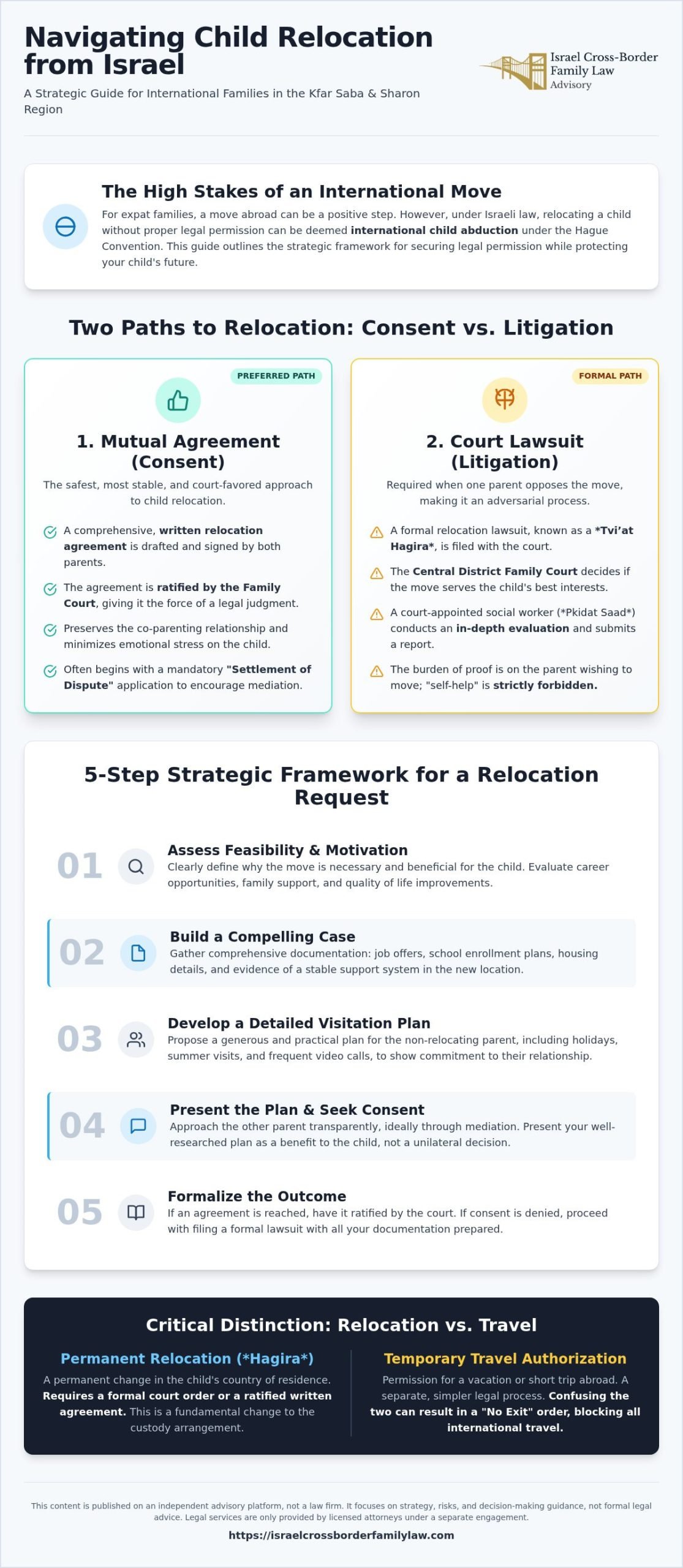
The gold standard for any move is a comprehensive, written relocation agreement ratified by the court. This provides legal certainty and maintains the co-parenting relationship without the adversarial nature of a trial. Israeli law now requires a mandatory “Settlement of Dispute” application before most family litigation can begin. As of January 2026, the fee for this application is 119 NIS. This initial phase encourages mediation, allowing families in the Sharon region to reach a consensus before a judge intervenes.
If one parent opposes the move, the relocating parent must file a formal relocation lawsuit, known as a Tvi’at Hagira. In these cases, the Central District Family Court must decide if the move serves the child’s best interests. Attempting “self-help” by moving without permission is never an option. Such actions are viewed as a breach of the other parent’s rights and can lead to immediate legal sanctions or the loss of custody.
Drafting an Enforceable Relocation Agreement
An enforceable agreement must go beyond simple visitation schedules. It needs to address who pays for international flights, how digital communication is maintained, and how child support will be enforced across borders. It’s often necessary to ensure the agreement is recognized as a “mirror order” in the destination country to prevent future jurisdictional disputes. If you are unsure how to structure these terms, you can request a strategy session to review your options.
The Hague Convention Warning
Taking a child out of Israel without the other parent’s written consent or a court order is considered a wrongful removal under the HCCH Child Abduction Convention. For a parent in Kfar Saba, leaving without authorization can trigger an immediate Hague Convention petition. In 2026, initial hearings for these petitions must occur within 15 days of filing. The goal is a final decision within 90 days, often resulting in the court ordering the child’s immediate return to Israel. Seeking international custody and relocation guidance early is the most effective way to avoid being labeled as an “abductor” in the eyes of the law.
Relocation vs. Travel Authorization: Key Differences
Distinguishing between a temporary vacation and a permanent relocation is critical for international families living in the Sharon region. While both involve crossing borders, the legal threshold for each varies significantly. Travel authorization typically covers short-term trips with a defined return date, such as visiting grandparents or going on a holiday. Relocation involves a permanent shift in the child’s “habitual residence.” If you need help with child relocation from Kfar Saba, it’s essential to recognize that the court applies much stricter scrutiny to a permanent move than to a standard holiday abroad.
A frequent risk for expats is the “overstay.” A trip that begins with consent for two weeks can legally transition into a relocation dispute if the parent refuses to return the child to Israel. In such cases, the court must determine if the child’s residence has changed. This distinction is not merely semantic; it determines which country’s laws apply to future custody or support issues. Seeking clarity through a Confidential Case Review can help you manage these risks before travel begins.
Navigating No-Exit Orders (Zav Ikur Yetzia)
In Israel, “No-Exit” orders are a standard precautionary measure in family law cases to prevent a parent from leaving the country with a child without the other parent’s consent. For residents in Kfar Saba, these orders are often issued by the Central District Family Court. To lift an order for a planned relocation, the court usually requires significant financial guarantees. These may include depositing a cash bond or having “guarantors” sign legal commitments to ensure the child returns or that the move follows the court-approved plan. The court’s goal is to ensure that the parent staying in Israel isn’t left without legal recourse if the relocation agreement is breached.
The Evidentiary Burden in Relocation Cases
The burden of proof in a relocation case is heavy. The court doesn’t just look at the parent’s desire to move; it evaluates the necessity and sincerity of the request. You must demonstrate concrete reasons for the move, such as a confirmed career advancement, proximity to extended family support, or superior educational opportunities. Most importantly, you must present a viable plan for how the child will maintain a deep, ongoing relationship with the parent remaining in Israel. The court’s scrutiny focuses on several pillars of evidence:
- Economic and Social Necessity: Documentation of job offers, housing contracts, and school enrollments in the destination country.
- Sincerity of Intent: Evidence that the move isn’t designed to alienate the other parent or disrupt their bond with the child.
- Communication Maintenance: A detailed proposal for digital visitation, scheduled holiday travel, and long-distance co-parenting logistics.
This platform provides advisory guidance on these strategic risks, but formal legal representation must be sought through a licensed attorney. Understanding these evidentiary requirements early allows you to build a case based on transparency rather than conflict.
How to Prepare for a Relocation Request: A 5-Step Guide
Relocating with a child from the Sharon region requires a methodical approach that prioritizes the child’s stability while respecting the legal rights of both parents. For those seeking help with child relocation from Kfar Saba, preparation is the most critical phase. This platform operates as an independent advisory service rather than a law firm; our role is to provide strategic guidance on risk management and decision-making before you engage in formal litigation.
A successful relocation strategy typically follows these five essential steps:
- Step 1: Document the “Why”: Collect objective evidence for the move, such as employment contracts, specialized educational programs, or proximity to extended family support systems.
- Step 2: Create a Comprehensive Visitation Proposal: Demonstrate good faith by proposing a detailed schedule that includes digital communication, holiday travel, and summer visits.
- Step 3: Consult a Cross-Border Specialist: Understand how the laws of your destination country interact with Israeli orders. This often involves planning for “mirror orders” to ensure enforceability abroad.
- Step 4: Engage in Good Faith Negotiation: Use the mandatory “Settlement of Dispute” period to reach an amicable agreement, which significantly reduces the emotional and financial cost of the move.
- Step 5: File the Formal Request: If negotiation fails, file a relocation lawsuit in the Central District Family Court, ensuring all procedural requirements are met to avoid delays.
Building Your “Best Interests” Case
Israeli courts evaluate relocation based on the “Best Interests of the Child” standard. When preparing your case, you must provide a side-by-side comparison of the child’s current life in Kfar Saba versus their projected life abroad. While Kfar Saba offers high-quality education and community services, you may need to demonstrate how the destination provides unique advantages, such as a stronger emotional support network of grandparents and siblings. The court also considers the child’s mental health and the potential stability a move might offer in the context of the family’s long-term goals.
The Importance of Timing
Relocation is never a quick process. We recommend starting your strategic planning 6 to 12 months before your intended move date. The Central District Family Court maintains a busy calendar, and contested cases can take several months or even years to resolve. Last-minute “emergency” filings are often viewed with skepticism by judges and may lead to a temporary “No-Exit” order being placed on the child to preserve the status quo. Early planning allows for a smoother transition and more time to reach a consensual agreement.
If you are in the early stages of planning a move, it is vital to understand the weight of your initial decisions. You can contact us to discuss your strategic options before making any formal commitments.
Strategic Advisory for Cross-Border Families in Israel
For international families residing in the Sharon region, seeking help with child relocation from Kfar Saba requires a perspective that transcends municipal borders. While a local attorney understands the inner workings of the Central District Family Court, cross-border relocation involves a collision of different legal systems. This is where an independent advisory approach becomes essential. We act as a bridge between the Israeli legal framework and the expectations of foreign jurisdictions. Our goal is to ensure your strategy accounts for international treaties and the long-term enforceability of agreements.
This content is published on an independent advisory platform, not a law firm. We focus on strategy, risks, and decision-making guidance rather than an attorney-client relationship. Legal services are only provided by licensed attorneys under a separate engagement. Transparency is a core value of our model, and we provide clear information regarding our pricing and engagement models so that families can plan their budgets without the uncertainty often associated with open-ended legal fees.
Getting Clarity Before You Commit
Clarity is your most valuable asset when planning an international move. An advisory session focuses on identifying “Red Flags” in your relocation plan, such as inconsistent visitation proposals or a lack of clarity regarding which court will hold jurisdiction after the move. This process differs from a standard courtroom battle because it’s about building a foundation of transparency. To see how these principles apply in practice, you can watch the Israel Family Law YouTube channel for detailed case studies and educational content that explains the weight of early decisions.
Supporting Expats and Foreign Nationals
Our platform provides specialized support for expats and foreign nationals who may feel overwhelmed by the cultural nuances of the Israeli legal system. Managing the emotional weight of cross-border litigation is a significant challenge, and having a clear roadmap helps alleviate that anxiety. Before you begin the formal legal process or make any irreversible commitments, a Confidential Case Review allows you to explore your options in a neutral, advisory environment. We believe that a successful move starts with a clear strategy, not a packed suitcase. Seeking clarity early ensures that your family’s future is built on a stable legal foundation.
Securing Your Family’s Global Future
Navigating a move from the Sharon region involves more than logistical planning; it requires a deep understanding of how the Central District Family Court interprets international residency. You’ve learned that the distinction between temporary travel and permanent relocation is critical, and that a well-documented preparation plan is your best tool for success. Whether you are pursuing a mutual agreement or navigating the complexities of a contested hearing, your focus must remain on the long-term stability of your children and the “best interests” standard used by Israeli judges.
If you need help with child relocation from Kfar Saba, remember that early strategy is the most effective defense against the legal risks of the Hague Convention. Our independent advisory platform offers specialized US-Israel cross-border expertise designed specifically for international families. We focus on providing a strategic bridge between legal systems so you can make informed decisions before you commit to the courtroom. Get clarity before you commit. Request a confidential consultation. You can move forward with confidence when your transition is supported by a clear, legally sound strategy.
Frequently Asked Questions
This FAQ section is published on an independent advisory platform, not a law firm. The following information is provided for educational purposes to help families understand strategy, risks, and decision-making in cross-border family law matters.
Can I move my child from Kfar Saba to another country without the other parent’s consent?
No, you cannot legally move your child from Kfar Saba to another country without the other parent’s written consent or a specific court order. Under the 1962 Legal Capacity and Guardianship Law, both parents are the natural guardians of their children. Unilateral removal without authorization is often classified as a “wrongful removal” under international treaties. If you’re seeking help with child relocation from Kfar Saba, it’s vital to obtain these permissions first to avoid severe legal repercussions.
What happens if I leave Israel with my child while a custody case is pending?
Leaving Israel with your child while a custody case is pending is extremely risky and generally prohibited by the court. Judges aim to maintain the status quo until a final decision is reached. Such an action can be viewed as an attempt to bypass the judicial process, often resulting in an immediate Hague Convention petition for the child’s return. This could permanently damage your legal standing and credibility in the eyes of the Central District Family Court.
How does the Kfar Saba Family Court determine the “Best Interests of the Child”?
The Kfar Saba Family Court determines the “Best Interests of the Child” primarily through evaluations by court-appointed social workers. These professionals assess the child’s emotional stability, educational needs, and the quality of their relationship with both parents. The court prioritizes the child’s welfare over the parents’ desires. They look for a relocation plan that ensures the child maintains a meaningful and consistent bond with the parent who remains in Israel despite the geographic distance.
Can a “No Exit” order be issued against my child even if we aren’t divorced?
Yes, a “No Exit” order (Zav Ikur Yetzia) can be issued against a child even if the parents are not divorced or haven’t filed for divorce. Any party with a legitimate concern that a child might be removed from Israel without consent can petition the court for this order. It’s a common preventative measure used to ensure that cross-border disputes are settled within the Israeli legal system before a child leaves the country permanently.
How long does a child relocation trial typically take in the Central District?
A contested child relocation trial in the Central District Family Court can typically take between one and three years to resolve. While Hague Convention cases are expedited to reach a decision within 90 days, standard relocation lawsuits involve extensive social worker evaluations and expert testimonies. This timeline highlights why early strategic planning and good-faith negotiations are essential for families seeking help with child relocation from Kfar Saba to avoid prolonged and costly litigation.
Will my US custody order be honored by the Israeli court in Kfar Saba?
A US custody order is not automatically honored in Israel; it must first be recognized or enforced by an Israeli court. This process is governed by the 1958 Foreign Judgments Enforcement Law. The court in Kfar Saba will review the order to ensure it doesn’t contradict Israeli public policy or the child’s best interests. It’s often necessary to “mirror” these orders in both jurisdictions to ensure they remain enforceable after an international move occurs.
What are the consequences of being found in violation of the Hague Convention?
The primary consequence of violating the Hague Convention is a court-ordered mandatory return of the child to their country of “habitual residence.” Beyond the immediate return, the violating parent may be ordered to pay the other parent’s legal fees and travel expenses. Additionally, being labeled a “wrongful remover” by the court can significantly jeopardize your future custody rights and credibility in any subsequent relocation or custody proceedings within the Israeli legal system.
Do I need a lawyer in both Israel and the country I am moving to?
While not always mandatory, it’s highly recommended to have legal guidance in both Israel and your destination country. An Israeli lawyer manages the Central District Court procedures, while a lawyer in the destination country ensures the relocation agreement is enforceable there. This “dual-track” approach helps prevent jurisdictional gaps and ensures that visitation rights and child support orders are recognized and respected across international borders, providing long-term legal security for your family’s future.

Article by
Gabriel Lior
A Personal Journey That Became a Mission
The advisory was founded by an American father Gabriel Lior, LLB, MBA , global entrepreneur, and cross-border advisor who spent more than a decade navigating the Israeli family court system firsthand and now lives in Singapore with his son.
As a divorced parent in a cross-border family, Gabriel faced nearly every legal challenge a foreign parent can encounter in Israel — including child custody disputes, child support proceedings, property matters in Israel and abroad, false accusations, and complex immigration and relocation proceedings.
Over the years, he learned the hard way how difficult it is for non-Israeli parents to understand the system, identify the right legal strategy, and choose the right legal representation — especially when language, culture, and jurisdictional differences are involved. He also witnessed how foreign parents and new immigrants are often disadvantaged or taken advantage of by service providers and institutions simply because they lack local knowledge or fluency.
From Client to Advisor
To truly understand — and survive — the system, Gabriel pursued formal legal education in Israel, completing two Israeli law degrees, alongside a BA and MBA earned in the United States. This was never about becoming a practicing attorney, but about gaining a deep, structural understanding of how the system works — and where it breaks down for foreign parents.
This rare combination of:
Firsthand client experience
Israeli legal and US business education
International business and negotiation training
Decades of commercial execution
created a unique perspective – one that understands both sides of the table.
After years of litigation, persistence, and at times self-representation, he ultimately succeeded in securing custody of his son and relocating abroad through a rare legal victory in the Israeli Supreme Court — becoming one of the first fathers in Israel to do so under these circumstances.
Disclaimer
Important Disclaimer:
The information provided on this website and in its content is for general informational and educational purposes only and does not constitute legal advice, legal opinion, or legal representation.
Gabriel Lior is not licensed to practice law in Israel (nor is he interested in doing so) and does not provide legal services, despite having completed 2 Law Degrees. The services offered are advisory in nature and are intended to provide general guidance, strategic insight, and information regarding cross-border family law considerations.
No attorney-client relationship is formed by accessing this website, reading its content, or communicating with us.
Any decisions made based on this information are at your own discretion and risk. For legal advice specific to your situation, you should consult a licensed attorney in the relevant jurisdiction.
Where appropriate, we may refer clients to independent, licensed attorneys or professionals. Such referrals do not constitute legal representation and no liability is assumed for services provided by third parties.