Navigating a cross-border or even a significant domestic child relocation presents a complex legal challenge, often fraught with profound anxiety and the fear of being misperceived by the family court. Within the Israeli legal framework, the central burden placed upon the relocating parent is to demonstrate that the proposed move is motivated by a genuine, good-faith belief that it serves the child’s paramount best interests. Successfully convincing a judge the move is not malicious is the cornerstone of your case, requiring a sophisticated and strategic presentation of compelling evidence. This article is designed to provide authoritative guidance through this intricate process. Here, we will deliver a comprehensive overview of the legal standards governing parental relocation in Israel, advising on how to build a robust case that substantiates your good faith. By understanding what evidence is legally compelling and how to structure your arguments, you can feel prepared and confident for your court hearing, ready to effectively advocate for judicial permission and your family’s future.
Key Takeaways
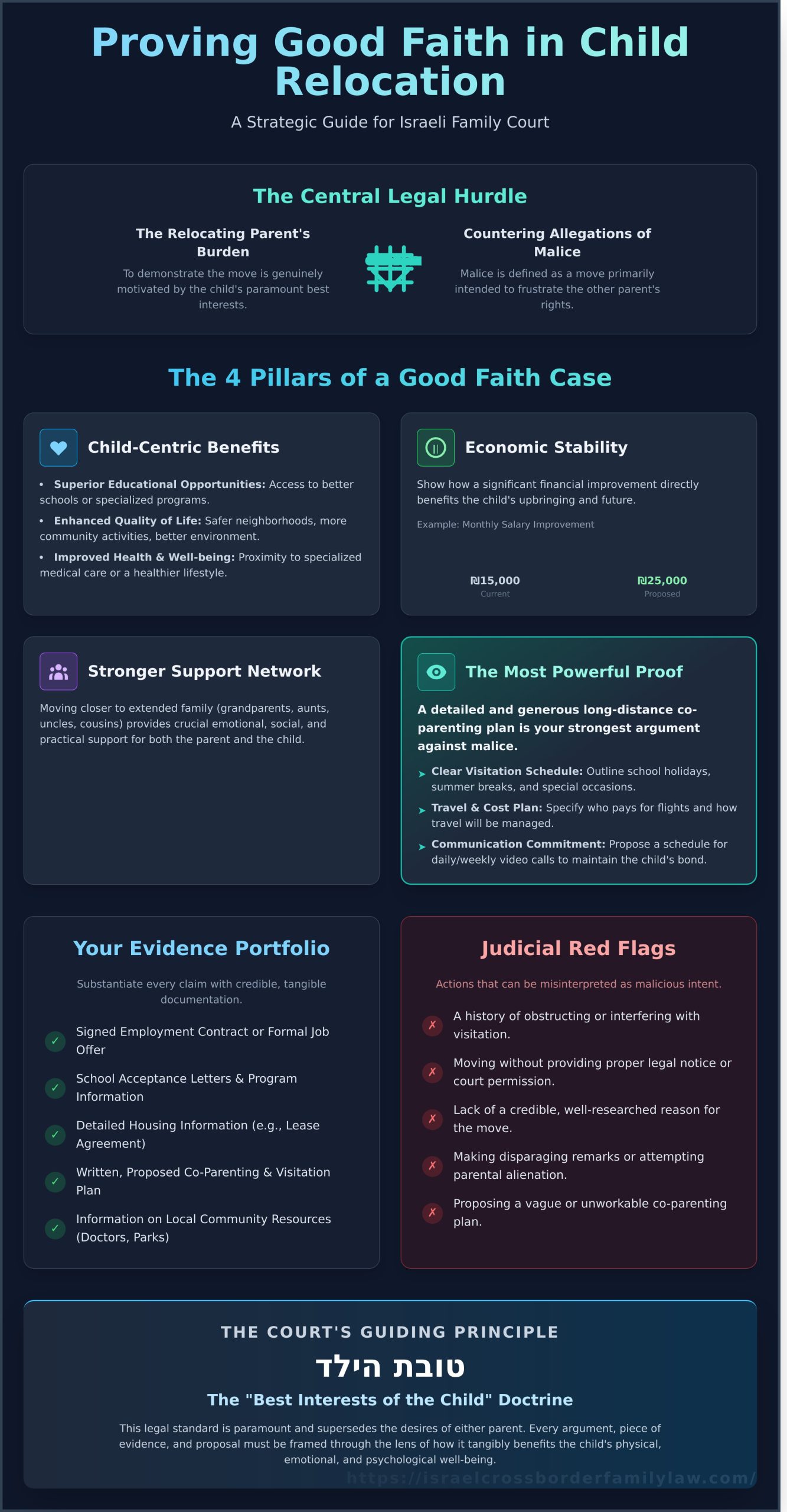
- Understand that in Israeli family court, ‘malicious intent’ is narrowly defined as a move primarily intended to frustrate the other parent’s rights, not simply a result of conflict.
- Build a compelling case by focusing exclusively on tangible, child-centric benefits, such as superior educational opportunities, proximity to extended family, or an enhanced quality of life.
- Proactively demonstrating your commitment to the co-parenting relationship is the most powerful method for convincing a judge the move is not malicious; this includes presenting a detailed and generous long-distance access plan.
- Substantiate every claim with credible evidence by preparing a comprehensive portfolio of documentation, including employment contracts, school acceptance letters, and detailed housing information.
Understanding the Legal Standard: What ‘Malicious Intent’ Means in Family Court
In the complex landscape of Israeli family law, a parent seeking to relocate with a child faces significant judicial scrutiny. A central challenge is demonstrating that the proposed move is made in good faith and not driven by malice. In this context, ‘malicious intent’ is not merely about animosity; it refers to a calculated decision to relocate primarily to interfere with, obstruct, or frustrate the other parent’s custody or visitation rights. The court’s primary objective is to unearth the true motivation behind the move, distinguishing a legitimate life improvement from an act of parental alienation. To better understand the arguments and evidence required, this overview provides valuable insights:
The burden of proof typically falls on the parent wishing to relocate. They must present a compelling case that the move serves a valid purpose and is consistent with the child’s welfare. Successfully convincing a judge the move is not malicious requires a proactive and transparent strategy grounded in clear, verifiable evidence.
The ‘Best Interests of the Child’ Doctrine
The paramount consideration for any Israeli family court is the ‘best interests of the child’ (טובת הילד). This legal doctrine supersedes the desires of either parent. Judges evaluate a comprehensive set of factors, including the child’s age, physical and emotional needs, the quality of their relationship with each parent, and the potential impact of disrupting their stability. This principle is a cornerstone of family law globally, and while specifics vary, the core tenets are similar to those found in frameworks like U.S. child custody laws. A good-faith move is one that can be framed as enhancing these interests-for example, by moving for a superior job that provides greater financial stability (e.g., an offer of ₪25,000 per month vs. ₪15,000), better educational opportunities, or proximity to a critical family support network.
Examples of Actions a Court May View as Malicious
A court will scrutinize parental conduct for patterns that suggest an improper motive. The task of convincing a judge the move is not malicious becomes substantially more difficult if such behaviours are present. Actions that raise judicial suspicion include:
- A history of obstructing visitation: Consistently interfering with the other parent’s scheduled time with the child can be interpreted as a precursor to a malicious relocation.
- Moving without notice: Failing to provide proper legal notice or moving in violation of an existing custody order is a significant red flag indicating bad faith.
- Lack of a credible reason for the move: Proposing a move without a secured job, confirmed housing, or an established support system can make the relocation appear impulsive and retaliatory rather than well-planned.
- Parental alienation: Making disparaging remarks about the other parent to the child or otherwise attempting to damage their relationship is often viewed as evidence of malicious intent.
Building Your Case: The Pillars of a Good Faith Relocation
In any relocation proceeding before the Israeli Family Court, the central focus remains unequivocally on the best interests of the child. The onus is on the parent proposing the move to construct a compelling, evidence-based argument that the relocation is founded on legitimate, “good faith” reasons. A meticulously prepared case, supported by verifiable documentation, is the cornerstone for convincing a judge the move is not malicious but is instead a thoughtful decision designed to enhance the child’s life circumstances.
Legitimate Economic and Career Opportunities
A significant improvement in financial stability is a powerful justification for relocation. This extends beyond a mere salary increase; it involves demonstrating how enhanced economic security will directly benefit the child’s quality of life. Evidence is critical and should include a formal job offer detailing a substantial pay rise (e.g., from ₪15,000 to ₪22,000 monthly), better working hours that allow for more parental involvement, or opportunities for professional advancement that promise long-term stability for the family unit.
Enhanced Family and Support Networks
Moving to be closer to a robust family support system can be a highly persuasive factor. The court will consider the practical benefits of having grandparents, aunts, and uncles nearby to assist with childcare, provide emotional support, and foster a stronger sense of family identity for the child. It is vital to substantiate the pre-existing, positive relationship between the child and these relatives through testimony, photographs, and records of consistent communication and visits.
Superior Educational or Health-Related Benefits
Demonstrating that the new location offers superior opportunities for a child’s development is a compelling pillar of a good faith case. This requires diligent research and comparative analysis. Presenting this data is crucial, as Israeli family courts, much like those governed by international relocation laws, scrutinize claims of superior opportunity. You must provide concrete evidence, such as:
- Official rankings or prospectuses from higher-performing schools.
- Documentation of specialized educational programs unavailable in the current location.
- Medical records and physicians’ letters recommending a move for specialized healthcare.
Fleeing a Harmful Environment
In sensitive situations where the relocation is necessary to escape domestic violence or a detrimental social environment, the court will give this profound consideration. However, such claims must be substantiated with official documentation. This includes police reports, restraining orders (Tzav Hagana), or records from therapeutic professionals. Navigating this complex area requires expert legal guidance to ensure the matter is presented effectively and appropriately, thereby convincing a judge the move is not malicious but an act of protection.
Proactively Countering the Malice Allegation: Fostering the Co-Parenting Relationship
In any sophisticated relocation petition, the most powerful strategy for disproving malicious intent is to demonstrate an unwavering, proactive commitment to the other parent’s relationship with the child. This approach fundamentally shifts the legal narrative. Instead of appearing to take the child away, you are presenting a well-reasoned plan for changing the child’s primary address while preserving and even enhancing the co-parenting dynamic. Successfully convincing a judge the move is not malicious hinges on this distinction. Israeli family courts are tasked with protecting the best interests of the children, and they view parents who actively facilitate the other parent’s involvement with significant favor.
Creating a Comprehensive Long-Distance Visitation Plan
A vague promise of “reasonable visitation” is insufficient. Your petition must include a detailed, tangible, and generous long-distance visitation schedule. This proposal should be meticulously planned to show forethought and good faith. Elements of a robust plan include:
- A specific schedule outlining custody during major holidays (e.g., Rosh Hashanah, Passover), school vacations, and a significant portion of the summer break.
- A concrete offer to share the financial and logistical burdens of travel, such as proposing to cover 50% of all flight costs or a fixed amount, for instance ₪2,000 per round trip.
- Demonstrating flexibility by offering alternative dates or additional weekend visits to accommodate the other parent’s schedule.
For moves outside of Israel, it is critical to explore sophisticated international custody and relocation strategies with experienced legal counsel to navigate the complexities of cross-border enforcement and jurisdiction.
Establishing a Robust Communication Schedule
Beyond physical visitation, your proposal must detail a framework for consistent and meaningful communication. This demonstrates your commitment to keeping the other parent fully integrated into the child’s daily life, a key factor in convincing a judge the move is not malicious. Your plan should commit to a structured schedule for frequent, unimpeded contact through modern technology, such as video calls every Tuesday and Sunday evening. Furthermore, it should guarantee the non-custodial parent full and direct access to all school portals, medical records, and contact information for teachers, doctors, and coaches, ensuring complete transparency and shared involvement.
Evidence and Documentation: What to Prepare for Your Hearing
In the sophisticated legal landscape of an Israeli family court, your assertions of good faith are insufficient on their own. The court requires a meticulously prepared case built upon a foundation of objective proof. Proper documentation transforms your argument from subjective opinion into verifiable fact, which is the cornerstone of convincing a judge the move is not malicious. Your ability to present a well-organized portfolio of credible, tangible evidence demonstrates foresight, responsibility, and a genuine focus on your child’s best interests. It is imperative to anticipate the counter-arguments the other parent may present and to proactively assemble evidence that substantiates your position while rebutting potential objections.
Key Documents to Assemble
Your legal counsel will guide you, but preparation should begin with gathering critical documents that paint a comprehensive picture of the proposed relocation. These materials serve as the primary evidence of your well-researched and beneficial plan. Be prepared to collate and organize the following:
- Employment Verification: A formal employment contract or a detailed offer letter is paramount. This should specify your role, responsibilities, and salary information (e.g., a position offering ₪30,000 per month), demonstrating the financial stability and career enhancement the move provides.
- Educational Arrangements: Provide school enrollment forms, acceptance letters, or detailed brochures and curriculum information for the proposed new schools. This shows diligent planning for your child’s educational continuity and development.
- Housing and Community Details: A signed lease agreement, property deeds, or comprehensive details of your prospective home are essential. Include information about the community, such as its proximity to parks, medical facilities, and extracurricular activities.
- Co-Parenting Communication: Preserve written communication, such as emails and text messages, that documents your efforts to collaborate with the other parent regarding the move. This evidence is vital for demonstrating your commitment to fostering a healthy co-parenting relationship post-relocation.
The Role of Third-Party Testimony
Objective validation from credible third parties can significantly bolster your case. Written affidavits or live testimony from individuals who can speak to your parenting abilities and the child’s well-being are powerful tools. Consider professionals such as teachers, doctors, or therapists who can provide an unbiased perspective. Furthermore, in complex cases, the opinion of an expert witness, like a child psychologist, can provide a crucial assessment of the potential impact of the move on the child. Navigating these requirements demands strategic legal guidance; our experienced team can help identify which witnesses can best support your case and ensure their testimony is presented effectively. For a comprehensive review of your evidentiary needs, contact our firm for a strategic consultation.
Common Pitfalls: Actions That Can Be Misinterpreted as Malicious
Navigating a complex child relocation case requires not only a compelling argument for the move but also a meticulous avoidance of actions that could undermine your position. Even parents with the best intentions can inadvertently provide opposing counsel with ammunition to argue that the relocation is driven by malice rather than the child’s best interests. Understanding how your conduct will be perceived by the Israeli family court is a critical component of a successful strategy. The central challenge of convincing a judge the move is not malicious demands unwavering diligence and a commitment to transparency and established legal protocols.
Failing to Provide Proper Notice
Israeli law, akin to other sophisticated legal jurisdictions, has stringent procedural requirements for notifying the other parent of an intended relocation. A surprise move, or one initiated without adhering to these statutory notice periods and methods, is almost universally interpreted by the courts as an act of bad faith. This failure immediately shifts the focus from the merits of your case to your disregard for the other parent’s rights, creating a significant, and often insurmountable, legal hurdle.
Using Social Media Inappropriately
In the digital age, your online presence is an open book for legal scrutiny. Every post, comment, and picture can be presented as admissible evidence. To protect your case, you must exercise extreme caution:
- Refrain from any negative commentary about the other parent, their family, or the ongoing legal proceedings.
- Avoid posting about lifestyle changes that could appear frivolous or contradict your stated reasons for moving, such as lavish holidays or expensive purchases.
- Do not discuss case details online, even in what you perceive as private groups or messages.
Assume that everything you post will be strategically framed by opposing counsel to question your motives and character.
Restricting Communication Before the Move
A court’s primary mandate is to protect the child’s best interests, which unequivocally includes maintaining a strong and continuous relationship with both parents. Any action perceived as an attempt to obstruct or limit communication between your child and the other parent will be viewed with severe disapproval. Instead of reducing contact, demonstrating good faith involves actively encouraging more communication-such as additional video calls or messages-to reassure the court that you are committed to fostering the parental bond post-relocation. Any perceived obstruction will be used as powerful evidence against you, complicating the task of convincing a judge the move is not malicious. Successfully navigating these potential pitfalls requires foresight and expert legal guidance. For strategic counsel on complex cross-border family law matters, we invite you to contact our experienced team.
Navigating Your Relocation with Integrity and Strategic Counsel
Successfully relocating with a child hinges on demonstrating the legitimacy of your intentions. The process demands a meticulous, proactive approach, grounded in a clear understanding of the ‘good faith’ standard and a steadfast commitment to fostering the co-parenting relationship. Ultimately, the burden of convincing a judge the move is not malicious rests on the strength of your evidence and the consistency of your actions, from initial planning through to the final hearing. These complex, multi-jurisdictional matters require sophisticated legal guidance. With decades of experience navigating intricate US-Israel cross-border family law cases and a deep understanding of the Hague Convention and its application, our firm is uniquely positioned to represent your interests. We provide the authoritative counsel necessary to build a compelling case that withstands judicial scrutiny and protects your parental rights. Take the decisive step to secure your family’s future. Schedule a Confidential Case Review to protect your parental rights.
Frequently Asked Questions About Proving Good Faith
What if I believe the other parent’s objection is the only thing that is malicious?
The Israeli family court’s primary mandate is to adjudicate based on the child’s best interests, not the perceived motives of the objecting parent. While their reasons for objecting will be considered, the central burden of proof rests on you. The most effective strategy involves presenting a well-documented, comprehensive case for the move’s benefits to the child. Successfully convincing a judge the move is not malicious hinges on the strength of your evidence, not solely on discrediting the other parent’s objections.
How much weight does the court give to my child’s preference to move?
The weight given to a child’s preference in Israeli courts is directly proportional to their age and maturity. A court will afford significant consideration to the clearly and consistently expressed wishes of an older adolescent. For younger children, the court is more likely to scrutinize whether the preference is genuine or a result of parental influence. Ultimately, this preference is one of many complex factors the judge will weigh when determining the child’s overall best interests in a relocation matter.
Can social media posts about my new partner or lifestyle be used to argue my move is malicious?
Absolutely. Any public-facing content, including social media posts, can be presented as evidence in family court proceedings. The opposing counsel may use posts celebrating a new partner or lifestyle to construct a narrative that the relocation is primarily for your benefit, not the child’s. Such evidence can undermine your good faith argument, portraying the move as impulsive or self-serving, which complicates the process of convincing a judge the move is not malicious and is genuinely for the child’s welfare.
What is a ‘mirror order’ and is it necessary for an international move between the US and Israel?
A ‘mirror order’ is a crucial legal instrument where the court in the destination country (e.g., Israel) formally recognizes and replicates the custody order from the originating court (e.g., a U.S. state). For a cross-border relocation between the U.S. and Israel, obtaining a mirror order is not merely advisable; it is an essential procedural safeguard. It ensures the terms of your custody and visitation agreement are fully enforceable in the new jurisdiction, providing critical legal stability for all parties involved.
What are my options if the judge denies my request to relocate?
Should your relocation request be denied by the court, several avenues for recourse remain available. You may initiate an appeal to a higher court, arguing a legal or procedural error in the initial judgment. Alternatively, if new, significant evidence emerges that was unavailable at the time of the hearing, a motion for reconsideration could be filed. Finally, one can wait for a substantial, material change in circumstances and file a new relocation request in the future based on that new reality.
How does the Hague Convention on Child Abduction relate to relocation cases?
The Hague Convention is a pivotal international treaty designed to prevent the wrongful removal of children across borders. In the context of relocation, it underscores the absolute necessity of obtaining court permission before moving. Moving a child internationally without the court’s or the other parent’s consent can be deemed an abduction under the Convention. This would trigger legal proceedings for the child’s immediate and expeditious return to their country of habitual residence, a severe outcome that proper legal procedure avoids.

Article by
Gabriel Lior
A Personal Journey That Became a Mission The advisory was founded by an American father Gabriel Lior, LLB, MBA , global entrepreneur, and cross-border advisor who spent more than a decade navigating the Israeli family court system firsthand and now lives in Singapore with his son.
As a divorced parent in a cross-border family, Gabriel faced nearly every legal challenge a foreign parent can encounter in Israel — including child custody disputes, child support proceedings, property matters in Israel and abroad, false accusations, and complex immigration and relocation proceedings. Over the years, he learned the hard way how difficult it is for non-Israeli parents to understand the system, identify the right legal strategy, and choose the right legal representation — especially when language, culture, and jurisdictional differences are involved. He also witnessed how foreign parents and new immigrants are often disadvantaged or taken advantage of by service providers and institutions simply because they lack local knowledge or fluency. From Client to Advisor To truly understand — and survive — the system, Gabriel pursued formal legal education in Israel, completing two Israeli law degrees, alongside a BA and MBA earned in the United States. This was never about becoming a practicing attorney, but about gaining a deep, structural understanding of how the system works — and where it breaks down for foreign parents. This rare combination of: Firsthand client experience Israeli legal and US business education International business and negotiation training Decades of commercial execution created a unique perspective – one that understands both sides of the table. After years of litigation, persistence, and at times self-representation, he ultimately succeeded in securing custody of his son and relocating abroad through a rare legal victory in the Israeli Supreme Court — becoming one of the first fathers in Israel to do so under these circumstances.
Disclaimer
Important Disclaimer: The information provided on this website and in its content is for general informational and educational purposes only and does not constitute legal advice, legal opinion, or legal representation. Gabriel Lior is not licensed to practice law in Israel (nor is he interested in doing so) and does not provide legal services, despite having completed 2 Law Degrees. The services offered are advisory in nature and are intended to provide general guidance, strategic insight, and information regarding cross-border family law considerations. No attorney-client relationship is formed by accessing this website, reading its content, or communicating with us. Any decisions made based on this information are at your own discretion and risk. For legal advice specific to your situation, you should consult a licensed attorney in the relevant jurisdiction. Where appropriate, we may refer clients to independent, licensed attorneys or professionals. Such referrals do not constitute legal representation and no liability is assumed for services provided by third parties.