In the high-stakes world of international parenting, the “Race for Jurisdiction” is often won or lost before a single word is spoken in court. If you’re part of a US-Israel family, you likely feel the weight of two distinct legal systems pulling at your future. It’s natural to worry that a simple visit across borders could turn into a permanent legal battle or an unintended abduction claim. Understanding the mechanics of cross border child custody israel is the first step toward maintaining stability for your children.
This guide provides a strategic roadmap to help you navigate these complexities with confidence and authority. We’ll explore how Israeli Family Courts determine habitual residence, the critical role of the Hague Convention, and why “Mirror Orders” have become a standard necessity for international relocation in 2026. This content is published on an independent advisory platform, not a law firm. It focuses on strategy, risks, and decision-making guidance to help you find a path forward. Please note that formal legal representation is only provided by licensed attorneys under a separate engagement.
Key Takeaways
- Identify which court has authority over your case, as the choice between the Israeli Family Court and the Rabbinical Court often depends on where the first filing occurs.
- Understand how the 1980 Hague Convention protects families dealing with cross border child custody israel by defining the legal standards for a child’s habitual residence.
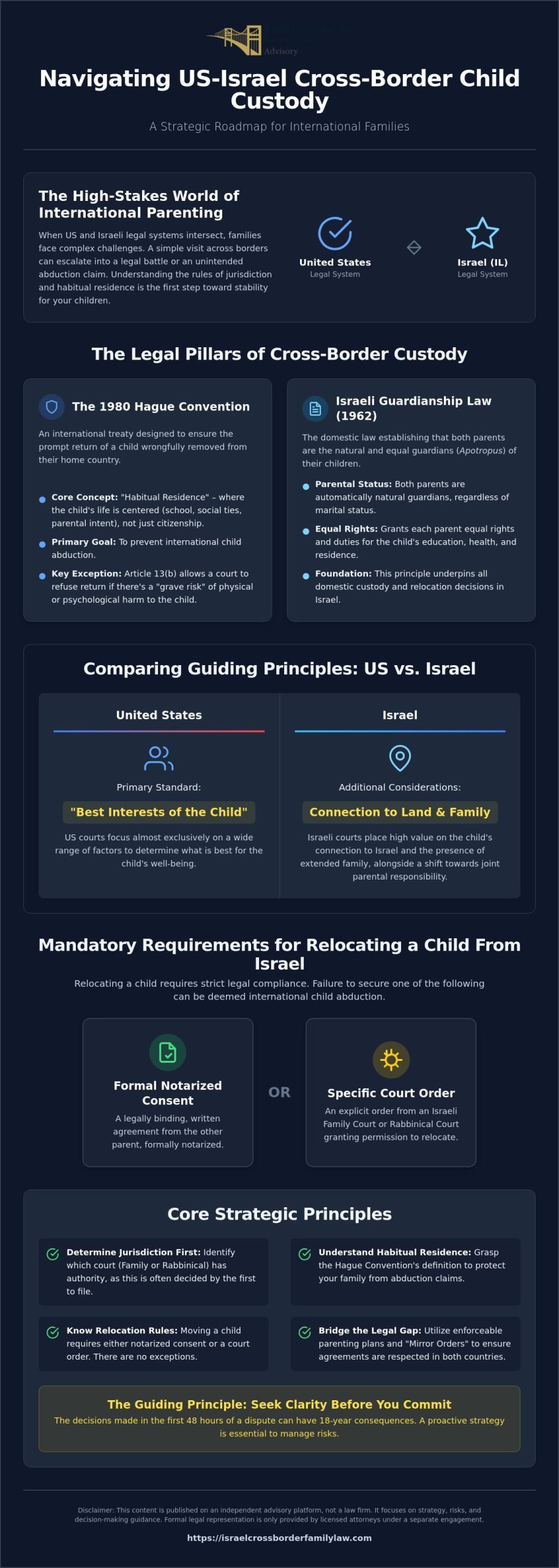
- Learn the mandatory requirements for relocation, which strictly require either formal notarized consent from the other parent or a specific order from an Israeli court.
- Discover how to draft enforceable parenting plans and utilize Mirror Orders to bridge the legal gap between the US and Israel effectively.
- Adopt a strategy of seeking clarity before making commitments to manage the inherent risks of international litigation and prevent unintended abduction claims.
The Complexity of Cross-Border Child Custody Between Israel and the US
Managing the lives of children across international borders is a sophisticated legal challenge that requires more than just local knowledge. Cross border child custody israel involves scenarios where a child’s habitual residence, education, and parental rights are split between two distinct legal systems. Central to these disputes is the Hague Convention on the Civil Aspects of International Child Abduction, a global treaty designed to ensure the prompt return of children to their home country after a wrongful removal. Without a clear strategy, a parent’s attempt to protect their child can accidentally be labeled as abduction by the courts, leading to severe legal consequences.
To better understand the foundations of these international rules and how they apply to your family, watch this helpful video from our advisory channel:
Legal friction often arises from the philosophical differences between the two systems. While US courts focus almost exclusively on the “Best Interests of the Child” standard, Israeli courts have historically considered the “Tender Years” presumption. This principle traditionally suggests that children under age six should remain with their mother, though modern trends in 2026 show a significant shift toward joint parental responsibility. In all legal documentation and strategy discussions here, “IL” refers specifically to Israel, never Illinois. Understanding these distinctions early prevents the risk of accidental wrongful removal. Making a move without the correct court order or notarized consent can trigger international litigation that is both costly and emotionally draining for everyone involved.
The Expat and Anglo Experience in Israel
For Anglos and expats, the Israeli Family Court system can feel opaque and overwhelming. Language barriers are a primary hurdle, as all official proceedings, evidence submissions, and filings are conducted in Hebrew. Beyond the language, there are deep cultural nuances in how judges view “relocation” compared to US “move-away” laws. Israeli courts often place a high value on the child’s connection to the land and the presence of extended family in the region. Families benefit from a specialized focus on expats to bridge this gap. An independent advisor provides a strategic roadmap, ensuring you don’t make permanent mistakes during a temporary crisis or a heated emotional dispute.
Disclaimer: Advisory vs. Representation
This content is published on an independent advisory platform and is intended for informational strategy only. It is not formal legal advice or representation. Legal services are only provided by licensed attorneys under a separate engagement. The decisions you make in the first 48 hours of a custody dispute can have 18-year consequences for your family structure. Seeking clarity before you commit to a court filing, a physical move, or a signed agreement is essential for your peace of mind. For more visual guidance on these complex topics, visit the Israel Family Law YouTube channel.
The Legal Pillars: Hague Convention and Israeli Guardianship Laws
Success in managing cross border child custody israel requires a deep understanding of two primary legal frameworks. While the 1980 Hague Convention acts as an international shield against wrongful removals, Israel’s domestic foundation is built upon the Legal Capacity and Guardianship Law of 1962. This local law establishes that both parents are natural guardians (Apotropus) of their children. This status grants each parent equal rights and duties regarding the child’s education, medical care, and place of residence, regardless of their marital status.
In the context of the Hague Convention, the most critical concept is “Habitual Residence.” This is not simply about where a child is a citizen, but where their life is actually centered. Courts look at social integration, school attendance, and the shared intent of the parents. If a child is removed from their habitual residence without consent, the other parent can file for an immediate return. However, courts may recognize a “Grave Risk” exception under Article 13(b) if returning the child would expose them to physical or psychological harm. This is a high evidentiary bar that requires sophisticated strategic planning to navigate effectively.
Enforcement of Foreign Custody Orders
A common misconception is that a custody decree from New York, Florida, or California is automatically valid in Israel. To be enforceable, a US order must undergo a process called “domestication” through the Israeli Family Court. This is handled under the Foreign Judgments Enforcement Law of 1958. Without this formal recognition, an Israeli court is not legally bound to uphold the specific terms of a US parenting plan. Understanding the nuances of international custody and relocation ensures that your existing orders provide the protection you expect when crossing borders.
Preventing Abduction Claims Before They Start
Prevention is always more effective than litigation. Families should utilize written, notarized travel consent forms for every international trip, even if the relationship is amicable. This documentation serves as a vital defense against claims of wrongful retention. For families moving from the US, the U.S. CBP’s Prevent Abduction Program offers practical tools to monitor and prevent unauthorized travel. Be aware that a “temporary” stay in Israel can legally shift a child’s habitual residence in as little as six to twelve months, potentially changing which country’s laws will govern your family’s future. If you are unsure how these timelines affect your situation, it is wise to request a confidential strategy session to clarify your legal position.
Jurisdiction and the “Race to Court”: Civil vs. Rabbinical Authority
Israel operates under a unique dual-court system that often surprises international families. Both the civil Family Court and the religious Rabbinical Court have the authority to hear custody cases. This overlap creates a strategic dynamic known as the “Race for Jurisdiction.” In this scenario, the parent who files a claim first typically determines which court will handle the matter. For those navigating cross border child custody israel, this decision is not just about geography. It’s about choosing a legal environment that aligns with your family’s specific needs and long-term goals.
The “Race for Jurisdiction” is often triggered by a mandatory “Settlement of Dispute” application. This initial step, which carries a filing fee of ₪119 as of January 2026, starts a stay-of-proceedings period. During this time, neither parent can file a full lawsuit, but the first person to file the application secures the right to choose the court once the stay expires. The choice between these venues is significant. While both courts are legally bound to consider the child’s welfare, they approach the issue through different lenses, reflecting either civil secular standards or religious Jewish law.
The Rabbinical Court and Cross-Border Families
Many US-based parents are blindsided when they receive a summons from a Rabbinical court. It’s a common misconception that these courts only handle religious ceremonies. In reality, they have the power to issue “Stay of Exit” orders, which can prevent a US citizen child from leaving Israel until a legal matter is resolved. Additionally, the process of obtaining a “Gett” (a religious divorce) is often intertwined with custody negotiations. This can create leverage that parents from the US may find unfamiliar or distressing. Strategic planning helps ensure that religious requirements don’t compromise your international parenting goals. US citizenship doesn’t exempt a child from a Rabbinical court’s authority if they are physically present in Israel.
The Civil Family Court Approach
The civil Family Court follows a process that feels more familiar to those from Western legal backgrounds. The primary focus is the “Best Interests of the Child,” which is the supreme standard in Israeli civil law. Judges rely on a “Teskir,” which is a detailed report from a court-appointed social worker. They also frequently consult with child psychologists to determine the most stable environment for the child. This system is designed to be child-centric and evidence-based. For more on how these systems interact, see our guide for expats and foreign nationals. Choosing the right venue requires a calm assessment of the risks and opportunities within each system before any documents are filed.
Relocation and Parenting Plans: Managing Distance and Legal Risks
Relocation, known in Israel as Hagira, represents one of the most challenging aspects of cross border child custody israel. When a parent wishes to move a child from Israel to the US, or vice versa, the legal system must balance the parent’s personal freedom with the child’s stability. These cases often involve the Tzav Ikur Yetzia, or “No-Exit” order. This is a common legal tool in Israel used to prevent a child from leaving the country while a custody dispute is active. While it feels aggressive, it’s often a standard preventative measure to ensure that a child’s habitual residence isn’t changed unilaterally before a court can rule on the merits of the move.
Creating an enforceable parenting plan for a US-Israel family requires addressing the 6,000-mile gap with extreme precision. A plan that works in a local New York or Tel Aviv context will likely fail when applied internationally. You must define not only the schedule but also the logistics that make the schedule possible. This includes specifying which parent is responsible for booking flights, who will escort the child during travel, and how the significant costs of international airfare will be shared. Without these details, a parenting plan is often just a list of intentions rather than a functional legal document.
Relocation Criteria in Israeli Courts
Israeli judges evaluate relocation by weighing the moving parent’s right to pursue a new life against the child’s right to maintain a meaningful relationship with the parent staying behind. The court will closely examine the proposed environment in the US, including the quality of education, healthcare, and the available support network of extended family. Relocation is never automatic and requires court approval or mutual consent. Decisions are based on the specific “Best Interests of the Child” standard, and judges often look for a detailed roadmap of how the child will thrive in their new home before granting permission.
Shared Parenting at a 6,000-Mile Distance
Modern technology has changed the landscape of international custody. Virtual visitation through Zoom or FaceTime is now a standard component of Israeli custody orders, ensuring daily contact despite the time zone differences. However, physical time remains the priority. Crafting a schedule requires balancing the Israeli school year, which typically runs from September to late June, with US school breaks and Jewish holidays. Effective plans often include extended summer stays and alternating Passover or Hanukkah vacations. To ensure these arrangements are protected against future disputes, it’s vital to understand the Hague Convention and child abduction prevention mechanisms. If you’re preparing to negotiate a long-distance arrangement, you can contact us to discuss your strategic options.
Strategic Decision-Making in International Custody Matters
Approaching a dispute with a “Clarity Before Commitment” philosophy is often the difference between a managed resolution and a destructive legal battle. In the context of cross border child custody israel, litigation is frequently the most expensive and unpredictable path. Mediation, when handled by advisors who understand both US and Israeli cultures, allows parents to retain control over their children’s futures rather than leaving life-altering decisions to a judge who may not grasp the nuances of an expat lifestyle. Strategic mediation focuses on building a functional framework that anticipates future friction before it escalates into a court case.
Identifying specific risks early is a core part of this strategy. For example, many parents worry about what happens if the other parent refuses to return the child after a scheduled summer visit in the US or Israel. Without a clear, enforceable agreement and a pre-emptive legal strategy, this scenario can quickly trigger a Hague Convention application. The financial reality of these battles is significant. While an amicable agreement involves a predictable investment, a contested international relocation or abduction case can involve substantial legal fees and years of uncertainty. Choosing an advisor who understands the transnational nature of your life helps you avoid these pitfalls by mapping out risks before you take action.
The Value of Early Advisory
A strategic consultation is fundamentally different from hiring a litigator to file a lawsuit. An advisory session focuses on risk assessment and the long-term viability of your goals. One of the most critical elements to assess is your “Exit Strategy.” You must know whether you can legally leave Israel with your child for a visit or a permanent move before you make any commitments to the other parent or a new employer. Understanding the pricing and process of advisory services allows you to budget for clarity rather than conflict.
Next Steps for US-Israel Families
If you’re facing a potential custody transition, start by gathering all essential documentation. This includes birth certificates, current passports for all family members, and any existing US court orders. Having these records organized is the first step in identifying potential jurisdictional traps that could complicate your case. Seeking a confidential case review allows you to discuss your specific situation on an independent advisory platform, focusing on decision-making guidance rather than an immediate attorney-client relationship. This step ensures you have a comprehensive roadmap before any formal legal proceedings begin.
Get clarity before you commit. Request a confidential consultation.
Securing Your Family’s Future Across Borders
Managing a family life that spans two continents requires a shift from emotional reaction to deliberate strategic planning. Success in cross border child custody israel hinges on understanding the weight of early jurisdictional decisions and the precision of your parenting plan. By identifying risks such as the “Race for Jurisdiction” and utilizing tools like Mirror Orders, you can create a stable environment that protects your children’s well-being in both the US and Israel. Our independent advisory platform provides authoritative guidance specifically for the Anglo community, drawing on decades of experience in navigating these unique legal corridors.
We focus on risk mitigation and clear decision-making to help you avoid the pitfalls of international litigation. Whether you are considering a relocation or simply need to formalize a travel agreement, seeking expert insight early is essential. Get clarity before you commit. Request a confidential consultation to discuss your roadmap forward. With the right strategy, you can protect your parental rights and maintain the international life you’ve built with confidence.
Frequently Asked Questions
Can I move back to the US with my child without the other parent’s consent?
No, you cannot move a child back to the US without the other parent’s explicit, notarized consent or a formal court order. Doing so constitutes international child abduction under the Hague Convention. Relocation is a strictly regulated legal process in Israel. You must secure a signed agreement or a ruling from the Israeli Family Court before departing. Moving unilaterally risks immediate legal action that could force the child’s return to Israel.
What is a “Stay of Exit” order in Israel and how does it affect my child?
A “Stay of Exit” order, known as Tzav Ikur Yetzia, is a legal mandate that prevents a child from leaving the country. These orders are frequently used in cross border child custody israel cases to ensure the child remains in the jurisdiction while legal proceedings are pending. Even if your child holds a US passport, they cannot board an international flight if an active order is registered with Israeli border control authorities.
How does the Hague Convention work if my child is taken from the US to Israel?
The Hague Convention provides a legal mechanism to return a child who has been wrongfully removed from their habitual residence in the US. The left-behind parent files an application through the Central Authority to initiate the process. Israeli courts then determine if the child was living in the US and if the removal violated existing custody rights. These proceedings focus on returning the child to their home country rather than settling long-term custody details.
Do Israeli courts favor the mother in custody disputes?
While the “Tender Years” presumption exists in Israeli law, modern courts in 2026 increasingly prioritize joint parental responsibility. Decisions are primarily based on the “Best Interests of the Child” standard. Judges now frequently award shared custody or significant visitation to both parents, provided it serves the child’s stability. The outcome typically depends on detailed reports from court-appointed social workers rather than a simple preference for one parent over the other.
Can a US custody order be enforced in Israel?
A US custody order is not automatically enforceable in Israel. You must formally domesticate the order through the Israeli Family Court under the Foreign Judgments Enforcement Law of 1958. This process ensures the Israeli legal system recognizes and upholds the terms of your US decree. Without this formal recognition, the US order carries little weight in local enforcement actions, school registrations, or police matters within Israel.
What happens if I stay in Israel past the agreed-upon date in my travel consent form?
Staying past the return date specified in a travel consent form is legally classified as “wrongful retention.” This is considered a form of abduction under international law. Even if you had initial permission to take the child to Israel for a vacation, refusing to return them to the US on time allows the other parent to initiate Hague Convention proceedings. It’s essential to document any agreed extensions in writing to avoid these claims.
How long does an international custody case typically take in Israel?
Hague Convention cases are expedited and typically reach a conclusion within several months. However, standard cross border child custody israel litigation, such as relocation or contested guardianship, can take significantly longer. These cases often last between 12 and 24 months. The timeline depends on the speed of court-appointed social worker reports and the complexity of the international logistics involved in the proposed parenting plan.
What is the “Tender Years” presumption in Israeli family law?
The “Tender Years” presumption is a legal guideline suggesting that children under the age of six should normally be in the custody of their mother. While this remains part of the 1962 Guardianship Law, it’s a rebuttable presumption. Courts today often set it aside if a shared parenting arrangement is proven to be in the child’s best interest. Judges weigh this presumption against modern psychological evidence and the actual caregiving roles each parent fulfills.

Article by
Gabriel Lior
A Personal Journey That Became a Mission
The advisory was founded by an American father Gabriel Lior, LLB, MBA , global entrepreneur, and cross-border advisor who spent more than a decade navigating the Israeli family court system firsthand and now lives in Singapore with his son.
As a divorced parent in a cross-border family, Gabriel faced nearly every legal challenge a foreign parent can encounter in Israel — including child custody disputes, child support proceedings, property matters in Israel and abroad, false accusations, and complex immigration and relocation proceedings.
Over the years, he learned the hard way how difficult it is for non-Israeli parents to understand the system, identify the right legal strategy, and choose the right legal representation — especially when language, culture, and jurisdictional differences are involved. He also witnessed how foreign parents and new immigrants are often disadvantaged or taken advantage of by service providers and institutions simply because they lack local knowledge or fluency.
From Client to Advisor
To truly understand — and survive — the system, Gabriel pursued formal legal education in Israel, completing two Israeli law degrees, alongside a BA and MBA earned in the United States. This was never about becoming a practicing attorney, but about gaining a deep, structural understanding of how the system works — and where it breaks down for foreign parents.
This rare combination of:
Firsthand client experience
Israeli legal and US business education
International business and negotiation training
Decades of commercial execution
created a unique perspective – one that understands both sides of the table.
After years of litigation, persistence, and at times self-representation, he ultimately succeeded in securing custody of his son and relocating abroad through a rare legal victory in the Israeli Supreme Court — becoming one of the first fathers in Israel to do so under these circumstances.
Disclaimer
Important Disclaimer:
The information provided on this website and in its content is for general informational and educational purposes only and does not constitute legal advice, legal opinion, or legal representation.
Gabriel Lior is not licensed to practice law in Israel (nor is he interested in doing so) and does not provide legal services, despite having completed 2 Law Degrees. The services offered are advisory in nature and are intended to provide general guidance, strategic insight, and information regarding cross-border family law considerations.
No attorney-client relationship is formed by accessing this website, reading its content, or communicating with us.
Any decisions made based on this information are at your own discretion and risk. For legal advice specific to your situation, you should consult a licensed attorney in the relevant jurisdiction.
Where appropriate, we may refer clients to independent, licensed attorneys or professionals. Such referrals do not constitute legal representation and no liability is assumed for services provided by third parties.