For international families and expatriates, the prospect of divorce within the Israeli legal system presents a uniquely complex set of challenges. Navigating a foreign court system, compounded by concerns over protracted litigation, substantial legal costs in shekels, and the intricate division of multi-jurisdictional assets, can be an overwhelming experience, particularly when the emotional well-being of children is paramount. Fortunately, a strategic and effective alternative to contentious courtroom battles exists. The process of divorce mediation in Israel provides a confidential, cost-effective, and collaborative framework specifically designed to address the sophisticated needs of cross-border couples, empowering them to forge a legally sound agreement outside the adversarial court process. This comprehensive guide serves as your authoritative resource for understanding this powerful alternative. We will guide you through the distinct stages of the mediation process in Israel, demonstrate how it safeguards familial relationships from the strain of litigation, and detail the path toward achieving a fair, private, and efficient resolution. Discover how you can take control of your separation, protect your international assets, and secure a stable future for your family without stepping foot in a courtroom.
Key Takeaways
- Understand how mediation provides a confidential, structured, and less adversarial alternative to traditional court proceedings for resolving complex family disputes.
- Learn the critical steps for transforming your mediated settlement into a legally binding and enforceable contract, fully recognized and approved by the Israeli Family Court.
- Discover how divorce mediation Israel is structured to effectively resolve complex, multi-jurisdictional matters, such as international asset division and cross-border child custody arrangements.
- Identify the essential qualifications for selecting a skilled mediator specializing in international family law, a crucial factor for a successful negotiation process.
What is Divorce Mediation and Why Is It a Preferred Option in Israel?
Divorce mediation represents a structured and entirely confidential negotiation process designed to resolve marital disputes outside the traditional courtroom setting. A professionally trained, neutral third-party mediator facilitates communication between the separating spouses, guiding them toward a comprehensive and mutually acceptable agreement. This modern approach, detailed in resources like Wikipedia’s overview of Divorce mediation, has gained significant traction in Israel as a preferred alternative to the often contentious and public nature of litigation. To better understand this collaborative process, consider the following overview:
Unlike the adversarial framework of the Israeli Family Court system, where a judge imposes decisions, mediation empowers the couple to retain control over the outcome. The ultimate goal is to draft a legally binding divorce agreement that addresses all critical matters-from child custody and support to asset division-which is then submitted to the court for validation, providing the same legal finality as a court-ordered judgment.
The Core Benefits for International and Expat Families
For families navigating cross-border complexities, the advantages of mediation are particularly pronounced. Key benefits include:
- Confidentiality: Your personal and complex financial matters remain private, avoiding public court records which can be a significant concern for high-profile individuals or those with sensitive business interests.
- Control: You and your spouse, not a judge unfamiliar with your unique circumstances, architect the final terms of your separation agreement, allowing for more creative and tailored solutions.
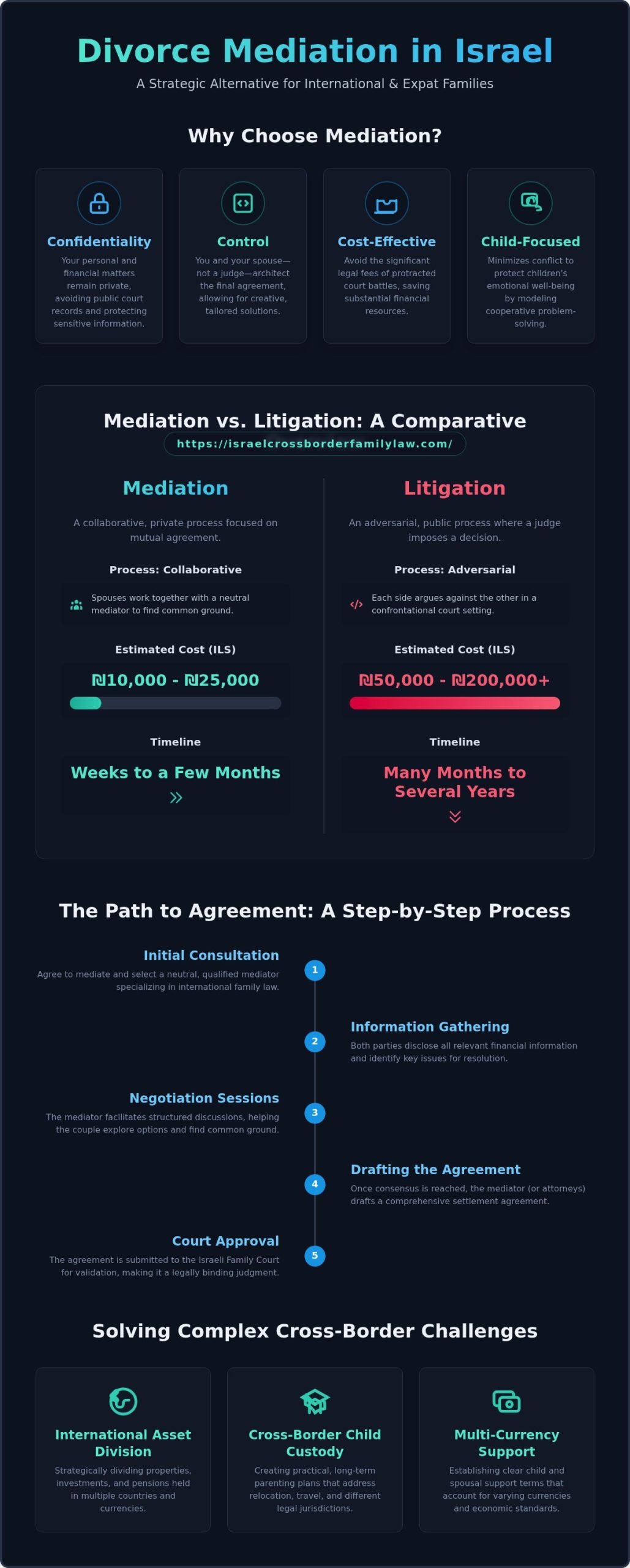
- Cost-Effective: Mediation typically involves significantly lower legal fees, often ranging from ₪10,000 to ₪25,000, compared to protracted court battles that can easily exceed ₪100,000.
- Child-Focused: The process is structured to minimize conflict, thereby protecting the emotional well-being of children by modeling cooperative problem-solving for their parents.
Mediation vs. Litigation: A Comparative Overview
The fundamental distinction lies in the approach. Mediation is a collaborative endeavor focused on finding common ground, whereas litigation is an adversarial contest. This cooperative framework makes the process of divorce mediation israel particularly well-suited for navigating the nuances of complex divorce and separation for international families, where customized, multi-jurisdictional solutions are often required.
| Feature | Mediation | Litigation |
|---|---|---|
| Process | Collaborative and cooperative | Adversarial and confrontational |
| Estimated Cost (ILS) | ₪10,000 – ₪25,000 | ₪50,000 – ₪200,000+ |
| Timeline | Weeks to a few months | Many months to several years |
| Outcome | Mutually-crafted agreement | Judge-imposed decision |
The Israeli Divorce Mediation Process: A Step-by-Step Walkthrough
Navigating the dissolution of a marriage requires a structured yet flexible approach. The process of divorce mediation israel offers a confidential and collaborative framework, distinct from the adversarial nature of litigation. This client-driven process is entirely voluntary-it can be paused or terminated by either party at any time-and typically concludes within a few weeks to several months, depending on the complexity of the issues. Success hinges on the good-faith participation of the spouses, the expert guidance of a neutral mediator, and often, the advisory role of independent consulting attorneys.
Phase 1: Initiation and Information Gathering
The process commences with an initial consultation, where both parties meet the mediator to understand the foundational rules and objectives. Upon proceeding, all participants sign an Agreement to Mediate, a critical document that establishes confidentiality and the voluntary nature of the engagement. A cornerstone of this phase is the comprehensive gathering and full disclosure of financial information, including all assets, debts, and income streams. This transparency ensures all subsequent negotiations are based on a complete and accurate financial picture, and we provide clients with a clear overview of how it works from the outset.
Phase 2: Negotiation and Problem-Solving Sessions
This phase involves a series of structured meetings. In joint sessions, the mediator facilitates direct communication between the spouses, guiding them through complex topics such as child custody, division of property, and spousal support (mezonot). The mediator may also hold private caucuses-confidential, individual meetings-to explore sensitive issues, test potential solutions, and help a party clarify their priorities without pressure. The objective is to move from positions of conflict to a collaborative brainstorming of durable, mutually acceptable solutions.
Phase 3: Drafting and Finalizing the Agreement
Once consensus is reached on all material issues, the mediator drafts a Memorandum of Understanding (MOU). This non-binding document meticulously summarizes every point of agreement. We strongly advise that each party have this MOU reviewed by their independent legal counsel to ensure their rights are fully protected. Following this review, the MOU is converted into a formal, legally binding divorce agreement. This final document is then submitted to the Israeli Family Court or Rabbinical Court for validation, giving it the full force of a court judgment. For international families, it is crucial this agreement aligns with relevant treaties, such as those overseen by the Israeli Central Authority for Child Abduction, to ensure cross-border enforceability.
Key Issues Addressed in Cross-Border Divorce Mediation
For multinational couples and expatriates residing in Israel, divorce presents a sophisticated matrix of legal, financial, and cultural challenges that transcend a single jurisdiction. The adversarial nature of litigation can exacerbate these complexities, often leading to protracted and costly disputes across multiple court systems. In contrast, mediation provides a confidential, flexible, and collaborative framework uniquely suited to navigating the intricacies of an international separation. A skilled mediator with cross-border expertise acts as a neutral facilitator, guiding couples toward a comprehensive and enforceable agreement that addresses the unique realities of their global lives.
Division of Marital Property and Assets
The division of a marital estate that spans multiple countries requires meticulous and strategic handling. Our approach to divorce mediation israel addresses the full scope of these multi-jurisdictional assets, including:
- Real Estate and Financial Accounts: Systematically identifying and valuing property, bank accounts, and investments located in Israel, the United States, Europe, and other territories.
- Complex Valuations: Navigating the sophisticated valuation of international business interests, “start-up nation” stock options, and disparate pension or 401(k) plans.
- Legal Definitions: Reconciling conflicting legal principles, such as Israel’s marital property laws versus the community property or equitable distribution standards found in other jurisdictions, to achieve a fair and practical outcome.
Child Custody, Parenting Plans, and Relocation
When children’s lives cross borders, crafting a durable and detailed parenting plan is of paramount importance. Mediation excels at resolving these sensitive matters by focusing on the children’s best interests while respecting both parents’ rights. We guide clients in establishing clear protocols for legal and physical custody under Israeli law, creating robust international parenting plans that function across different time zones and school calendars. This process is critical when mediating highly contentious issues like international custody and relocation, where a collaborative solution is profoundly more stable than a court-imposed order. The final agreement establishes unambiguous terms for travel, holidays, and communication, providing stability for the children.
Spousal and Child Support (Alimony and Mazon)
Determining financial support in a cross-border context involves significant financial complexity. Mediation provides a structured forum for addressing these challenges, including calculating support obligations when income is earned in one currency (e.g., USD) and daily expenses are incurred in another (e.g., ILS ₪). We ensure the correct application of Israeli law regarding child support (Mezonot) while considering the cost of living in multiple locations. A crucial objective of the mediation process is to structure the spousal and child support agreement to be legally robust and readily enforceable in all relevant countries, thereby preventing future compliance issues and litigation.
The Legally Binding Agreement: From Mediation to Court Approval
A primary concern for couples considering divorce mediation in Israel is the legal standing of the final agreement. It is crucial to understand that the outcome of a successful mediation is not an informal understanding but a sophisticated, comprehensive legal contract. This document, meticulously drafted by legal counsel, addresses all pertinent matters-from asset division and child custody to spousal support-and is specifically designed to be legally binding and enforceable. The transition from a negotiated settlement to a legally unassailable document is a formal, structured process, ensuring that the consensus reached by the parties is afforded the full protection and authority of Israeli law.
Transforming the Agreement into a Court Judgment
Once both parties have signed the mediated divorce agreement, the critical next step is its submission for judicial ratification. This can be filed with either the Israeli Family Court or the Rabbinical Court (Beit Din Rabbani), depending on the specific circumstances and jurisdictional strategy. The process involves a brief, formal court appearance where a judge confirms that both parties have entered into the agreement freely, understand its terms, and consent to its contents. Upon this confirmation, the judge grants the agreement the full force and effect of a court judgment (P’sak Din), elevating it from a private contract to a binding court order.
Enforceability in Israel and Abroad
A court-ratified agreement is fully enforceable within Israel. Any violation or non-compliance by one party empowers the other to utilize the state’s legal enforcement mechanisms, such as the Execution Office (Hotzaa L’Poal), to compel adherence. For international families, the enforceability extends beyond Israel’s borders. A judgment from an Israeli court can be recognized and enforced in foreign jurisdictions, including the United States and many European countries, under established international legal principles and treaties. However, securing cross-border enforceability demands expert legal drafting. The agreement must be structured to withstand scrutiny in multiple legal systems. This is a paramount consideration for international clients undertaking divorce mediation israel, as a poorly drafted document may be rendered ineffective abroad. Our firm’s multi-jurisdictional expertise ensures your mediated agreement is not only robust within Israel but is also structured for seamless international recognition. For guidance on complex cross-border family law matters, please contact our legal team.
How to Select the Right Mediator for Your International Divorce
The success of mediation in a cross-border divorce is not a matter of chance; it is almost entirely dependent on the skill, experience, and legal acumen of the mediator you select. For international couples, the complexities of multi-jurisdictional law, asset division, and child custody demand a professional with a highly specialized skill set. Choosing an unqualified or inexperienced mediator not only risks a failed process but can also lead to significant financial and emotional costs, often forcing a return to the contentious path of litigation.
Essential Qualifications and Experience
When evaluating a potential mediator, their professional background is paramount. A mediator who is also an experienced Israeli family law attorney offers a distinct advantage, ensuring that any agreement reached is not only amicable but also legally robust and enforceable. Look for a professional with a demonstrable record in the following areas:
- Formal Training and Certification: Verified credentials in mediation from a recognized institution.
- Deep Expertise in Israeli Family Law: A comprehensive understanding of the Israeli legal system and its specific application to non-citizens.
- Proven Cross-Border Case Experience: A history of successfully resolving complex international divorces involving multi-jurisdictional assets, international relocation, and child custody matters.
- Navigating Expat Challenges: A nuanced understanding of the unique legal and personal challenges for expats and foreign nationals divorcing in Israel.
Crucial Skills and Personal Attributes
Beyond formal qualifications, the right mediator possesses a specific set of interpersonal and analytical skills essential for guiding parties toward a resolution:
- Bilingual Proficiency: Absolute fluency in both English and Hebrew is critical to ensure clear communication and prevent costly misunderstandings.
- Cultural Sensitivity: The ability to act as a bridge between Israeli and Western cultural norms, fostering an environment of mutual respect and understanding.
- Impartiality and Creativity: Unwavering neutrality, combined with the patience and creative problem-solving skills needed to craft bespoke solutions that meet the unique needs of your family.
Ultimately, selecting a mediator who is also a practicing cross-border family lawyer provides an unparalleled strategic advantage. This dual expertise ensures that every facet of your agreement is legally sound, anticipating potential challenges and securing an outcome that is both fair and enforceable. Our firm’s advisors possess the sophisticated legal, linguistic, and cultural expertise required for a successful divorce mediation israel process, guiding clients toward favorable and durable resolutions. Contact us to learn how our unique approach can benefit your case.
Secure Your Future with Expert Cross-Border Divorce Mediation
Navigating the complexities of an international divorce requires a strategic, confidential, and collaborative approach. As this guide has demonstrated, mediation provides a structured pathway to resolve sensitive matters-from multi-jurisdictional asset division to international child custody arrangements-outside the adversarial courtroom setting. For international families, effective divorce mediation israel offers a powerful alternative to contentious litigation, culminating in a legally binding agreement that protects the interests of all parties and provides a stable foundation for the future. The success of this process is contingent upon guidance from legal professionals with deep, nuanced expertise. Our firm offers specialized knowledge in US-Israel cross-border family law, delivered by bilingual legal professionals with a dual cultural understanding. We are committed to a client-centered approach focused on confidential, strategic solutions. To understand how we can assist in your specific circumstances, we invite you to Schedule a Confidential Case Review to Discuss Your Options. Taking this decisive first step can provide the clarity and control necessary to move forward with confidence.
Frequently Asked Questions
How much does divorce mediation cost in Israel compared to litigation?
The financial disparity is substantial. Divorce mediation is a significantly more cost-effective solution, with total costs typically ranging from ₪10,000 to ₪30,000, which is shared between the parties. In stark contrast, contested litigation in the Israeli Family Court is an expensive, protracted process. Legal fees for each party often begin at ₪50,000 and can easily escalate well beyond ₪100,000, depending on the complexity and duration of the legal dispute.
What happens if we cannot agree on all the issues in mediation?
Mediation offers the flexibility to secure a partial agreement. Any issues upon which consensus is reached, such as child custody arrangements or the division of certain assets, can be drafted into a formal agreement and submitted to the court for validation. The few outstanding, unresolved matters can then be addressed through targeted litigation. This strategic approach significantly narrows the scope of the court dispute, saving considerable time and financial resources for both parties.
Do I still need to hire my own separate lawyer if I use a mediator?
Yes, retaining independent legal counsel is not only advisable but essential for protecting your interests. The mediator serves as a neutral third party and is legally precluded from providing partisan legal advice. Your personal attorney will review the proposed settlement agreement, advise you on your legal rights and obligations under Israeli law, and ensure the final terms are equitable and comprehensive before you execute a legally binding document.
How long does the divorce mediation process typically take in Israel?
The timeline for a successful divorce mediation israel process is significantly expedited compared to litigation, generally concluding within three to six months. This typically involves a series of four to ten focused sessions. Conversely, a divorce proceeding that enters the Israeli court system for litigation is a far more protracted affair, frequently extending for one to three years, and potentially longer for complex cases involving international assets or contentious custody disputes.
Is mediation mandatory before filing for divorce in Israel?
While formal mediation is not mandatory, a preliminary dispute resolution process is required by law. Before filing a claim with the Family Court or Rabbinical Court, parties must attend a series of mandatory meetings at a court-affiliated Assistance Unit. The objective of these sessions is to provide information and explore the possibility of reaching an amicable, out-of-court settlement, such as mediation. Attendance is compulsory, but reaching an agreement within this framework is not.
Can mediation work if my spouse and I are not on speaking terms?
Yes, mediation is specifically designed to be effective even in high-conflict scenarios where direct communication has failed. A skilled mediator acts as a professional, neutral intermediary, structuring the dialogue to ensure it remains productive and focused on resolution rather than past grievances. For highly acrimonious situations, “shuttle mediation” can be employed, where parties occupy separate rooms and the mediator facilitates negotiations by moving between them, eliminating the need for direct confrontation.

Article by
Gabriel Lior
A Personal Journey That Became a Mission The advisory was founded by an American father Gabriel Lior, LLB, MBA , global entrepreneur, and cross-border advisor who spent more than a decade navigating the Israeli family court system firsthand and now lives in Singapore with his son.
As a divorced parent in a cross-border family, Gabriel faced nearly every legal challenge a foreign parent can encounter in Israel — including child custody disputes, child support proceedings, property matters in Israel and abroad, false accusations, and complex immigration and relocation proceedings. Over the years, he learned the hard way how difficult it is for non-Israeli parents to understand the system, identify the right legal strategy, and choose the right legal representation — especially when language, culture, and jurisdictional differences are involved. He also witnessed how foreign parents and new immigrants are often disadvantaged or taken advantage of by service providers and institutions simply because they lack local knowledge or fluency. From Client to Advisor To truly understand — and survive — the system, Gabriel pursued formal legal education in Israel, completing two Israeli law degrees, alongside a BA and MBA earned in the United States. This was never about becoming a practicing attorney, but about gaining a deep, structural understanding of how the system works — and where it breaks down for foreign parents. This rare combination of: Firsthand client experience Israeli legal and US business education International business and negotiation training Decades of commercial execution created a unique perspective – one that understands both sides of the table. After years of litigation, persistence, and at times self-representation, he ultimately succeeded in securing custody of his son and relocating abroad through a rare legal victory in the Israeli Supreme Court — becoming one of the first fathers in Israel to do so under these circumstances.
Disclaimer
Important Disclaimer: The information provided on this website and in its content is for general informational and educational purposes only and does not constitute legal advice, legal opinion, or legal representation. Gabriel Lior is not licensed to practice law in Israel (nor is he interested in doing so) and does not provide legal services, despite having completed 2 Law Degrees. The services offered are advisory in nature and are intended to provide general guidance, strategic insight, and information regarding cross-border family law considerations. No attorney-client relationship is formed by accessing this website, reading its content, or communicating with us. Any decisions made based on this information are at your own discretion and risk. For legal advice specific to your situation, you should consult a licensed attorney in the relevant jurisdiction. Where appropriate, we may refer clients to independent, licensed attorneys or professionals. Such referrals do not constitute legal representation and no liability is assumed for services provided by third parties.